Like Adèle Geras, who as Hope Adams wrote Dangerous Women, I saw the Rajah quilt at an exhibition at the Victoria & Albert Museum in 2009. What a fascinating piece of history, and what a twisty fictional story Geras has written using the quilt as inspiration. 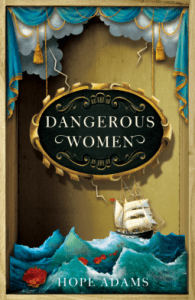 Dangerous Women is set in 1841 aboard the transport ship Rajah as it sails from Woolwich, England bearing 180 female convicts to Van Dieman’s Land [today’s Tasmania]. What a fascinating piece of history this is. Geras takes the true story of the ship – some of her characters are real, including matron Kezia Hayter – and tells a tale of troubled, sometimes wronged and abused women, confined together on a ship for three months. Miss Hayter is the only free woman on board and, at the behest of the British Ladies Society for the Reformation of Female Prisoners, organises a team of 18 women who can sew. Every day they stitch patchwork, creating the now famous quilt, but also stitching together the truth of their own lives, their crimes and hopes for a new beginning in a strange country. Miss Hayter is a young well-meaning woman, perhaps naïve, but with a strong belief in what is right.
The story of the voyage is told through three viewpoints – Miss Hayter and two prisoners, Hattie Matthews and Clara Shaw – and at two points on the timeline of the voyage, ‘Then’ and ‘Now’. The alternating passages of each women are quite short, telling chunks of back story. These slipped by too quickly and I would have welcomed longer sections. There were also so many peripheral characters that I got them mixed up, a female love triangle and various women with torrid pasts and mental health issues.
We learn early on that Clara should not be on board and is masquerading as someone else. She has been violent in the past, so should we believe anything she says? This matters because Dangerous Women is not just a glimpse of history, it is also a murder mystery. And this is where I ran into difficulties. When one of the women is stabbed on deck, Miss Hayter is appointed to the on-board committee, also including the captain, doctor and minister, to solve the mystery and find the attacker. The number of female convicts plus the sailors means the list of potential criminals is long and the lack of strong characterisation meant I confused Marion with Joan, Becky with Rose… and some of the admittedly low-level tension was lost.
The pace is slow for a locked room murder mystery, despite the suggestive title. But Dangerous Women creates a snapshot of an unfamiliar piece of history; the standards on the ship, and the stories behind the convictions of many of the women, are startling. This is a gentle story about a brutal, difficult subject, told through the eyes of the gentle, well-meaning Miss Hayter.
CLICK HERE TO READ MORE ABOUT THIS BOOK AT AMAZON
If you like this, try:-
‘The Almanack’ by Martine Bailey [#1 Tabitha Hart]
‘The Miniaturist’ by Jessie Burton
‘Gone Are the Leaves’ by Anne Donovan
And if you’d like to tweet a link to THIS post, here’s my suggested tweet:
#BookReview DANGEROUS WOMEN by Hope Adams @adelegeras https://wp.me/p5gEM4-5hN via @SandraDanby


 SANDRA DANBY'S BOOK REVIEWS