Tag Archives: contemporary fiction

#BookReview ‘Maureen Fry and the Angel of the North’ by Rachel Joyce

If you haven’t read the two previous books in this trilogy, please don’t start Maureen Fry and the Angel of the North by Rachel Joyce until you have. This novella can standalone but you will miss many references. It’s as delightfully funny and painfully sad as The Unlikely Pilgrimage of Harold Fry and The Love Song of Miss Queenie Hennessy, and neatly completes the Fry story. It supplies the missing piece in the jigsaw, that hole in the middle. Rachel Joyce It is ten years since Maureen Fry’s husband Harold returned home from his walking adventure in search of old friend, Queenie. Maureen has a minor presence in the first two novels, so this is her painfully supressed story about unbearable grief. Not always a sympathetic character, Maureen has always felt different. Until she met Harold, she felt as if she were ‘being measured against something she didn’t understand and would never get right.’ Always lacking in self-confidence, Maureen struggled first after the death of their son David and later to accept Harold’s quest to see Queenie one last time. This book tells of Maureen’s quest, to find herself.
Deeply emotional and simply written, this is about the longevity of grief and how it can permeate every minute of your day. The depth of Joyce’s understanding of human nature, the poetically simple language and the parallel rather than sequential storytelling reminds me of Elizabeth Strout’s Lucy Barton novels.
There are some ‘chuckle out loud’ moments such as the scene with the assistant in a diner. Like Harold, Maureen meets people on her winter journey who surprise her in positive and darker ways. But principally it is about Maureen learning the confidence to accept – and love – herself as she is, to accept each person as an individual and to understand that David was his own person too. She cannot mould the real person David was into one that fits her memory of him.
A quick read, it can be read in one sitting, but for all its brevity it packs a punch. I was still thinking about it days after I read the last page, always a good sign.

Read my reviews of these other novels by Rachel Joyce:-
MISS BENSON’S BEETLE
PERFECT
THE LOVE SONG OF MISS QUEENIE HENNESSY

And read here the first paragraph of THE UNLIKELY PILGRIMAGE OF HAROLD FRY

If you like this, try:-
The Last Days of Rabbit Hayes’ by Anna McPartlin
The Hoarder’ by Jess Kid
The Funny Thing About Norman Foreman’ by Julietta Henderson

And if you’d like to tweet a link to THIS post, here’s my suggested tweet:
#BookReview MAUREEN FRY AND THE ANGEL OF THE NORTH by Rachel Joyce https://wp.me/p2ZHJe-5Td via @SandraDanby

COMING SOON… THE NEXT BOOK I REVIEW WILL BE:-
Kiran Millwood Hargrave

#BookReview ‘An Unfamiliar Landscape’ by Amanda Huggins @troutiemcfish #shortstories

An Unfamiliar Landscape, the new short story collection by Amanda Huggins, is made for dipping in and out of, comprising longer reads with satisfying snappy flash fiction. There is something in every story that made me think, ‘that’s so right,’ or ‘that happened to me,’ or ‘I know how that feels.’ That’s why everyone should read her work. Amanda HugginsThe landscape changes from story to story, from Huggins’ native Yorkshire via Paris and London to Spain and Japan. Each story offers a glimpse of a relationship, an insight into the emotions of love, hope, longing, loss, betrayal, regret and grief. She writes about everyone’s emotions, her stories seem familiar, so well-worn and lived-in they must be true.
‘Ten of Hearts’ is a short, hard-hitting story about magic, about vulnerability, gullibility and sleight of hand. Once bitten, it is difficult to move to a new relationship but often too easy. A previous version of this story was broadcast on BBC Radio Leeds in 2021.
In ‘Eating Unobserved,’ Marnie rents an apartment in Paris where she will work on her next book. Seduced by the beauty of the apartment and the simple delight of the food, she spends her time alone. Until one dark night she sees a light on in an apartment opposite, a man unpacks groceries and pours a glass of wine. For a few nights she watches him, and then grows bolder.
Sam and Isla are in the kitchen in ‘In the Time it Takes to Make a Risotto.’ He is chopping vegetables and she is reading headlines off her phone, reciting his horoscope, sharing crossword clues. As he cooks, her mind returns to the affair she had with his best friend, the lies she has told and secrets kept. As the risotto cooks, the atmosphere tightens with words unspoken.
In other stories, a teenage daughter challenges her father; a tourist visits a war grave on behalf of a friend; a young waiter delivers a room service tray to an older female guest.
Themes recur. Food, the eating and drinking of; the freeing sensation of being somewhere foreign, somewhere that is not home; the assumptions made on first meetings and the subsequent challenging of those perceptions; the making of repeat mistakes; and the time it takes to grieve, both for loved ones, and for chances lost or misused.
Excellent.

Read my reviews of other work by Amanda Huggins:-
Novellas
ALL OUR SQUANDERED BEAUTY
CROSSING THE LINES
THE BLUE OF YOU
Short stories
BRIGHTLY COLOURED HORSES
EACH OF US A PETAL
SCRATCHED ENAMEL HEART
SEPARATED FROM THE SEA
Poetry
THE COLLECTIVE NOUNS FOR BIRDS

If you like this, try:-
The Story’ by Victoria Hislop
Yuki Chan in Bronte Country’ by Mick Jackson
Big Sky’ by Kate Atkinson

And if you’d like to tweet a link to THIS post, here’s my suggested tweet:-
#BookReview AN UNFAMILIAR LANDSCAPE by Amanda Huggins @troutiemcfish https://wp.me/p5gEM4-5Qr via @SandraDanby

#BookReview ‘Pod’ by @LalinePaull #contemporary

Pod by Laline Paull is an environmental allegory for the ocean today, for the state of the world, the climate and for humanity. The topics are huge. Man’s misuse of the ocean and its creatures. Migration and our treatment of refugees who are different from us. Violence against women. Drug addiction. Selfishness and the betrayal of trust and respect for others. The connections of family and the meaning of home. It reminded me of Watership Down, not read since childhood but which made a lasting impression on me. Laline PaullThere are several narratives. The main voice is Ea, a spinner longi dolphin whose inability to hear the music of the ocean prevents her from spinning beautifully. Unable to take part in the annual Exodus ritual, she feels a failure. When tragedy happens in her small pod, she flees and finds herself alone in the ‘vast’. When she joins a huge pod of bigger bottlenose tursiops dolphins, Ea finds a society completely alien to the world she knows. The First Alliance is ruled by lord Ku who, with his second in command lord Split, maintains a strict structure of order using the vira military officers. Devi, first wife and head of Ku’s harem, is a bully who enjoys her power and the hold she has over the co-wives. She plots against rivals and controls the harem’s access to sarpa, the small fish which when eaten have a calming, hallucinogenic effect.
Other voices in Pod include a misplaced humphead wrasse, separated from his kind, who switches gender. A refugee fugu fish who re-starts her cleaning station business in a new unfamiliar home. A prophetic rorqual baleen whale who sings a warning of doom. Google, a dolphin trained, exploited and mis-treated by the military, used by humans as an attack weapon.
And hovering above them all are the anthrops, the humans, recognisable by the noise from their boats and the plastic pollution which the dolphins call ‘moult’. The brutality and cruelty, sometimes unthinking sometimes conscious and glorifying, of man to animals in this book is shaming. Paull doesn’t withhold the brutality of nature, the fights, the sex, the survival of the fittest, the expulsion of the weak who it is assumed will soon die. But there is hope too, the idea that through adaptation, a group can fight to survive. That the oppressed can gain power and strength by combining together.
Quickly read, this book is emotional, shocking and the parallels with the human race are thought-provoking. It has stayed with me long since finishing it.

Read my review of Laline Paull’s climate change thriller, THE ICE.

If you like this, try:-
The Horseman’ by Tim Pears #1WESTCOUNTRYTRILOGY
‘A Dangerous Business’ by Jane Smiley
The Hen Who Dreamed She Could Fly’ by Sun-Mi Hwang

And if you’d like to tweet a link to THIS post, here’s my suggested tweet:
#BookReview POD by @LalinePaull https://wp.me/p5gEM4-5Dv via @SandraDanby

#BookReview ‘Oh William!’ by @LizStrout #contemporary

What a gifted writer Elizabeth Strout is. Oh William! sees the return of Lucy Barton as she meets again her first husband, William, and reflects on love, loss, friendship and the fact that life can seem bewildering. Lucy’s voice is so real it seemed as if we were having a real conversation, face-to-face. Elizabeth StroutThis is the stream-of-consciousness story – complete with ums, ahs, meanderings and distractions – of a few months in Lucy’s life, after the death of her second husband David and when William’s latest wife, Estelle has just left him. Lucy and William were married for twenty years and have two daughters; that’s a lot of baggage. The connections that bind a married couple do not disappear after they are divorced, memories and experiences are inextricably linked. William, now 71, came home one day to find the flat looking odd, with gaps where things should be, and a note from his wife Estelle saying she had moved out. As he explains to Lucy, now a successful writer in her sixties, what has happened, she relives the moment she also left William, how she felt at the time and how she feels now. She calls him Pillie, he calls her Button. They spend more time together and their daughters ask if they are getting back together. In fact, they are investigating a family secret recently revealed when William is given the gift of an ancestry records service. As they travel back into the past of William and of his mother, Catherine Cole, Lucy recalls her own childhood, the neglect, the poverty, and considers how this shaped who she is today.
Strout has written a short, elegant story with hidden depths that draw you in. She explores the affections, regrets, irritations and resentments of a couple, once married, now sort-of friends. They are an everyman couple who loved each other, who were at times thoughtless, cruel, unforgiving and impatient but now show moments of heart-stopping fondness. Lucy recounts the road trip undertaken into William’s past except it is also a journey into her own past as the revelations of someone else’s secrets shed new insight into her own desperately sad childhood.
A novel about human flaws that shows how it’s almost impossible to know ourselves as others see us, as we can never thoroughly know someone else.
This is a companion novel to My Name is Lucy Barton, the first ever book by Strout I read, but each novel can be read independently.
CLICK HERE TO READ MORE ABOUT THIS BOOK AT AMAZON

Read my reviews of these other books by Elizabeth Strout:-
AMY & ISABELLE
ANYTHING IS POSSIBLE
LUCY BY THE SEA
MY NAME IS LUCY BARTON
OLIVE KITTERIDGE
OLIVE, AGAIN

If you like this, try:-
Mum & Dad’ by Joanna Trollope
A Little Life’ by Hanya Yanagihara
In Another Life’ by Julie Christine Johnson

And if you’d like to tweet a link to THIS post, here’s my suggested tweet:
#BookReview OH WILLLIAM! by @LizStrout https://wp.me/p5gEM4-5pB via @SandraDanby

#BookReview ‘A Town Called Solace’ by Mary Lawson #mystery #smalltown

My favourite book of the year so far is also the discovery of a new author to love. A Town Called Solace is the fourth novel by Mary Lawson. The previous three have been nominated for, and won, many awards and much acclaim. I’m not sure how I have overlooked her but I’m now planning to catch-up. Mary LawsonSuch a quiet book with a powerful emotional punch, the story is set in a solitary lakeside town in northern Canada in 1972. It is a story of mistakes made and paid for, longed-for recompenses, the complexities of child/parent relationships and how things can so easily go wrong. Most of all it is about deep love, understanding and forgiveness. Told through the experiences of three people – eight-year old Clara, widow Elizabeth who is seriously ill in hospital, and Liam who appears one day and moves into the house next door to Clara’s family.
Clara has a key to Mrs Orchard’s house next door so she can feed the shy cat Moses and spend time playing with him so he won’t be bored alone. Clara prefers this to being at home because her older sister Rose has run away and her parents aren’t telling her the truth of what is happening. We learn Elizabeth’s story as she lays in bed struggling to breathe, remembering her life with husband Charles and a wrong she committed decades earlier which she still fiercely defends. Liam has recently split with his wife, left his job as an accountant, and comes to the town of Solace to take possession of a house, a surprise inheritance from someone he knew long ago. These three stories are wound together with builder Jim, policeman Karl, library assistant and ice cream maker Jo, and the sullen waitress at the Hot Potato cafe.
Like my favourite authors – Elizabeth Strout, Anne Tyler, Penelope Lively, Jane Smiley – Lawson has the ability to write about complex emotions with an easy style set in everyday situations that are believable, that could be happening to you, or someone you know. I immersed myself in the story, only towards the end did I appreciate Lawson’s deft plotting and subtle management of character. She writes about the ugliness of human behaviour with a beauty that helps you to understand the human dilemma, to look at the whole picture and see the person behind the actions.
A novel to treasure.

Here’s my review of THE OTHER SIDE OF THE BRIDGE, also by Mary Lawson.

If you like this, try:-
Summerwater’ by Sarah Moss
The House at the Edge of the World’ by Julia Rochester
The Last of the Greenwoods’ by Clare Morrall

And if you’d like to tweet a link to THIS post, here’s my suggested tweet:
#BookReview A TOWN CALLED SOLACE by Mary Lawson https://wp.me/p5gEM4-5lF via @SandraDanby

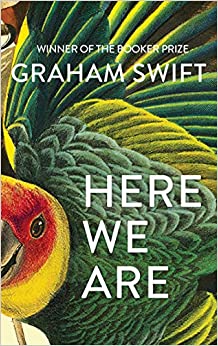
#BookReview ‘Here We Are’ by Graham Swift #theatre #Brighton

What a delightful slim story is Here We Are by Graham Swift. On the surface it’s a simple tale of a summer season at the theatre at the end of Brighton Pier in 1959. It’s a tale about a magician and his assistant. It’s also a tale about perception and delusion, truth and lies, what is real and an illusion. Graham Swift When young magician Ronnie Deane gets a job for a seaside summer season, he advertises for an assistant. Evie White has experience in the chorus line but has never worked for a magician before. They are both on a steep learning curve. Their guide in Brighton is Ronnie’s friend Jack Robbins, compere, listed on the bill as Jack Robinson. ‘Some patter, some gags, some of them smutty, a bit of singing, some dancing, some tapping of his heels.’ As Ronnie and Evie, listed as ‘Pablo & Eve’, perfect their act, work their way up the bill, they go out as a foursome in the evenings with Jack and his latest girl. They change so frequently Evie can’t keep track of their names, instead thinking of them simply as ‘the Floras’.
This is principally Ronnie’s story, how at the age of eight he left his mother and was evacuated to safety in Oxford. There he found a new home, new parents and a magician to share all the secrets and tricks of the trade. By the end of the war, when Ronnie returns home to London and to his mother, he is a man who knows what job he wants to do.
Like all Swift’s stories, this can be read on many levels. At its simplest it is about a love triangle.
Only 208 pages, it is a short novel. The language is beautiful with not an unnecessary word. Not much may happen, but as the events of 1959 unfold Swift tells us the story of Ronnie’s childhood and how it impacts on the man he has become. The lies told to prevent hurt, the lies told for self-protection, lies told for unknown reasons, and some lies which may actually be the truth. As unknowable as Ronnie’s Famous Rainbow Trick. Unpretentious, at its heart lies a mystery that is in itself mysterious.
CLICK HERE TO READ MORE ABOUT THIS BOOK AT AMAZON

Here’s my review of Swift’s MOTHERING SUNDAY.

If you like this, try:-
A View of the Harbour’ by Elizabeth Taylor
The Gustav Sonata’ by Rose Tremain
Redhead by the Side of the Road’ by Anne Tyler

And if you’d like to tweet a link to THIS post, here’s my suggested tweet:
#BookReview HERE WE ARE by Graham Swift https://wp.me/p5gEM4-5iB via @SandraDanby

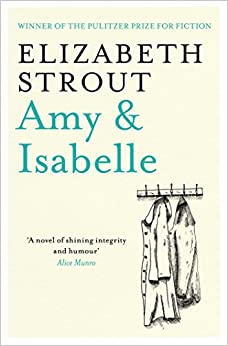
#BookReview ‘Amy & Isabelle’ by Elizabeth Strout @LizStrout #contemporary

The mother and daughter portrayed in Amy & Isabelle by Elizabeth Strout are at odds with each other. The events of one long sweltering summer in Shirley Falls are simple, familiar across the ages, but are told with a hefty emotional punch. So strong is this book it’s difficult to see that it was Strout’s first novel, published in 2000 to be followed only eight years later by her Pulitzer Prize-winning Olive Kitteridge. Strout is adept at peeling away the layers of character and events to show the raw emotion, shame, guilt and pain beneath. Elizabeth StroutWhen Isabelle Goodrow arrived in Shirley Falls with her baby daughter, she took a job at the local mill. Now, in a time that feels like 1970s America, Amy is sixteen and has a summer job in the same office as her mother. They sit and fume at each other, barely talking, brushing past each other without a word. Amy, who has fallen in love with her maths teacher, believes her upright, unemotional mother, has no idea of what she is feeling right now. Isabelle despairs of her daughter’s behaviour. Told in absorbing detail, switching between the two viewpoints, the trauma of the two women is revealed. Shirley Falls is an evocative setting, an industrial town with a river flowing through it. As the temperature rises, the river begins to stink adding to the stresses not just on the Goodrows but on the small community in which they exist. Strout excels at portraying the circle of characters which make the world of a novel so believable – Amy’s friend Stacy, Fat Bev and Dottie Brown at the mill, Isabelle’s boss Avery Clark.
Isabelle finds it difficult to fit in, has always felt like an outsider. As she judges others, she assumes others judge her. This is more about her own experience and inadequacies than about anyone else. As the summer days plod on and Amy’s affair unravels, we see hints of the truth of Isabelle’s past that go some of the way to explaining why she is as she is.
Difficult to put down, I enjoyed Amy & Isabelle very much. Both women are so real, their situations are real, you want to slap them both and hug them both. Strout writes in an extraordinarily perceptive manner about ordinary people in ordinary places, so real you feel you are in the room too.

Read my reviews of these other books by Elizabeth Strout:-
ANYTHING IS POSSIBLE
LUCY BY THE SEA
MY NAME IS LUCY BARTON
OH WILLIAM!
OLIVE KITTERIDGE
OLIVE, AGAIN

If you like this, try:-
‘If I Knew You Were Going to be This Beautiful, I Never Would Have Let You Go’ by Judy Chicurel
The Museum of You’ by Carys Bray
When All is Said’ by Anne Griffin

And if you’d like to tweet a link to THIS post, here’s my suggested tweet:
#BookReview AMY & ISABELLE by Elizabeth Strout @LizStrout https://wp.me/p5gEM4-5id via @SandraDanby

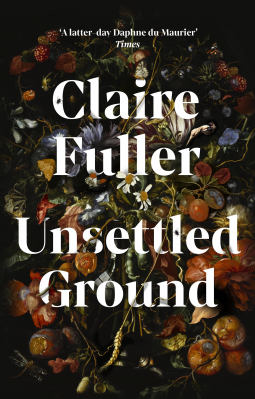
#BookReview ‘Unsettled Ground’ by Claire Fuller #contemporary

The title is well chosen. From the first page, Unsettled Ground by Claire Fuller is unsettling. An eclectic mixture of setting and detail make the timeframe difficult to pin down, it seems other-worldly. An ordinary world, but not quite. This is a world of Google and internet banking, of smartphones and digital life. Claire FullerFuller writes about twins Julius and Jeanie who, aged 51, still live with their mother in a remote rural cottage. They scratch a living, cash-in-hand earned from odd jobs, vegetables and eggs sold at the garden gate and the local deli, money kept in a tin rather than a bank account. Everything changes when their mother, Dot, dies suddenly and they realise how she protected them and kept them safe. But with Dot gone, their familiar world collapses. Their routines don’t work, the difficulties their mother smoothed are now rocky, and they are evicted from their home.
This is a novel about relationships – sibling, parental and with the local community – both supportive and dismissive. As the twins attempt to cope with the paperwork following their mother’s death, their isolation from modern society becomes evident to them. Many people step aside from their helplessness, finding them strange and ignorant, people make assumptions and take the easy option of turning away. Jeanie is mortified to find out that other people know more about her life and family history than she does, how neighbours silently colluded in a scenario either from a sense of helplessness, a misguided assumption they are helping, or malicious sniggering. Unsettled Ground is an uncomfortable but at the same time uplifting read.
As Julius and Jeanie confront each revelation about the life they have been living, they begin to question each other’s loyalty. Jeanie finds emotional strength she didn’t know she had, despite a heart complaint she’s had since childhood. She sneaks back home and finds solace in the abandoned garden, harvesting vegetables. This is an uncomfortable depiction of modern poverty in a society where money exchange is cashless and application for help depends on literacy. Both find a way to cope but inevitably they need each other despite their grumbles and disagreements. At times of stress, they pick up their guitars and sing folk songs as their parents taught them.
When the truth slowly emerges about their father’s accidental death and Dot’s subsequent struggle as a single mother, they realise that deep down they had always had suspicions. This is a powerful story about the strength of human nature and the bonds of family, about fighting back against bullies and finding light in the future.

If you like this, try:-
The Midnight Library’ by Matt Haig
In the Midst of Winter’ by Isabel Allende
The Lie of the Land’ by Amanda Craig

And if you’d like to tweet a link to THIS post, here’s my suggested tweet:
#BookReview UNSETTLED GROUND by Claire Fuller https://wp.me/p5gEM4-5a0 via @SandraDanby

#BookReview ‘How to Belong’ by Sarah Franklin #contemporary

How to Belong by Sarah Franklin considers what it is to belong – in a place, and within a family – and how not belonging affects one’s wellbeing. Like Franklin’s successful debut novel Shelter, How to Belong is set in the Forest of Dean, at times a stifling woodland location where community seems set beneath a magnifying glass in which everyone knows everyone else’s business and they rub along together. Except, they don’t if you don’t belong. Sarah FranklinThis is the story of two women who don’t belong; one believes she does, the other thinks she is too different. Jo Porter grew up in the forest, daughter of the local butcher, and close friends with Liam whose single mum sometimes struggled to cope. Liam grew up learning to recognise his mum’s good and bad times and what to do when the bad periods happened, knowing there was always sanctuary provided by Jo’s parents. When Jo leaves the forest for university and then to work as a lawyer, Liam stays at home, marries Kirsty and has two daughters.
Tessa is a farrier, loving her solitary job in the open air, working with horses. When her romance in Bristol with Marnie turns sour, Tessa retreats to the country and into herself, blaming her fainting fits, her memory losses and secretly afraid she is ill.
When Jo’s parents retire, Jo surprises everyone by leaving London and the law to return to the Forest and take over her parents’ business. She rents a room in Tessa’s remote cottage. Things don’t go as Jo expected. Butchering is not her natural occupation despite having practically grown up in the shop at her parents’ knees, her landlady proves herself silent and uncommunicative, and worst of all Liam seems to be giving her the cold shoulder. Meanwhile, Tessa has crashed her van and is earning barely enough to feed herself. When Jo tries to help diagnose Tessa’s illness, things don’t go according to plan. While Tessa keeps her secrets to herself, Jo doesn’t understand her own motivation in wanting to help her landlady. Neither woman appreciates the effect that their actions have on others, neither feels comfortable in the role of landlady/lodger perhaps because they are unsure of their own identity. It’s difficult to fit into a place if you’re not sure why you are there, whether you should be there, and if you are running towards or away from something.
The contemporary setting is very different from the wartime story of Shelter. This is a character study of two women lacking self-awareness who begin to understand themselves through their new friendship. When awareness arrives, it is raw and uncompromising. At times I grew impatient with each of them, perhaps because the author had to withhold some information about them in order to maintain the mysteries from their past until the end is reached. The end, when it came, felt like a rather quick shutting of the door.
The cover of How to Belong is one of my favourites of this year, but then I love trees.

Read my review of SHELTER also by Sarah Franklin.

If you like this, try:-
We Are All Completely Beside Ourselves’ by Karen Joy Fowler
Offshore’ by Penelope Fitzgerald
The Lost Lights of St Kilda’ by Elisabeth Gifford

And if you’d like to tweet a link to THIS post, here’s my suggested tweet:
#BookReview HOW TO BELONG by Sarah Franklin https://wp.me/p5gEM4-4Qb via @SandraDanby

#BookReview ’Summerwater’ by Sarah Moss #contemporary

Twenty-four hours in the Scottish countryside, twelve people are staying in holiday cabins beside an isolated loch. Summerwater by Sarah Moss starts off with strangers concerned with the minutiae of their own lives and ends with a tragedy. Sarah MossThis is beautifully written with sly humour coupled with sensory description of the place which puts you right there. The pace is slow and contemplative, taking time to plait together the observations by characters and the actual names, so carefully building together a picture of a temporary community. At first, they make assumptions and generalisations about each other. A retired couple sit and look out at the rain, reminiscing about the previous years they spent in this cabin. A young mother runs in all weathers and at all times of day, leaving her husband to look after the children. A teenager escapes the boredom of his bedroom by kayaking around the loch. The Romanian family, who party all night and don’t know how to behave, are the only ones seeming to have fun on holiday. They are also the only ones whose viewpoint we don’t hear, setting them apart from the rest. While at night a shadow stands in the woods, watching.
I never did get the identity of some characters straight in my head and the building of tension – the shadow in the woods – didn’t convince me. I didn’t feel it was necessary as I quickly became fascinated by the setting and the gradual interaction of characters. The constant rain acts as a claustrophobia device keeping everyone inside, feeling trapped, looking out and watching others, making judgements.
Summerwater is also darkly funny. Don’t miss the chuckle-out-loud scene when Milly and Josh are having sex but she’s thinking about a cup of tea and a bacon butty. The chapters about people are alternated with short sections about the natural world – a deer and fawn, the geology of the rocks, the origin of water flowing into the loch, bats, birds waiting for the rain to stop. These briefly pause the story – most are two paragraphs long – but add to the sense of place.
Most definitely not a page-turner in the thriller sense, Summerwater ends abruptly. It is however thick with atmosphere. The rain, the wet vegetation, the finger-chilling cold, the sense of the holiday park, the loch and earth being much older than the visitors. It is a book about a day in which not a lot happens, showing how small things become big when you are bored, and how we are all inter-connected.

And here’s my review of another novel by Sarah Moss:-
GHOST WALL

If you like this, try:-
Akin’ by Emma Donoghue
These Dividing Walls’ by Fran Cooper
Anderby Wold’ by Winifred Holtby

And if you’d like to tweet a link to THIS post, here’s my suggested tweet:
#BookReview SUMMERWATER by Sarah Moss https://wp.me/p5gEM4-4SD via @SandraDanby