Tag Archives: grief

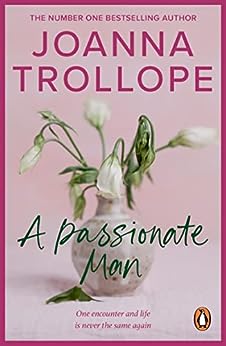
#BookReview ‘A Passionate Man’ by Joanna Trollope #familysaga #contemporary

I started A Passionate Man by Joanna Trollope wondering about the identity of the man in the title, and finished it not being entirely sure. There are three men in the story who could fit the label and although I enjoyed the book I finished it feeling incomplete. Joanna TrollopeJoanna Trollope is so good at exploring the experiences faced by couples and families, relationship challenges are emotionally similar despite differences in the ages of the people involved, class, geography, decade or century. In A Passionate Man, published in 1990, she deals with a seemingly happy couple whose lives are rent apart by the death of a parent and the unexpected interest of an amorous colleague. Trollope’s characters are middle class, doctor Archie and teacher Liza Logan live a comfortable life in a covetable house in a Hampshire village. But all is not beautiful in this beautiful setting. A plan to build house on a field causes ruptures between friends and neighbours, locally-born workers struggle to live where they grew up while the elderly die quietly in loneliness. The cosy life of the Logans begins to fracture.
As husband and wife become focussed on their own emotions and needs, the divisions grow to the degree that their three children notice the undercurrents. Grief of a parent is an unexpectedly intense, disorientating experience which makes one question one’s own life, achievements, mistakes, dreams and longings. Trouble can often follow. I found myself becoming irritated by both Archie and Liza, rather than sympathetic, as each struggles with the consequences of their own actions and the other’s. As the family’s fractures deepen to chasms, Trollope’s portrayal of the children however is excellent.
I was left feeling that the ending is rather rushed and convenient and that ‘passionate’ is not the most appropriate adjective. Not my favourite Trollope novel.
CLICK HERE TO READ MORE ABOUT THIS BOOK AT AMAZON

Here are my reviews of other Trollope novels:-
A VILLAGE AFFAIR
MUM & DAD
THE CHOIR
THE RECTOR’S WIFE

If you like this, try:-
In the Midst of Winter’ by Isabel Allende
The Marriage Plot’ by Jeffrey Eugenides
In Another Life’ by Julie Christine Johnson

And if you’d like to tweet a link to THIS post, here’s my suggested tweet:
#BookReview A PASSIONATE MAN by Joanna Trollope https://wp.me/p2ZHJe-6KA via @SandraDanby

COMING SOON… THE NEXT BOOK I REVIEW WILL BE:- Andrew Taylor

#BookReview ‘Old God’s Time’ by Sebastian Barry #contemporary #grief

Old God’s Time by Sebastian Barry is a sensitively and quietly written tale of family tragedy and loss. Beautiful, so subtle, with moments of extreme grief and love, flashes of helplessness and impending trouble. A difficult read but also enjoyable, Barry is a master of his craft. Sebastian BarryThe pace starts slowly, gently with Barry tightening the screw of perception as newly-retired policeman Tom Kettle [what a great name] is forced to remember what he has buried so deep. You may think, as I did, oh please not another story about abusive Irish priests; but this is about Tom and his beloved wife June, their children Winnie and Joe, not about the clergy. Barry dallies with our perception of what the story is about. He shows us Tom adjust to his existence without work, his flat, the changeable Irish weather, the coastline, at the same time exploring the nature of memory, lived memory, what is true and what is perception or presumption, while increasing the mystery of Tom’s past. The misty, stormy changing weather echoes this visibility/invisibility of personal truth.
Tom’s new routine is disturbed by a visit from two young detectives, uncomfortable in his presence, unsure of how to behave with such a venerable retired detective. Tom makes them cheese on toast and gives them a bed for the night. But their absence lingers in his mind as memories of an old crime resurface.
Is Tom Kettle a reliable or unreliable narrator? Is his truth believable and reliable – who is alive now, and who dead – or the confusion of an ageing memory? He sees real people, and ghosts, which suggests he is older than he is, confused, fading, vulnerable. As Tom revisits his memories again for the detectives, and in private moments on his own, the emotional story comes together. The responsibilities of husband and father stay with him, all of his time, ‘Things happened to people, and some people were required to lift great weights that crushed you if you faltered just for a moment. It was his job not to falter. But every day he faltered.’
A novel about the depth of love, it defines genre description. It is mystery, suspense, tragedy, gentle humour, contemporary, Irish history and crime but is ultimately a story of mourning lives lost and innocence destroyed. A dark read about lasting trauma, it is slow at times but please persist with it.

Read my reviews of these other novels by Sebastian Barry:-
A LONG LONG WAY
DAYS WITHOUT END #1DAYSWITHOUTEND
A THOUSAND MOONS #2DAYSWITHOUTEND
THE WHEREABOUTS OF ENEAS MCNULTY

If you like this, try:-
A History of Loneliness’ by John Boyne
Last Stories’ by William Trevor
Did You Ever Have a Family’ by Bill Clegg

And if you’d like to tweet a link to THIS post, here’s my suggested tweet:
#BookReview OLD GOD’S TIME by Sebastian Barry https://wp.me/p2ZHJe-6Nb via @SandraDanby

COMING SOON… THE NEXT BOOK I REVIEW WILL BE:- Mick Herron

A poem to read in the bath… ‘Invisible Man’ by @MargaretAtwood #poetry

At Christmas I was given Dearly, the slim hardback book of Margaret Atwood’s poems. I’ve never thought of her as a poet but Dearly is a revelation. As with her novels, Atwood crystalises those intense emotional moments of life, the ones that stay with us, and sets them into everyday context. This is a wonderful collection about growing old, rememberings, endings and beginnings, passing by and moving on. Dedicated to her partner it is a personal collection, and very touching.

Margaret Atwood

[photo: Sueddeutsche Zeitung Photo – Alamy Stock Photo]

The poem I have chosen is ‘Invisible Man’. A short poem of five verses, full of how it feels to lose your lifelong partner. The absence at the table, on a walk, like an invisible man in comic books, still there but seen only by the one left behind, remembering

This poem is subject to copyright restrictions so here’s the first verse as a taster. Please search for the full poem in an anthology or at your local library.

‘Invisible Man’
It was a problem in comic books:
drawing an invisible man.
They’d solve it with a dotted line
that no one but us could see’

Margaret AtwoodBUY THE BOOK

Read these other excerpts and find a new poet to love:-
Tulips’ by Wendy Cope
Serious’ by James Fenton
Sounds of the Day’ by Norman MacCaig

And if you’d like to tweet a link to THIS post, here’s my suggested tweet:
A #poem to read in the bath: ‘Invisible Man’ by @MargaretAtwood https://wp.me/p5gEM4-590 via @SandraDanby

A poem to read in the bath… ‘Do Not Go Gentle into That Good Night’ by Dylan Thomas #poetry

Dylan Thomas’s most famous, arguably most familiar, poem is a villanelle with five stanzas of three lines followed by a single stanza of four lines, making a total of 19 lines. It is structured with two repeating rhymes, ‘Do not go gentle into that good night’ and ‘Rage, rage, against the dying of the light’. Written in 1947 when Thomas was in Florence with his family, it is popularly thought to refer to the death of his father though his father did not die until 1952. In contrast to many poems of death, popular for reading at funerals, this speaks clearly and strongly at the anger and resentment at dying.

Dylan Thomas

[photo: poetryfoundation.org]

Due to copyright restrictions, I cannot reproduce the whole poem here. Please search for the full poem in an anthology or at your local library.

‘Do Not Go Gentle into That Good Night’

Do not go gentle into that good night,
Old age should burn and race at close of day;
Rage, rage, against the dying of the light.

 
Though wise men at their end know dark is right,
Because their words had forked no lightning they
Do not go gentle into that good night.

 
Good men, the last wave by, crying how bright
Their frail deeds might have danced in a green bay,
Rage, rage, against the dying of the light.

Dylan ThomasBUY THE BOOK

Dylan ThomasThomas’s best known poem has been referenced frequently in popular culture. In the 1996 film Independence Day, the president gives a rousing speech to his bedraggled army as they prepare to fight the aliens, saying “We will not go quietly into the night.”
BUY THE DVD

Dylan ThomasIn the 2014 film Interstellar, the poem is quoted frequently by Michael Caine’s character, Professor John Brand, while Matthew McConaughey and Anne Hathaway are sent into hyper sleep with the words, “Do not go gentle into that good night.”
BUY THE DVD

Read these other excerpts and find a new poet to love:-
Dunt: A Poem for a Dried-Up River’ by Alice Oswald 
After a Row’ by Tom Pickard
My Mother’ by Ruby Robinson

And if you’d like to tweet a link to THIS post, here’s my suggested tweet:
A #poem to read in the bath: ‘Do Not Go Gentle into That Good Night’ by Dylan Thomas https://wp.me/p5gEM4-4bZ via @SandraDanby

#BookReview ‘Smash All the Windows’ by @janedavisauthor #contemporary

Thought-provoking, sometimes difficult, always moving, Smash All The Windows by Jane Davis starts at a run as we are pitched straight into emotional turmoil, grief, anger and betrayal. Jane DavisAn inquest investigates an accident thirteen years earlier, it is the undoing of a miscarriage of justice. In turn we meet the survivors, and the relatives of the victims. Davis follows the paths of each person to their own resolution; there is no self-help book to follow, they must each must work it out for themselves. We see flashbacks to the days and hours before the accident as Davis unravels the real truth of what happened.
This is a complex story with legal twists and turns, misunderstandings and minute step-by-step detail of what happened on that day, thirteen years ago, when over-crowding at St Botolph and Old Billingsgate tube stations in London ended in death. For thirteen years, blame has been thrown around, scapegoats have been targeted, the media has dug for dirt. This is an imaginary accident but with echoes of so many disasters – Hillsborough, Grenfell, Kings Cross – that it can’t help but be affecting.
There are a lot of victims and survivors, a lot of relatives. The high number of characters causes initial confusion: who is who, who is alive and who is dead, what was the actual accident. As I read the first quarter of the book, I longed for a short summary of what happened. But as the story progressed I understood that my confusion mirrors the confusion of an accident as it happens, the disorientation of victims, the powerlessness of the loved ones who are waiting. It is a purposeful obfuscation by the author to reflect the opacity of what happens, the difficulty of finding the truth in any inquest or public enquiry, and ultimately the slippery nature of memory.
The survivors and relatives of victims are now living fractured lives. Gina lost her son. Her daughter Tamsin has grown into a young woman, still living at home to support her mother after Gina’s husband left, as husband and wife dealt with grief in different ways. Gina often forgets in the bottom of a glass. Donovan lost his pregnant daughter, her partner and his unborn grandchild; grief has caused his wife to withdraw into her own world, agoraphobic she stays at home. Maggie lost her daughter, newly-promoted station supervisor Rosie; Rosie is the scapegoat and Maggie receives hate mail. She understands the need of people to blame someone, and tries to deal with the anger and bitterness thrown her way, but is unable to ‘move on’ as her husband can. Jules lost his wife and is raising his young son alone. None of these people were there on the day but they are also victims. Add to this mix the two lawyers, Eric and Sorrel. It is Eric’s cussedness, his determination to unravel the truth, to read obscure documents about operating procedures and identify the failings, that makes the new inquest possible. He proves that accidents happen because of an unpredictable collision of small things.  I found Eric’s sections about the minutae of the accident, the legal arguments, the leaden language of official documents, to be a slow read that interupts the flow of emotions as Gina, Tamsin, Donovan, Maggie and Jules process their grief.
Ultimately, Jules is the catalyst for resolution. Transformed from plumber to artist, his reputation has gradually grown. Now a commission from the Tate Modern to produce a collection of art about the disaster allows ‘the 59’ to achieve a form of public resolution to their grief. The story came alive for me with Jules and his art. He takes the story of each survivor or relative and uses small items to tell a huge story, about their grief, their anger, the need to hit out, the need to be recognised.
Davis writes well about the powerful emotion unleashed by the accident, and its lasting effects. This book is about the nature of victimhood and how it is possible to shake it off if you have the will to do so. But that does not mean forgetting. Davis shows the transition of remembering; at the beginning, the second inquest has refreshed the trauma anew; but at the end, memories are welcomed in.

If you like this, try:-
In the Midst of Winter’ by Isabel Allende
The Bone Church’ by Victoria Dougherty
The Little Red Chairs’ by Edna O’Brien

And if you’d like to tweet a link to THIS post, here’s my suggested tweet:
#BookReview SMASH ALL THE WINDOWS by @janedavisauthor https://wp.me/p5gEM4-3TP via @SandraDanby

#BookReview ‘When All Is Said’ by Anne Griffin #Irish #contemporary

This book stayed with me a long time after I finished it. Three words sum up When All is Said by Anne Griffin. Masterful. Emotional. Funny. It is the story of Maurice Hannigan as he sits at a bar one evening. He drinks a toast to five people and tells the story of his life. It is one of those Irish novels which makes your emotions tingle and say ‘yes, it is like that’, which makes tears prick your eyes and laughter rise in your chest. This is Griffin’s debut novel but she is an accomplished prizewinning writer who knows how to tell a story. It is unbearingly touching and will, without fail, make you cry. Anne GriffinMaurice is in the bar of the Rainsford House Hotel in Rainsford, Co Meath, Ireland. At the beginning we don’t know why he is there, the first few pages are an introduction to Maurice, how he feels his age, as he conducts an imaginary conversation with his son Kevin who lives in America. His first drink is a bottle of stout and as he drinks, he tells the story of his brother Tony and their childhood. A key incident in this section has reverberations throughout Maurice’s life and throughout this novel; a gentle reminder that we all may grow old, we may live in the same place or move away, but our childhood and our actions stay with us. We are introduced to Emily, owner of the hotel, and Svetlana, barmaid. Griffin has a talent with sense of place; she makes the hotel come alive.
Four more drinks follow. For Molly, a glass of Bushmills 21-year old malt. For Noreen, a bottle of stout. For Kevin, a rare whiskey, Jefferson’s Presidential Select. And for his wife Sadie, Maurice drinks a glass of Midleton whiskey. “Svetlana places my final drink down in front of me: Midleton, you can’t fault it. Majestic stuff. I look at it like she has just handed me the keys to a new harvester. It’s the autumn colours that get me. It’s the earth of it, the trees, the leaves, the late evening sky.”
As each story is told, Anne Griffin weaves in the present day so the two strands blend and the past explains Maurice’s situation, why he feels as he does, why he longs for what he longs for. This is a beautiful Irish novel about love, dyslexia, grumpiness, family, bullying, forgiveness and whiskey. I loved it and didn’t want it to end.

Read my review of LISTENING STILL, also by Anne Griffin.

If you like this, try:-
A History of Loneliness’ by John Boyne
Brooklyn’ by Colm Tóibín 
That They May Face the Rising Sun’ by John McGahern

And if you’d like to tweet a link to THIS post, here’s my suggested tweet:
#BookReview WHEN ALL IS SAID by Anne Griffin https://wp.me/p5gEM4-3Qg via @SandraDanby

A #poem to read in the bath… ‘I loved her like the leaves’

The sense of loss in this Japanese poem is unquenchable. Written by Kakinonoto Hitomaro in 7th century Japan, it speaks of emptiness so great there is no hope or comfort. Hitomaro was a poet of the Asuka period [538-710], serving as court poet to the Empress Jitō, and is considered to be one of the four greatest poets in Japanese history along with Fujiwara no Teika, Sōgi and Bashō.

Kakinonoto Hitomaro

Kakinomoto Hitomaro by Kikuchi Yosai

‘I loved her like the leaves,
The lush green leaves of spring
That pulled down the willows
on the bank’s edge
where we walked
while she was of this world.
I built my life on her.
But man cannot flout
the laws of this world.
To the shimmering wide fields
hidden by the white cloud,
white as white silk scarf
she soared away like the morning bird,
hid from our world like the setting sun.
The child, the gift she left behind –
he cries for food; but always
finding nothing that I might give him,
I pick him up and hold him in my arms.
On the pillow where we lay,
My wife and I, as one,
I pass the daylight lonely till the dusk,
the black night sighing till the dawn.
I grieve and grieve and know no remedy.
I ache and know no road where I might meet her.

[NB. This poem features in two editions of poems that I own and, owing to different translations, there are variations]

The poem features in many anthologies, including my own The Picador Book of Funeral Poems and The Penguin Book of Japanese Verse.
Amazon


Read these other excerpts, and perhaps find a new poet to love:-
‘Alone’ by Dea Parkin
‘A thousand years, you said’ by Lady Heguri
‘After a row’ by Tom Pickard

And if you’d like to tweet a link to THIS post, here’s my suggested tweet:
A #poem to read in the bath: ‘I loved her like the leaves’ by Kakinonoto Hitomaro https://wp.me/p5gEM4-3dY via @SandraDanby

A poem to read in the bath… ‘A thousand years, you said’

Written in 8th century Japan, this poem speaks of the longing of love shadowed by impending death, and it is as relevant today as it was then. I discovered this poem in The Picador Book of Funeral Poems, and then stumbled on it again in an old paperback on my bookshelf, The Penguin Book of Japanese Verse. It was written by Lady Heguri in mid-late eighth century. No details are known of her, except that her poems are addressed to Yakamochi.

‘A thousand years, you said,
As our two hearts melted.
I look at the hand you held
And the ache is too hard to bear.’


‘The Picador Book of Funeral Poems’ ed. by Don Paterson
Amazon UK

Read these other excerpts, and perhaps find a new poet to love:-
‘Runaways’ by Daniela Nunnari
‘Winter Song’ by Wilfred Owen
‘The Cinnamon Peeler’ by Michael Ondaatje

And if you’d like to tweet a link to THIS post, here’s my suggested tweet:
A #poem to read in the bath: ‘A thousand years, you said’ by Lady Heguri https://wp.me/p5gEM4-3dS via @SandraDanby

A poem to read in the bath… ‘Because I could not stop for Death’

This lyrical poem by Emily Dickinson sees the poet meet Death who, as a gentleman caller, takes a leisurely carriage drive with her. It was first published posthumously under the title ‘The Chariot’ in Poems: Series 1 in 1890, the edition assembled and edited by her friends Mabel Loomis Todd and Thomas Wentworth Higginson.

Here are the first two verses.
‘Because I could not stop for Death –
He kindly stopped for me –
The Carriage held but just Ourselves –
And Immortality.

We slowly drove – He knew no haste
And I had put away
My labor and my leisure too,
For His Civility.’

The poem has since been set to music by Aaron Copland as the twelfth song of his cycle The Twelve Poems of Emily DickinsonEmily Dickinson

Emily Dickinson


‘The Picador Book of Funeral Poems’ ed. by Don Paterson [UK: Picador]

Read these other excerpts, and perhaps find a new poet to love:-
‘Happiness’ by Stephen Dunn
‘Lost Acres’ by Robert Graves
‘The Roses’ by Katherine Tempest

And if you’d like to tweet a link to THIS post, here’s my suggested tweet:
A #poem to read in the bath: ‘Because I could not stop for Death’ by Emily Dickinson https://wp.me/p5gEM4-3dG via @SandraDanby

#BookReview ‘The Museum of You’ by Carys Bray #contemporary

This novel by Carys Bray starts with a wonderful description of twelve-year-old Clover watering her father’s allotment on a hot summer’s day. It is the beginning of the summer holidays and it is the first time she has her own front door key and is allowed out on her own. I smelt the dust, could see the shimmering heat and feel the cool of the water splashing from the tap. Carys BrayIt is not a book in which a lot happens; rather it is a sensitive portrait of a single father and his daughter and how the past refuses to be ignored.
After a school trip to the Merseyside Maritime Museum in Liverpool, Clover decides her holiday project will be to curate an exhibit of her mother. She has no memories of her mum, who died soon after Clover was born, and her father never talks about the past. Clover never used to mind about this, not wanting to press him and cause distress. But now, poised on the edge of womanhood, her curiosity mounts. And so she ventures into the spare bedroom, a repository of the unwanted and unused. Amongst the piles of old clothes and broken things, she discovers objects which enchant her, things which belonged to her mother. From these pieces she compiles a picture of the mother she never knew.
What follows is an enchanting tale of a motherless girl, her bus driver father, neighbour Mrs Mackerel (what a great name), grandfather and unpredictable Uncle Jim. It took me quite a while to sort out who is who. We see Clover’s life through the lens of her childlike but observant eyes, balanced by the story of her father Darren who feels the daily struggle of a man raising a daughter alone: how to tie a towel turban on her head, what to tell her about boyfriends. It is a very real story about an ordinary family, touching but sometimes caustic, funny and believable. It could be a mawkish read about long-term grief, but Clover energises the story. Her family is surviving, despite the difficulties it faces. Darren’s sections tells us the truth about the things Clover finds, which makes some of her museum exhibits so poignant. I loved the scenes between Clover and schoolfriend Dagmar at the allotment, though Mrs Mackerel’s malapropisms became a little wearing towards the end.

If you like this, try:-
‘The Girls’ by Lisa Jewell
‘Somewhere Inside of Happy’ by Anna McPartlin
‘Beginnings’ by Helen J Christmas

And if you’d like to tweet a link to THIS post, here’s my suggested tweet:
#BookReview THE MUSEUM OF YOU by Carys Bray via @SandraDanby http://wp.me/p5gEM4-2bp