Tag Archives: Irish writers

#BookReview ‘The Hoarder’ by Jess Kidd #mystery #contemporary

Part crime-mystery, part mystical ghost story, The Hoarder, the second novel by Jess Kidd, is difficult to define. Maud Drennan is an irreverent Irish carer who has been assigned the unholy task of bringing order to the life of Cathal Flood, a cantankerous old man who lives with his cats in a decrepit house surrounded by piles of rubbish. The previous carer who did Maud’s job, was run off the scene. Amongst the piles of junk, though, are ghosts of Cathal’s past, clues to the disappearance of one maybe two women, and traps for Maud to fall into. Jess KiddThis is at times a bewildering smorgasbord of imagery and description, there were times when I wanted to shout ‘give me a breather’ but the humour of Maud kept me reading. There are some giant character arcs to work through, both Maud and Cathal change and change again, not to mention Maud’s glorious cross-dressing neighbour Renata. To add to the merry-go-round of confusion, Maud is followed around in her daily life by a collection of ghosts, Irish saints that she learned about in a childhood book. Each saint passes comment on Maud’s actions adding a hilarious Greek Chorus effect to the story. Maud, egged on by the agoraphobic Renata, starts to look for ways of breaching the walls of rubbish which Cathal has built around himself and his private section of his old home, Bridlemere. When she does creep through, she encounters a dusty spooky world of collectibles, automata and gruesome collections which add to the feeling that secrets are hidden somewhere in the house.
The action steps up a gear when Maud’s predecessor Sam Hebden, the carer hounded off the property by Cathal, reappears. As well as flirting with Maud, he simultaneously encourages and discourages her from her detecting. Clues appear after dreams or apparitions, at times I was unclear, and Maud stumbles onwards unsure who to trust. Cathal may be old, but he is also cunning, clever and warm. When a man turns up claiming to be Gabriel Flood, Cathal’s son, the old man protests he is a villain. There is also a rather unpleasant case manager, Biba Morel. Quite a lot of the time, I didn’t know who to believe. The story is set in London but Maud’s strong Irish voice could lead you to think you are in Ireland.
So, this is a crime mystery that is not really about a crime, rather it is about Cathal and Maud and how their pasts cannot be ignored. Cathal, who tries to barricade himself in his house, away from modern life; and Maud, who is haunted by the childhood disappearance of her sister; are both characters adrift. I loved Kidd’s debut, Himself and enjoyed The Hoarder though I wish the frenetic storytelling could be toned down a notch or two.

And see my reviews of these two other novels by Jess Kidd:-
HIMSELF
THE NIGHT SHIP

If you like this, try:-
‘The Good People’ by Hannah Kent
‘Elizabeth is Missing’ by Emma Healey
‘The Ghost of Lily Painter’ by Caitlin Davies

And if you’d like to tweet a link to THIS post, here’s my suggested tweet:
#BookReview THE HOARDER by Jess Kidd https://wp.me/p5gEM4-36p via @SandraDanby

#BookReview ‘Himself’ by @JessKiddHerself #mystery #contemporary

I loved Himself by Jess Kidd from the first page. It defies pigeonholing: at once a literary crime mystery, a fond comic tale of an Irish village, an investigation of long-buried secrets of murder and illegitimacy.Jess KiddJess Kidd is a refreshing new voice, I don’t remember enjoying a debut novel this much since Hannah Kent’s Burial Rites though the two books are completely different.
In 1976 Mahony walks into the village of Mulderrig, seeking the truth of his birth twenty-six years earlier. From the forest around the village, and the houses within it, the dead walk out to greet him. They are a silent cast throughout the book, do they hold the answer to the mystery?
Kidd has created a village which feels alive, filled by a cast of characters so clearly drawn, and which swirls between the horrific beating of a nurse, downright nastiness, belly laughs and hallucinogenic drugs. The cast includes a pinched, controlling priest; a wizened old actress who organizes the village play from her wheelchair; a bogeyman who reputedly lives in the forest; and a pub landlord who tries to court the Widow Farelly, a nurse who has the sourest disposition visible to everyone except him. Mahony grew up in a Dublin orphanage, knowing only that he was left there as a baby with a letter marked ‘For when the child is grown’. What he reads in this letter sends him to Mulderrig to find out what happened to his mother, Orla, in 1950.
Did she disappear, running away to a better life, as most of the villagers tell him; or was she murdered? And why was she so hated by her neighbours?
As Mahony, Bridget Doosey, Shauna Burke and the indefatigable Mrs Cauley investigate his origins, the true nastiness of the village emerges.

And see my reviews of these two other novels by Jess Kidd:-
THE HOARDER
THE NIGHT SHIP

If you like this, try:-
‘A History of Loneliness’ by John Boyne
‘Ghost Moth’ by Michele Forbes
‘After the End’ by Clare Mackintosh

And if you’d like to tweet a link to THIS post, here’s my suggested tweet:
#BookReview HIMSELF by @JessKiddHerself via @SandraDanby http://wp.me/p5gEM4-23K

#BookReview ‘Somewhere Inside of Happy’ by @annamcpartlin #contemporary #grief

Somewhere Inside of Happy by Anna McPartlin is a thoughtful book with strongly drawn characters, Irish humour and a fair amount of ripe language. And there is laughter and tears. Yet again, Irish author McPartlin tackles difficult issues. Grief – as in the superb The Last Days of Rabbit Hayes –  dementia and homophobia. Anna McPartlinThis is the story of Maisie Bean, a single mother who has fought bravely to escape a violent husband and raise her two children, Jeremy and Valerie. The story starts, on January 1, 1995, when Jeremy disappears.
Ever since his mother found the strength to leave her abusive husband, Jeremy has been the man of the family. He has been responsible, thoughtful, helpful, caring for his grandmother Bridie who suffers from dementia, keeping an eye on his younger sister Valerie. In doing so he has repressed who he is because he doesn’t really understand who he is, all he knows is that he is different.
Somewhere Inside of Happy is an examination of generalisations, assumptions and misunderstandings, how the crowd dynamic and a troublesome media can turn a whisper into fact. How a community looks the other way whilst a drug-addict father neglects his son and how gays are referred to as ‘queer’ and worse. The mirror held up to society is not a pretty one. It is a reminder to us all to be more respectful of others, to stop ourselves being unfair and condemnatory about things we do not understand. The setting is Ireland in the Nineties, not that long ago. The title of the book is actually a place within Jeremy, to where he retreats, curled up, when the outside world gets too much.
If I have one criticism, it is the Prologue set twenty years after the main story. It tells us so many things I would expect to discover through reading the book.
My favourite character? Bridie. She is drawn with such affection, a ‘game old bird’ dancing with her sixteen-year-old grandson.
CLICK HERE TO READ MORE ABOUT THIS BOOK AT AMAZON

Read my review of THE LAST DAYS OF RABBIT HAYES, also by Anna McPartlin.

If you like this, try:-
‘The Little Red Chairs’ by Edna O’Brien
‘Nora Webster’ by Colm Tóibín
‘Butterfly Barn’ by Karen Power

And if you’d like to tweet a link to THIS post, here’s my suggested tweet:
#BookReview SOMEWHERE INSIDE OF HAPPY by @annamcpartlin http://wp.me/p5gEM4-21A via @SandraDanby

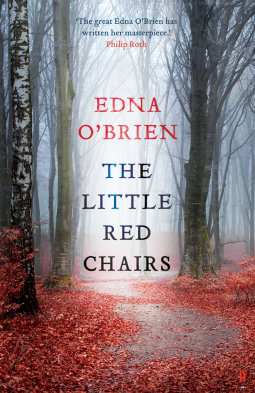
#BookReview ‘The Little Red Chairs’ by Edna O’Brien #war

The Little Red Chairs by Edna O’Brien is a fictional portrait, a ‘what if’ scenario: what if a war criminal, a Balkan war lord, was on the run and pitched up in a small town in the West of Ireland. What if the locals took him at face value. What if one woman saw him as a way to bring a child into her childless marriage. What if his true identity was revealed. What then… would happen to the woman. This is the story of Fidelma, to reveal more about her would be to giveaway the drama of the book. She is a sad character, unsatisfied with her lot, reaching for the unattainable and ultimately suffering for her need. Edna O’BrienThis book has attracted some outstanding reviews, but I hesitated. It sat for a while on my Kindle before I read it, I think because the subject matter is depressing and intimidating. O’Brien’s writing is at times flowing and lyrical especially when describing nature, at times her structure is a little wavy and the story a little flabby. Some passages are horrifying in their brutality, the war flashbacks are vivid. I find violence, when left to the imagination, more effective than violence written on the page or acted on stage.
I never really settled into reading this book. It is split into three parts, each with a different personality. The portrayal of small town life in Ireland in the first half was so full of sketchy characters I got confused. I longed for a simpler format to allow the moral dilemma to come through. In part two, Fidelma is in London, searching for healing, and for answers. She cleans a City tower block, and works in a kennel for abandoned greyhounds. At The Centre, where Fidelma goes for support, we hear the stories of abused refugees and asylum seekers, they are victims of war, genocide and physical assault and sexual abuse. For me, their stories sit uncomfortably alongside Fidelma’s own self-created dilemma and, I think because of this, I was left oddly untouched. In part three, Fidelma goes to see Vlad in The Hague at the war crimes tribunal. I admit to not understanding her motivation in going there, but it is a conversation in a bar with a victim of genocide which finally prompts Fidelma to complete the circle and return to Ireland to see the other victim in all this – her husband.
The power of O’Brien’s topic is undeniable. Is it a comment on our gullibility, how we can all be taken in by appearances; or a comment on how we avoid confrontation, not wanting to be the person to say the difficult thing, the one thing which afterwards people say ‘I thought that too.’ It is also a comment on a society which punishes and isolates the victim.

If you like this, try:-
‘Dominion’ by CJ Sansom
‘The Aftermath’ by Rhidian Brook
‘A Long Long Way’ by Sebastian Barry

And if you’d like to tweet a link to THIS post, here’s my suggested tweet:
#BookReview THE LITTLE RED CHAIRS by Edna O’Brien via @SandraDanby http://wp.me/p5gEM4-1TY

My ‘Porridge & Cream’ read: Shelley Weiner

Today I am pleased to welcome novelist, Shelley Weiner who will share her ‘Porridge & Cream’ read.

“Tiring of a well-worn book is like outgrowing a friendship, or a fashion statement, or a taste for cheap confectionary – depressing but, sadly, a fact of life. We change, our tastes change, the priorities that seemed so immutable ten years ago can alter or become irrelevant And so, having scoured my bookshelves to find a ‘Porridge & Cream’ read, I had to conclude that the old faithfuls by the authors I chose (sorry Carol Shields, apologies Jane Smiley …) no longer moved me.

Shelley WeinerI might have darted back to Dickens, to Austen, to Tolstoy, for classics of that calibre are beyond fatigue. Instead I consoled myself with a movie – the excellent screen adaptation of Colm Tóibín’s Brooklyn – and a large tub of popcorn. And as I sat in the darkness imbibing salty kernels and Irish angst, I recalled the spare beauty of Tóibín’s prose and resolved to return to the novel.

Which I did.

And – relief upon relief – it’s as I remembered it; as simple and quiet and engrossing as when I devoured it on publication eight years ago. It’s the kind of writing I identify with and aspire towards, confirming for me the power of understatement.

Brooklyn focuses on young Eilis, who ventures from the limitations of small-town Ireland to the strangeness and dislocation of New York. It’s a story of immigration, a rite of passage tale that reminds me how the deepest and most important universal truths can resonate through discipline and restraint. Tóibín has the rare ability to disappear into the heart and mind of his character; his lack of authorial ego means that no point does the reader stop to admire his turn of phrase or philosophical astuteness. We’re with Eilis entirely – feeling for her, laughing and crying with her, identifying in the most profound way with her plight. Tóibín revisits the same small-town community in the excellent Nora Webster – a more recent and slightly darker work, satisfyingly alluded to in Brooklyn.”

About ‘A Sister’s Tale’ by Shelley Weiner [Constable]
Shelley WeinerMia is dumpy, earthy and responsible, while her sister Gabriella is flighty and spoilt – a prima donna. Middle aged, their lives in a mess, they find themselves alone together in a parched Israeli town. Is it the promised land or a last resort? As the sisters wait together in the sultry heat for something, anything, to happen, they watch each other and remember. They think back to their isolated Jewish childhood in London; the devastation of their father’s sudden death; their mother languishing hopelessly in bed. They conjure up Mia’s Irish Catholic romantic lover, father of her child; and Gabriella’s well-heeled and ‘suitable’ husband. Meanwhile, at the entrance to their flat, an unexpected visitor arrives in time for a fish supper. A Sisters’ Tale is a wicked yet poignant story about the complex and powerful bond between sisters.

Shelley Weiner’s Bio
Shelley Weiner’s novels include A Sisters’ Tale, The Last Honeymoon, The Joker, Arnost, and The Audacious Mendacity of Lily Green.
Her 60-minute guides to writing fiction are published by The Guardian. She is a regular tutor for the Faber Academy and trusted mentor on the Gold Dust Mentoring Scheme. She has presented workshops for Guardian Masterclasses, Norwich Writers Centre, and the Cheltenham Literary Festival. A former Fellow of the Royal Literary Fund, Shelley has also taught fiction for – among others – Birkbeck College, Anglia Ruskin University, the Open University, the British Council, and Durham University Summer School.

Shelley Weiner’s links
Website
Facebook
Twitter

porridge_and_cream__rainyday_111_long


What is a ‘Porridge & Cream’ book? It’s the book you turn to when you need a familiar read, when you are tired, ill, or out-of-sorts, where you know the story and love it. Where reading it is like slipping on your oldest, scruffiest slippers after walking for miles. Where does the name ‘Porridge & Cream’ come from? Cat Deerborn is a character in Susan Hill’s ‘Simon Serrailler’ detective series. Cat is a hard-worked GP, a widow with two children and she struggles from day-to-day. One night, after a particularly difficult day, she needs something familiar to read. From her bookshelf she selects ‘Love in A Cold Climate’ by Nancy Mitford. Do you have a favourite read which you return to again and again? If so, please send me a message via the contact form here.


Discover the ‘Porridge & Cream’ books of these authors:-
Jane Cable
JG Harlond
Jane Lambert

Shelley Weiner


‘Brooklyn’ by Colm Tóibín [UK: Penguin]

And if you’d like to tweet a link to THIS post, here’s my suggested tweet:
Why does author @shelleyweiner love BROOKLYN by Colm Toibin? via @SandraDanby #books http://wp.me/p5gEM4-1QZ

#BookReview ‘The Betrayal’ by Laura Elliot #family #secrets #mystery

The Betrayal by Laura Elliot is a well-written study of a teenage relationship which, when it falters and is left to fester into adulthood, can mess up a whole family.Laura Elliot

Slow-moving for me until towards the end, its billed as a ‘gripping novel of psychological suspense’ but to me seemed more of a family drama. At its heart is an examination of the marriage breakdown between two empty-nesters, Jake and Nadine, who are then messed around by Karin, the ex-friend from hell. Yes, there is a stalker. Yes, there are accidents and co-incidences. There are some colourful sections to Jake and Nadine’s viewpoints which I enjoyed reading – the band Shard, Alaska, the container village – but these seemed like diversions when I spent a long time waiting to find out what the actual betrayal was. Perhaps an insight into Karen’s mind would have helped to balance Jake and Nadine’s story.

Read my review of STOLEN CHILD, also by Laura Elliot.

If you like this, try:-
The Accident‘ by CL Taylor
Butterfly Barn by Karen Power
‘The House at the Edge of the World’ by Julia Rochester

And if you’d like to tweet a link to THIS post, here’s my suggested tweet:
#BookReview THE BETRAYAL by Laura Elliot http://wp.me/p5gEM4-1K1 via @SandraDanby

#BookReview ‘Nora Webster’ by Colm Tóibín #historical

Nora Webster by Colm Tóibín is such a slow burn. I came to it after reading a thriller, so perhaps that’s why the pace seemed so slow. And then I took a deep breathe and let myself sink into the deep pool of the story. Colm Tóibín Reading this book was a little like listening to my mother tell the story of her life, tiny baby steps. The everyday voice of Nora, a kind of everywoman, is so clear. An ordinary woman, she is grieving for her husband Maurice and living in a world of echoes. This is a novel about grief, living with grief, and the slow re-awakening of life. Tiny baby steps.
Nora cannot indulge her grief. For one thing, money is short and her two young sons must be cared for. Her two daughters too, though older, need their mother although they don’t think they do. Nora struggles to get through her own day in which every minute is shadowed by her loss, but life gets in the way, decisions must be made. Day to day she does the best she can, trying to get the everyday detail right but not seeing how her sons’ grief is manifesting itself. Instead she worries about paying the bills and avoiding people in the street who want to pay their respects. Tóibín has created a timeless rural Ireland where everyone knows everyone else from childhood, where the etiquette of grief is followed, where it is difficult to have secrets.
As readers we experience all of this in Nora’s own mind, we are inside her head: this is Tóibín’s real skill. It would be easy to say this is a book about the grief of an Irish woman, and not much else. And to be fair, there is not a lot of action in the first half of the book. Then, unable to say ‘no’ to an invitation as it would be impolite, Nora starts to sing. And that is the first baby step of her re-awakening.
At the beginning, I wondered if I would finish it. When I finished it, I wanted to start reading it again.

Read my reviews of these other novels by Colm Tóibín:-
BROOKLYN
HOUSE OF NAMES

If you like this, try:-
Himself’ by Jess Kidd
How to Belong’ by Sarah Franklin
Elmet’ by Fiona Mozley

And if you’d like to tweet a link to THIS post, here’s my suggested tweet:
#BookReview NORA WEBSTER by Colm Tóibín http://wp.me/p5gEM4-1eW via @SandraDanby

#BookReview ‘A Long Long Way’ by Sebastian Barry #Irishhistory #WW1

A Long Long Way by Sebastian Barry is the story of Willie Dunne, an innocent, who goes away to war not understanding fully what is involved but determined to do his bit. Written in 2005 and nominated for the Booker Prize, it is the tender tale of a young Irish man who volunteers for the British army and ends up in Belgium. Sebastian Barry Set against the background of the Easter Rising, Willie does not fully understand the political implications of what is happening around him. He is born in Dublin, as a baby “he was like the thin upper arm of a beggar with a few meagre bones shot through him, provisional and bare.” Barry’s language throughout is a delight, something I didn’t expect when the book is about the worst of trench warfare. Barry does not spare punches, at times the action and conditions he describes brought me close to tears, but I read on, pulled forwards by Willie’s life force.
He travels to new places, “ravished by the simple joy of seeing new places of the earth.” This joy unravels when arrives at the trenches. “The biggest thing there was the roaring of Death and the smallest thing was a man. Bombs not so far off distressed the earth of Belgium, disgorged great heaps of it, and did everything except kill him immediately, as he half-expected them to do.” And all the time he longs from Gretta, his girl at home. “He was in love with Gretta like a poor swan was in love with the Liffey and cannot leave it.”
I will be reading more by Sebastian Barry.

Read my reviews of these books also by Sebastian Barry:
A THOUSAND MOONS
DAYS WITHOUT END
OLD GOD’S TIME
THE WHEREABOUTS OF ENEAS MCNULTY

If you like this, try:-
The Lie’ by Helen Dunmore
Life Class’ by Pat Barker
Wake’ by Anna Hope

And if you’d like to tweet a link to THIS post, here’s my suggested tweet:
#BookReview A LONG LONG WAY by Sebastian Barry http://wp.me/p5gEM4-Bx via @SandraDanby

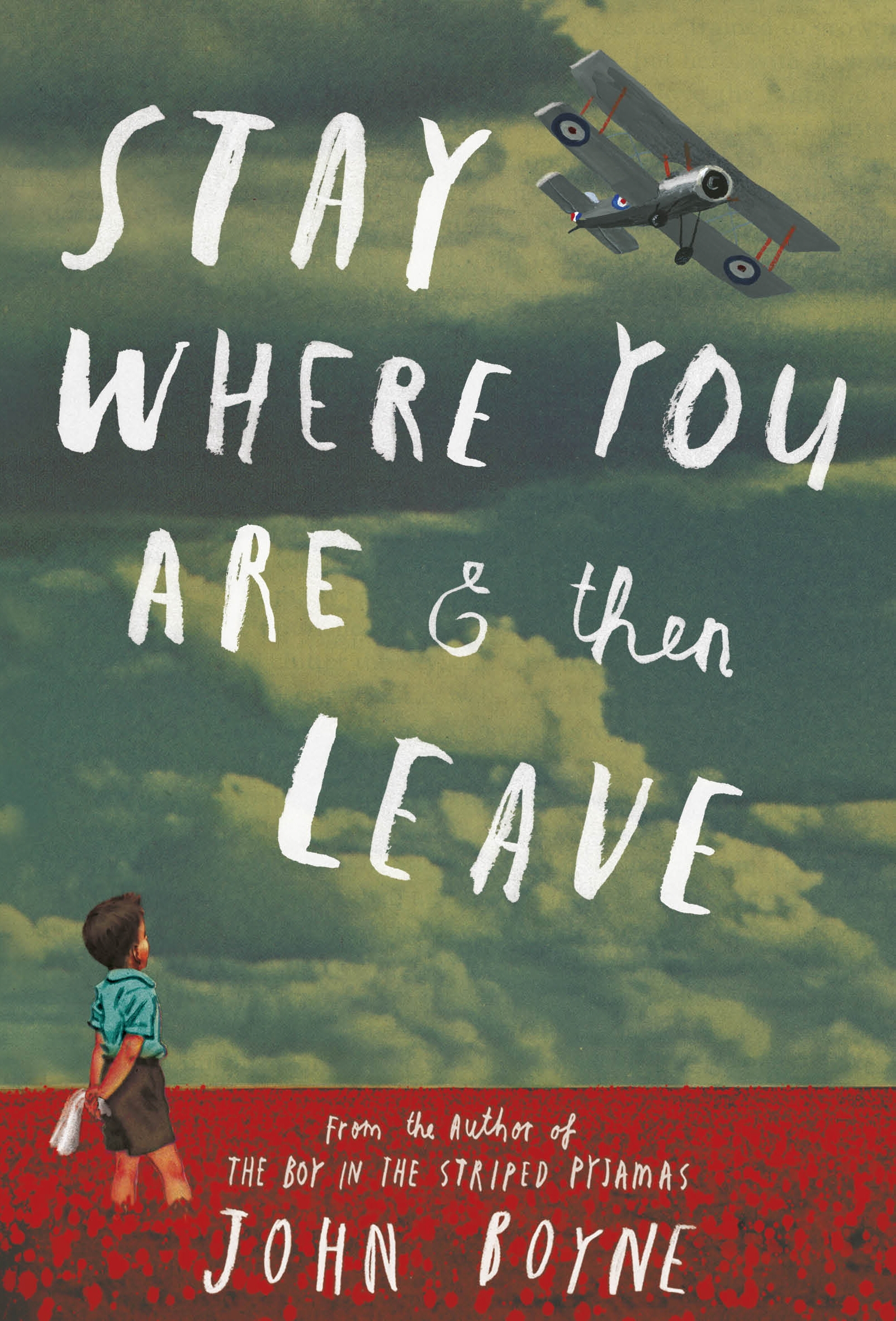
#BookReview ‘Stay Where You Are & Then Leave’ by John Boyne @JohnBoyneBooks #WW1

I’m sure Stay Where You Are & Then Leave will be the first of many books about the First World War which I will read over the next two years [written in 2013], and what a one to start with. Written by John Boyne, probably best known for The Boy in the Striped Pyjamas, this is a touching story of a boy’s determination to help his soldier father. John BoyneDestined to become a children’s classic, it is a tough tale with a tender touch. Boyne doesn’t shy away from the difficult subjects of enemy aliens, conscientious objectors, loss, injury, death and fear. On July 28th 1914, war is declared. It is also Alfie Summerfield’s fifth birthday. His biggest wish is to go one morning with his father Georgie on the milk cart with his horse Mr Asquith. Life changes for Alfie and his mother without Georgie. As the years pass, Alfie stops believing the grown-ups who say the war ‘will be over by Christmas’. Then his father’s letters stop arriving. Alfie’s mother says Georgie is ‘on a special mission and cannot write’ but Alfie doesn’t believe her. He doesn’t like being treated as a child, so he decides to do something about it.
This is a story about belief, empowerment, and the strength of children in adversity.

Read my reviews of these other novels by John Boyne:-
A HISTORY OF LONELINESS
A LADDER TO THE SKY
A TRAVELLER AT THE GATES OF WISDOM
ALL THE BROKEN PLACES
THE HEART’S INVISIBLE FURIES… Curious? Read the first paragraph of THE HEART’S INVISIBLE FURIES here.
WATER #1ELEMENTS
EARTH #2ELEMENTS

If you like this, try:-
‘Himself’ by Jess Kidd
‘Ghost Moth’ by Michele Forbes
‘Nora Webster’ by Colm Tóibín

And if you’d like to tweet a link to THIS post, here’s my suggested tweet:
#BookReview STAY WHERE YOU ARE AND THEN LEAVE by John Boyne @JohnBoyneBooks https://wp.me/p2ZHJe-4bh via @SandraDanby