Tag Archives: war

#BookReview ‘The Little Red Chairs’ by Edna O’Brien #war

The Little Red Chairs by Edna O’Brien is a fictional portrait, a ‘what if’ scenario: what if a war criminal, a Balkan war lord, was on the run and pitched up in a small town in the West of Ireland. What if the locals took him at face value. What if one woman saw him as a way to bring a child into her childless marriage. What if his true identity was revealed. What then… would happen to the woman. This is the story of Fidelma, to reveal more about her would be to giveaway the drama of the book. She is a sad character, unsatisfied with her lot, reaching for the unattainable and ultimately suffering for her need. Edna O’BrienThis book has attracted some outstanding reviews, but I hesitated. It sat for a while on my Kindle before I read it, I think because the subject matter is depressing and intimidating. O’Brien’s writing is at times flowing and lyrical especially when describing nature, at times her structure is a little wavy and the story a little flabby. Some passages are horrifying in their brutality, the war flashbacks are vivid. I find violence, when left to the imagination, more effective than violence written on the page or acted on stage.
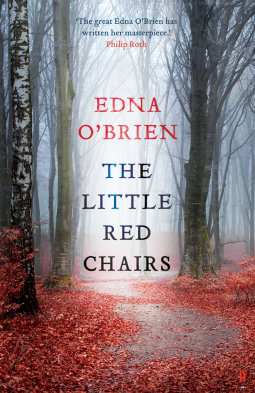
I never really settled into reading this book. It is split into three parts, each with a different personality. The portrayal of small town life in Ireland in the first half was so full of sketchy characters I got confused. I longed for a simpler format to allow the moral dilemma to come through. In part two, Fidelma is in London, searching for healing, and for answers. She cleans a City tower block, and works in a kennel for abandoned greyhounds. At The Centre, where Fidelma goes for support, we hear the stories of abused refugees and asylum seekers, they are victims of war, genocide and physical assault and sexual abuse. For me, their stories sit uncomfortably alongside Fidelma’s own self-created dilemma and, I think because of this, I was left oddly untouched. In part three, Fidelma goes to see Vlad in The Hague at the war crimes tribunal. I admit to not understanding her motivation in going there, but it is a conversation in a bar with a victim of genocide which finally prompts Fidelma to complete the circle and return to Ireland to see the other victim in all this – her husband.
The power of O’Brien’s topic is undeniable. Is it a comment on our gullibility, how we can all be taken in by appearances; or a comment on how we avoid confrontation, not wanting to be the person to say the difficult thing, the one thing which afterwards people say ‘I thought that too.’ It is also a comment on a society which punishes and isolates the victim.

If you like this, try:-
‘Dominion’ by CJ Sansom
‘The Aftermath’ by Rhidian Brook
‘A Long Long Way’ by Sebastian Barry

And if you’d like to tweet a link to THIS post, here’s my suggested tweet:
#BookReview THE LITTLE RED CHAIRS by Edna O’Brien via @SandraDanby http://wp.me/p5gEM4-1TY

#BookReview ‘The Bone Church’ by @vicdougherty #war #WW2

The Bone Church was a difficult story to get into for me, which surprised me. The premise by Victoria Dougherty seems so good – Czechoslovakia, wartime, fugitive lovers, a faked religious icon, and a plot to assassinate Josef Goebbels – the promise of which kept me reading. But I found the time shifts, the point of view shifts, and the way the action changed from paragraph to paragraph quite confusing. Assuming this was a formatting issue with my Kindle copy, I kept reading. Victoria DoughertyThe story starts in Rome in 1956 in the Vatican City with a Cardinal and a man called Felix. Then we see Magdalena and her son Ales in Czechoslovakia, a man arrives and takes away her son. Then the action switched to 1943, as Felix and Magdalena are on the run in Prague. He is a famous hockey player, a celebrity, she is a Jew. By this point, the story should have gripped me but I’m afraid it didn’t, I hadn’t read enough about the two characters to care. I think my basic problem is the way the story was told, not the actual story itself; the writing is rich with description and the author certainly knows her history. Halfway through, things started to make a little more sense though at times the plot seemed unnecessarily complicated.
The best bit? An assassination scene, involving a birthday cake, a gun, and Josef Goebbels.

If you like this, try:-
‘Life After Life’ by Kate Atkinson
‘The Little Red Chairs’ by Edna O’Brien
‘Dominion’ by CJ Sansom

And if you’d like to tweet a link to THIS post, here’s my suggested tweet:
#BookReview THE BONE CHURCH by @vicdougherty http://wp.me/p5gEM4-1Bl via @SandraDanby

#BookReview ‘The Aftermath’ by @Rhidianbrook #WW2

1946. Post-war Germany, Hamburg. The Aftermath by Rhidian Brook is a gentle novel with an emotionally difficult core: the adjustment of two families, one German one English, to the landscape of rubble a year after the end of the Second World War. Broken country, broken families, broken minds. The title refers to the aftermath of the war and also to the aftermath of events in the lives of both families. Both are grieving and are in new territory, geographically and emotionally. They are proud and unsure. Together, will they heal? Rhidian BrookThe English family: Colonel Lewis Morgan is occupied with the Occupied while his newly-arrived wife Rachael prevaricates, “I don’t know. It was suffix and prefix to her every other thought. This indecision was becoming her signature.” Their son Edmund has no such doubts, facing a challenging encounter with the teenage girl upstairs involving a glimpse of knickers and a steaming pisspot, he then ventures beyond the house’s garden into forbidden territory and meets the local feral youth.
The German family: Herr Lubert, a widower, and his daughter move upstairs when the Morgans arrive in the requisitioned house. Ironically Stefan Lubert is an architect, surrounded by broken buildings, but works instead in a factory while waiting for his papers to arrive which will allow him to practise again. School is closed so Frieda is on the ‘rubble runs’, clearing bricks and rubbish, where she mixes with the feral youth.
They all make their own adjustments to the new situation and for a while it is a quiet, polite tussle for power. Rachael makes changes in the house; she moves plants and drapes a modest cloth over a nude sculpture. She sets herself rules about not fraternising with the Germans, who she believes need punishing. She disagrees with Herr Lubert about a Mies van der Rohe chair which he explains is a Bauhaus design, functionality stripped to simplicity. She says it is uncomfortable.
It is as if each family is trying the other on for size, it is a fascinating observation of ordinary people in extraordinary times. Lewis reflects on the logic of the tasks he must perform: “They blow up a soap factory which employed two thousand Germans, made something everyone needed and had no military value whatsoever and, in return, the Russians send the Germans bread. It was like balancing Hell’s ledger.”
The cover of the book is an attractive, calm monotone and the story is also told in a calm tone; but underneath the emotions are building. As the initial discomfort eases, passion rises.

Read my review of another Rhidian Brook novel:-
THE TESTIMONY OF TALIESIN JONES

If you like this, try:-
The Translation of Love’ by Lynne Kutsukake
Homeland’ by Clare Francis
The Ways of the World’ by Robert Goddard

And if you’d like to tweet a link to THIS post, here’s my suggested tweet:
#BookReview THE AFTERMATH by @Rhidianbrook via @SandraDanby http://wp.me/p5gEM4-So

#BookReview ‘Life After Life’ by Kate Atkinson #WW2

It’s a while since I read a book I didn’t want to put down, a book that made me continue reading in bed gone midnight. Life After Life by Kate Atkinson is that book. Kate AtkinsonAtkinson manages the macro settings and the micro details with ease, from the petty sibling squabbles at Fox Corner to the camaraderie of the ARP wardens in the Blitz. Before I started reading Life after Life I read the phrase ‘Groundhog Day’ a few times in reviews, which belittles the intricate weaving of Ursula Todd’s lives. In the way that Logan Mountstuart’s life runs parallel to the great historical moments of the last century, Ursula’s life stories are book-ended by the approach and aftermath of the First and Second World Wars. Ursula, little bear, is an engaging character we see born and die, again and again through her own personal déjà vu.  I wasn’t sure how this was going to work but once I stopped worrying about it and surrendered myself to Ursula, I was transfixed.
This is another work of art, as mesmerising as her first Behind the Scenes at the Museum. It is such an ambitious novel, that I can only guess at the intricacy of the writing process and admire her for it.

Read my reviews of these other novels by Kate Atkinson:-
A GOD IN RUINS
BIG SKY #5JACKSONBRODIE
DEATH AT THE SIGN OF THE ROOK #6JACKSONBRODIE
NORMAL RULES DON’T APPLY
SHRINES OF GAIETY
TRANSCRIPTION

If you like this, try:-
Homeland’ by Clare Francis
‘The Aftermath’ by Rhidian Brook
‘The Translation of Love’ by Lynne Kutsukake

And if you’d like to tweet a link to THIS post, here’s my suggested tweet:
#BookReview LIFE AFTER LIFE by Kate Atkinson via @SandraDanby https://wp.me/p2ZHJe-4aw