Yearly Archives: 2014

#BookReview ‘Stolen Child’ by Laura Elliot #family #secrets #mystery

Stolen Child by Laura Elliot wasn’t as I expected it to be. Given the title, I expected a detective hunt for a missing child, kidnap and perhaps murder. Instead it is a character study of two women encompassing grief, guilt, blame, anger, loss and redemption. Laura Elliot Susanna loses her own baby before term and steals one to replace it. Carla, a model who lives her life on the fashion pages, gives birth but days later her baby disappears from the hospital without trace. This is a page-turner but is so much more than that. It is a character study of two women at the extreme of horror and grief, not just in the immediate aftermath of the theft, but years later. Both experience loss, grief, guilt and dashed hopes.
Susanne steals baby Isobel and calls her Joy. Devastated mum Carla is dealing with an avid media which cannot believe its luck at the juicy headlines. Both women struggle to live day-to-day. Relationships crack, friendships shake. Susanne is over-protective of Joy. Carla refuses to let go, even after her husband leaves the country to ‘move on’. She changes her name, cuts her hair short and dyes it black. The years pass. But rural Ireland is a small place. The network of who-knows-who overlaps the lives of both women, now and in the past. Why did Susanne choose Carla’s baby to steal? Part of my motivation to turn the page was the curiosity about who would spot the strong physical likeness between Joy and Carla. As Joy/Isobel grows, her voice joins the story too: teenage angst, boyfriend trouble, rebellion and confusion.
Susanne and Carla are connected by an umbilical cord. I waited for the moment that the cord would be yanked, and the two pulled together. This book is an examination of what makes a family: blood, proximity, do they have to start with a birth or are they more loosely assembled?

Read my review of THE BETRAYAL, also by Laura Elliot.

If you like this, try:-
The Birdcage’ by Eve Chase
Ghost Moth’ by Michele Forbes
In Another Life’ by Julie Christine Johnson

And if you’d like to tweet a link to THIS post, here’s my suggested tweet:
#BookReview STOLEN CHILD by Laura Elliot via @SandraDanby http://wp.me/p5gEM4-1fx
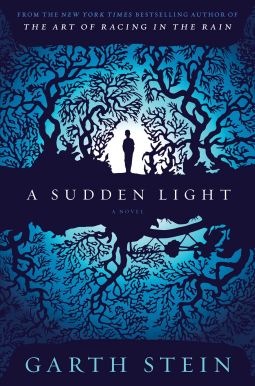
#BookReview ‘A Sudden Light’ by Garth Stein @garthstein #contemporary

How to define A Sudden Light by Garth Stein? It’s a coming of age tale, a ghost story, it’s about forests and trees and about man’s responsibility to nature. I loved it, one of the best books I‘ve read this year and quite different from everything else. Garth SteinStein is a new author for me. I was attracted to this book by three features: the ethereal cover, the setting in the Pacific North-Western corner of the US, and the family/saga ghost story combination.
Trevor’s parents are separated. His mother has flown home to England for the summer while Trevor visits for the first time his ancestral home on the Olympic Peninsula outside Seattle. Trevor’s objective is to repair his parents’ marriage, he is not sure how. But from the first day he and his father, Jones, arrive at Riddell House on The North Estate, everything seems strange. The house is enormous, built by Trevor’s great-great-grandfather Elijah Riddell a century earlier, testament to Elijah’s riches earned from his logging business. It is a mansion, built from timber, set amongst trees, isolated and rotting. The house is at the centre of this story; its physicality, its history, what it meant to Elijah and his son Ben, and what the sale of it could mean to the current Riddell generation: much needed cash. Trevor meets his aunt Serena [she asks him to call her Simply Serena] and his Grandfather Samuel, who suffers from Alzheimer’s. The mysteries start from day one. Is the ghost of Jones and Serena’s mother dancing upstairs? What exactly is Serena’s agenda, is she trying to seduce 14-year old Trevor? Is Grandfather Samuel speaking rubbish, or not? And what secret is Jones hiding? Money is at the centre of this tale, a family who earned fortunes as the 19th century turned into the 20th by forging timber links with the railroads. That same family now has a mansion which is falling into ruin, while Jones is newly bankrupt after the failure of his boatbuilding business.
Everyone has an agenda at Riddell House that summer, including Trevor.

If you like this, try:-
‘The Ship’ by Antonia Honeywell
The Good People’ by Hannah Kent
Barkskins’ by Annie Proulx

And if you’d like to tweet a link to THIS post, here’s my suggested tweet:
#BookReview A SUDDEN LIGHT by Garth Stein @garthstein via @SandraDanby http://wp.me/p5gEM4-1fc

#BookReview ‘The Love Song of Miss Queenie Hennessy’ by Rachel Joyce #contemporary

I was blown away by The Love Song of Miss Queenie Hennessy by Rachel Joyce and read it in two sittings. First, you do not need to have read The Unlikely Pilgrimage of Harold Fry before you read this. I don’t really think it matters which of the two you read first, they are companion books rather than prequel and sequel. Second, this is the most accurate portrayal of people living in a hospice that I have read, and it is not something often written about. Rachel JoyceRachel Joyce confronts head-on the fact of Queenie’s terminal illness, and that of her fellow residents at St Bernadine’s Hospice. But she doesn’t concentrate on their illnesses, she concentrates on their characters and in this way they form a colourful backdrop to Queenie’s story. They are not defined by their illnesses, and neither is Queenie. This is the story of her life, a story we learn because she is writing a long letter to Harold Fry.
Queenie is in the North-East of England, Harold is in Devon. They worked together many years ago. Queenie writes to Harold to tell him he is dying. He writes a reply, but instead of posting the letter he decides to deliver it himself and starts walking. That was the plot of The Unlikely Pilgrimage of Harold Fry, a book about Harold coming to terms with his own life.
This book is about Queenie’s life. Afraid he will not arrive before she dies, Queenie starts to write the story of her life – with the help of nun Sister Mary Inconnue who re-types Queenie’s handwritten notes. It is Queenie’s explanation of and apology for a wrong she did to Harold while they both worked at a brewery in Kingsbridge, Devon. As she nears her end, Queenie struggles to write, but Sister Mary quietly encourages her, lifts her when she is faltering, puts the notebook in her lap and tells her she has to finish her story.
It is so moving, and it is very funny. St Bernadine’s Hospice is a real place populated by real people and they are the fabric of Queenie’s life now. This is a book about death, and about life. It is about love, grief, difficult choices, and finally it is about making peace with yourself before the end.
Just read it!
CLICK HERE TO READ MORE ABOUT THIS BOOK

Read my reviews of these other novels by Rachel Joyce:-
MAUREEN FRY AND THE ANGEL OF THE NORTH
MISS BENSON’S BEETLE
PERFECT

And read here the first paragraph of THE UNLIKELY PILGRIMAGE OF HAROLD FRY

If you like this, try:-
The Museum of You’ by Carys Bray
The Roundabout Man’ by Clare Morrall
Paper Cup’ by Karen Campbell

And if you’d like to tweet a link to THIS post, here’s my suggested tweet:
#BookReview THE LOVE SONG OF MISS QUEENIE HENNESSY by Rachel Joyce via @SandraDanby http://wp.me/p5gEM4-1f5

Great opening paragraph 60… ‘Lord Jim’ #amreading #FirstPara

“He was an inch, perhaps two, under six feet, powerfully built, and he advanced straight at you with a slight stoop of the shoulders, head forward, and a fixed from-under stare which made you think of a charging bull. His voice was deep, loud, and his manner displayed a kind of dogged self-assertion which had nothing aggressive in it. It seemed a necessity, and it was directed apparently as much at himself as at anybody else. He was spotlessly neat, apparelled in immaculate white from shoes to hat, and in the various Eastern ports where he got his living as ship-chandler’s water-clerk he was very popular.”
Joseph ConradFrom ‘Lord Jim’ by Joseph Conrad

Here’s the #FirstPara of THE SECRET AGENT, also by Joseph Conrad.

Try one of these #FirstParas & discover a new author:-
‘Diary of an Ordinary Woman’ by Margaret Forster
‘The Big Sleep’ by Raymond Chandler
‘Before I Go To Sleep’ by SJ Watson

And if you’d like to tweet a link to THIS post, here’s my suggested tweet:
#Books #FirstPara LORD JIM by Joseph Conrad http://wp.me/p5gEM4-f3 via @SandraDanby

Great opening paragraph…60

Lord Jim - OP
“He was an inch, perhaps two, under six feet, powerfully built, and he advanced straight at you with a slight stoop of the shoulders, head forward, and a fixed from-under stare which made you think of a charging bull. His voice was deep, loud, and his manner displayed a kind of dogged self-assertion which had nothing aggressive in it. It seemed a necessity, and it was directed apparently as much at himself as at anybody else. He was spotlessly neat, apparelled in immaculate white from shoes to hat, and in the various Eastern ports where he got his living as ship-chandler’s water-clerk he was very popular.”
‘Lord Jim’ by Joseph Conrad

#BookReview ‘Nora Webster’ by Colm Tóibín #historical

Nora Webster by Colm Tóibín is such a slow burn. I came to it after reading a thriller, so perhaps that’s why the pace seemed so slow. And then I took a deep breathe and let myself sink into the deep pool of the story. Colm Tóibín Reading this book was a little like listening to my mother tell the story of her life, tiny baby steps. The everyday voice of Nora, a kind of everywoman, is so clear. An ordinary woman, she is grieving for her husband Maurice and living in a world of echoes. This is a novel about grief, living with grief, and the slow re-awakening of life. Tiny baby steps.
Nora cannot indulge her grief. For one thing, money is short and her two young sons must be cared for. Her two daughters too, though older, need their mother although they don’t think they do. Nora struggles to get through her own day in which every minute is shadowed by her loss, but life gets in the way, decisions must be made. Day to day she does the best she can, trying to get the everyday detail right but not seeing how her sons’ grief is manifesting itself. Instead she worries about paying the bills and avoiding people in the street who want to pay their respects. Tóibín has created a timeless rural Ireland where everyone knows everyone else from childhood, where the etiquette of grief is followed, where it is difficult to have secrets.
As readers we experience all of this in Nora’s own mind, we are inside her head: this is Tóibín’s real skill. It would be easy to say this is a book about the grief of an Irish woman, and not much else. And to be fair, there is not a lot of action in the first half of the book. Then, unable to say ‘no’ to an invitation as it would be impolite, Nora starts to sing. And that is the first baby step of her re-awakening.
At the beginning, I wondered if I would finish it. When I finished it, I wanted to start reading it again.

Read my reviews of these other novels by Colm Tóibín:-
BROOKLYN
HOUSE OF NAMES

If you like this, try:-
Himself’ by Jess Kidd
How to Belong’ by Sarah Franklin
Elmet’ by Fiona Mozley

And if you’d like to tweet a link to THIS post, here’s my suggested tweet:
#BookReview NORA WEBSTER by Colm Tóibín http://wp.me/p5gEM4-1eW via @SandraDanby

#BookReview ‘A Death in Valencia’ by @Jwebsterwriter #crime #Spain

A Death in Valencia by Jason Webster is about more than a singular death, it is an exploration of the nature of death and what constitutes murder. Max Cámara, the Valencia detective introduced by Webster in Or the Bull Kills You, cannot sleep: his street is being dug up as the new Metro line is being built, the summer heat pulsates, and Valencia is crazy as it prepares for the arrival of the Pope. Jason Webster The city buzzes with pro- and anti-Catholic emotions, with pro-life and pro-choice campaigners lining up their arguments for the Pope. Meanwhile the police force prepares security for the visit, as a developer is ripping up the old fisherman’s quarter El Cabanyal to build new apartment blocks. On the first page, a dead body is washed up on the shore. A well-known paella chef.
Max has eaten the chef’s paella but is taken off the case to help hunt for a kidnapped woman, a gynaecologist who performs abortions. The eve of the Pope’s visit is the worst possible time for this to happen. As always seems to happen in crime novels, two seemingly separate incidents are linked. The link, in this case, is carefully plotted so I didn’t spot it until the end. For me, this is a deeper more intelligent novel than the first in the Max Cámara series, perhaps because the author is settling into the genre and the character.
I must add that Valencia simply rocks in this book, it comes alive off the page, the heat, the tension, the grief. I can smell the summer dust.
CLICK HERE TO READ MORE ABOUT THIS BOOK AT AMAZON

Read my reviews of other books in Webster’s Spanish detective series:-
OR THE BULL KILLS YOU #1MAXCÁMARA
THE ANARCHIST DETECTIVE #3MAXCÁMARA
BLOOD MED #4MAXCÁMARA

If you like this, try:-
Wilderness’ by Campbell Hart
The Ice’ by Laline Paull
In the Blood’ by Steve Robinson

And if you’d like to tweet a link to THIS post, here’s my suggested tweet:
#BookReview A DEATH IN VALENCIA by @Jwebsterwriter via @SandraDanby http://wp.me/p5gEM4-19d

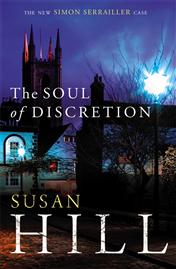
#BookReview ‘The Soul of Discretion’ by @susanhillwriter #crime

Lafferton, England. A naked child wanders down a street. A woman is raped at a black tie Freemansons’ Dinner. This is the beginning of The Soul of Discretion by Susan Hill. Detective Simon Serrailler is coming to terms with his girlfriend moving into his flat which now seems very small and confined, no longer his own private space. His widowed sister is struggling for money and must decide what to do about it. His stepmother is struggling to deal with the detective’s increasingly irritable and irascible father. Serrailler’s girlfriend feels like the lodger in her boyfriend’s flat. And then Serrailler is posted undercover. Susan HillThis is the eighth novel about detective Simon Serrailler and as far as I’m concerned, Susan Hill can continue writing them until kingdom comes. I have read them all over the years, but this is the first I have reviewed [something I will remedy over the coming year]. Serrailler is a thoughtful, solitary-minded detective, surrounded by a family which, in The Soul of Discretion, has its own crises. But the central thread of the book, which kept me reading late into the night, was Serrailler going undercover. In this book, you wonder if he will live or die. I read this book in 24 hours, including a night’s sleep. The subject matter is difficult, the nastiest child abuse, and to go undercover Serrailler must know his subject, be able to act the part of a ‘nonce,’ he must look as if he likes the nasty stuff.
Susan Hill doesn’t show us the unpleasantness, she lets us imagine it by showing us Serrailler’s reaction. He becomes Johnno Miles and we take every step with him as he goes to prison, the aim to get close to a prisoner who it is hoped holds the key to unlocking a prolific child abuse ring. With him is a James Bond-style watch with coded buttons to send messages to HQ, except it is a cheap black plastic watch, not a Rolex. There are a lot of heart-in-mouth passages, Hill’s writing makes you turn page after page. And just when you get to a key bit, the chapter ends and the attention switches – to Cat who is trying to decide whether to work for a hospice or a GP practice, or his stepmother Judith on holiday in France with his father, or Serrailler’s girlfriend Rachel who is opening a bookshop – and you get an emotional breather from the tension. But all the stories are linked, in the end.

Read my reviews of the other novels in the series:-
THE VARIOUS HAUNTS OF MEN #1SIMONSERRAILLER
THE PURE IN HEART #2SIMONSERRAILLER
THE RISK OF DARKNESS #3SIMONSERRAILLER
THE VOWS OF SILENCE #4SIMONSERRAILLER
THE SHADOWS IN THE STREET #5SIMONSERRAILLER
THE BETRAYAL OF TRUST #6SIMONSERRAILLER
A QUESTION OF IDENTITY #7SIMONSERRAILLER
THE COMFORTS OF HOME #9SIMONSERRAILLER
THE BENEFIT OF HINDSIGHT #10SIMONSERRAILLER
A CHANGE OF CIRCUMSTANCE #11SIMONSERRAILLER

And also by Susan Hill, HOWARD’S END IS ON THE LANDING

If you like this, try:-
‘Referendum’ by Campbell Hart #3ARBOGAST
The Silent Twin’ by Caroline Mitchell
Agatha Raisin and the Quiche of Death’ by MC Beaton #1AGATHARAISIN

And if you’d like to tweet a link to THIS post, here’s my suggested tweet:
#BookReview THE SOUL OF DISCRETION by @susanhillwriter via @SandraDanby http://wp.me/p5gEM4-1dD

#BookReview ‘The Sunrise’ by Victoria Hislop @VicHislop #Cyprus #historical

I’m a big fan of Victoria Hislop’s previous three novels, The Thread, The Return, and The Island so was expecting a lot from the new one, The Sunrise. I was a little disappointed and it’s difficult to pin down why. Victoria HislopThe Cyprus setting is great, the historical setting is stirring, the characters… I didn’t connect as well with them as I did with Alexis and Eleni in The Island. Finally, I decided that the difference between The Sunrise and the Hislop’s earlier books is that it wears its history a little too heavily. That said, it is a fascinating period and one I knew little about, except a memory of a distant cousin who lived near Kyrenia at the time. He and his family were forced to flee their house, empty-handed, running across open countryside towards a cave, dodging bullets being fired from an airplane
The Sunrise tells the story of three families in Famagusta from the sunny days of 1972 when tourism brings riches to Cyprus, to 1974 when a Greek coup forces the island into chaos. Greek Cypriots flee in one direction, Turkish Cypriots flee in the other, and the Turkish army invades to protect the Turkish Cypriot minority. The city of Famagusta empties as people run for their lives. Today, 40 years later, the city is still empty. This is the setting for Hislop’s novel.
Two of the families in The Sunrise – the Georgious and the Ozkans – remain behind in Famagusta, hiding, scavenging for food, keeping silent to avoid capture. One is Greek Cypriot, the other Turkish Cypriot. Initially suspicious of everyone, the families are brought together by the two mothers and encouraged to support each other. This is a story of survival on the edge of war, of starvation, ingenuity, bravery and fear. Sons disappear, the city is bombed, soldiers patrol the streets, and a baby is born. The third family – the Papacostas, owners of the sparkling new hotel The Sunrise – flee to their apartment in Nicosia, locking up their stronghold hotel and leaving valuables in its safe, but taking the danger and emotional attachments with them.
Though the book at times drifts towards impersonal reportage and can feel a little like reading a history book or newspaper report, the accuracy of the complicated political and social situation is clearly explained. The island is heft in two and its population uprooted with possessions, without warning. They are attacked, raped, killed, simply for being ‘the other kind’. Finally they settle into North and South, either side of the east-west dividing line.
Victoria Hislop always writes about places she knows well and that knowledge shines off the page in every sound, smell and touch she conjures up. She was not able to go to Famagusta, the city is still closed off, and had to be content with looking through the wire fence. In The Sunrise she has tackled a hugely complex political and emotional subject. For me, the story took off in 1974 once the Georgious and Ozkans were trapped in the city and fighting to survive. I found Savvas and Aphroditi Papacosta less sympathetic, I’m afraid, perhaps because the story starts in 1972 when they develop their luxury hotel, two years before the Cypriot coup takes place. Perhaps that’s just me, impatient for the action to start.

Read my reviews of other these books by Victoria Hislop:-
THE FIGURINE
THE STORY
THOSE WHO ARE LOVED

If you like this, try:-
‘The Ballroom’ by Anna Hope
‘Mrs Sinclair’s Suitcase’ by Louise Walters
The Lightning Tree’ by Emily Woof

And if you’d like to tweet a link to THIS post, here’s my suggested tweet:
#BookReview THE SUNRISE by Victoria Hislop @VicHislop http://wp.me/p5gEM4-1dx via @SandraDanby 

A poem to read in the bath… ‘Not Waving but Drowning’

I remember the title of today’s poem from my schooldays but have no strong memory of reading the poem until many years later. But it always made me smile, then feel guilty for smiling.

[photo: poetryfoundation.org]

[photo: poetryfoundation.org]

Because of copyright restrictions I am unable to reproduce the poem in full, but please search it out in an anthology or at your local library.

‘Not Waving but Drowning’
Nobody heard him, the dead man,
But still he lay moaning:
I was much further out than you thought
And not waving but drowning.

Stevie Smith [1902-1971] was born in Hull, East Yorkshire, and knowing that made a big impression on me: born in East Yorkshire, 1960. The fact that her family moved to London when she was three didn’t stop me seeing her as a Yorkshire role model. Her poetry never seemed to fit a label and she seems to have been rather overlooked. I love her rather dry wit. My copy of Selected Poems was bought in October 1981, I know this as I have written my name and the date on the inside front cover. The green cover design [below] is still a favourite of mine. Selected poems by stevie smith 19-6-14aTo watch a 1950s seaside film as Stevie Smith recites ‘Not Waving But Drowning’, click here.
To read Stevie Smith’s biography at The Poetry Foundation, click here.
Selected poems by stevie smith - new cover 19-6-14


‘Selected Poems’ by Stevie Smith [Penguin Classics]