Monthly Archives: October 2022

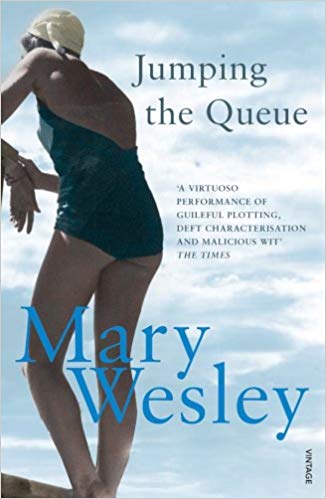
#BookReview ‘Jumping the Queue’ by Mary Wesley #contemporary

Jumping the Queue is a must-read for fans of Mary Wesley’s writing. It is a slim volume about a deadly serious topic. Widow Matilda Poliport prepares to commit suicide. She cleans the house, organises her papers, destroys anything incriminating and gives away her pets. On the day she judges the tide to be favourable, she makes a picnic and takes a bottle of wine to the beach. She plans to wade into the sea and drown. What happens changes the course of Matilda’s death, and life. Mary Wesley This is a quirky mixture of a book with heavy topics which, as you get older, become more familiar and understandable, with dark humour and a touch of forbidden romance. There is also betrayal, all kinds of betrayal actually – between husband and wife, between parents and children, between friends. As Matilda contemplates suicide, she thinks, ‘I am the great betrayer… That is my sin. I am not a sticker. I betray from laziness, fear and lack of interest.’
The story is told from Matilda’s point of view, at times despairing, at times wickedly funny and lusty. It’s hard to believe Jumping the Queue was Mary Wesley’s first adult novel, published in 1983 when she was seventy; its topics are as pertinent today, as then.
Matilda and her husband Tom made a pact, to end it all when they were old and no longer enjoying life. But when Tom dies suddenly in Paris, Matilda is left alone in an isolated West Country house, rarely visited by her four children. The villagers pretty much leave her alone except for her neighbour Mr Jones, who carries a not-so-secret torch for Matilda. But not everything is as it seems. What was Tom really doing in Paris, why don’t the children visit, and does Mr Jones really see UFOs?
When Matilda’s plan at the beach is interrupted by a group of holidaymakers, she retreats to the town to wait. There she meets The Matricide, a man on-the-run, wanted for killing his mother and whose face is in all the newspapers. Matilda is anything but conventional and she doesn’t fear for her safety. The Matricide, whose name is Hugh Warner, checks she understands who he is and that he killed his mother. ‘Of course’, says Matilda. ‘Lots of people long to. You just did it.’
At first glance, this could be a depressing novel about getting older and longing to be out of it. But in fact it is a tale of loyalty, love and trust; just in unexpected places. Thought provoking, sad and uplifting, all at the same

Here’s my review of THE CAMOMILE LAWN, also by Wesley, or read its #FirstPara.

If you like this, try:-
Whistle in the Dark’ by Emma Healey
The Hoarder’ by Jess Kidd
‘The Carer’ by Deborah Moggach

And if you’d like to tweet a link to THIS post, here’s my suggested tweet:
#BookReview JUMPING THE QUEUE by Mary Wesley https://wp.me/p5gEM4-4jF via @SandraDanby

#BookReview ‘Shrines of Gaiety’ by Kate Atkinson #historical

Shrines of Gaiety by Kate Atkinson is a sparkling portrayal of London in the 1920s, a heady mixture of madly-themed nightclubs, teenage runaways and the Bright Young Things. It is 1926 and the generation most damaged by the War to End All Wars is dancing to forget. But 1920s London is not as glittering it seems. Though the nightclubs sparkle by night, they are dank and dowdy in daylight. London has a dark, dangerous underbelly. Kate AtkinsonWhen veteran gangland boss Ma Coker is released from Holloway prison, a train of events is set in place. Her six children jostle for her attention, approval and power. The police at Bow Street station are either in her pay or are trying to convict her. Meanwhile, others are plotting the takeover of her rich kingdom – the five nightclubs the Amethyst, the Sphinx, the Crystal Cup, the Pixie and the Foxhole. Each is carefully targetted at specific clientele, each is managed by one of her five eldest children. The Amethyst is the jewel in the crown but Nellie, post-prison, is acting oddly and has taken to sitting alone in the immaculate, unoccupied, pink-decorated flat above the Cup. Is she losing it?
Two young women arrive in the closed world of the Coker family and will change things forever. Fourteen-year-old Freda Murgatroyd has run away from York with her bovine friend Florence, desperate to dance on the stage in London. Gwendolen Kelling, a former librarian and also from York, follows them to London with the aim of returning them to their families. Though Gwendolen’s tweed skirt and plain cardigan may suggest timidity, she is not what she seems.
What a wonderful read this is, this hybrid part-historical, part-literary, part-mystery novel. Atkinson juggles a huge cast and given this it takes a while to settle into the story, but as the pages turn the parties become more hysterical and people begin to die. There are three main viewpoints – Nellie Coker, Gwendolen and Freda – supplemented by Inspector John Frobisher and Nellie’s three eldest children Edith, Niven and Ramsay. But always Atkinson reminds us of the dark side. The Bright Young Things dazzle at the beginning of the evening in beautiful extravagant costumes, but their syringes and drugs become visible at twilight. Meanwhile, Nellie seems to be losing her iron grip on the clubs. When Gwendolen is recruited by Frobisher to visit the Amethyst undercover one night, with a policeman as her dance partner, things spin out of control. There is no sign of Flora or Florence, Gwendolen’s dance partner disappears, a fight breaks out and her beautiful dress from Liberty is covered in blood. The identity of her saviour is unexpected.
The story has been described as Dickensian and I can see why. Atkinson never wastes a sentence and, with a sure hand, she directs this complicated plot full of richly-drawn characters, criminal gangs, two-faced policemen and blotto partygoers. The historical detail stretches from the richest to the poorest, plus there’s a touch of romance and plenty of wry and witty anecdotes to make you chuckle. Some of the minor characters are classics to delight in, particularly Vanda and Duncan aka The Knits.
Excellent.

Click the title to read my reviews of these other books by Kate Atkinson:-
A GOD IN RUINS
BIG SKY #5JACKSONBRODIE
DEATH AT THE SIGN OF THE ROOK #6JACKSONBRODIE
LIFE AFTER LIFE
NORMAL RULES DON’T APPLY
TRANSCRIPTION
… and try the #FirstPara of EMOTIONALLY WEIRD

If you like this, try:-
‘Fatal Inheritance’ by Rachel Rhys
Freya’ by Anthony Quinn
The Light Years’ by Elizabeth Jane Howard #1CazaletChronicles

And if you’d like to tweet a link to THIS post, here’s my suggested tweet:
#BookReview SHRINES OF GAIETY by Kate Atkinson https://wp.me/p5gEM4-5PO via @SandraDanby

#BookReview ‘One Moonlit Night’ by Rachel Hore @Rachelhore #WW2

Life can turn on a sixpence and that’s what happens to Maddie and her two small daughters in the Blitz. One Moonlit Night by Rachel Hore doesn’t start with a glimpse of the main character’s ordinary life before the change happens. It starts with a shock… a family made homeless by a bomb. Rachel HoreAlone in the midst of chaos, her husband Philip has been missing for ten months since the British army’s retreat from Dunkirk, Maddie takes Sarah and Alice to Knyghton in Norfolk to stay with Philip’s elderly Aunt Gussie. Maddie is caught in limbo, unable to grieve for Philip, unable to make decisions, not accepting his probable death, while living in an isolated country house – where Philip spent his childhood – which is the focus of long-held rumour and superstition in the nearby village.
Trying to make a living as a book illustrator, Maddie is seldom without a pencil and paper. But when she draws the face of an unfamiliar young girl, enigmatic, mysterious, she doesn’t know where her inspiration came from. Instinctively she keeps her drawing secret, not wanting to upset the fragile atmosphere at Knyghton. A secret is being kept, by Aunt Gussie, Philip’s cousin Lyle who runs the Knyghton farm, by family retainers, the Fleggs, and Maddie is sure it surrounds this mysterious young woman.
Bookended by a Prologue and Epilogue both set in 1977, Hore tells the stories of Maddie and Philip during World War Two with a flashback to their meeting in 1934. Many of the book’s themes are established in this pre-war section. Wild animals, painted by Maddie, but shot by Philip; children raised while parents are absent; the sharing of some secrets and the keeping of others. It is a complex, emotional story as Maddie, who flees to Knyghton seeking sanctuary instead finds unexplained silences, whispers and rumours she fears are aimed at Philip. Meanwhile Philip, having survived a massacre of British troops by the German army, attempts to find a way home. Philip’s sections are tense, forlorn and at times hopeless, a vivid portrayal of soldiers fleeing through Occupied and Vichy France.
This is a slow-burning story which rewards the reader’s perseverance as tension in the final third picks up and Maddie finally finds some answers. It’s a book which rewards further reading as layers of information, missed on first reading, become significant.

Click the title to read my reviews of two other books by Rachel Hore:-
A BEAUTIFUL SPY
A WEEK IN PARIS
THE HIDDEN YEARS
THE LOVE CHILD

If you like this, try:-
‘The Book of Lies’ by Mary Horlock
The Tuscan Secret’ by Angela Petch
The Skylark’s Secret’ by Fiona Valpy

And if you’d like to tweet a link to THIS post, here’s my suggested tweet:
#BookReview ONE MOONLIT NIGHT by Rachel Hore @Rachelhore https://wp.me/p5gEM4-5PJ via @SandraDanby

#BookReview ‘Wildwood’ by Roger Deakin #trees #nature

Wildwood: A Journey Through Trees is the first nature book by Roger Deakin I’ve read, now I want to read more. I’ve always loved trees, in nature, in art, the timber, wooden objects. As we know, it is beneficial to lose ourselves outside in nature, breathing in the fresh air, absorbing the quiet, acknowledging the trees and flowers, and so I found the experience of reading this book. It will make you want to camp outside in the woods. Roger DeakinThe first half of this book is a journey through the woods of Suffolk around Deakin’s home, talking to woodlanders and slipping in literature, poetry, woodworking and science. The second half is travel writing… about trees. Deakin travels to Kazakhstan in search of wild apple groves, the founding trees on which all our domesticated apples are based. In complete contrast are the chapters about Australia. Deakin lives and travels with local people in both places, enthusiasts and specialists in their subject, and this comes through in his writing. Both parts of this book are fascinating, just different. In the UK he talks to artists, woodcarvers, naturalists and thatchers in East Anglia, the New Forest, Wye and the Forest of Dean. His memories of schoolboy camping trips to the New Forest analysing and chronicling a small part of woodland show how young minds can find a fascination that lasts a lifetime.
At times quite dense with detail, I read this in short bursts rather than in one long reading session. Deakin inhabits his book with real people, he describes what they look like and how they speak, their cabins [often rough shacks in woodland], their tools, the timber they grow, manage and work with. Many are scientists others are artists. It is a homogeneous read in that everyone featured loves trees.
A delightful read. I was particularly pleased to read about artist David Nash, whose work I saw at Yorkshire Sculpture Park and instantly fell in love with.

If you like this, try:-
Underland’ by Robert Macfarlane
Woods etc’ by Alice Oswald
Fiends Fell’ by Tom Pickard

And if you’d like to tweet a link to THIS post, here’s my suggested tweet:
#BookReview WILDWOOD by Roger Deakin #trees #nature https://wp.me/p5gEM4-40D via @SandraDanby