Author Archives: sandradan1

Unknown's avatar

About sandradan1

Novelist. I blog about writing, reading and everything to do with books and writing them at http://www.sandradanby.com/. Come and visit me!

#BookReview ‘A Deadly Discovery’ by @JCKenney1 #cosycrime #crime

Needing a change one day, as I sometimes crave a calming walk in the green countryside, I picked up cosy mystery A Deadly Discovery by JC Kenney. Knowing the book was fourth in a series, I didn’t know what to expect. JC KenneyLiterary agent Allie Cobb lives in Rushing Creek, Indiana where her life revolves around her clients, their manuscripts, taking her cat Ursi for a walk, family and friends. Having previously investigated local murders, and being injured in the process, before this book starts Allie had promised her nearest and dearest that she would drop her private investigating. But when a body turns up in the local woods, everyone wonders if it could be a girl who disappeared twenty ago. As Allie asks questions around town, tensions with the police department arise with suspicions of clues missed at the time of the original disappearance.
This is a different style of whodunnit in that the story is firmly anchored and clues processed in the head of detective Allie. This is a tell-don’t-show style that sinks us into Allie’s daily life and concerns, the reader must unravel the clues from the seemingly ordinary. Of course this is a mystery story so clues, and red herrings, can be anywhere.
Diving into a series mid-way has its benefits and issues. I’m sure I missed lots of references to characters and past stories that would help my reading of Allie’s detecting and understanding of Rushing Creek. From page one a lot of names and relationships are introduced, featured in the previous novels, that I struggled to remember. A character cast at the beginning would help.
Kenney has created a believable small-town world at Rushing Creek where lives, secrets, resentments and loves have been entwined since birth. It reminded me of Charlotte Hinger’s Lottie Albright genealogical mystery series, set in another American small town. When everyone knows everyone else, secrets are not simply embarrassing or shameful. They can be deadly.
An easy, gentle read without a confusing tangle of multiple suspects. I guessed the murderer well before Allie’s big reveal scene, which owed much to the trend of Poirot. I finished it feeling curiously unattached from the people involved, perhaps because Allie dominates the story so thoroughly.
CLICK HERE TO READ MORE ABOUT THIS BOOK AT AMAZON

If you like this, try:-
Deadly Descent’ by Charlotte Hinger
‘Agatha Raisin and the Quiche of Death’ by MC Beaton
Murder at Catmmando Mountain’ by Anna Celeste Burke

And if you’d like to tweet a link to THIS post, here’s my suggested tweet:
#BookReview A DEADLY DISCOVERY by @JCKenney1 https://wp.me/p5gEM4-5lg via @SandraDanby
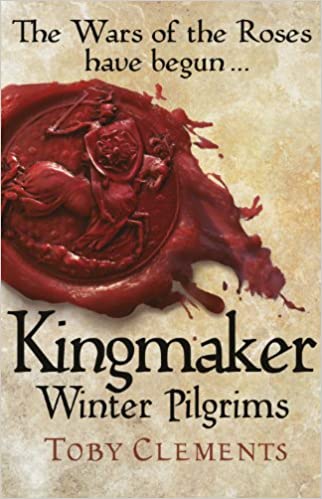
#BookReview ‘Winter Pilgrims’ by Toby Clements #historical #WarsoftheRoses

This is the first of a four-book series about the Wars of the Roses. Toby Clements is a new author for me, I admit to picking up the paperback by mistake in a bookshop when browsing and am happy to find an unknown historical author to explore. Winter Pilgrims is the first of the four novels, telling the well-documented story of the Lancaster versus York wars through the eyes of two fictional people on the edge of the action. Toby ClementsIn February 1460, at a priory in Lincoln, two people flee from marauding soldiers. Despite living yards apart in the same priory Brother Thomas and Sister Katherine have never met until this morning, their previously segregated lives are to be entwined as they escape danger only to encounter new threats. And some old ones.
At first I worried that the plot was moving slowly and felt occasionally drowned by detail, but I stuck with it and was rewarded. By the end – and it’s a long book, the paperback is 560 pages – I wanted to starting reading the second novel straight away. Clements excels at historical detail, particularly soldiers and fight scenes, living conditions and basic human detail. Both characters are conflicted by their religious backgrounds, the things they must do to survive frequently challenge their faith. Life in the real world is brutal, dirty, dangerous and poor. Neither have the personalities of victims. Thomas trains as an archer, Katherine – adopting the male persona as Kit – proves to be an adept surgeon.
Making snap decisions takes them to unknown places with sometimes reliable, sometimes untrustworthy people. Along the way they become involved in some of the key battles of the year as their story is set within the broader framework of civil war. Over the years I have read a lot about the Wars of the Roses due to an early fascination via Shakespeare, but still find it disorientating and so was disappointed with the map and superficial character list. But the story of Thomas and Katherine kept me turning the pages late at night, just one more chapter.
A good book to lose yourself in.

Read my review of the next in this series:-
BROKEN FAITH #2KINGMAKER

If you like this, try:-
The Evening and the Morning’ by Ken Follett
The Lady of the Rivers’ by Philippa Gregory
The Burning Chambers’ by Kate Mosse

And if you’d like to tweet a link to THIS post, here’s my suggested tweet:
#BookReview WINTER PILGRIMS by Toby Clements https://wp.me/p5gEM4-5iY via @SandraDanby

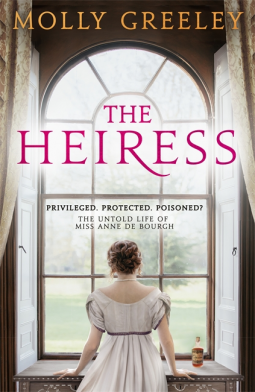
#BookReview ‘The Heiress’ by @MollyJGreeley #historical #romance

An intriguing premise for this second novel by Molly Greeley which re-imagines the story of a minor character in Jane Austen’s Pride and Prejudice. In The Clergyman’s Wife it was Charlotte Collins, in The Heiress it’s the turn of Anne de Bourgh. Molly GreeleyWell-written in a slightly modernised style of Austen, it is easy to slip into the head of Lady Catherine de Bourgh’s sickly daughter who at first sight seems an unpromising protagonist. But keep reading. Greeley starts with the birth of a daughter to a young married couple. In order for this book to work you have to both forget Austen’s portrayal of Anne, to sink yourself into the life of this delicate child, but also to remember the original. That is the path to enjoying the asides, thoughts and occasionally darting but puzzling urges that Anne experiences growing up. Scenes I looked forward to, critical in Pride and Prejudice, were skirted over here in favour of new material. Familiar characters occur, some more importantly than others – Darcy, Colonel Fitzwilliam, Mr Collins – but this is 100% Anne’s story.
Sickly from birth, Anne is dosed twice daily with laudanum drops. She is protected from exertion, emotions and unspecified dangers of the outside. Playing the piano is too strenuous, novels and poetry too emotional. Then when she is twelve after an unsuccessful treatment of sea bathing, Anne’s life change when a governess arrives. This is not yet the nodding Mrs Jenkinson from Austen but Miss Hall, a young woman determined to teach her unschooled young pupil what she needs to know to be the future mistress of Pemberley and Rosings.
This is a story of laudanum addiction, the tentacles of the drug’s control preventing any small rebellion by Anne, any protestation that she feels healthy before her curative drops are administered and only weak afterwards. Cocooned from emotion, her true personality smothered, Anne lives at a distance from those closest to her. An article in a newspaper is to be the catalyst for change. But change of any kind takes immense courage, needing a confrontation with her controlling mother. Greeley gives Lady Catherine a moment of redemption though as we, and Anne, catch a glint of history that explains the elderly woman portrayed by Austen and challenged so gleefully by Lizzie Bennet.
For Anne to fulfill Miss Hall’s objective of being a fit mistress of the estate of Rosings, she must do more than break free of drugs. She must discover the truth of who she is.
A fascinating exploration of one woman’s search for freedom in a time of female subjugation to men, when females were labelled as delicate with little diagnosis or review, when many women were unable to live alone or manage their own inheritance. At times surprising, the detail of The Heiress is Austen-like but the emotions are of the twenty-first century.

Click here to read my review of THE CLERGYMAN’S WIFE, also by Molly Greeley.

If you like this, try:-
Cecily’ by Annie Garthwaite
The Cottingley Secret’ by Hazel Gaynor
The Almanack’ by Martine Bailey

And if you’d like to tweet a link to THIS post, here’s my suggested tweet:
#BookReview THE HEIRESS by @MollyJGreeley https://wp.me/p5gEM4-5l4 via @SandraDanby

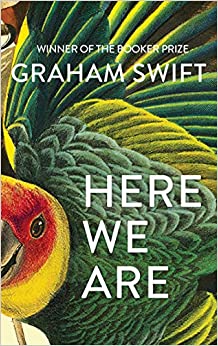
#BookReview ‘Here We Are’ by Graham Swift #theatre #Brighton

What a delightful slim story is Here We Are by Graham Swift. On the surface it’s a simple tale of a summer season at the theatre at the end of Brighton Pier in 1959. It’s a tale about a magician and his assistant. It’s also a tale about perception and delusion, truth and lies, what is real and an illusion. Graham Swift When young magician Ronnie Deane gets a job for a seaside summer season, he advertises for an assistant. Evie White has experience in the chorus line but has never worked for a magician before. They are both on a steep learning curve. Their guide in Brighton is Ronnie’s friend Jack Robbins, compere, listed on the bill as Jack Robinson. ‘Some patter, some gags, some of them smutty, a bit of singing, some dancing, some tapping of his heels.’ As Ronnie and Evie, listed as ‘Pablo & Eve’, perfect their act, work their way up the bill, they go out as a foursome in the evenings with Jack and his latest girl. They change so frequently Evie can’t keep track of their names, instead thinking of them simply as ‘the Floras’.
This is principally Ronnie’s story, how at the age of eight he left his mother and was evacuated to safety in Oxford. There he found a new home, new parents and a magician to share all the secrets and tricks of the trade. By the end of the war, when Ronnie returns home to London and to his mother, he is a man who knows what job he wants to do.
Like all Swift’s stories, this can be read on many levels. At its simplest it is about a love triangle.
Only 208 pages, it is a short novel. The language is beautiful with not an unnecessary word. Not much may happen, but as the events of 1959 unfold Swift tells us the story of Ronnie’s childhood and how it impacts on the man he has become. The lies told to prevent hurt, the lies told for self-protection, lies told for unknown reasons, and some lies which may actually be the truth. As unknowable as Ronnie’s Famous Rainbow Trick. Unpretentious, at its heart lies a mystery that is in itself mysterious.
CLICK HERE TO READ MORE ABOUT THIS BOOK AT AMAZON

Here’s my review of Swift’s MOTHERING SUNDAY.

If you like this, try:-
A View of the Harbour’ by Elizabeth Taylor
The Gustav Sonata’ by Rose Tremain
Redhead by the Side of the Road’ by Anne Tyler

And if you’d like to tweet a link to THIS post, here’s my suggested tweet:
#BookReview HERE WE ARE by Graham Swift https://wp.me/p5gEM4-5iB via @SandraDanby

First Edition ‘The Age of Innocence’ by Edith Wharton #oldbooks #bookcovers

Published in 1920, The Age of Innocence was Edith Wharton’s twelfth novel and the one which would win her the Pulitzer Prize in 1921; the first woman to do so. This [below left] is the American first edition, published by D Appleton.

It is said the first choice of the Pulitzer judges was Main Street by Sinclair Lewis, which was rejected on ‘political grounds’. Wharton’s story first appeared in 1920 in the magazine Pictorial Review, serialised in four parts, then published in book form in the USA by D Appleton.

Edith Wharton

The Age of Innocence – character study by Joshua Reynolds

It is believed the title of the novel was taken from the painting by Joshua Reynolds [above] which was much reproduced in the late 18th century and came to represent the commercial face of childhood.

Edith Wharton

Wordsworth Classics current ed 1994

The current edition by Wordsworth Classics [above] dates from 1994.
BUY THE BOOK

The story
Set in 1870s upper class New York society, The Age of Innocence was set around the time of Wharton’s own birth. She wrote the book had allowed her to find “a momentary escape in going back to my childish memories of a long-vanished America… it was growing more and more evident that the world I had grown up in and been formed by had been destroyed in 1914.”
Gentleman lawyer Newland Archer is due to marry the shy and beautiful May Welland until he encounters May’s cousin. The exotic Countess Ellen Olenska pays no court to society’s fastidious rules and, scandalously, is separated from her husband, a Polish count. To avoid scandal, Ellen is advised to live separately from her husband rather than pursue divorce. Newland tries to forget Ella and marries May but their marriage is loveless. Newland and Ellen meet again and as Newland falls in love with Ellen his behaviour breaks the rules of accepted behaviour. When he finally decides to follow Ellen to Europe, May announces she is pregnant.

Other editions

Films

Edith Wharton

film poster 1993

The 1993 film [above] starring Daniel Day-Lewis as Newland Archer, Michelle Pfeiffer as the Countess Olenska and Winona Ryder as May Welland, was directed by Martin Scorsese. Watch the trailer.
BUY THE DVD

Edith Wharton

film poster 1934

A 1934 film [above] with the same title took inspiration from the Wharton novel but set the action two generations later. Dallas Archer has fallen in love with a married woman, to the displeasure of all his family except his grandfather Newland Archer. And in 1924, a black and white film of The Age of Innocence [below] starred Elliott Dexter as Newland.

Edith Wharton

film poster 1924

If you like old books, check out these:-
It’ by Stephen King 
Ulysses’ by James Joyce
Five on a Treasure Island’ by Enid Blyton

And if you’d like to tweet a link to THIS post, here’s my suggested tweet:
First Edition THE AGE OF INNOCENCE by Edith Wharton #oldbooks #bookcovers https://wp.me/p5gEM4-4aX via @SandraDanby

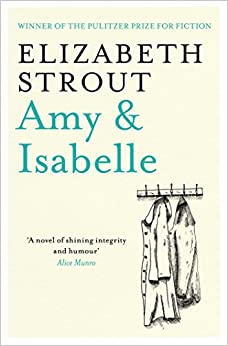
#BookReview ‘Amy & Isabelle’ by Elizabeth Strout @LizStrout #contemporary

The mother and daughter portrayed in Amy & Isabelle by Elizabeth Strout are at odds with each other. The events of one long sweltering summer in Shirley Falls are simple, familiar across the ages, but are told with a hefty emotional punch. So strong is this book it’s difficult to see that it was Strout’s first novel, published in 2000 to be followed only eight years later by her Pulitzer Prize-winning Olive Kitteridge. Strout is adept at peeling away the layers of character and events to show the raw emotion, shame, guilt and pain beneath. Elizabeth StroutWhen Isabelle Goodrow arrived in Shirley Falls with her baby daughter, she took a job at the local mill. Now, in a time that feels like 1970s America, Amy is sixteen and has a summer job in the same office as her mother. They sit and fume at each other, barely talking, brushing past each other without a word. Amy, who has fallen in love with her maths teacher, believes her upright, unemotional mother, has no idea of what she is feeling right now. Isabelle despairs of her daughter’s behaviour. Told in absorbing detail, switching between the two viewpoints, the trauma of the two women is revealed. Shirley Falls is an evocative setting, an industrial town with a river flowing through it. As the temperature rises, the river begins to stink adding to the stresses not just on the Goodrows but on the small community in which they exist. Strout excels at portraying the circle of characters which make the world of a novel so believable – Amy’s friend Stacy, Fat Bev and Dottie Brown at the mill, Isabelle’s boss Avery Clark.
Isabelle finds it difficult to fit in, has always felt like an outsider. As she judges others, she assumes others judge her. This is more about her own experience and inadequacies than about anyone else. As the summer days plod on and Amy’s affair unravels, we see hints of the truth of Isabelle’s past that go some of the way to explaining why she is as she is.
Difficult to put down, I enjoyed Amy & Isabelle very much. Both women are so real, their situations are real, you want to slap them both and hug them both. Strout writes in an extraordinarily perceptive manner about ordinary people in ordinary places, so real you feel you are in the room too.

Read my reviews of these other books by Elizabeth Strout:-
ANYTHING IS POSSIBLE
LUCY BY THE SEA
MY NAME IS LUCY BARTON
OH WILLIAM!
OLIVE KITTERIDGE
OLIVE, AGAIN
TELL ME EVERYTHING

If you like this, try:-
‘If I Knew You Were Going to be This Beautiful, I Never Would Have Let You Go’ by Judy Chicurel
The Museum of You’ by Carys Bray
When All is Said’ by Anne Griffin

And if you’d like to tweet a link to THIS post, here’s my suggested tweet:
#BookReview AMY & ISABELLE by Elizabeth Strout @LizStrout https://wp.me/p5gEM4-5id via @SandraDanby

#BookReview ‘A Room Made of Leaves’ by Kate Grenville #historical

When she is 21, a moment’s dalliance in a bush forces orphan Elizabeth to marry soldier John Macarthur. The story of their marriage in 1788, journey to the colony of Australia on board a convict ship and life in the new settlement called Sydney Town, is told in A Room Made of Leaves by Kate Grenville. Kate GrenvilleElizabeth was a real woman but little is known of her, though her husband features in Australia’s history books as the British army officer who became a politician, legislator and pioneer of the Australian wool industry. Grenville is free to imagine what life must have been like as a white settler, and a woman, in a rough, uncultured town where the native people are viewed as animals.
Very quickly Elizabeth finds her new husband is a bully and her new home is a brutal, unforgiving, judgmental place. She spends much time alone with her sickly son and survives by disguising how clever she is, particularly from her husband. More children quickly follow and she bonds more with the convicts who work for her as servants, than she does with the wives of her husband’s friends. An outlier, she decides to improve her learning and seeks lessons on astronomy from an officer in her husband’s corps. What follows changes her understanding of her new country and her place in it.
The pacing seems at times off kilter, a trifle slow in places and rushed at the end, but the writing is as beautiful as I remember from Grenville’s earlier books. Of the book’s two halves, I wanted less of the first half and more of the second about Elizabeth’s role in developing breeds of sheep suited to the wool trade.
Essentially this is a delicately-written story of a young woman who, after making one mistake, is trapped in a loveless marriage far away from her Devon home. She learns how to manage her husband without him realising he is being managed, she tempers his outbursts and steers him out of trouble. Perhaps this fictional account of Elizabeth’s life will mean more to Australians who have grown-up with the historical story of the real John Macarthur.
A good read but not my favourite Grenville book.

Read my review of another Kate Grenville book, RESTLESS DOLLY MAUNDER.

If you like this, try:-
Dangerous Women’ by Hope Adams
The Pearl Sister’ by Lucinda Riley
Rush Oh!’ by Shirley Barrett

And if you’d like to tweet a link to THIS post, here’s my suggested tweet:
#BookReview A ROOM MADE OF LEAVES by Kate Grenville https://wp.me/p5gEM4-5jI via @SandraDanby

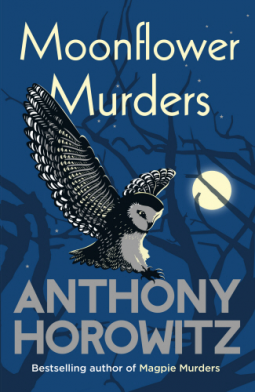
#BookReview ‘Moonflower Murders’ by Anthony Horowitz @AnthonyHorowitz #crime

Moonflower Murders by Anthony Horowitz is a sandwiching together of two mysteries – one murder, one disappearance – that take place eight years apart in the same place. Second in Horowitz’s crime series featuring literary agent Susan Ryeland and Atticus Pünd, the fictional hero of her client Alan Conway’s 1950s detective books – are you keeping up? – this is at the same time a page-turning read and a mystifying Rubik’s Cube challenge. Definitely a book that will reward re-reading. Anthony HorowitzSusan’s, now deceased, author Conway loved word play and riddled his short novels with in-jokes, complicated clues and witticisms. Many of these only make sense at the very end of Horowitz’s book. Susan, now living in Crete with boyfriend Andreas, running the just-surviving Hotel Polydorus, is asked by the owners of Branlow Hall hotel in Suffolk to investigate the disappearance of their daughter Cecily. Eight years earlier, one of the hotel’s staff was convicted of murdering a guest, Frank Parris. Shortly after the trial, Conway visited the hotel after which he wrote, Atticus Pünd Takes the Case. The book was edited by Susan who knew nothing about the links to the real-life crime.
Cecily, who manages Branlow Hall with her sister, reads Conway’s novel and is certain the wrong man was convicted of the crime. And then she disappears. How did Conway use the real crime in his fictional Atticus Pünd mystery to reveal the true murderer? What did Cecily see in the book that convinced her of the convict’s innocence? How can Susan unravel the clues and fit together two completely separate stories? And what has happened to Cecily?
The story is littered with clues, everyone has something to hide and it seems everyone is lying. Alongside the detecting we have the continuing story of Susan’s life – did she do the right thing in moving from London to Crete, should she marry Andreas or leave him, can she really be happy running a hotel and not editing books? And like the first in the series, Magpie Murders, there is also a book-within-a-book; we also get to read Atticus Pünd Takes the Case.
Layer upon layer, at times there are so many twists and turns it seems tortuous. Yes, there are coincidences and convenient secrets but if you enjoy Miss Marple and Hercule Poirot you will enjoy spotting the Christie links. If you go-with-the-flow and don’t get caught up on keeping track of the details, this is a fun read.

Read my review of MAGPIE MURDERS, first in the Susan Ryeland crime series.

If you like this, try:-
The Mystery of Three Quarters’ by Sophie Hannah #3POIROT
A Gift of Poison’ by Bella Ellis #4BRONTEMYSTERIES
Lord John and the Private Matter’ by Diana Gabaldon

And if you’d like to tweet a link to THIS post, here’s my suggested tweet:
#BookReview MOONFLOWER MURDERS by Anthony Horowitz @AnthonyHorowitz https://wp.me/p5gEM4-5j9  via @SandraDanby

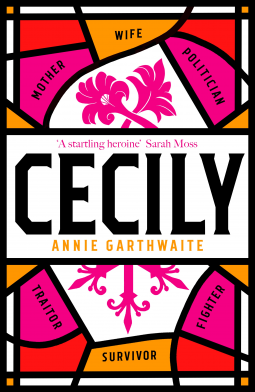
#BookReview ‘Cecily’ by @anniegarthwaite #historical

Cecily by Annie Garthwaite was a gradual falling-in-love process for me as I became so immersed in the story and fell in fascination with the character of Cecily Neville. What a wonderful fictionalised account of the Duchess of York it is. Mother of two kings, equal partner to her husband Richard, mother, politician, diplomat, kingmaker. Annie GarthwaiteI started knowing nothing more of her than that she was mother to both Edward IV and Richard III. Garthwaite paces herself in the telling of Cecily’s story and there were times when the [necessary] exposition of England’s 15th century politics and the seemingly endless battles and arguments of the Wars of the Roses, seemed to pause the narrative. But as the pages turn, the tension builds as you wonder how the family will survive. The politics and family connections of the time were intricately linked and can be confusing, so the exposition is a necessary part of the novel.
Cecily is a gift of a character who was somehow overlooked in the history books, as Garthwaite explains in her afterword, ‘Writing Cecily’. “Cecily lived through eighty years of tumultuous history, never far from the beating heart of power. She mothered kings, created a dynasty, brought her family through civil war…. Last woman standing.”
This does not feel like a debut novel. Cecily comes alive off the page and it’s clear that Garthwaite lived and breathed in Cecily’s shoes. She creates a modern woman, a strong woman in a man’s world which, given Cecily’s history, she must have been to survive. This is an epic story starting in 1431 as the teenage Cecily watches as Joan of Arc burns at the stake, ending with the coronation of her eldest son as King Edward IV. On the way, family alliances are sundered, friends become traitors, battles are won and lost and Cecily gives birth to thirteen children. Through it all, she believes her husband has a stronger claim to the throne than the current king, Henry VI. The tension between husband and wife ebbs and flows throughout the years as Cecily encourages and pushes Richard to claim his rightful place.
There are so many twists, betrayals, secrets and threats that I found myself just reading one more page, one more chapter, even as my eyes closed late at night. I did not want this book to end.
And what a stunning cover!

Here’s my review of THE KING’S MOTHER, also by Annie Garthwaite

If you like this, try:-
Orphans of the Carnival’ by Carol Birch
Dangerous Women’ by Hope Adams
Rush Oh!’ by Shirley Barrett

And if you’d like to tweet a link to THIS post, here’s my suggested tweet:
#BookReview CECILY by @anniegarthwaite https://wp.me/p5gEM4-5it via @SandraDanby

A poem to read in the bath… ‘Invisible Man’ by @MargaretAtwood #poetry

At Christmas I was given Dearly, the slim hardback book of Margaret Atwood’s poems. I’ve never thought of her as a poet but Dearly is a revelation. As with her novels, Atwood crystalises those intense emotional moments of life, the ones that stay with us, and sets them into everyday context. This is a wonderful collection about growing old, rememberings, endings and beginnings, passing by and moving on. Dedicated to her partner it is a personal collection, and very touching.

Margaret Atwood

[photo: Sueddeutsche Zeitung Photo – Alamy Stock Photo]

The poem I have chosen is ‘Invisible Man’. A short poem of five verses, full of how it feels to lose your lifelong partner. The absence at the table, on a walk, like an invisible man in comic books, still there but seen only by the one left behind, remembering

This poem is subject to copyright restrictions so here’s the first verse as a taster. Please search for the full poem in an anthology or at your local library.

‘Invisible Man’
It was a problem in comic books:
drawing an invisible man.
They’d solve it with a dotted line
that no one but us could see’

Margaret AtwoodBUY THE BOOK

Read these other excerpts and find a new poet to love:-
Tulips’ by Wendy Cope
Serious’ by James Fenton
Sounds of the Day’ by Norman MacCaig

And if you’d like to tweet a link to THIS post, here’s my suggested tweet:
A #poem to read in the bath: ‘Invisible Man’ by @MargaretAtwood https://wp.me/p5gEM4-590 via @SandraDanby