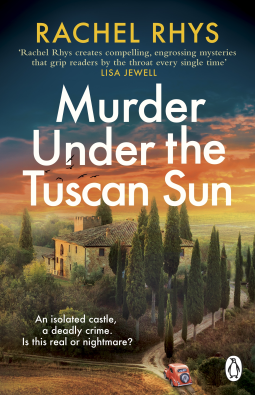
#BookReview ‘Murder Under the Tuscan Sun’ by Rachel Rhys #mystery #suspense

Against her son’s wishes, widow Constance Bowen travels to Tuscany to take a job as companion to an ill English gentleman in the Castello di Roccia Nera just outside Florence. Murder Under the Tuscan Sun by Rachel Rhys is set in an exquisitely beautiful place and the change of scenery is exactly what Constance believes she needs. It is very different from Pinner. Rachel RhysCarrying with her a double grief – for her husband, dead a year, and daughter Millie, five years earlier – Constance is wracked with nerves and doubt. Her patient, stroke-sufferer William North, proves irascible and sparing in his conversation. Constance has been employed by William’s niece, Evelyn Manetti. A flighty beautiful creature devoted to her Italian-American husband Roberto, Evelyn seems less enchanted with Nora, her daughter with her first husband.
The setting is voluptuous and it’s easy to fall for the delights of this Tuscan summer, as Constance quickly does. But all is not happy in this beautiful place and there are occasional unkindnesses and cruelty that make it uncomfortable. It is 1927 and fascism is rising. The castle is said to be haunted by a young girl, a talented violinist, denounced as a witch and bricked up alive in the castle walls.
The community of locals and ex-pats is populated with a collection of likeable and objectionable characters. When spooky things start to happen – mysterious music at night, the vision of a disappearing child dressed in white – which only Constance witnesses, I wanted to shout ‘leave now.’ The story is told in its entirety from Constance’s point of view. Her confusion at what she sees and experiences, and her inability or unwillingness to challenge anyone, becomes repetitive until her son James arrives and asks difficult questions of his mother.
So the title is misleading, this is not a thriller, not a crime novel. More a mystery suspense story in the vein of Mary Stewart or Daphne du Maurier. A strong sense of unease permeates the castle, something is not quite right – is Constance ill, vulnerable, suffering from exhaustion, or is there evil at work.
CLICK HERE TO READ MORE ABOUT THIS BOOK

And here’s my review of FATAL INHERITANCE, also by Rachel Rhys

If you like this, try:-
The Vanishing of Audrey Wilde’ by Eve Chase
The Paris Apartment’ by Lucy Foley
The Snakes’ by Sadie Jones

And if you’d like to tweet a link to THIS post, here’s my suggested tweet:
#BookReview MURDER UNDER THE TUSCAN SUN by Rachel Rhys https://wp.me/p2ZHJe-6Bp via @SandraDanby

COMING SOON… THE NEXT BOOK I REVIEW WILL BE:- Mick Herron

#BookReview ‘Ordinary Thunderstorms’ by William Boyd #contemporary #mystery

Ordinary Thunderstorms by William Boyd is a pacy mystery story in the mould of John Buchan’s The 39 Steps and the Will Smith film Enemy of the State. Innocent man in the wrong place at the wrong time. Cloud scientist Adam Kindred is eating a meal alone in a quiet West London restaurant when his instinct to help a fellow diner sends him on the run, accused of a crime he didn’t commit. William BoydThis is a fast-paced story that takes suspected murderer Kindred from a forgotten triangle of wasteland near Chelsea Bridge to the East End of London. As his name and face become media headlines, he finds a new identity at the Church of John Christ. As ‘John 1603’ he meets fellow dropouts, all with their own reasons for leaving behind a previous identity, all willing to sit through a two-hour sermon for the hearty meal that follows. Adam’s first priority, with his stash of cash running out, is to make money. Second, he sets out to discover the truth of the crime he witnessed and is accused of doing; the murder of Dr Philip Wang, head of research and development at pharmaceutical company Calenture-Deutz.
This is Kindred’s story and 70% of the action is told from his viewpoint. But Boyd adds pace to the story by adding the narrative of Ingram Fryzer, CEO of Calenture-Deutz, river police officer Rita Nashe and ex-soldier JonJo Case. Essentially this is a story of corporate greed and pharmaceutical fraud lightened by dark humour and the touching relationship of Kindred, Mhouse and her son Ly-on.
There are a few sticky coincidences but, forgiving these, this is an entertaining ‘what would I do if it happened to me’ tale. An average thriller elevated by the quality of Boyd’s writing.

Here are my reviews of other books by William Boyd:-
ANY HUMAN HEART
LOVE IS BLIND
NAT TATE: AN AMERICAN ARTIST 1928-1960
SWEET CARESS
THE BLUE AFTERNOON
THE DREAMS OF BETHANY MELLMOTH
TRIO
WAITING FOR SUNRISE

… and try the first paragraph of ARMADILLO.

If you like this, try these:-
‘Reservoir 13’ by Jon McGregor
‘Thornyhold’ by Mary Stewart
‘Brat Farrar’ by Josephine Tey

And if you’d like to tweet a link to THIS post, here’s my suggested tweet:
#BookReview ORDINARY THUNDERSTORMS by William Boydhttps://wp.me/p2ZHJe-6zO via @SandraDanby

COMING SOON… THE NEXT BOOK I REVIEW WILL BE:- Rachel Rhys

#BookReview ‘Gregor the Overlander’ by Suzanne Collins #fantasy #adventure

As a lover of The Hunger Games trilogy by Suzanne Collins, I decided to explore her other books and found this, her first novel. Gregor the Overlander, first in a five-book fantasy series for children but also suitable for young adults and adults, is a New York Times best-selling series. How quickly I raced through it. Suzanne CollinsEleven-year old Gregor lives in a New York apartment with his mother, grandmother and two sisters, Lizzie who is seven and Boots, two. His father disappeared without a trace and Gregor thinks of him every day. He has one rule, not to think of what will happen on the day his father comes home. Which means he never thinks about the future. Then one day, in the laundry room, Boots is chasing a tennis ball while Gregor is doing the washing. Until Boots disappears. Through a metal grate. Gregor follows her and falls down. Down into the Underworld where the first people he meets are cockroaches. Collins has created a fascinating world beneath the city streets. There are some meaty themes and the Underworld character list includes many giant animals and insects that usually provoke a squeamish human reaction. Collins encourages the reader to look beyond appearance to the real person inside. The world-building is fascinating, something that Collins did so well in The Hunger Games.
This is an adventure story so Gregor must go on a quest and face danger. The decisions he takes will affect everyone in this subterranean world. The Underworld is on the brink of war. Collins is not afraid to put favoured characters in danger, and to kill them. Gregor has a destiny, and purpose, of which he is unaware.
Gregor – like Katniss, like Harry Potter – is an unlikely hero, an ordinary kid without special skills. But he loves his sister deeply and this means he speaks up, and steps up, when others hesitate about danger.
Loved it.

Here are my reviews of the next books in the series:-
GREGOR AND THE PROPHECY OF BANE #2UNDERLANDCHRONICLES
GREGOR AND THE CURSE OF THE WARMBLOODS #3UNDERLANDCHRONICLES
GREGOR AND THE MARKS OF SECRET BY SUZANNE COLLINS #4THEUNDERLANDCHRONICLES
GREGOR AND THE CODE OF CLAW #5UNDERLANDCHRONICLES

Read the first paragraph of THE HUNGER GAMES, also by Suzanne Collins.

If you like this, try:-
The Queen of the Tearling’ by Erika Johansen #1TEARLING
La Belle Sauvage’ by Philip Pullman #1THE BOOK OF DUST
Children of Blood and Bone’ by Tomi Adeyemi #1LEGACYOFORISHA

And if you’d like to tweet a link to THIS post, here’s my suggested tweet:
#BookReview GREGOR THE OVERLANDER by Suzanne Collins https://wp.me/p2ZHJe-6A9 via @SandraDanby

COMING SOON… THE NEXT BOOK I REVIEW WILL BE:- William Boyd
#BookReview ‘Nat Tate: An American Artist 1928-1960’ by William Boyd #historical #art

A fictitious biography of a non-existent artist, this is an entertaining novella which I read in one sitting. Nat Tate: an American Artist 1928-1960 by William Boyd‪ has been on my to-read list forever. William Boyd‪What a stir it caused when it was published in 1998. The New York art world soon realised it had been set-up. The first edition appeared with endorsements from Gore Vidal and David Bowie but with hindsight the clues are there. Logan Mountstuart features as a friend of Tate and regular Boyd readers will recognise the protagonist of Boyd’s novel Any Human Heart published in 2002. So, a piece of mischief.
If you’ve read any art biography, or one of those weighty ‘exhibition books’ that accompany major art shows, the tone of this story will be familiar to you. Lots of references to famous artists, the process, the tortured creativity, the successes and setbacks – shown here by Tate’s reverence for American poet Hart Crane – the mentors, financial backers and agents. But there never was an artist called Nat Tate. The book features Tate’s art and photographs from his life but which originate for Boyd whose satire asks questions about the morals and values of the art world, as topical today as in 1998.
An enjoyable novella, beautifully-written in the style of the ‘art biography,’ a confirmation of Boyd’s flexibility and skill as a writer. A convincing hoax. Something different.

Here are my reviews of other books by William Boyd:-
ANY HUMAN HEART
LOVE IS BLIND
ORDINARY THUNDERSTORMS
SWEET CARESS
THE BLUE AFTERNOON
THE DREAMS OF BETHANY MELLMOTH
TRIO
WAITING FOR SUNRISE

… and try the first paragraph of ARMADILLO.

If you like this, try these:-
How to be Both’ by Ali Smith
The Girl in the Painting’ by Renita d’Silva
Life Class’ by Pat Barker

And if you’d like to tweet a link to THIS post, here’s my suggested tweet:
#BookReview NAT TATE: AN AMERICAN ARTIST 1928-1960 by William Boydhttps://wp.me/p2ZHJe-6tQ via @SandraDanby

COMING SOON… THE NEXT BOOK I REVIEW WILL BE:- Suzanne Collins

#BookReview ‘The Good Death’ by @SD_Sykes #historical #mystery

The Good Death is fifth in the Oswald de Lacy historical mystery series by SD Sykes and it feels like the last. That is only my guess but there is a ‘rounding of the circle’ to the story, answering questions raised in the first novel. I read it quickly, and sort of guessed the mystery but not quite. SD SykesThe story is told in two timelines as Oswald in 1370 sits at the bedside of his mother, who is dying. She clutches to her breast a letter which she will not show him. Instead she demands he tell her the truth of what happened in 1349 when Oswald was an eighteen-year-old novice monk, prior to where Plague Land, first novel in this series, begins. Sent by his mentor in the infirmary, Brother Peter, to gather herbs in the woods, Oswald meets a terrified girl who runs from him into a fast-flowing river where she drowns. Oswald carries her body to the village and discovers that other young girls have disappeared, never seen again, but no one in authority will investigate. Plague is reported in neighbouring villages and everyone wants to stay close to home. Only the beautiful widow Maud Woodstock listens to Oswald’s concerns and, flattered by her attention, he decides to investigate.
Brief passages are spent at Somerhill Manor in 1370 – Oswald’s mother is dying but still manipulative, his wife is bored, a house guest is irritating and his sister is jealous of the time he spends with their mother – but the bulk of the story takes place in 1349. Oswald is forced to remember an incident in his past that he would rather forget, when as a teenager he becomes an enthusiastic investigator. He jumps to conclusions based on prejudice, generalisations and gossip, putting himself in danger, but finding each possible suspect is innocent. As his list of potential murderers gets shorter, the danger to Oswald – from the murder, and also from the approaching plague – increases. But what if the murderer is someone he doesn’t know or doesn’t consider a likely suspect.
This series has got better with every book and if this is the last, it will be a loss. Sykes tells Oswald’s story in a fast-moving engaging way that is rooted in its medieval time of violence, patriarchy, misogyny and forbidden passions.
Excellent.
CLICK HERE TO READ MORE ABOUT THIS BOOK

Click the title to read my reviews of the first three books in this series:-
PLAGUE LAND #1 OSWALDDELACY
THE BUTCHER BIRD #2 OSWALDDELACY
CITY OF MASKS #3 OSWALDDELACY
THE BONE FIRE #4 OSWALDDELACY

If you like this, try:-
‘Moonlight and the Pearler’s Daughter’ by Lizzie Pook
‘Wakenhyrst’ by Michelle Paver
‘Heresy’ by SJ Parris

And if you’d like to tweet a link to THIS post, here’s my suggested tweet:
#BookReview THE GOOD DEATH by @SD_Sykes https://wp.me/p2ZHJe-6xU via @SandraDanby

COMING SOON… THE NEXT BOOK I REVIEW WILL BE:- William Boyd‪

#BookReview ‘House of Grace’ by @PMOsborneWriter #familysaga #romance

Grace Granville, teenager and budding fashion designer, falls in love and makes a choice which takes her a long way from her privileged, familiar world. House of Grace is first in the ‘House of Grace’ family saga trilogy by Patricia M Osborne. Patricia M OsborneGrace’s story starts in 1950 as she leaves boarding school in Brighton and travels to Lancashire to stay with her best friend from school, Katy. Coming from a sheltered childhood with a strict father and little emotional closeness, Grace is keen to make her own way in life. But when she sees the new Katy, free from the restrictions of school rules –  she smokes, has a boyfriend who she disappears into the bushes with – Grace is shocked, and intrigued. Katy’s family, though wealthy, are friendly, emotionally open and mix with people from different backgrounds. Completely the opposite to Grace’s parents. When Grace meets Katy’s cousin Jack, a coal miner’s son, she falls in love. Their summer romance is brought to an abrupt halt by Grace’s father who insists she marry one of the eligible suitors he has lined up for her. He is adamant that her new life as a wife and mother must begin now. But Grace, having seen the freedom of Katy’s family life, now knows there’s another way. She loves Jack and still dreams of designing and making clothes. The decision she makes changes everything.
House of Grace is a story of social conflict at a time when women, exploring freedoms glimpsed during World War Two, wanted more than a domestic bliss as imagined by men. This is an easy-to-read family saga of a young woman’s life, which I read over a weekend, with clearly-drawn characters and striking parallels between the social classes and inequalities of the 1950s and 60s. This is a more a family story rather than a focus on the battle to established Grace’s fashion business, this happens in the background and I was quite curious to know more about it.
A quick refreshing read, ideal if you need a change of pace. I really enjoyed it and am intrigued to read the next in the trilogy, The Coal Miner’s Son, and to find out what’s in store for Grace’s children, George and Alice.
CLICK HERE TO READ MORE ABOUT THIS BOOK

If you like this, try:-
A Daughter’s Hope’ by Margaret Kaine
The Orphan Twins’ by Lesley Eames
Pattern of Shadows’ by Judith Barrow

And if you’d like to tweet a link to THIS post, here’s my suggested tweet:
HOUSE OF GRACE by @PMOsborneWriter #bookreview https://wp.me/p2ZHJe-6wu via @SandraDanby

COMING SOON… THE NEXT BOOK I REVIEW WILL BE:- SD Sykes

#BookReview ‘The Winter Garden’ by @NicolaCornick #historical

A timeslip novel that slips effortlessly between now and 1605, The Winter Garden by Nicola Cornick is an intriguing mixture of the Gunpowder Plot, garden history, archaeology and spookiness. Nicola CornickLucy, recovering from a viral illness that has forced her to give up her career as a professional violinist, is recuperating at Gunpowder Cottage, home of her absent Aunt Verity. Verity has commissioned a garden archaeologist to investigate links to the original house on the land, said to have belonged to Robert Catesby, one of the Gunpowder plotters, and his wife Catherine. Lucy, weak and depressed, is upset to find her bolthole is not as isolated as she expected. But she soon becomes pulled into the mystery of the garden and the story of the Catesbys. When Lucy gets the chills and sees the figure of a woman in a cloak and the outline of a beautiful winter garden full of snow and frost, she’s unsure if she is hallucinating and on medication that doesn’t agree with her. As Finn, the architect, and Johnny his assistant, explain more about their discoveries, Lucy finds herself pulled into the mystery and becomes a researcher of historical documents. More visions, and a dead bouquet left threateningly in her kitchen, add to the tension.
In both time narratives there is personal grief, loss and the togetherness of family and friends. Lucy is in limbo, emotional and full of indecision. Just like Catherine Catesby. Following the clues, Lucy regains her emotional strength as she asks difficult questions, faces opposition and rediscovers her bravery.
In 1605, Anne Catesby must pick up the pieces after the sudden deaths of her husband William, daughter-in-law Catherine and eldest grandson William. Her grieving son Robert, always a flighty, strong-willed boy, leaves his youngest son Robbie with his mother and disappears to London. Anne, already short of money because of fines imposed on Catholic families such as the Catesbys by King James I, struggles to live from day to day. And in the background is Anne’s brooding brother-in-law Thomas Tresham, Robert’s godfather, who is involved in the mysterious Order of the Knights Hospitallers of St John of Jerusalem. There are hints of lost treasure, which may, or may not, be buried in the garden.
I found the clues at times sketchy and unrealistic and the names of the various houses and estates added to this confusion, though Cornick is constrained at times by historical fact.
An unusual story which kept me returning to the book to read more. There’s a particularly strong cast of supporting characters including Lucy’s sister Cleo, Finn the architect with his dog Geoffrey, and brooding siblings Gabriel and Persis. The two timelines melt into each other as the mystery progresses and I didn’t, as is often the case with dual narrative novels, prefer one story to the other. Cornick is a wonderful novelist who tells a good fictional story built on strong historical foundations and doesn’t allow her historical knowledge to bully its way into the reader’s mind.

Read my reviews of these other novels by Nicola Cornick:-
THE FORGOTTEN SISTER
THE LAST DAUGHTER
THE OTHER GWYN GIRL

If you like this, try:-
‘Plague Land’ by SD Sykes #1OswalddeLacy
‘The Lady of the Ravens’ by Joanna Hickson #1QueensoftheTower
‘The French Lesson’ by Hallie Rubenhold

And if you’d like to tweet a link to THIS post, here’s my suggested tweet:
#BookReview THE WINTER GARDEN by @NicolaCornick https://wp.me/p2ZHJe-6w1 via @SandraDanby

COMING SOON… THE NEXT BOOK I REVIEW WILL BE:- Patricia M Osborne

#BookReview ‘The English Führer’ by Rory Clements #thriller #WW2

It is autumn 1945 and Cambridge history professor Tom Wilde, American citizen, has returned to his daytime job. The war is over. Or is it. The English Führer, seventh in the Tom Wilde spy series by Rory Clements, hits the ground running as a Japanese submarine waits off the coast of Norfolk. Rory ClementsYet again, Tom and his wife Lydia are in danger. But Lydia is living in a hostel in London as she trains as a doctor – pretending to be a single woman in order to qualify for study – while Tom and Johnny have a new housekeeper at home in Cambridge. When the quiet Norfolk village next to an American airbase is subjected to a strange plague, its residents dead and dying, Wilde finds himself pulled back into the world of the security services. He calls on familiar faces – Philip Eaton of MI6, ‘Dagger’ Templeman of MI5, old friend and GP Rupert Weir and Bill Donovan, Wilde’s old boss of America’s wartime security service, Office of Strategic Services [OSS] – and new ones, some of whom may not be who they appear to be. As a spy during the war, Tom has grown used to dissembling but acting a role is a new territory for Lydia who must convincingly appear to be unmarried and not a mother, or be thrown out of St Ursula’s Hospital Medical School. New characters include Lydia’s fellow medical student, room-mate and addict of spy stories Miranda March; Danny Oswick, new history student with a dodgy moustache and even dodgier past; and widow Syliva Keane who moves into the Wilde house as Tom’s new housekeeper in Cambridge but who disappears once a week.
As previously, Wilde must work out who to trust, treading a fine line between wrong and right, to get to the heart of the truth. What is a Japanese biological weapon doing in England and who are the plotters? Japanese. Fascists. Communists. The clues are myriad and the web woven by Clements is at times impenetrable, the story telling is compelling.
A series that is so addictive that when you finish one book you want to start the next immediately.

Click the title to read my reviews of the other books in the Tom Wilde series:-
CORPUS #1TOMWILDE
NUCLEUS #2TOMWILDE
NEMESIS #3TOMWILDE

HITLER’S SECRET #4TOMWILDE
A PRINCE AND A SPY #5TOMWILDE
THE MAN IN THE BUNKER #6TOMWILDE

And from the Sebastian Wolff series:-
MUNICH WOLF #1SEBASTIANWOLFF

If you like this, try:-
‘The Diamond Eye’ by Kate Quinn
The Partisan’ by Patrick Worrall
An Officer and a Spy’ by Robert Harris

And if you’d like to tweet a link to THIS post, here’s my suggested tweet:
#BookReview THE ENGLISH FÜHRER by Rory Clements https://wp.me/p2ZHJe-6tH via @SandraDanby

COMING SOON… THE NEXT BOOK I REVIEW WILL BE:- Nicola Cornick

#BookReview ‘A Dangerous Business’ by Jane Smiley #historical #mystery

Gold Rush California 1851. In Monterey, young women are going missing. Assumed to be whores, the authorities take no notice. So two prostitutes Eliza and Jean decide to investigate the disappearances. The principal suspects are their clients. A Dangerous Business by Jane Smiley is a book I didn’t want to put down, not in the way a thriller makes you want to read one more page but with a curiosity about Eliza’s prospects. Jane SmileyInspired by Edgar Allen Poe’s fictional detective Dupin – which Jean insists is pronounced ‘DuPANN’ – they begin to look for clues, looking at their surroundings more cautiously than ever before. Eliza re-reads Poe, ‘What struck her the most about Dupin was that he could look at all sorts of injury and destruction and still keep thinking in what you might call a cold and logical way.’ At times they investigate more by instinct than clue, but Smiley keeps us interested in Eliza. She is the heart of the book. She tells the story as she seeks clues in between doing business with her clients.
Life in Monterey is free and wild. People come and go without notice, ships arrive and leave, ranchers build houses in wild country, which means plenty of customers for Eliza at Mrs Parks’ establishment. The two women are unsure how many other girls are presumed to have left town but are really dead. After they find a body hidden beneath bushes, Eliza suspects everyone. The friends explore remote tracks up the hillsides on rented horses and this experience is to prove useful.
Both women are taking in a pause in their lives, rootless, with no reason to return home, they are earning a living while deciding what to do next and where to go. Eliza swings between finding the occasional client attractive and then wondering if he is the murderer. Jean, who works in a brothel for the female trade, occasionally dresses as a man and passes convincingly on the street in her disguise. She toys with the idea of a life on the stage in San Francisco. Smiley is an expert at building character layer on layer. She is also good at letting the girls’ imaginations run wild though this is not a crime story with threat and danger around every corner.
More a historical mystery than a crime novel, A Dangerous Business is a different subject for Smiley. But at the heart of the novel are her observations of women’s lives, the experience of women on the edge of civilization in Gold Rush California and what it means to be a woman alone at this time.
CLICK HERE TO READ MORE ABOUT THIS BOOK AT AMAZON

Click the title below to read my reviews of other novels by Jane Smiley:-
A THOUSAND ACRES
SOME LUCK [LAST HUNDRED YEARS #1]
EARLY WARNING [LAST HUNDRED YEARS #2]
GOLDEN AGE  [LAST HUNDRED YEARS #3]

If you like this, try:-
Frog Music’ by Emma Donoghue
The Dance Tree’ by Karen Millwood Hargrave
‘At The Edge of The Orchard’ by Tracy Chevalier

And if you’d like to tweet a link to THIS post, here’s my suggested tweet:
#BookReview A DANGEROUS BUSINESS by Jane Smiley https://wp.me/p2ZHJe-6sa via @SandraDanby

COMING SOON… THE NEXT BOOK I REVIEW WILL BE:- Rory Clements
#BookReview ‘Last Stories’ by William Trevor #shortstories

The books of William Trevor have delighted me over many years, his novels and short stories are all excellent. Last Stories is the last of his short stories, published in 2018, two years after his death. They are masterful. His a such an observer of human nature, sensitive to emotion, the fickleness and unpredictability of human nature, and the longevity of longing. William TrevorTen stories. Each touching. Trevor focusses on the solitary people, quiet, often overlooked but each with emotional turmoil beneath the surface. Trevor digs deep to reveal the things unseen. The stories are simple, mostly involve two people, and revolve around love, loss and guilt. Most are poignant.
In ‘The Women,’ two women stand at the side of the hockey pitch and watch the schoolgirls play. They concentrate on one girl in particular. Cecilia, sent away to school by her widowed father who wants to her grow up as a girl surrounded by girls, is aware of the attention but puzzled by it.
‘Giotto’s Angels’ tells the story of two lost, lonely people, whose lives converge by accident. A man with poor memory stops people on the street, asking if St Ardo’s church is nearby. No one can help him, except a woman standing in a doorway who misreads his signals and assumes he wants female company. The two walk together, each consumed by their own understanding of the situation, completely wrong in their assumptions.
In ‘The Unknown Woman,’ a priest visits the home of Harriet Balfour to tell her Emily Vance has died in a street accident. He found Harriet’s name on a list of Emily’s cleaning clients. He can find no one who knows her but Harriet can tell him nothing of Emily’s life. Trevor explores the gap remaining when someone dies, especially the death of someone private, whose life touches only lightly they people met.
If you enjoy reading Elizabeth Strout, Mary Lawson, Anita Shreve and similar writers, please try William Trevor. His writing is concise, beautiful but also sharply observed.
CLICK HERE TO READ MORE ABOUT THIS BOOK AT AMAZON

For a taster of William Trevor’s novels, click the titles below to read the opening paragraphs of:-
DEATH IN SUMMER
TWO LIVES: READING TURGENEV & MY HOUSE IN UMBRIA

If you like this, try:-
‘All the Rage’ by AL Kennedy
Separated from the Sea’ by Amanda Huggins
‘The Dreams of Bethany Mellmoth’ by William Boyd

And if you’d like to tweet a link to THIS post, here’s my suggested tweet:
#BookReview LAST STORIES by William Trevor #bookreview https://wp.me/p2ZHJe-6s0 via @SandraDanby

COMING SOON… THE NEXT BOOK I REVIEW WILL BE:- Jane Smiley