
Paula Cocozza has written a strange but compelling novel about relationships. In How to Be Human, she questions where the lines lie between sanity and obsession, love and infatuation, delusion and self-awareness. Beneath the surface of our intellect, sophistication and technology, we are still animals. 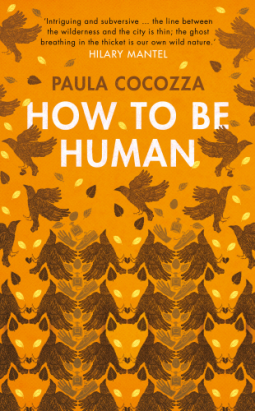 Mary lives alone in a house in East London which backs onto woods, land which other neighbours complain is a unpalatable wilderness of weeds, rubbish and foxes. To Mary, it is the countryside. One day she sees a fox in her garden and believes he has visited her, that the gifts he leaves her are his way of communicating with her. She interprets his movements and snuffles as communication to her, and so validates her belief he understands her as no-one else does. As her relationship with the fox grows, her interactions with other people – her ex-boyfriend Mark, her neighbours Eric and Michelle, her mother, her boss – begin to disintegrate. At the beginning she has some semblance that her friendship with the fox is not usual but she persuades herself that animal specialists do talk to animals so she is not alone in doing this. It is other people who do not understand him. She experiments with different names for the fox – Red, Sunset – but finally abandons this attempt to humanize him.
This is a strange novel, part-psychological thriller, part-study of how wild and domesticated live side-by-side, part-portrayal of emotional disturbance [Mary’s breakdown and Michelle’s post-natal depression]. It is a portrayal of Mary’s two relationships, both controlling, both involving elements of stalking, both where one partner overwhelms the other with claustrophobic caring. Except one relationship is between a man and a woman, the other between a woman and a fox. Events are told mostly from Mary’s point of view and partly from the fox’s, though I found the latter unsatisfactory, stilted and romanticized. Significantly, the fox’s viewpoint disappears towards the end. Some passages of description were too long for me, too indulgent of Mary’s inner world, pushing the boundaries of her madness into psychotic episodes, pushing the boundaries of veracity. It is a strange, unsettling novel, like nothing else I have read. The slow descent of Mary into her fox world is at first believable while being weird but gets stranger as the story progresses. The story did take a while to get going, I almost abandoned it twice. It is a long time before the first line – ‘There was a baby on the back step’ – is explained, so long that its significance is muted and not what I first expected it to be.
If you like this, try:-
‘The Bear’ by Claire Cameron
‘The Ship’ by Antonia Honeywell
‘Pretty Is’ by Maggie Mitchell
And if you’d like to tweet a link to THIS post, here’s my suggested tweet:
#BookReview HOW TO BE HUMAN by @CocozzaPaula http://wp.me/p5gEM4-2HM via @SandraDanby
 I suppose I re-read this book when I feel the need for a little mother-love in my life! My own mum is gone now and I’m mum myself to two boys – and still in Switzerland, which is now ‘home’. The thing about having two home countries is, you have neither 100%. I have dual nationality, I speak two languages, my life is here in the middle of Europe – but Scotland still has a corner of my heart. Yet the Scotland I left in the 80s exists no longer; times change and so do places.
 Baby Dear is Linda’s latest novel, published in May 2017 by Bloodhound Books. Set in Scotland, it follows three women through a turbulent summer. Caro longs for a child to love, but her husband is infertile. Sharon is eight months pregnant and unsure if she really wants to be a mother. Julie, a single mum with a baby and a small boy, is struggling to make ends meet. Then there’s Jeff, Caro’s husband. All he wants is a happy wife with a baby – but how far is he prepared to go to achieve this?
 What is a ‘Porridge & Cream’ book? It’s the book you turn to when you need a familiar read, when you are tired, ill, or out-of-sorts, where you know the story and love it. Where reading it is like slipping on your oldest, scruffiest slippers after walking for miles. Where does the name ‘Porridge & Cream’ come from? Cat Deerborn is a character in Susan Hill’s ‘Simon Serrailler’ detective series. Cat is a hard-worked GP, a widow with two children and she struggles from day-to-day. One night, after a particularly difficult day, she needs something familiar to read. From her bookshelf she selects
 The story
 This first edition dates to 1959 and was published in the USA by the New York Heritage Press. George Macy’s Heritage Press reprinted classic volumes previously published by the more exclusive Limited Editions Club. Bound in red Morocco leather and including colour lithographs, it costs £450 at rare bookseller
  There are many editions of The Moonstone now listed at Amazon, many are self-published and take advantage of the lack of copyright. Above is the current Penguin Classics edition.
 ‘The Moonstone’ by Wilkie Collins [UK: Penguin Classics]



 SANDRA DANBY'S BOOK REVIEWS