Tag Archives: books

#BookReview ‘Elizabeth is Missing’ by Emma Healey #crime #dementia

Can there be a more unreliable narrator than an 81-year old woman with dementia? Elizabeth is Missing by Emma Healey is a brilliant debut. Emma HealeyMaud lives on her own, she has carers visiting, they leave prepared food for her and tell her not to use the cooker. But she does love toast. There is a rebelliousness about Maud which immediately made me connect with her. She reminded me of my mother, who suffered from dementia. I was impressed with the way Maud’s condition is portrayed, in convincing detail, slowly deteriorating as the story progresses. Maud writes herself notes, as memory prompts, and keeps them in her pockets and around the house. The note she re-reads most often is ‘Elizabeth is missing’. Elizabeth is Maud’s friend, and she is not at her house. The story has a cyclical motion as Maud finds the note, goes out to hunt for Elizabeth, and then is told by someone that Elisabeth is not missing, that she is fine. And then Maud finds the note again, and the cycle re-starts.
Interwoven with Maud’s search for Elizabeth, is a narrative strand set in 1946 when she lives with her parents and lodger Douglas. People are displaced as a population comes to terms with the end of the conflict, a poor economy, returning soldiers who are not the husbands they were when they went away to fight. Post-war rationing makes meals difficult, people grow vegetables, forage for fruit, make their own clothes. Maud’s older sister Sukey is good at dressmaking and she gives Maud items to wear. The sisters are close. And then Sukey disappears, no-one knows where she has gone, including her husband Frank.
I am a little unsure how a reader will react if they have no experience of dementia. Maud’s thought processes are, by the nature of her illness, repetitive. But her memories are key to understanding the mystery of Sukey’s disappearance. You, I, the reader, is the detective. It is up to us to sift through the clues, keeping them and discarding them.
In the background, throughout the novel, is the attitude of people towards dementia sufferers. The impatience, the lack of empathy, the unwillingness to understand someone obviously not in their full senses, and also the kindness, gentleness, the fondness, the helpfulness of strangers. For example the police sergeant who repeatedly takes down the information when Maud reports Elizabeth as missing.
“‘Same as usual?’ he says, his voice sounding metallic through the speakers.
‘Usual?’ I say.
‘Elizabeth, is it?’ He nods, as if encouraging me to say a line in a play.
‘Elizabeth, yes,’ I say, amazed. Of course, that’s what I’ve come for. I’ve come for her.”
It is a nice touch that he appears at the end of the story, closing the circle.

And read my review of WHISTLE IN THE DARK, also by Emma Healey.

If you like this, try:-
‘Etta and Otto and Russell and James’ by Emma Hooper
‘Yuki Chan in Bronte Country’ by Mick Jackson
‘The Girls’ by Lisa Jewell

And if you’d like to share a link, try:
#BookReview ELIZABETH IS MISSING by Emma Healey http://wp.me/p5gEM4-11S via @SandraDanby


Great opening paragraph…56

Lord of the Flies“The boy with the fair hair lowered himself down the last few feet of rock and began to pick his way towards the lagoon. Though he had taken off his school sweater and trailed it now from one hand, his grey shirt stuck to him and his hair was plastered to his forehead. All round him the long scar smashed into the jungle was a bath of heat. He was clambering heavily among the creepers and the broken trunks when a bird, a vision of red and yellow, flashed upwards with a witch-like cry; and this cry was echoed by another.”

‘Lord of the Flies’ by William Golding

Great opening paragraph 56… ‘Lord of the Flies’ #amreading #FirstPara

“The boy with the fair hair lowered himself down the last few feet of rock and began to pick his way towards the lagoon. Though he had taken off his school sweater and trailed it now from one hand, his grey shirt stuck to him and his hair was plastered to his forehead. All round him the long scar smashed into the jungle was a bath of heat. He was clambering heavily among the creepers and the broken trunks when a bird, a vision of red and yellow, flashed upwards with a witch-like cry; and this cry was echoed by another.”
William GoldingFrom ‘Lord of the Flies’ by William Golding

Try one of these #FirstParas & discover a new author:-
‘Death in Summer’ by William Trevor
‘Fair Exchange’ by Michele Forbes
‘Herzog’ by Saul Bellow

And if you’d like to tweet a link to THIS post, here’s my suggested tweet:
#Books #FirstPara LORD OF THE FLIES by William Golding http://wp.me/p5gEM4-7Z via @SandraDanby

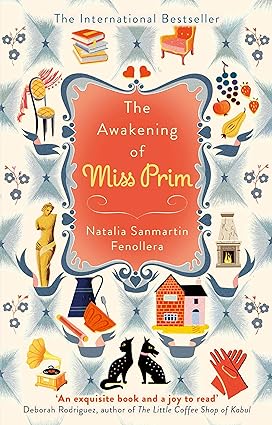
#BookReview ‘The Awakening of Miss Prim’ by Natalia Sanmartin Fenollera #contemporary

The title, The Awakening of Miss Prim, gives away the storyline of this charming tale by Spanish journalist Natalia Sanmartin Fenollera. Miss Prim is to be awakened. The assumption is that the catalyst for this awakening is love. But that is to over-simplify a thoughtful tale of self-knowledge, or maturing as an adult, about making the leap from intellectual maturity to emotional maturity. Natalia Sanmartin FenolleraPrudencia Prim is a librarian who begins a new job in a private house in the village of San Ireneo de Arnois, in an un-named country. Even when I had finished the book I was still unclear in which country it is set, though this does not affect the storytelling at all. Miss Prim is to catalogue the private library of a man who is never named, but is known simply as The Man in the Wingchair.
San Ireneo is an unusual village, it feels as if you are taking a step back in time. “That morning she urgently needed to buy notebooks and labels. The day before, she had had a small disagreement with her employer, the fifth since her arrival at the house. He’d come into the library and declared that he didn’t want her to use a computer to catalogue the books.” So, a computer, it is a contemporary tale then.
The discussions beside the fireplace between Miss Prim and The Man in the Wingchair range widely, from literature and philosophy to the quality of life in the village. And the neighbours, who all have wonderfully exotic names such as Herminia and Hortensia. The women seem to run the village, and have formed a club to support each other and they tackle problems together. Their meetings are always characterised by cake, tea and toast. Miss Prim finds this inclusiveness difficult to handle, she resents interference and in the beginning finds the atmosphere claustrophobic. She is an independent, well-qualified young woman, who knows her own mind. She does not need anyone else and is not looking for love. Of course not!
This is a delightful tale which ranges from classical literature to art to the philosophy of education. One of my favourite scenes is when Miss Prim takes The Man in the Wingchair to task for not including Little Women in his library, lamenting the loss of his nieces in not being able to read the story of the Meg, Jo, Beth and Amy.

If you like this, try:-
‘Paper Cup’ by Karen Campbell
‘The Perfect Affair’ by Claire Dyer
‘The Language of Others’ by Clare Morrall

And if you’d like to share a link:
#BookReview THE AWAKENING OF MISS PRIM by Natalia Sanmartin Fenollera http://wp.me/p5gEM4-11v via @SandraDanby

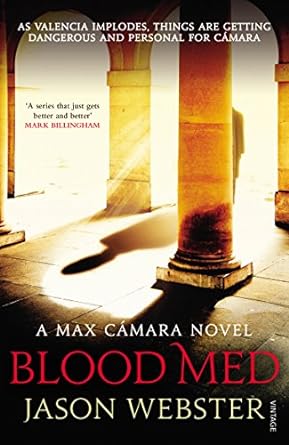
#BookReview ‘Blood Med’ by Jason Webster @Jwebsterwriter #crime #Spain

Page one, Spain waits, the king lies dying. There is the feeling of a nation on the edge. In Valencia, there are homeless on the street, immigrants are being harassed, the police department faces cutbacks despite rumblings of public unrest, and there are not enough drugs for the sick. Blood Med is the fourth in the Cámara Valencia-based detective series by Jason Webster. Jason WebsterThere are two deaths and Cámara and his colleague Torres are given one case each, the hidden agenda is that one of the two men must be made redundant. One death is suspected suicide, the other a brutal murder. In the way of crime fiction, you know there will be a connection but that connection is of course invisible at the beginning.
The detective, orphaned young and raised by his grandfather, now lives in Valencia with elderly Hilario plus Max’s girlfriend, journalist Alicia. Both Hilario and Alicia have key roles in this story. Hilario is a huge influence on Max’s approach to life, and he often recalls his grandfather’s fondness for proverbs when he finds himself in a sticky situation. ‘Visteme despacio que tengo prisa’ he tells himself when he feels the investigation is being rushed. It translates as ‘Dress me slowly, I’m in a rush.’ He feels the investigation has tunnel vision; that it is being rushed and would benefit from a step back. ‘If he could have his way he would send everyone home for the rest of the day to switch off. Go to the beach, go wherever. And have sex – with someone else if possible. If not, whatever. If helped clear the mind.’
This is the most accomplished Cámara novel so far, the setting in Valencia is so strong and the political background feels very real. The ‘corralito’ described [the government decree to close the banks] feels very real.

Read my reviews of other books in Webster’s Spanish detective series:-
OR THE BULL KILLS YOU #1MAXCÁMARA
A DEATH IN VALENCIA #2MAXCÁMARA
THE ANARCHIST DETECTIVE #3MAXCÁMARA

If you like this, try:-
‘The Long Drop’ by Denise Mina
‘Snow White Must Die’ by Nele Neuhaus
‘An Uncertain Place’ by Fred Vargas #8COMMISSAIREADAMSBERG

And if you’d like to tweet a link to THIS post, here’s my suggested tweet:
#BookReview BLOOD MED by Jason Webster @Jwebsterwriter via @SandraDanby http://wp.me/p5gEM4-10N

#BookReview ‘Burial Rites’ by Hannah Kent #historical #crime

So much has been written about Burial Rites by Hannah Kent, I feel pretty sure that by now you know it is the fictionalised story of an Icelandic woman found guilty of murder in the 1820s. You may possibly also know that this book, rich in Icelandic saga and with Iceland present on every page of the story, is written by a young Australian. Hannah KentIf this book does not win a drawerful of awards, it will make me lose faith in literary awards. The confidence with which the story is told defies the knowledge that this is a debut novel, any allowances I had mentally made for a debut are not required. Not only does Kent write a historical novel set in a foreign country with a difficult language, from page one you are in Iceland. Put aside the names of people, the names of the farms [the map at the front of my edition was much thumbed in the beginning, then forgotten], Iceland surrounds you as you read the story of Agnes Magnúsdóttir. You sit with her in the badstofa, the smell of the dung walls in your lungs, the dirt under your fingernails.
“The herb plot of Kornsá is overgrown and wild, surrounded by a rough stone wall that has toppled to the ground at one end. Most of the plants have gone to seed, frostbitten roots rotting in the warmer weather, but there are tansies, and little bitter herbs I remember from Natan’s workshop at Illugastadir, and the angelica smells sweetly.” Natan is the man Agnes is found guilty of murdering. Whilst awaiting arrangements for her execution she is placed with a local family – as is the tradition, this being a rural area with no prisons, no police stations, justice is managed locally – who receive a little extra silver in recompense for their service. Her story is told through a series of official letters about the trial, Agnes own voice and that of Tóti, the reverend she requests to prepare her for execution.
Agnes is made to work for her keep, she is not shackled or locked away. The family is poor, an extra pair of hands to work the land is valuable, even if they watch her every minute. Agnes, for her part, enjoys the fresh air during harvest. “I let my body fall into a rhythm. I sway back and forth and let gravity bring the scythe down and through the grass, until I rock steadily. Until I feel that I am not moving myself, and that the sun is driving me. Until I am a puppet of the wind, and of the scythe, and of the long, slow strokes that propel my body forward. Until I couldn’t stop if I wanted to.”
I was gripped from page one, wanting to know the end of the story, not wanting it to end. Kent has combined poetry with a murder mystery – by the way don’t listen to those reviews which class it as Scandi-crime, this is so much more than that.

See my reviews of two other Hannah Kent novels:-
DEVOTION
THE GOOD PEOPLE

If you like this, try:-
‘Rush Oh!’ by Shirley Barrett
‘Sweet Caress’ by William Boyd
‘Freya’ by Anthony Quinn

And if you’d like to tweet a link to THIS post, here’s my suggested tweet:
#BookReview BURIAL RITES by Hannah Kent via @SandraDanby http://wp.me/p5gEM4-101

#BookReview ‘An Appetite for Violets’ by Martine Bailey @MartineBailey #historical

The beginning: it is 1773. Kitt, a brother who seeks his disappeared sister, arrives at an Italian villa to find it abandoned, the dinner table laid with forgotten cakes and sweetmeats. You think the story of An Appetite for Violets by Martine Bailey will be about Kitt’s sister Lady Carinna but she is a bit-player. The real story belongs to her under-cook Obedience, Biddy, Leigh, forced to accompany her mistress on a Grand Tour to the Continent. Martine BaileyAfter this first short section at the Villa Ombrosa, the story starts at Mawton Hall in 1772 where the servants are surprised by the arrival of their new mistress, without her elderly husband. Lady Carinna asks Biddy to copy her favourite violet sweets bought from an expensive London store. Although Biddy is an honest cook she is not a craftswoman, and her attempt produces “shocking poor copies of the originals.” She is rescued by the Indonesian footman Mr Loveday who provides a box of original sweets to substitute for Biddy’s home-made variety. Pleased with the sweets Lady Carinna gives Biddy a rose silk gown. Trying on the dress, Biddy gets a glimpse of a life so different from her own.
This experience bonds the two servants, a bond which lasts throughout their journey to Italy. Biddy and Loveday each have their own way of escaping the demands of their mistress, and they vow to support each other no matter what happens. But then they start overhearing secrets, Loveday reads the letters he is bidden to deliver, and Biddy becomes entwined in Carinna’s plan of deception.
Bailey admits to being fascinated by food, and every chapter of Biddy’s is preceded by an excerpt from The Cook’s Jewel, an old household book of recipes, which she takes with her on the journey. As she travels through France and then Italy, Biddy begins to add her own recipes which are linked to the next part of her tale. And it is a tale of excess, guilt and deception, ideally suited to the language of food. As the carriage leaves Mawton Hall at the beginning of the journey, Biddy thinks of her sweetheart Jem left behind, “I pulled down my cap and wept, like a bag of whey that drips without end.”

And here are my reviews of other novels by Martine Bailey:-
THE ALMANACK #1TABITHAHART
THE PROPHET #2TABITHAHART
THE PENNY HEART

If you like this, try:-
‘The Art of Baking Blind’ by Sarah Vaughan
‘The Fountains of Silence’ by Ruta Sepetys
‘The Swift and the Harrier’ by Minette Walters

And if you’d like to tweet a link to THIS post, here’s my suggested tweet:
#BookReview AN APPETITE FOR VIOLETS by Martine Bailey @MartineBailey http://wp.me/p5gEM4-10C via @SandraDanby

#BookReview ‘The Blind Man of Seville’ by Robert Wilson @RobWilsonwriter #crime #Spain

The first time I heard of the Javier Falcón books by Robert Wilson was when the first was dramatized on TV, and unfortunately I missed it. So it was with anticipation that I turned to the first of the four books, The Blind Man of Seville. Robert Wilson My first impression was that it was the longest detective book I’d read in a while, but the reason for this soon became apparent: the back story in Tangiers. In a note at the back of the book, Wilson directs his readers to the full-length diaries he wrote for Francisco Falcón, Javier’s late father, artist, Tangiers resident and key character in The Blind Man of Seville.
It is a complicated novel, entangling the Spanish legal system, bullfighting, the worlds of art and restaurants, Seville, Tangiers and the theme which lurks just below the surface of everyday Spain: the Spanish Civil War. There is something about the first murder which slowly tips Inspector Falcón towards mental breakdown. Like all detectives, the interest lies in his frailties, how he overcomes them and manages to do the day job, how he outwits the criminal mind.
Francisco’s diaries are fascinating; an insight into the Spanish Legion, its time in Morocco and Russia, the brutality and hardships, the sense of brotherhood. At times as Javier reads his father’s story, the story churns his guts; mine too. Anyone who has read anything about the Civil War will anticipate some of the brutality. Wilson skilfully weaves this storyline into the modern-day hunt for a murderer.
This is far from a formulaic detective story. Wilson writes about heavy subjects with a confident hand, and creates atmosphere easily. “The hotel had suffered in the intervening half-century. There was a glass panel missing from one of the doors in his room. Paint peeled off the metal windows. The furniture looked as if it had taken refuge from a violent husband. But there was a perfect view of the bay of Tangier and Falcón sat on the bed and gaped at it, while thoughts of deracination spread through his mind.”

Here are my reviews of the other books in the Javier Falcón series:-
THE SILENT AND THE DAMNED #2FALCÓN
THE HIDDEN ASSASSINS #3FALCÓN
THE IGNORANCE OF BLOOD #4FALCÓN

If you like this, try:-
‘Snow White Must Die’ by Nele Neuhaus
‘No Time for Goodbye’ by Linwood Barclay
‘A Fatal Crossing’ by Tom Hindle

And if you’d like to tweet a link to THIS post, here’s my suggested tweet:
#BookReview THE BLIND MAN OF SEVILLE by Robert Wilson @RobWilsonwriter http://wp.me/p5gEM4-P1 via @SandraDanby

#BookReview ‘Allegiant’ by Veronica Roth #YA #fantasy

The tone of Allegiant, the third in the ‘Divergent’ trilogy by Veronica Roth, is different. Tris lives in Chicago where every citizen belongs to one of five factions, each representing a human virtue. But Tris doesn’t fit in and is searching for a new world. Veronica RothKey to the change of tone in this book is a change in point-of-view, which is split for the first time; between Tris and Tobias [Four]. Getting a male perspective is interesting, and I guess Veronica Roth took this approach to add more tension to the storytelling. It certainly highlights the lack of communication between the two. But at times, I lost track of whose thoughts I was reading.
The book is full of strong female characters, but not strong in a good way. Evelyn, head of the factionless; Edith Prior, Tris’s ancestor, whose mystery hangs over this third book. The world Tris knew in Divergent and Insurgent has been shattered by violence so she and Tobias set out beyond the fence to find a new world. Except the new world is not green fields, but just as violent and unequal as the world they are escaping.

Click the title to read my reviews of the other books in this series:-
DIVERGENT #1DIVERGENT
INSURGENT #2DIVERGENT

If you like this, try:-
‘The Bear and the Nightingale’ by Katherine Arden #1WINTERNIGHT
‘Dark Earth’ by Rebecca Stott
‘The Secret Commonwealth’ by Philip Pullman #2THEBOOKOFDUST

And if you’d like to share a link:
#BookReview ALLEGIANT by Veronica Roth via @SandraDanby http://wp.me/p5gEM4-Pt

Great opening paragraph 55… ‘Far from the Madding Crowd’ #amreading #FirstPara

“When Farmer Oak smiled, the corners of his mouth spread till they were within an unimportant distance of his ears, his eyes were reduced to chinks, and diverging wrinkles appeared round them, extending upon his countenance like the rays in a rudimentary sketch of the rising sun.”
Thomas HardyFrom ‘Far from the Madding Crowd’ by Thomas Hardy

Try one of these #FirstParas & discover a new author:-
‘Lord Jim’ by Joseph Conrad
‘Notes on a Scandal’ by Zoe Heller
‘The Adventures of Huckleberry Finn’ by Mark Twain

And if you’d like to tweet a link to THIS post, here’s my suggested tweet:
#Books #FirstPara FAR FROM THE MADDING CROWD by Thomas Hardy http://wp.me/p5gEM4-7J via @SandraDanby