Tag Archives: Canadian writers

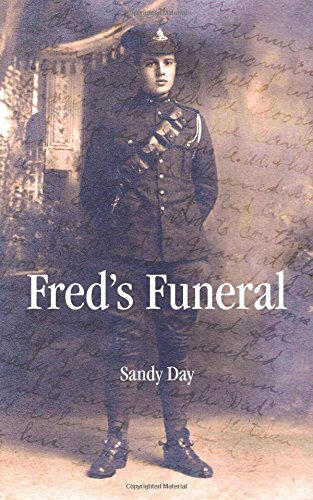
#BookReview ‘Fred’s Funeral’ by Sandy Day #genealogy #family #WW1

None of us have the luxury of hearing what is said about us after we are dead. In Fred’s Funeral, Canadian author Sandy Day tells the story of one soldier, returned from the First World War, who felt misunderstood and sidelined by his family. Only when he dies in 1986, seventy years after he went to war, does he observe his own funeral and find out what they really think of him. Sandy DayFred Sadler has lived his post-fighting years in one institution or another. Clearly he is suffering from some form of shell shock or Post-Traumatic Stress Disorder but this goes undiagnosed. There are periods of living in boarding houses, his family is unwilling to have him live with them, until his behaviour deteriorates and he is sent back to hospital. Now dead and trapped as an unwilling ghost, Fred observes his funeral presided over by Viola, the sister-in-law he always disliked. As the mourners sit around and share memories of Fred, he watches, frustration mounting, as he is unable to correct their observations. They portray a ‘Fred Sadler’ which he does not recognise. I kept expecting something to happen; a true memory of the war, an event, which would explain Fred’s illness and set the record straight with his family. But it didn’t come. The story is told in linear fashion; the anecdotes of Viola and the remaining family are interchanged with Fred’s reaction to these stories plus a few flashbacks to the war. Clearer signposting of these sections would make reading easier.
Day clearly captures the time and place of post-Great War Canada, a subject which is new to me. However I found the repeated digressions into the extended family history and details of the lifestyle a distraction from the main story [so many cousins, great-great grandparents and houses]. I so wanted to cut some of these unrelated sections to allow a stronger novel to push its way to the surface; simpler, more powerful. The inclusion of so many family details makes me wonder if the core of Fred’s Funeral is a memoir, inspired by a real family, from which the author feels unable to cut some relations and take the leap into pure fiction.
The portrayal of Fred’s experience at Whitby Hospital for the Insane is heart breaking, as is the disinterest of his family. For them, Fred is an embarrassment. It is a sad indictment of our treatment of soldiers returning from war and our ignorance that the effect of fighting can last a lifetime. It is easy to assume that in the 21st century this has changed, but the modern day strand of Day’s story suggests it hasn’t. It is as if Fred’s life has paused. “He banished feeling anything long ago. He feels timid. He feels tentative, like every step he takes is on a thick layer of ice and at any moment, he might crash through into a frenzy of drowning.”
At the end of the novel, there is no ‘reveal’, no surprise, and I felt a little let down. Overall, this is a thoughtful examination of how family tensions, petty jealousies and misunderstandings can spread down the generations. Gossip and guesses are transformed into ‘truth’.

If you like this, try:-
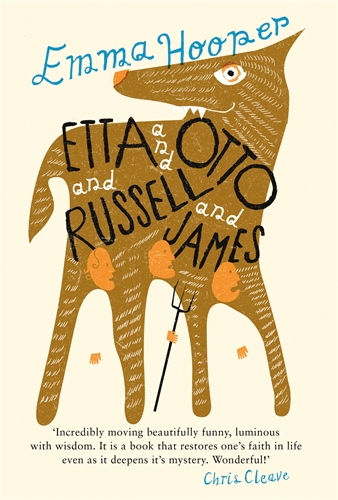
Etta and Otto and Russell and James’ by Emma Hooper
‘Wake’ by Anna Hope
‘Yuki Chan in Bronte Country’ by Mick Jackson

And if you’d like to tweet a link to THIS post, here’s my suggested tweet:
#BookReview FRED’S FUNERAL by Sandy Day https://wp.me/p5gEM4-35o via @SandraDanby
SaveSave

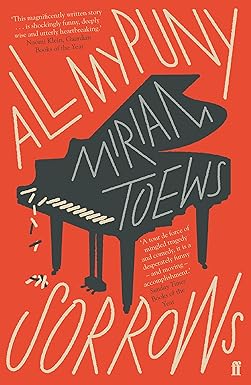
#BookReview ‘All My Puny Sorrows’ by Miriam Toews #contemporary

This is a novel about depression, suicide, death, broken families, love and music. Yes, it is sad, but it is also laugh-out-loud in places. Canadian writer Miriam Toews drew heavily on her own experiences in the writing of All My Puny Sorrows and that depth of empathy shines from every page. Do not ignore this book because you think it will be depressing: it is uplifting, and you will feel sad to finish it. Miriam Toews The story centres on sisters Yolandi and Elfrieda von Riesen. Elf, the elder, is a concert pianist. Yoli writes the Rodeo Rhonda teen novels. Elf’s story – and that of the family of women surrounding the two sisters, their mother, their aunt, Yoli’s daughter, their friends – is told by Yoli. “When we were kids she would occasionally let me be her page-turner for the fast pieces that she hadn’t memorized. Page turning is a particular art. I had to be just ahead of her in the music and move like a snake when I turned the page so there was no crinkling and no sticking and no thwapping. Her words.”
We do not hear Elf’s inner voice except in excerpts from letters and poems. What we do have is Yoli’s contemplation of Elf’s request to be taken to Switzerland to end her own life. No judgements are made although Yoli runs through every gamut of emotion from sorrow to guilt to anger to exasperation to despair. She loves her sister and does not want to lose her, but if her sister is so unhappy then how can she not help her? Is Elf’s wish not hugely selfish, does she not care for the feelings of those she will leave behind? Anyone who has been close to someone with a long-term illness will recognise many of the healthcare situations and Yoli’s many meltdowns with medical authority.
It is a sad, poignant book which made me laugh out loud.

If you like this, try:-
‘The Bear’ by Claire Cameron
‘Etta and Otto and Russell and James’ by Emma Hooper
‘A View of the Harbour’ by Elizabeth Taylor

And if you’d like to tweet a link to THIS post, here’s my suggested tweet:
#BookReview ALL MY PUNY SORROWS by Miriam Toews http://wp.me/p5gEM4-1Dw via @SandraDanby

#BookReview ‘Girl Runner’ by Carrie Snyder #contemporary #mystery

I was unsure what to expect of Girl Runner by Carrie Snyder. I chose it because in my youth I was a runner and the story premise intrigued me, unusual for a novel.  It is fiction based on a real event. The key fictional character, the ‘girl runner,’ is Aganetha Smart. She wins the gold medal at the 1928 Olympics for the ground-breaking Canadian team of female athletes. Carrie SnyderThe historical setting is real and is a fascinating glimpse into the barriers which women faced in 1920s and 1930s Canada and society’s attitudes to the strength, ability and success of women. But this novel is not just about athletics, it is the story of Aganetha’s life, of the child who liked to run and how a random chance allowed her to train with a running coach. Eventually she won her gold medal at the Amsterdam games. This is a book about the growth of a girl into a young woman, and from a young woman into an old one, lugging with her the memories, guilt and secrets of her childhood. Running colours Aganetha’s life, her character, and her approach to problems.
For Aganetha, running is everything. When feeling troubled as a child, she runs. When feeling trapped as an elderly woman, she pulls on her running shoes and goes out into the fresh air. Running is at the core of her character, but is she running to win, to be a champion, or to run away? When, in her forties, she is asked where she wants to be, she replies without hesitation, “running”.
We cannot understand Aganetha without the story of her family, she is the child of her father’s second marriage and so the home is full of step-siblings. Perhaps the novel would have benefitted from less siblings, sometimes too many characters can clutter the narrative and at times the story jumps around a bit in time. The detail in which the rural life of this family is told – with the mother who cares for distressed girls, and the father who builds a lighthouse in the field – reminded me of Jane Smiley and Anne Tyler.
At the end of the book we find the answer to a secret from Aganetha’s youth: this mystery is so subtly handled that I missed the first clues, so the solving of the mystery fell a little flat. There is also a second line of narrative involving two young people who arrived unannounced at Aganetha’s care home and take her back, in her wheelchair, to the country home where she grew up. For a long way through the book the relevance of this storyline was unclear, but it becomes clear at the end.
CLICK HERE TO READ MORE ABOUT THIS BOOK AT AMAZON

If you like this, try:-
‘Paper Cup’ by Karen Campbell
‘The Lie of the Land’ by Amanda Craig
‘Somewhere Inside of Happy’ by Anna McPartlin

And if you’d like to tweet a link to THIS post, here’s my suggested tweet:
#BookReview GIRL RUNNER by Carrie Snyder http://wp.me/p5gEM4-1yN via @SandraDanby

#BookReview ‘Etta and Otto and Russell and James’ by Emma Hooper #contemporary

This was a ‘sort of’ book for me. I ‘sort of’ enjoyed it but… I was ‘sort of’ irritated with it too. The story premise for Etta and Otto and Russell and James by Emma Hooper grabbed me straightaway, and the excellent first paragraph. Emma Hooper

Otto,
The letter began, in blue ink.
I’ve gone. I’ve never seen the water, so I’ve gone there. Don’t worry…”

Etta and Otto are in their eighties. The setting is Canada. Etta sets out one day to walk towards the water, which means either east to the Atlantic or west to the Pacific. She goes east. Otto stays at home, working his way through Etta’s index cards, trying hard to make cinnamon buns like hers. Gradually we learn their back stories: Otto’s childhood on the farm then as a soldier in France during the Second World War; of Etta’s teaching days and then a munitions worker. The Russell in the title is their childhood neighbour and friend. The James of the title is a coyote.
I was unclear why Etta was walking, unclear why Otto seemed philosophical and Russell concerned by her adventure. The relationships are enigmatic, the memories are fluid, which I found confusing. And what precisely happened at the end, I re-read and still do not understand. Enigmatic again, perhaps too much smoke and mirrors. Partly, also I think the problem was insufficient editing combined with the layout of the text [in the Kindle edition]. The viewpoint shifts from paragraph to paragraph, something I hate as it means a minute mental re-adjustment each time which interrupts the flow of the story. Also there is no punctuation to show dialogue, another pet hate of mine, and it is often difficult to know who is talking when. Anything which takes you ‘out’ of the story has to be a bad thing.
Some of the writing is beautiful though. My favourite passages were when Etta is walking with James; their relationship, their dialogue, and the description of the places they walk through are wonderful. When they come to their final river to cross, she takes the bridge and he swims, and we never see James again. I was sorry for that loss.

If you like this, try:-
‘In Another Life’ by Julie Christine Johnson
‘The Love Song of Miss Queenie Hennessey’ by Rachel Joyce
‘Ferney’ by James Long

And if you’d like to tweet a link to THIS post, here’s my suggested tweet:
#BookReview ETTA + OTTO + RUSSELL + JAMES by Emma Hooper http://wp.me/p5gEM4-1wo via @SandraDanby