
Wow. Tyrant, book two of the Nero trilogy by Conn Iggulden, doesn’t disappoint. An ageing emperor who appeases his younger wife. A fatherless son, wild and untameable. His ruthless mother, single-minded, unscrupulous, determined her son should rule. This is the story of Nero’s ascent to the most powerful seat of all. 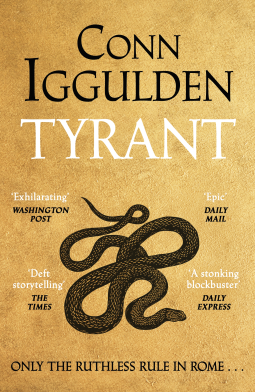 In his portrayal of Roman history, Iggulden’s writing bears his research lightly. Never once did I sense a fact included superfluously, everything was there for a reason. Where historical accounts are thin, Iggulden adds his own fictional interpretation. The result is a gripping story of political machinations not unfamiliar to today’s global governments, where ambition and dominion drive everything; loyalty is fragile, words have double meanings, while at the heart of it all are money and power.
Where Nero was the story of Agrippina, Tyrant is the story of her son Lucius, now re-named Nero. A headstrong teenager, Nero is out of control. His mother persuades her husband Emperor Claudius, and now Nero’s adoptive father, to name Nero as his heir in place of his natural son Britannicus who is the butt of Nero’s ridicule. An education is arranged at the hands of statesman and dramatist Seneca and praetorian Burrus.
A combination of political power struggles, subterfuge, a spot of teenage shoplifting and reckless charioteering, Tyrant shows Rome at its bloodiest and most dangerous. Plenty of plot twists, betrayals and plotting set against excessive wealth. I particularly enjoyed the portrayal of the naumachia, a naval battle in a flooded amphitheatre between ships crewed by prisoners of war. I was willing on Caractacus; first seen in Nero, as king of the Catuvellauni in Britain he fought the Romans many times but was captured and taken to Rome as a prisoner. He provides an interesting comparison on the nature of leadership, responsibility and power.
Conn Iggulden’s portrayal of Nero is compelling, despite the darkness, brutality and often insanity of the story. It’s a tribute to his storytelling that the writing does not descend into hyperbole. Tyrant is the story of Nero from boy to man, as he breaks free of the influence of his mother. A really entertaining read.
The final book of the trilogy is Inferno.
Read my review of NERO, first instalment of Conn Iggulden’s ‘Nero’ trilogy
If you like this, try:-
‘The Beasts of Paris’ by Stef Penney
‘The Last Hours’ by Minette Walters #1BlackDeath
‘The Lost Lights of St Kilda’ by Elisabeth Gifford
And if you’d like to tweet a link to THIS post, here’s my suggested tweet:
#BookReview TYRANT by Conn Iggulden https://wp.me/p2ZHJe-8i1 via @SandraDanby
COMING SOON… THE NEXT BOOK I REVIEW WILL BE:- 


 SANDRA DANBY'S BOOK REVIEWS