Tag Archives: Greek myths

#BookReview ‘Stone Blind’ by Natalie Haynes @officialnhaynes #mythology

Stone Blind is the first novel by Natalie Haynes I’ve read and I came to it without expectations or pre-conceived ideas. Billed as the story of Medusa, the mortal raped by a god and turned into a Gorgon with a writhing head of snakes, this is in fact a much broader tale of Greek gods, goddesses and myths. Medusa is featured but is not prominent until the final third. A fleeting appearance and a disappointment I didn’t recover from. Natalie HaynesA story of the abuse of power and privilege, of trickery and arrogance, mostly of men against women, this heaviness is leavened with wit and a modern feminist voice. It is the tale of assorted women, goddesses and mortals and their places in their worlds alongside men. In a complex weaving of many stories and narrators, this is a novel to read with your full attention. I felt it drag in the middle, perhaps my concentration wavered, perhaps the thin presence of Medusa began to weigh on me. Oh how I wanted more about Medusa and her Gorgon sisters, Euryale and Stheno, and less squabbles, battles and jealousies of so many immortals and their offspring.
Haynes examines the question, what makes a monster and who decides. She updates the relevance of Medusa and Perseus and questions the very idea that the Gorgons were monstrous. So, an ambitious tale in breadth – perhaps too ambitious – but with some feminist lines to remember. ‘So to mortal men, we are monsters. Because of our teeth, our flight, our strength. They fear us, so they call us monsters.’
There are so many books out there that are fictionalised re-tellings of the Greek myths that we’re spoilt for choice. Will I read another by Haynes? I’m not sure, not for a while.

If you like this, try:-
The Silence of the Girls’ by Pat Barker
The Women of Troy’ by Pat Barker
‘House of Names’ by Colm Tóibín

And if you’d like to tweet a link to THIS post here’s my suggested tweet:
#BookReview STONE BLIND by Natalie Haynes @officialnhaynes https://wp.me/p2ZHJe-64w via @SandraDanby

COMING SOON… THE NEXT BOOK I REVIEW WILL BE:-

#BookReview ‘The Women of Troy’ by Pat Barker #historical #myths

The Women of Troy is the second of the Trojan War novels by Pat Barker, telling the post-war story of Trojan woman Briseis, a trophy of war owned by Achilles. I loved the first, The Silence of the Girls, but wanted to hear the stories of more of the women. That’s what we get in this second book. Pat BarkerBriseis, now pregnant with Achilles’ child, is again narrator along with a new male voice, that of Pyrrhus, eldest son of Achilles and Briseis’ stepson. Now Achilles is dead Briseis belongs to Alcimus, charged by Achilles before his death with caring for his unborn child.
The story starts with Pyrrhus inside the wooden horse, constructed by the Greeks, to trick the Trojans. ‘Inside the horse’s gut: heat, darkness, sweat, fear. They’re crammed in, packed as tight as olives in a jar.’ It is Pyrrhus who kills Priam, king of the Trojans, and that murder echoes throughout The Women of Troy. As storms rage – punishment of the victorious Greeks by the Gods for their impious behaviour – the army and its captives are now trapped on the beach waiting for a chance to sail home. This enclosure at close quarters raises emotions, tensions, jealousies and pride. As Alcimus arranges games – chariot racing, archery, spear throwing, wrestling – Briseis acts as a mother-figure for the other women, all now slaves.
Barker explores the after-effects of war on the Trojan women during these empty days – Hecuba, widow of Priam, and Cassandra, her daughter; Andromache, wife of Hector now concubine to Pyrrhus – high-born Trojan women now slaves in the households of their Greek victors, as concubines, whores, cooks and housemaids.
The story is about survival on the edge of despair when women are secondary creatures deemed without opinions or rights, exploring how women individually and collectively find ways to live. There is bravery, despair, foolishness, obsession and madness. When the actions of Pyrrhus are questioned, Briseis must remember the events of one night when Achilles was alive. ‘Both of us [Briseis and Cassandra, another witness] were women – and a woman’s testimony is not considered equal to a man’s. In a court of law, if a man and woman disagree it’s almost invariably his version of events that’s accepted. And that’s in a courtroom – how much more so in this camp where all the women were Trojan slaves and the only real law was force.’
But this is also the story of Pyrrhus, a young man who struggles to match the reputation of a father he never felt close to, a father lauded as a God. These were brutal times when small mistakes were punished by death and Pyrrhus, who has few friends, takes risks and makes bad decisions.
This book works as a standalone story as well as companion to The Silence of the Girls. Both are magnificent examples of storytelling by an author at the peak of her writing. Faithful to the myths, Barker is an inventive writer who adds her own interpretations and twists.
Excellent, I whizzed through this in no time. Will there be a third novel? I hope so.

Read my reviews of other Pat Barker novels:-
THE SILENCE OF THE GIRLS #1WOMENOFTROY
LIFE CLASS #1LIFECLASS
TOBY’S ROOM #2LIFECLASS
NOONDAY #3LIFECLASS
DOUBLE VISION
ANOTHER WORLD
BLOW YOUR HOUSE DOWN
UNION STREET

If you like this, try:-
These Dividing Walls’ by Fran Cooper
A Thousand Acres’ by Jane Smiley
Vinegar Girl’ by Anne Tyler

And if you’d like to tweet a link to THIS post, here’s my suggested tweet:
#BookReview THE WOMEN OF TROY by Pat Barker https://wp.me/p5gEM4-5sm via @SandraDanby

#BookReview ‘The Silence of the Girls’ by Pat Barker #historical #myths

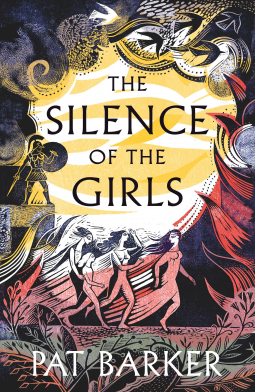
What a tumult of emotions this book unleashes. The Silence of the Girls by Pat Barker is a re-telling of the Trojan War from the viewpoint of Briseis, a captured Trojan queen who is enslaved in the Greek camp and claimed by Achilles as a prize of war. No matter that he killed her husband and brothers; that was the way things worked. Women were chattels without a voice, without feelings. Pat BarkerThis is not a simple retelling of a myth, it is a comment on the danger of male-dominated warfare fuelled by anger, hate and a sense of competition while the women are treated as possessions. The first action of a conquering army was to slaughter all babies and pregnant women, to prevent more males being born which may be future enemies. Barker has long written about war, and about women; now she combines the two with a microscopic focus on Briseis. It is an emotional story, overwhelming at times. Some women adapt, others collapse; some fall in love with their captors. The details of daily life are steeped in realism – the butchering, the piss, the blood – and Barker makes you believe it all.
Structurally, the [albeit, short] sections that didn’t work for me were those told by Achilles. I was disappointed to leave Briseis and resented the intrusion of a male voice. In preference I would have preferred to hear from other women – Hecamede perhaps, Ritsa or Iphis – in the style of Barker’s first novel Union Street where the stories of the women intertwine so by the end of the book you have a full picture.
At the beginning I worried about getting my Homer and classical history references straight, but realised this was taking me away from Briseis’s story. As soon as I stopped trying to remember The Iliad, I became entirely wrapped up in the book. Pat Barker never disappoints. She writes with passion, anger and earthiness about war and is a writer who never shirks from the difficult stuff.
This is the first book in the Women of Troy trilogy.

Read my reviews of other Pat Barker novels:-
THE WOMEN OF TROY #2WOMENOFTROY
LIFE CLASS #1LIFECLASS
TOBY’S ROOM #2LIFECLASS
NOONDAY #3LIFECLASS
ANOTHER WORLD
BLOW YOUR HOUSE DOWN
DOUBLE VISION
UNION STREET

If you like this, try:-
‘The House of Names’ by Colm Tóibín
‘Glorious Exploits’ by Ferdia Lennon
‘White Chrysanthemum’ by Mary Lynn Bracht

And if you’d like to tweet a link to THIS post, here’s my suggested tweet:
#BookReview THE SILENCE OF THE GIRLS by Pat Barker https://wp.me/p5gEM4-3An via @SandraDanby

#BookReview ‘House of Names’ by Colm Tóibín #Greekmyths #saga

I have a sketchy knowledge of Greek literature lost in the mist of time, and so approached House of Names by Colm Tóibín with a sense of trepidation combined with anticipation of reading something new. As always with Colm Tóibín’s novels, the writing is exquisite but House of Names did, for me, lack an emotional connection. And I’m not sure why. Colm TóibínThe novel begins with the story of Agamemnon, warrior king, who sacrifices his daughter Iphigenia to the gods in the hope of victory in battle. However this novel is not about the king but what happens next. Tóibín imagines the continuance of the story, of Agamemnon’s wife Clytemnestra, daughter Electra and son Orestes. As always with classical literature, it is easy to find parallels with modern life, in politics, war and television. Double-crossing, lies, scheming politicians, vengeful soldiers, royal disagreements, distrustful servants, sibling rivalry, kidnapping and violence.
We share Clytemnestra’s version of the story first, told in first person and more vivid for that, as her husband murders their daughter rather than celebrating her marriage. Clytemnestra broods and plans her revenge, revenge which she takes with her own hand. But the central question in this story is who is telling the truth. Did Clytemnestra arrange for the ‘safe-guarding’ of her son Orestes and the banishment to the dungeon of her daughter Electra? Or was it her new ally, the prisoner-turner-lover Aegisthus?
The story then switches to Orestes who is marched across country to be imprisoned with a group of kidnapped boys. The title of the novel comes from this section, told in the third person it moves slower. Orestes, with friend Leander, escapes captivity and wanders the barren countryside, on the edge of starvation, until they stumble on refuge in a cottage by the sea occupied by an elderly woman. With Electra’s viewpoint, the narration switches back to first person. Electra is the most enigmatic, conversing with spirits, moving silently, observing the plotting. Is she simply a watcher, or has she inherited the vengeful nature of her mother? Through Electra we finally put together the pieces of Agamemnon’s death and the subsequent intrigue, though it pays to be patient as some things only make sense as the end approaches. Somewhere through the tale the emphasis is placed on the violence of Clytemnestra’s revenge while the event which sparked her fury – her husband’s murder of Iphigenia – becomes blurred.
I did not research Aeschylus’ Oerestia before reading House of Names and there are other reviews online which efficiently compare the original with Tóibín’s re-imagining. However I do feel that an ignorance of the original is perhaps helpful when reading a novel such as this, I was able to relax into the story without worrying about changes made and diversions taken.
Colm Tóibín is one of my favourite authors and House of Names, though an experimental read for me, has not changed my mind.

Read my reviews of these other novels by Colm Tóibín:-
BROOKLYN
NORA WEBSTER

If you like this, try:-
The Silence of the Girls’ by Pat Barker
Stone Blind’ by Natalie Haynes
A Traveller at the Gates of Wisdom’ by John Boyne

And if you’d like to tweet a link to THIS post, here’s my suggested tweet:
#BookReview HOUSE OF NAMES by Colm Tóibín http://wp.me/p5gEM4-2NV via @SandraDanby