Tag Archives: historical crime fiction

#BookReview ‘Smoke and Ashes’ by Abir Mukherjee @radiomukhers #crime #historical #India #Raj

Captain Sam Wyndham is having a bad week. His opium addiction is keeping him awake at night. Two murders bearing the same grisly modus operandi have occurred. Non-violent protests by the Indian self-rule movement are intensifying, and the Prince of Wales is due to arrive in Calcutta. Smoke and Ashes by Abir Mukherjee starts at a pace and doesn’t stop. Abir MukherjeeThe story starts on December 21, 1921. Calcutta is a smouldering tinderbox of political unrest about to ignite. Wyndham and Sergeant ‘Surrender-not’ Banerjee expect the worst, both fear personal repercussions. Bannerjee’s family is close to one of the protest leaders, Chitta-Ranjan Das, while Wyndham fears for the safety of his Anglo-Indian ex-girlfriend Annie. When a Goan nurse is murdered, her body bears grisly wounds that Wyndham has seen only days before on another dead body. Except this was at an opium den. At first sight he’s not sure if the body is real or a fever dream. Second, his career will be over if he admits where he was. So not even Surendranath knows about the dead Chinaman found in the notorious Tangra district. Only Wyndham knows there may be a serial killer in Calcutta.
Mukherjee excels at highlighting the dichotomies, similarities and moral dilemnas of this huge continent with a population of 269 million ruled by a small number of British officials and military. Behaviour and manners play their part, in a way. When a protest demonstration takes place just before a newly-introduced curfew is due to start, the protestors and Gurkha soldiers observe each other. ‘It was still some minutes before six, and the troops stood their ground, bound by the rules of the curfew. The fact that the demonstration itself was illegal had been conveniently overlooked by all concerned. As usual, the whole thing felt like a game where both parties agreed which rules applied and which could be discounted. Rules, after all, were important.’
Wyndham and Bannerjee are caught in the moral trap experienced by those working for the Raj out of necessity but whose hearts are with the protestors. ‘To see a man as your enemy, you needed to hate him, and while it was easy to hate a man who fought you with bullets and bomns, it was bloody difficult to hate a man who opposed you by appealing to your own moral compass.’ When there’s a third murder, it begins to feel like revenge. But what for, and who is next. When they discover the answer they have minimal time to stop the attacker. Calcutta is grinding to a halt, Prince Edward is arriving, the protestors are gathering. Thousands could die. The last hundred pages are a breathless sprint.
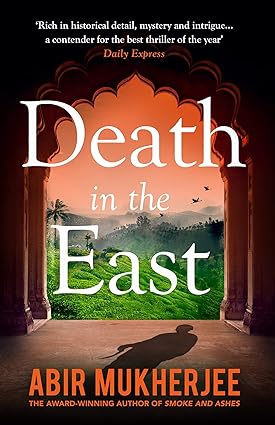
This series is maturing nicely. Smoke and Ashes is a fascinating book, cleverly constructed with a pair of lead characters you care about. It’s a classic whodunnit set within the broader landscape of India’s political and social upheaval. Smoke and Ashes is third in this fascinating Raj-era police procedural series. Next is Death in the East.

Here are my reviews of the first two books in the Wyndham & Banerjee series:-
A RISING MAN #1WYNDHAM&BANERJEE
A NECESSARY EVIL #2WYNDHAM&BANERJEE

If you like this, try:-
‘The Pure in Heart’ by Susan Hill #2SIMONSERRAILLER
‘Shroud for a Nightingale’ by PD James #4ADAMDALGLIESH
An Expert in Murder’ by Nicola Upson #1JOSEPHINETEY

And if you’d like to tweet a link to THIS post, here’s my suggested tweet:
#BookReview SMOKE AND ASHES by Abir Mukherjee @radiomukhers https://wp.me/p2ZHJe-8zc via @SandraDanby 

COMING SOON… THE NEXT BOOK I REVIEW WILL BE:- Amanda Huggins
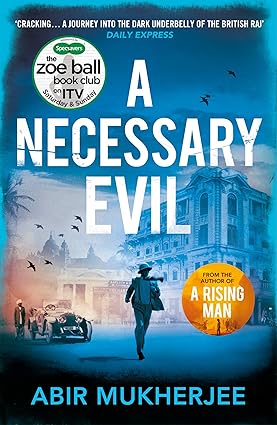
#BookReview ‘A Necessary Evil’ by Abir Mukherjee @radiomukhers #crime #historical #India

After thoroughly enjoying A Rising Man, first in the Wyndham & Banerjee Raj-era Indian crime series by Scottish author Abir Mukherjee, I couldn’t wait to read the next. A Necessary Evil doesn’t disappoint. Abir MukherjeeMukherjee has a wonderful way with words that make you smile but also put you straight into the place and time of his setting. Within five pages I’d already smiled three times, starting with the opening line, ‘It’s not often you see a man with a diamond in his beard.’ Other favourites include, ‘If the prince wanted to talk to me, it at least saved me from hanging around eavesdropping like an Indian mother on the night of her son’s wedding’ and ‘The man was bald, bespectacled and nervous – like a librarian lost in a dangerous part of town.’
When Captain Sam Wyndham and Sergeant Surendranath (aka Surrender-not) Banerjee accompany His Serene Highness the Crown Prince Adhir Singh Sai of Sambalpore to important government talks at Government House in Calcutta, they do not expect to witness a murder. The small but fabulously wealthy kingdom is thrown into uncertainty at a critical time; the Viceroy is inviting twenty local maharajas to join the new Chamber of Princes, as a sop to Indian demands for Home Rule. Adi’s younger brother, playboy Punit, is now heir to the throne and their father, the Maharaja of Sambalpore, is ageing.
Wyndham suspects the clues to Adi’s killer are based in his homeland and not in Calcutta. As a schoolmate of Adi at Harrow, Surrender-not is invited to the state funeral in Sambalpore and so Wyndham goes along too, ‘on holiday.’ Limited by the Raj’s absence of authority to investigate in the state of Orissa, language difficulties and the inability to speak to women living in purdah in the palace’s zenana, nevertheless Wyndham stubbornly continues to seek the truth. They encounter a maelstrom of politics, religion, ambition, secrets and jealousy with power at the heart.
Mukherjee writes atmospherically of this period towards the end of the Raj, juxtaposing the arrogant authoritarian but sometimes well-meaning nature of the Raj towards the Indians with that of the maharajas towards their subjects. It is a complicated time. The wealth on display is as glittering as the poverty is dirty. There is law and order, tradition and community. But scratch the surface to find cruelty, rivalry, envy and ambition; everywhere.
This is a fast-paced read with the two central characters catapulted into a dangerous political arena in a strange city where they have no back-up and no friends. Everyone comes under suspicion, except each other. Banerjee quite often adds a hand of restraint on Wyndham’s arm as he is about to go dashing off into the fray, whereas Wyndham adds words of encouragement and motivation when Banerjee’s self-confidence is wavering. They make a brilliant pairing.
A Necessary Evil is an exciting sequel to A Rising Man, faster-paced and more intricate. This series is now up and running. Next in the series is Smoke and Ashes.

Here are my reviews of two other books in the Wyndham & Banerjee series:-
A RISING MAN #1WYNDHAM&BANERJEE
SMOKE AND ASHES #3WYNDHAM&BANERJEE

If you like this, try:-
‘Murder at the Dolphin Hotel’ by Helena Dixon #1MissUnderhay
The Guest List’ by Lucy Foley
‘A Death in Valencia’ by Jason Webster #2MaxCamara

And if you’d like to tweet a link to THIS post, here’s my suggested tweet:
#BookReview A NECESSARY EVIL by Abir Mukherjee @radiomukhers https://wp.me/p2ZHJe-7Zz via @SandraDanby

COMING SOON… THE NEXT BOOK I REVIEW WILL BE:- Nicola Upson

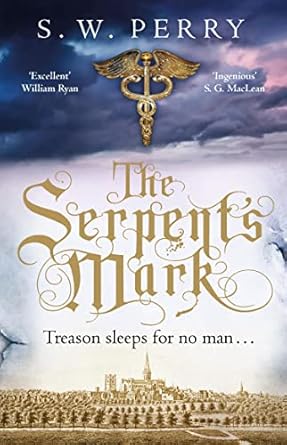
#BookReview ‘The Serpent’s Mark’ by SW Perry @swperry_history #historical #crime

Second in the Elizabethan Jackdaw Mysteries series by SW Perry, The Serpent’s Mark is a satisfyingly twisty story involving medical malpractice, religious fanatics, complicated espionage and a likeable pair of heroes. SW PerryThe story takes off from page one with many entangled knots that aren’t smoothed out into separate strands until the end of the book. Disgraced physician Dr Nicholas Shelby and apothecary-publican Bianca Merton are catapulted into an international conspiracy where chance plays as big a part as spycraft. The contrasting wealth and poverty in London in 1591 is real on every page, death or imprisonment can strike without warning and the poor are manipulated at the whims of the academics and the rich.
When Italian-born Bianca visits the Sirena di Venezia, a newly arrived ship from Italy, she is planning to encourage the crew to visit her inn where they will receive a warm welcome in their own language. On board she is surprised to find her cousin, Captain Bruno Barrani, a bit of a dandy who is trading rice. After Bruno is attacked and suffers a nasty head wound, Bianca nurses him at the Jackdaw inn where he is visited daily by members of his crew. Meanwhile Nicholas is in Gloucestershire, engaged by Robert Cecil to investigate the dodgy medical practices of a Swiss doctor, Professor Arcampora, who slimily refers to himself in the third person. Cecil is concerned that Arcampora, who has been engaged to treat a family member who suffers from the falling sickness, is a charlatan. Nicholas is acquainted with the family having fought alongside Sir William Havington and his son-in-law Sir Joshua Wylde in the wars in Holland. It is Joshua’s son, Samuel, who is ill. William is recently deceased and it his widow Lady Mercy who told her cousin Robert of her concern for Samuel. There are a lot of family twists to get your head around, who is related to who, who knew who when and what they did when they were younger.
This is a convoluted plot, impossible to predict, with some rather nasty medical procedures described. Sixteenth century medicine was not for the faint-hearted. Nicholas, called before the College of Physicians to answer charges of disreputable conduct and proficiency [featured in the first book, The Angel’s Mark] finds himself drawn to practical surgery and treatment that takes effect quickly rather than the approved medical procedures involving humours and astrology.
At the heart of the story is the continuing tension between the Protestant and Catholic faiths, full of dislike and suspicion which often tips quickly into violence. The tension builds as the separate paths followed by Nicholas and Bianca begin to mysteriously converge. Have they uncovered different plots or are they in some unseen way connected. Both are in danger, both must second-guess the other’s next move at pain of violence and possibly murder. How well do they really know each other, trust each other? And when will Nicholas be ready to put aside the grief for his dead wife and child, and recognise the chance of new love.
Bianca is an easy character to like, sharp-witted, resourceful, unbowed and brave when threatened. And it’s difficult not to cheer on Nicholas, kind-hearted, moral, brave but shy.
A page-turner. I’m looking forward to the next in the series, The Saracen’s Mark.

Here’s my review of the first book in the series:-
THE ANGEL’S MARK #1JACKDAWMYSTERIES

If you like this, try:-
A Traveller at the Gates of Wisdom’ by John Boyne
Glorious Exploits’ by Ferdia Lennon
Winter Pilgrims’ by Toby Clements #1Kingmaker

And if you’d like to tweet a link to THIS post, here’s my suggested tweet:
#BookReview THE SERPENT’S MARK by SW Perry @swperry_history https://wp.me/p2ZHJe-80C via @SandraDanby

COMING SOON… THE NEXT BOOK I REVIEW WILL BE:- Kristin Hannah

#BookReview ‘Alchemy’ by SJ Parris @thestephmerritt #historical #crime

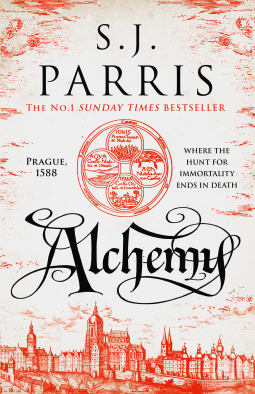
Prague 1588, the city of a hundred spires is also a city in political and scientific turmoil. In Alchemy, seventh in the excellent Giordano Bruno series by SJ Parris, lapsed Catholic Bruno arrives in Prague as a spy for Elizabeth I. He quickly discovers that this tolerant city, famed for freedom of thought and expression, is really seething with barely concealed hatred, suspicion and violence. SJ ParrisLiving a quiet academic life in the German city of Wittenberg, teaching at the university, Bruno receives a secret letter from the Queen’s spymaster, Sir Francis Walsingham. He bids him speed to Prague where he believes there is a plot against Emperor Rudolf, the Holy Roman Emperor and ally of Queen Elizabeth. When Bruno and his young student assistant Besler arrive in the city, they see a grizzly sight; the corpse of an alchemist hanging from the Stone Bridge, his eyes and tongue cut out. Killed, it is rumoured on the streets, by the Golem, a Jewish monster conjured by the Chief Rabbi of Prague and released in the city.
Bruno, who is hoping the emperor may be a patron enabling him to settle in the city to write and publish his philosophical books, arrives at the house where his mentor, scientist and free-thinker John Dee is lodging, to find him disappeared. Keen to find Dee, Bruno is instead tasked by the emperor to find the murderer of the alchemist, a favourite of his, Ziggi Bartos. Soon Bruno is confronted by an old enemy, one he hasn’t seen since he renounced the Catholic faith and fled Italy.
The juxtaposition of wealth and poverty, believers and chancers, scientists, gamblers and swindlers, is handled excellently. Parris has plotted a thriller which twists together the destinies of an eccentric emperor, a powerful Catholic lobby with a gang of toughs ready to threaten and kill, a disparate band of scientists all eager to make a big discovery and win the favour of Rudolf, and a Jewish quarter watched with suspicion and prejudice. As always Bruno is a reluctant detective who throws himself enthusiastically into his investigation, with multiple suspects and plots to explore. Being a stranger in town who doesn’t know the streets or speak the local language is a significant disadvantage. Bruno, sometimes too quick to trust, is made to reflect more than usual on his theories by the logical questions of his young assistant. Besler repeatedly asks why, and how?
A fascinating historical story packed with myth, legend and superstition, it is also great fun. Throw in a lion, the Emperor’s renowned erotic art collection, a precocious 11-year old, the naïve and charming Besler, the mysterious Powder Tower where the alchemists work, and Rudolf’s castle with its dark underground passages and opulent rooms full of artistic and scientific wonders. Wonderful.

Read my reviews of other books in the series:-
HERESY #1 GIORDANOBRUNO
PROPHECY #2 GIORDANOBRUNO
SACRILEGE #3 GIORDANOBRUNO
TREACHERY #4GIORDANOBRUNO
CONSPIRACY #5GIORDANOBRUNO
EXECUTION #6GIORDANOBRUNO

If you like this, try:-
The Angel’s Mark’ by SW Perry #1JackdawMysteries 
A Column of Fire’ by Ken Follett #3Kingsbridge 
Lord John and the Private Matter’ by Diana Gabaldon

And if you’d like to tweet a link to THIS post, here’s my suggested tweet:
#BookReview ALCHEMY by SJ Parris @thestephmerritt https://wp.me/p2ZHJe-7Z1 via @SandraDanby

COMING SOON… THE NEXT BOOK I REVIEW WILL BE:- Helena Dixon
#BookReview ‘A Rising Man’ by Abir Mukherjee @radiomukhers #crime #historical #India

I love discovering a new author and series and savouring the delight of books to come. A Rising Man by Abir Mukherjee is first in the Wyndham & Banerjee historical crime series set in Calcutta in 1919. Abir MukherjeeA fascinating combination of facts and settings get this book moving quicker than is normal for the first of a series. An English policeman newly arrived in India who asks awkward questions, a tradition-bound corrupt and racist white police force, a dead man found with a note in his mouth threatening the English in India, powerful men who are very enthusiastic about hanging the obvious suspect. All set within the framework of an India in the last decades of Empire when a newly-arrived Ghandi was advocating peaceful non-cooperation rather than violent terrorism.
Former Scotland Yard detective Captain Sam Wyndham arrives in Calcutta fleeing bad memories of tragedy at home and nightmares from trench warfare in the Great War. His tipple is whisky and, when things get really bad, opium. He joins an Indian Police Force organised on racial lines and operating according to the newly introduced Rowlatt Rules, emergency legislation to combat terrorism allowing indefinite detention and imprisonment without trial or judicial review. Wyndham, something of a naif and idealist, persists in following the method of investigation he learned in England which means he soon ruffles feathers.
The dead man is an important white civil servant, that he was found dead outside a brothel in a dodgy part of town means the powers-that-be want a quick arrest. Wyndham, with Sub-Inspector Digby and Sergeant ‘Surrender-not’ Banerjee, must find the killer quickly. Wyndham acts on instinct. Digby, the cynical old hand who has been looked over for promotion, is steeped in the casual racism with which Calcutta is riddled. Banerjee is the fresh-faced Indian policeman, university-educated, who always asks the pertinent questions but is painfully shy with women. One of the pleasures of the book is seeing the friendship between Wyndham and Bannerjee develop.
Fresh, entertaining. A very satisfying read. Next is A Necessary Evil.

Here are my reviews of two other books in the Wyndham & Banerjee series:-
A NECESSARY EVIL #2WYNDHAM&BANERJEE
SMOKE AND ASHES #3WYNDHAM&BANERJEE

If you like this, try:-
Wilderness’ by Campbell Hart #1Arbogast
Darktown’ by Thomas Mullen
Death at the Sign of the Rook’ by Kate Atkinson #6JacksonBrodie

And if you’d like to tweet a link to THIS post, here’s my suggested tweet:
#BookReview A RISING MAN by Abir Mukherjee @radiomukhers https://wp.me/p2ZHJe-7SD via @SandraDanby

COMING SOON… THE NEXT BOOK I REVIEW WILL BE:- Verity Bright

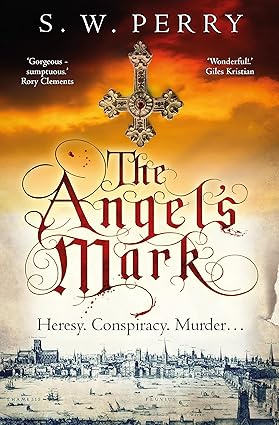
#BookReview ‘The Angel’s Mark’ by SW Perry @swperry_history #historical #crime

SW Perry is a new author for me. I first came across the Jackdaw Mysteries when The Rebel’s Mark was published. But, discovering that book was fifth in the series, I decided to start at the beginning with The Angel’s Mark. And I’m so glad I did. SW PerrySome first novels of a series can seem a little slow, concentrating on establishing world and character at the expense of tension but in The Angel’s Mark, Perry tells a rollicking good historical mystery. It is 1590, Queen Elizabeth I’s reign is nearing its end, Catholics are still celebrating mass in secret, there are wars, plotting, spies and witchcraft. Young physician Nicholas Shelby has a good career ahead of him and is due to become a father until tragedy sends him reeling towards alcoholism, vagrancy and ruin.
This is at once a sad story, and one of hope. Watching Nicholas suffer the worst imaginable kind of grief is a painful read, until Perry presents him with a puzzle to be solved, a medical dilemma that doesn’t make sense, a challenge to his intellect currently sozzled by alcohol and to his vanished self-esteem. He is convinced a killer is at large, preying on the weak, unfortunate and overlooked in London’s streets. At first no-one wants to hear his complaints, the victims are found south of the river, unimportant, and Shelby is a ruined man, certainly no doctor, whose word cannot be trusted. Each victim has a strange symbol cut into the leg; could it be devilry, a sacrifice? But Shelby is still a physician at heart, he believes in facts and evidence not hearsay and superstition. So with the help of innkeeper Bianca Merton, who rescued him at his lowest point, he begins to investigate. Their search for the truth takes them into one of the most glamorous houses in London, Nonsuch Palace. Bianca is a fascinating character; an apothecary and healer forbidden a license to practise, she runs an inn, keeps a herb garden and helps local people with her salves and potions.
A well-written thriller in Elizabethan London featuring a likeable hero with a strong conscience and vulnerabilities. If, like me, you love Shardlake, give this series a go.

If you like this, try:-
The Almanack’ by Martine Bailey #1TabithaHart
The Swift and the Harrier’ by Minette Walters
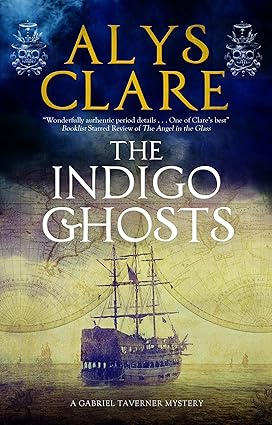
A Rustle of Silk’ by Alys Clare #1GabrielTaverner

And if you’d like to tweet a link to THIS post, here’s my suggested tweet:
#BookReview THE ANGEL’S MARK by SW Perry @swperry_history https://wp.me/p2ZHJe-7PM via @SandraDanby

COMING SOON… THE NEXT BOOK I REVIEW WILL BE:- Joseph O'Connor
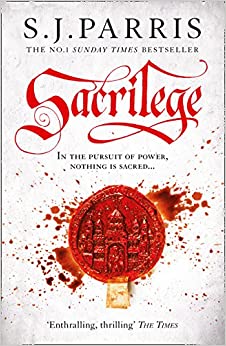
#BookReview ‘Sacrilege’ by SJ Parris @thestephmerritt #historical #crime

Everywhere he goes in the England of Queen Elizabeth I, Italian philosopher Giordano Bruno runs into trouble. In Sacrilege, third in this quickly-becoming-addictive series by SJ Parris, Bruno is in Canterbury to help an old friend prove her innocence of murder. And to spy for his master, Sir Francis Walsingham. SJ ParrisWhen the woman he loved in the first book of the series asks for his help, Bruno risks the wrath of Walsingham and heads to Canterbury. Set in turbulent political times, the various historical plots are twisted and complicated. Weary at Bruno’s determination to pursue what he believes is a lost cause, Walsingham charges him with identifying a traitor in the cathedral administration in Canterbury. Parris weaves a fictional plan by Catholics in Britain and France to use the ‘discovered’ bones of Thomas Becket to anoint a new Catholic king when France should invade England. The labyrinthine politics and geography of the inner sanctums of Canterbury cathedral add to the tension. The scenes in the crypt are thrilling as Bruno again and again takes huge risks to discover the truth. When he is charged with murder and a fabricated charge of theft, he realises his contacts at the royal court in London are too far away to help.
Bruno is a foreigner in England, a country where a strange accent and tanned skin make him an instant threat, his guilt automatically assumed. Parris populates her Canterbury with a collection of believable fictional characters, conflicted people who must sometimes take a wrong decision in order to survive or protect a loved one. Throw in an odious servant, a persecuted family of Huguenot weavers, a tremulous canon who has spied for Walsingham but missed some big hints of trouble and an independently-minded young woman not afraid to tell the truth as she sees it.
At times the pace slows to walking speed but turn a page and another chase begins or clue arrives. When the twist arrived at the end I was surprised, then realised I had known all along. Surely a satisfactory conclusion?
CLICK HERE TO READ MORE ABOUT THIS BOOK AT AMAZON

Read my reviews of other books in the series:-
HERESY #1GiordanoBruno
PROPHECY #2GiordanoBruno

If you like this, try:-
The Diabolical Bones’ by Bella Ellis
Lord John and the Private Matter’ by Diana Gabaldon
Or the Bull Kills You’ by Jason Webster

And if you’d like to tweet a link to THIS post, here’s my suggested tweet:
#BookReview SACRILEGE by SJ Parris @thestephmerritt https://wp.me/p5gEM4-5CC via @SandraDanby

#BookReview ‘The Vanished Bride’ by Bella Ellis #historical #crime

Yorkshire, 1845. A woman disappears overnight from her home. Her husband is distraught. All that remains of her is copious amounts of blood on the bed. The local police are inept. The Vanished Bride by Bella Ellis [also writing as Rowan Coleman] is the first in the ‘Bronte Mysteries series about the three Bronte sisters, amateur sleuths. Bella EllisI loved this book from the beginning. Bronte fans will love it but anyone new to Bronte will find it an engaging introduction to the three clever and inspirational sisters. What a fresh idea to involve Charlotte, Emily and Anne in an occupation that suits their imaginations, attention to detail and energy. Anne says, ‘It is truly terrible that I am a little thrilled to think of us as three invisible lady detectors seeking out the truth? I believe we could be quite the only such creatures in all existence.’
Their characters are clearly drawn and their engagements with other characters – brother Branwell, father Patrick, cook Tabby and maid Martha – are all convincing. The case of the vanished bride comes to their attention because the governess to the two small children of the missing woman is none other than Matilda French, a former schoolfriend of Charlotte and Emily at Cowan Bridge school.
As they track down clues and bravely confront strangers to ask questions, the three sisters must learn to manage the wilder leaps of their imagination and use judgement to analyse clues, sifting, comparing, discarding. At first their naivety while charming, is a problem, as they tend to believe everything they hear. But they soon wise up to the disreputable agendas of others and become adept at setting trick questions, analysing body language, and basically not believing everything they are told. Stepping outside their comfort zone at Haworth, they venture into worlds not usually frequented alone by unmarried women. Though obviously a fictional not historical account, it is an interesting picture of the real world limitations they faced.
Owing not a little to the gothic, their detecting involves folklore and supernatural elements, a wonderful journey to the seaside at Scarborough to find a witness, and thrilling night time excursions involving a little breaking and entering. Throughout it all, their clergyman father is ignorant of their ‘detecting’ and the risks they take, and they become adept at soothing his concerns at their odd behaviour.
The author has been a Bronte fan since childhood and this is demonstrated in her knowledge of character, setting and historical context. In the Author’s Note, she explains her choice of August 1845 for this first novel. Charlotte has returned home from Brussels to join Emily while Branwell and Anne are home again from employment at Thorp Grange. It is the first time for several months the four are under the same roof. The characters, the settings, are pure Bronte; the detective story is Ellis’s own.
To set the timing of The Vanished Bride within the context of the Brontes’ real life, it takes place a year before their first publication – of Poems by Currer, Ellis and Acton Bell – in 1846. In 1847, Charlotte’s Jane Eyre, Emily’s Wuthering Heights, and Anne’s Agnes Grey, were published.
Excellent, one of the most enjoyable books I’ve read this year.

Click the title below to read my reviews of these other Bella Ellis novels:-
THE DIABOLICAL BONES #2BRONTEMYSTERIES
THE RED MONARCH #3BRONTEMYSTERIES
A GIFT OF POISON #4BRONTEMYSTERIES

And one by Rowan Coleman [aka Bella Ellis]:-
THE GIRL AT THE WINDOW 

If you like this, try:-
The Dream Weavers’ by Barbara Erskine
Yuki Chan in Bronte Country’ by Mick Jackson
A Snapshot of Murder’ by Frances Brody 

And if you’d like to tweet a link to THIS post, here’s my suggested tweet:
#BookReview THE VANISHED BRIDE by Bella Ellis https://wp.me/p5gEM4-4uY via @SandraDanby

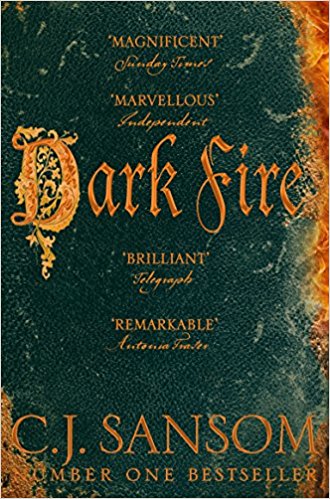
#BookReview ‘Dark Fire’ by CJ Sansom #Tudor #detective

Dark Fire by CJ Sansom is a story of political intrigue, whodunit and a Tudor weapon of mass destruction. Second in the series about Tudor lawyer Matthew Shardlake, Dark Fire combines two criminal mysteries; the appearance and subsequent disappearance of the alchemical formula to make an ancient terrifying weapon, and the impending trial and expected sentencing of a young woman to death by pressing. CJ SansomDespite a tenuous connection between the two cases, and a somewhat meandering pace at times, I enjoyed this book for its further development of Shardlake, first seen in Dissolution. It is 1540, King Henry VIII wishes to anul his marriage to Anne of Cleves, recommended to him by Thomas Cromwell, and marry instead the teenager Catherine Howard. At the beginning of the book Cromwell’s relationship with Henry is weakening and this imposes time pressure on both the novel and on Shardlake. As the novel opens, the lawyer is defending Elizabeth Wentworth, a teenage girl accused by her family of killing her cousin by pushing him down a well. She languishes in the Hole in the cellars of Newgate Prison and refuses to speak. Shardlake, though convinced of her innocence, despairs of being able to help her.
The alchemical formula for Greek Fire, the legendary substance with which the Byzantines destroyed the Arab navies, has been lost for centuries but is discovered in the library of a closed monastery in London by a government official. Cromwell decides to present it to the king as a demonstration of his fealty. He charges Shardlake with finding the Greek Fire within two weeks; to ease this he instructs the postponement of Elizabeth’s case for two weeks. As in Dissolution, Shardlake is once again living every minute under threat of Cromwell’s demands and bad temper. When Shardlake tracks down the official and his alchemist brother, he is too late; both men are dead and the formula is missing. So starts a chase across London.
As always with Sansom, the historical setting is convincingly written with vivid descriptions of the lives of rich and poor, the divisions between them and the melting pot that is the City and its surroundings in Tudor London. As this is the second book of the series, the community around Shardlake is becoming clearer and we see a small group of people who are different. Shardlake with his hunched back; Brother Guy, Moor and apothecary, who is stared at on the streets because of the colour of his skin; Jack Barak, Cromwell’s assistant who is sent to work with Shardlake, is threatened because of his Jewish heritage. Shardlake seems a modern interpretation of a sixteenth century lawyer; he has enlightened views of both race and the role of women, and is becoming disillusioned with religion. These loyalties and views potentially cause trouble for him, adding to the vulnerability that makes him appealing.
A pleasure to read, I am hooked on this series.
CLICK HERE TO READ MORE ABOUT THIS BOOK AT AMAZON

And here are my reviews of other novels by CJ Sansom:-
DOMINION
DISSOLUTION #1SHARDLAKE
SOVEREIGN #3SHARDLAKE
REVELATION #4SHARDLAKE
HEARTSTONE #5SHARDLAKE
LAMENTATION #6SHARDLAKE

If you like this, try:-
The Western Wind’ by Samantha Harvey
The Wicked Cometh’ by Laura Carlin
The French Lesson’ by Hallie Rubenhold

And if you’d like to tweet a link to THIS post, here’s my suggested tweet:
#BookReview DARK FIRE by CJ Sansom https://wp.me/p5gEM4-3Ne via @SandraDanby

#BookReview ‘Lord John and the Private Matter’ by Diana Gabaldon @Writer_DG #historical #crime

If you have read the time-travelling Outlander series by Diana Gabaldon, you will be familiar with the character of Lord John Grey. Lord John and the Private Matter is a historical detective story starring Lord John in his own right, without Jamie and Claire Fraser. Many Gabaldon fans will bemoan the lack of the Frasers, but Lord John is a quite capable protagonist. Diana Gabaldon

Gabaldon is an experienced storyteller and she paints a picture of London in 1757 which the reader trusts as authentic. The plot pushes on as Lord John gets involved in two separate matters which in the beginning I found a little confusing, but which inevitably became neatly entwined. Along the way he encounters an eccentric German, a sweet whore and a dodgy molly house, all of which he deals with in his distinctive charming and intelligent manner. Lord John is certainly worthy of his own standalone series, and can be read independently of the Outlander series. This book is more than just a tale for readers suffering from Fraser-withdrawal syndrome. And it is also much shorter, Gabaldon could never be accused of writing novellas.

If you like this, try:-
The French Lesson’ by Hallie Rubenhold
The Lady of the Rivers’ by Philippa Gregory
The Secrets of Gaslight Lane’ by MRC Kasasian #4GOWERDETECTIVE

And if you’d like to tweet a link to THIS post, here’s my suggested tweet:
#BookReview LORD JOHN AND THE PRIVATE MATTER by Diana Gabaldon @Writer_DG https://wp.me/p2ZHJe-4ax via @SandraDanby