Tag Archives: Roman Empire

#BookReview ‘Tyrant’ by Conn Iggulden #historicalfiction #RomanEmpire

Wow. Tyrant, book two of the Nero trilogy by Conn Iggulden, doesn’t disappoint. An ageing emperor who appeases his younger wife. A fatherless son, wild and untameable. His ruthless mother, single-minded, unscrupulous, determined her son should rule. This is the story of Nero’s ascent to the most powerful seat of all. Conn IgguldenIn his portrayal of Roman history, Iggulden’s writing bears his research lightly. Never once did I sense a fact included superfluously, everything was there for a reason. Where historical accounts are thin, Iggulden adds his own fictional interpretation. The result is a gripping story of political machinations not unfamiliar to today’s global governments, where ambition and dominion drive everything; loyalty is fragile, words have double meanings, while at the heart of it all are money and power.
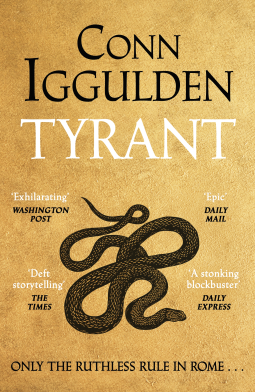
Where Nero was the story of Agrippina, Tyrant is the story of her son Lucius, now re-named Nero. A headstrong teenager, Nero is out of control. His mother persuades her husband Emperor Claudius, and now Nero’s adoptive father, to name Nero as his heir in place of his natural son Britannicus who is the butt of Nero’s ridicule. An education is arranged at the hands of statesman and dramatist Seneca and praetorian Burrus.
A combination of political power struggles, subterfuge, a spot of teenage shoplifting and reckless charioteering, Tyrant shows Rome at its bloodiest and most dangerous. Plenty of plot twists, betrayals and plotting set against excessive wealth. I particularly enjoyed the portrayal of the naumachia, a naval battle in a flooded amphitheatre between ships crewed by prisoners of war. I was willing on Caractacus; first seen in Nero, as king of the Catuvellauni in Britain he fought the Romans many times but was captured and taken to Rome as a prisoner. He provides an interesting comparison on the nature of leadership, responsibility and power.
Conn Iggulden’s portrayal of Nero is compelling, despite the darkness, brutality and often insanity of the story. It’s a tribute to his storytelling that the writing does not descend into hyperbole. Tyrant is the story of Nero from boy to man, as he breaks free of the influence of his mother. A really entertaining read.
The final book of the trilogy is Inferno.

Read my review of NERO, first instalment of Conn Iggulden’s ‘Nero’ trilogy

If you like this, try:-
The Beasts of Paris’ by Stef Penney
The Last Hours’ by Minette Walters #1BlackDeath
‘The Lost Lights of St Kilda’ by Elisabeth Gifford

And if you’d like to tweet a link to THIS post, here’s my suggested tweet:
#BookReview TYRANT by Conn Iggulden https://wp.me/p2ZHJe-8i1 via @SandraDanby

COMING SOON… THE NEXT BOOK I REVIEW WILL BE:- William Boyd

#BookReview ‘Sparrow’ by James Hynes #historical #RomanEmpire

Sparrow by James Hynes is a unique novel. It is a harsh and unrelenting story, often harrowing to read, about a slave boy in a brothel in a Spanish city on the edge of the fading Roman Empire. It is a slow burner told in retrospective by the grown boy, now a man called Jacob. So, we know he survives but we don’t know how. James HynesIn the city of New Carthage [now Cartagena in Spain] towards the end of the Roman Empire, Pusus, the slave name for ‘boy,’ is growing up in Helicon, a taberna with a brothel upstairs. Pusus thinks this is the name he was given by his parents, until he learns that slave names refer to the job done by that slave. His nickname in the household is Mouse. He lives a hard life but the women of the taberna, particularly cook Focaria and wolf Euterpe [one of the whores] try to shield him. Euterpe tells him stories, in part to distract him, in part to educate him but as Pusus sees more of the world outside Helicon he’s unsure if her stories are true or not. As he is exposed to the harsh realities of slave life he begins to resent her untruthfulness.
One day Euterpe tells a story about a small bird, a sparrow, and Pusus realises he is like a sparrow who is ‘not excellent at anything, but just good enough at everything.’ Being a slave means his body, his time, his privacy and everything about him belongs to his Dominus, his master, and Audo, the bully who manages the brothel. Only his thoughts are still his own. So Pusus imagines himself as a sparrow flying high, flying free, up high in the sky, looking down at life in the taberna and the small thin slave boy below.
His first job is as house boy, scrubbing floors. The taberna and its enclosed garden are his world, he’s not allowed beyond the heavy wooden door to the street. Next, he is sent out to the local fountain to fill the heavy water buckets. Then he is trusted with money to visit local merchants and buy bread and fish and deliver dirty sheets to the laundry. With each new freedom comes a wakening awareness of the wider world of Carthago Nova. Until the day comes when Pusus is renamed Antinous and moves upstairs into his own cell amongst the wolves.
The story moves slowly, tiny detail built on tiny detail. It is told retrospectively by the elderly Jacob, how old he is we don’t know, as he reflects on the ups and downs of his life at Helicon. Jacob is educated, he reads the philosophers and histories and reflects on his life as a boy. The Roman Empire ended in AD476 but Sparrow’s life speaks also about today’s class distinctions, racism, selfishness and corruption. The detail of life in Carthago Nova is honest and tough, the sophistication of the mansions, the grinding poverty of the slaves and the free people who live hand to mouth. The neighbours of the taberna, tradesmen such as fullers and bakers, are often customers of the wolves upstairs. There is a clear strata to society which reminds me of the 1966 Frost Report sketch ‘I Know My Place’ featuring John Cleese, Ronnie Barker and Ronnie Corbett. Watch it at You Tube.
There is much pain, mental and physical, and always the threat that if Pusus doesn’t pick himself up he will be sold at the slave market. There is also sex, friendship, betrayal, abuse, violence, ambition and corruption. I honestly can’t say I enjoyed this story, it is too brutal for that, but it tells a story of a time long ago, and a time that is now.

If you like this, try:-
The Wolf Den’ by Elodie Harper #1WolfDen
A Traveller at the Gates of Wisdom’ by John Boyne
‘The Silence of the Girls’ by Pat Barker

And if you’d like to tweet a link to THIS post, here’s my suggested tweet:
#BookReview SPARROW by James Hynes https://wp.me/p2ZHJe-76L via @SandraDanby

COMING SOON… THE NEXT BOOK I REVIEW WILL BE:- Noah Hawley