Tag Archives: The Blitz

#BookReview ‘The Camomile Lawn’ by Mary Wesley #WW2

It’s many years since I first read The Camomile Lawn by  Mary Wesley. I remember liking it, and that one of the characters is called Calypso, but nothing else. So it was with delight that I read the wartime story of Calypso and her four cousins – Oliver, Polly, Walter and Sophy. It renewed my intention to re-read all Wesley’s novels. Mary WesleyThe story is enrichened by the mode of telling. It starts in Cornwall in the summer of 1939 as the cousins of assorted ages gather for what will be the last time. There is a poignancy hanging in the air as the run their ritual race, The Terror Run, along the clifftop path, joined by their neighbours, the Floyer twins.
The cousins are the children of the three Cuthbertson siblings – we see the parents only fleetingly, if not at all – but they are gathered at their Uncle Richard’s house and picnic on the camomile lawn. What follows are the piecemeal stories of individuals and how they overlap with each other as the war progresses. Overlaid, are short passages from the Eighties as they travel independently to Cornwall for a funeral. Drawn into the cousins’ stories are their neighbours, in Cornwall and London, wartime acquaintances, lovers, and refugees Max and Monika. Amidst the bombings, the rationing and the worries about loved ones fighting, Wesley tells a story of a family both united and separated, as individuals strike out on their own, liberated by wartime urgencies. There are affairs, unexpected babies, hints of underage sex, all without accusations of blame or betrayal. Each makes assumptions about the others, assumptions the reader may know are misplaced given we are privileged to see into the minds of each cousin, and sometimes assumptions which are proven right or wrong only at the very end of the novel.
Paths cross, diverge and cross again. Not everyone is nice, not everyone is honest. They are people getting through the war, trying to keep things together; some turn to drink and partying, one keeps guinea pigs, most feel emboldened by the openings presented to them by war. And all the time, fear lurks in the pit of their stomachs. And through it all, the house in Cornwall and memories of that last party on the camomile lawn, remind us of pre-war normality. At a time when ‘normal’ ceases to exist.
Very different from other wartime novels. Now a classic.

Read the first paragraph of THE CAMOMILE LAWN.

If you like this, try:-
‘The Guernsey Literary and Potato Peel Pie Society’ by Mary Ann Shaffer & Annie Barrows
Half of the Human Race’ by Antony Quinn
My Dear, I Wanted to Tell You’ by Louisa Young 

And if you’d like to tweet a link to THIS post, here’s my suggested tweet:
#BookReview THE CAMOMILE LAWN by Mary Wesley https://wp.me/p5gEM4-48g via @SandraDanby
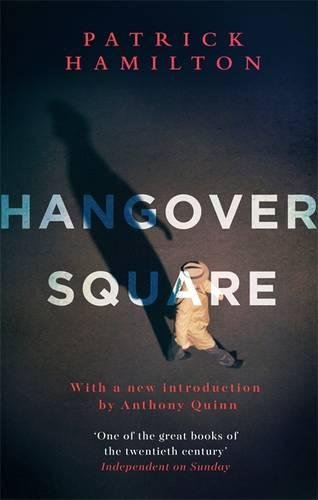
#BookReview ‘Hangover Square’ by Patrick Hamilton #WW2 #historical

Hangover Square by Patrick Hamilton, first published in 1941, is deservedly being re-discovered as a perceptive portrayal of people getting-by, living in the low rent district of Earls Court, London, months before war is declared. It is the mournful tale of one man’s hopeless love for a woman who exploits him relentlessly, his inability to see her for what she is, and the battle of his psyche, half of which is telling him to commit murder. Patrick HamiltonGeorge Harvey Bone loves Netta Longdon despite, or perhaps because of, her disdain for him. ‘When she had finished making up, she went into the sitting room to change her shoes, and he followed her. He was always following her, like her shadow, like a dog.’ This is a novel about love, about living on the edge, and schizophrenia, and about the underbelly of a city paused on the brink of war.
The story flicks back and forth in George’s head between his lucid moments planning a new life in Maidenhead when he will stop drinking, and what happens after the ‘click’ in his head – a blackout or loss of sense of time and place – when he realizes the only solution is to kill Netta. George is put-upon by Netta and her circle of friends, he buys drinks, brings food, and they tolerate his company only when he can contribute something. Netta goes to Brighton with George, not to be with him but because she hopes he can introduce her to someone useful. George, bless him, fails to see this. ‘She was wildly, wildly, lovely that night. He looked across the table at her, and she was violets and primroses again.’ Netta and her heartless group of friends exploit George mercilessly and he allows them to do it.
Hamilton’s Earls Court is a seedy place where people get-by on little money, living in rented rooms or boarding houses, scrounging off others, seemingly without jobs to go to. Netta goes to bed in the small hours, rises at eleven in the morning with a hangover – the Hangover Square of the title – then navigates her day via pubs, bars and restaurants or drinking from a bottle of gin provided by a friend. Brighton – London-by-the-Sea – brings a breath of fresh air but, as is always the way, George’s problems follow him there. There is a lovely section when he plays golf, a successful round which gives him the confidence to woo Netta. ‘He wasn’t going to get drunk. She could drink if she wanted to, but he wasn’t going to – at least only a little. He was going to keep his head.’ The irony, of course, is that George is schizophrenic and has another psychotic episode.
This novel is very funny in places, in others the action can seem slow to progress, but I found myself willing George to tell Netta where to go. He is the sort of character you want to take by the hand. Of course, he is unable to stand up to Netta’s rude and ungrateful behaviour and it is the uncertainty of what he will do, where he will go, and whether his schizophrenic murder plans will come to fruition, which made this such an absorbing read.

Read my review of THE SLAVES OF SOLITUDE, another World War Two novel by the same author, and click here to try the #FirstPara of THE SLAVES OF SOLITUDE.

If you like this, try:-
The Heat of the Day’ by Elisabeth Bowen
Midnight in Europe’ by Alan Furst
At Mrs Lippincote’s’ by Elizabeth Taylor

And if you’d like to tweet a link to THIS post, here’s my suggested tweet:
#BookReview HANGOVER SQUARE by Patrick Hamilton http://wp.me/p5gEM4-2EQ via @SandraDanby 

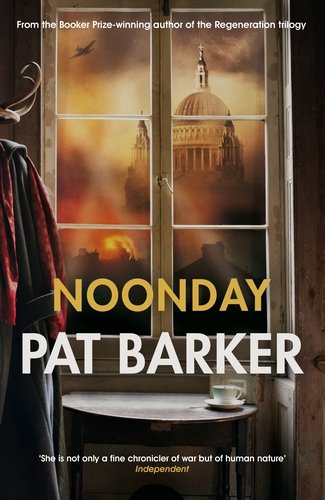
#BookReview ‘Noonday’ by Pat Barker #WW2 #historical

It seems inevitable that the final novel in a trilogy which started with the Great War should end with the Blitz, and that the theme should be death. Death, grief, guilt at being alive, guilt at longing for death, and guilt at wishing another dead. Noonday is a fitting end to the ‘Life Class’ trilogy by Pat Barker, the tale of three young artists – Elinor Brooke, Paul Tarrant and Kit Neville – which started on the verge of the Great War in Life Class, and continued through the war in Toby’s Room. But although the context is war, there are a lot of other things going on. Pat BarkerThe story opens with Elinor at the country home of her mother, who is dying. The assorted relatives wait, in the scorching heat, for death to arrive. Also present is Kenny, an evacuee sent from London to avoid death by bombing. So, the shadow of death is present from the very first page. Don’t forget about Kenny, he is important, particularly in the impact he has on Paul Tarrant – now Elinor’s husband. Paul’s connection with this sorry out-of-place boy leads him to a meeting with a medium, Bertha Mason. This is a story thread criticised by some readers as being irrelevant – and perhaps it is in that it doesn’t connect with either Elinor or Kit – but for me it falls within the theme of grief in war when it is common to not see the body of your loved one. Death, in war, surrounds everyone daily, is expected daily, but is not easier to accept. Perhaps it is understandable that in these circumstances, without a body to bury, communicating with ghosts becomes popular.
As with Life Class and Toby’s Room, the lives of the three protagonists are entwined like snakes. Elinor and Kit are London ambulance drivers, Paul is an air raid warden by night and official war artist by day. The Blitz is the fourth character on the page. The final third of the book is an intense description of the firebombing of the City, an experience which Barker describes with simplicity, urgency, and not a spare word.
Barker is one of my favourite living authors because she writes with such detail about small things, seemingly insignificant ordinary things, but which in her hands and in the context of her story, add layers of meaning. She pays equal attention to the lives of her three main protagonists, the interaction of their lives, and how their desires and motivations impact on each other. She does not step away from sharing an unpleasant thought or action, she tells it as it is, and for this she is a clear voice in a modern world of fiction in which characters often seem too ‘nice’. But that is not realistic and it is not Pat Barker’s way.

For my reviews of other Pat Barker novels, click the title below:-
ANOTHER WORLD
BLOW YOUR HOUSE DOWN
DOUBLE VISION
LIFE CLASS #1LIFECLASS
TOBY’S ROOM #2LIFECLASS
THE SILENCE OF THE GIRLS
THE WOMEN OF TROY
UNION STREET

If you like this, try:-
‘Mrs Sinclair’s Suitcase’ by Louise Walters
‘The Paying Guests’ by Sarah Waters
‘Midnight in Europe’ by Alan Furst

And if you’d like to tweet a link to THIS post, here’s my suggested tweet:
#BookReview NOONDAY by Pat Barker via @SandraDanby http://wp.me/p5gEM4-1Rf