Tag Archives: World War Two

#BookReview ‘The Book of Lies’ by Mary Horlock #Guernsey #WW2

What is the truth and what is a lie? Is a fib a lie, is an omission a lie? And what would make you lie? To save yourself, to save a loved one? Is it okay to lie in war? I read The Book of Lies by Mary Horlock without keeping the title in my mind, but at the end I knew what the title meant. Mary Horlock The island of Guernsey is the setting for this family story told through the eyes of two children: in 1985, Catherine is 15; in 1940, her uncle Charlie is 12. He sees the German soldiers arrive to occupy the small island; a generation later, Cat still feels the after-effects of the lies told then. More lies are being told now, the difficulty is in identifying truth from lies.
Cat is central to the novel. She is an irreverent narrator who tells us not only her own story but also the history of the island and her family’s war story. She was told both stories by her father, and now that he is dead Cat wishes she had asked him more questions. Cat’s voice is a true teenager, her banter is littered with humour, insecurity, crushes, curiosity and indignation. Charlie’s story is told in flashbacks, but mostly through the transcripts of tapes made of his conversation with his brother Emile, Cat’s father’, telling the truth of what happened to him.
Keep reading, the twists and turns of this family, its tricks and lies, its love and secrets, ends in a twist I didn’t see coming. Forty-five years later, the truth still hurts.

If you like this, try:-
Mrs Sinclair’s Suitcase by Louise Walters
A Week in Paris’ by Rachel Hore
‘The Light Years’ by Elizabeth Jane Howard #1CAZALETCHRONICLES

And if you’d like to tweet a link to THIS post, here’s my suggested tweet:
#BookReview THE BOOK OF LIES by Mary Horlock http://wp.me/p5gEM4-1LQ via @SandraDanby
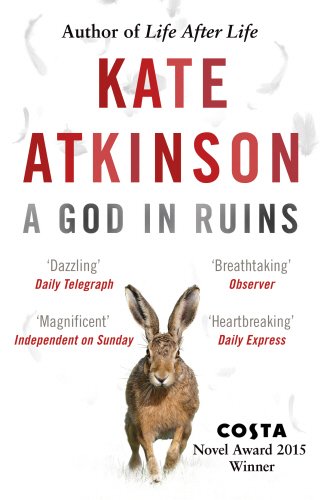
#BookReview ‘A God in Ruins’ by Kate Atkinson #WW2

If the best recommendation for a novel is that, once you finish it, you want to start reading it all over again, then this is my recommendation for A God in Ruins by Kate Atkinson. The story of Teddy Todd reeled me in until I was reading late into the night.

Kate AtkinsonTeddy is brother to Ursula Todd, who featured in Atkinson’s Life after Life, but this is not a sequel. More a companion piece, one book informs the other but stands up fully on its own. Read either first, it doesn’t matter. This is a book about war – the Second World War, the daily grind of Teddy’s life as a bomber pilot – and the effect this experience has on the rest of his life. War doesn’t happen and then go away, it colours lives and affects them until death, mostly unnoticed or misunderstood by relatives. And so we see Teddy’s life, told in a chopped up manner with excerpts from his childhood, war, early marriage and fatherhood, and as a much-loved grandfather. I don’t think I’m giving much away here to say he survives the war, but Atkinson’s descriptions of his bomber sorties are realistic, we feel the cold, the fear, the near-misses, the camaraderie, the determination and discomfort. Reading the bibliography at the back of the book, her research was thorough but it never shouts out from the page. Details are included because they are important to Teddy’s life, not because they happened.
Kate Atkinson remains a ‘go to’ author for me, I buy every book she writes.

Read my reviews of these other books by Kate Atkinson:-
BIG SKY #5JACKSONBRODIE
DEATH AT THE SIGN OF THE ROOK #6JACKSONBRODIE
LIFE AFTER LIFE
NORMAL RULES DON’T APPLY
SHRINES OF GAIETY
TRANSCRIPTION

… and try the #FirstPara of EMOTIONALLY WEIRD

If you like this, try:-
The Aftermath’ by Rhidian Brook
The Light Years’ by Elizabeth Jane Howard
After the Bombing’ by Clare Morrall

And if you’d like to tweet a link to THIS post, here’s my suggested tweet:
#BookReview A GOD IN RUINS by Kate Atkinson via @SandraDanby http://wp.me/p5gEM4-1IK

My Top 5… World War Two novels

This was an impossible list to write. My childhood was filled with World War Two novels and films, plus lots of cowboy and westerns too, thanks to my father. So this list combines childhood favourites with literature discovered in later years.

‘Sophie’s Choice’ by William Styron World War TwoWho can forget the book, or that scene in the 1982 film. Sophie’s Choice: the phrase now commonly known to mean ‘an impossible choice’. Buy now

‘Where Eagles Dare’ by Alistair MacLean World War TwoThe 1968 film: Clint Eastwood, Richard Burton, need I say more? I gobbled Alistair MacLean’s books as a child; cheap paperbacks bought by my father and read by us all. Old-fashioned now, but still great page-turners. Buy now

‘Schindler’s Ark’ by Thomas Keneally World War TwoI bought this one in July 1983 after it won the 1982 Booker Prize. In 1993 it was made into the film Schindler’s List starring Liam Neeson as Oskar Schindler, Ben Kingsley as Itzhak Stern and a young Ralph Fiennes as the terrifying Amon Goeth. Buy now

‘Fortunes of War 1-3’ [The Balkan Trilogy] by Olivia Manning World War TwoGuy and Harriet Pringle [aka a very young Kenneth Branagh and Emma Thomspon, then married in real life, in the 1987 BBC television production]. I read the trilogy with hunger, back-to-back. They are still on my bookshelf, in fact all of these top five books are still on my bookshelf as are the others listed below. Buy now

‘Empire of the Sun’ by JG Ballard World War TwoAnother book turned into a great film. Features the Batman actor as a child, Christian Bale. This was the edition I bought, and my introduction to Ballard. After this, I bought many more of his books. Buy now

I have many more favourites:-
Fatherland and Enigma by Robert Harris
The English Patient by Michael Ondaatje
The End of the Affair by Graham Greene
The Reader by Bernhard Schlink
The Eagle has Landed by Jack Higgins
Captain Corelli’s Mandolin by Louis de Bernières
Restless by William Boyd
Suite Française by Irène Némirovsky
A Town Like Alice by Nevil Shute

Others on my to-read pile?
Those Who Save Us by Jenna Blum
Every Man Dies Alone by Hans Fallada
Night by Elie Wiesel

Do you agree with my other ‘Top 5’ choices?:-
My Top 5… music to write to
My top 5… novels about paintings
My Top 5… the Booker winners I re-read, and why

And if you’d like to tweet a link to THIS post, here’s my suggested tweet:
My Top 5 #WW2 novels http://wp.me/p5gEM4-1eh via @SandraDanby

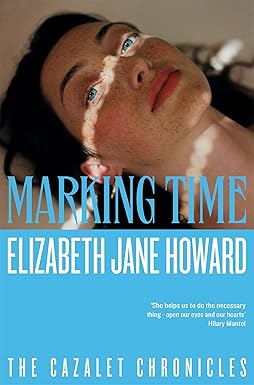
#BookReview ‘Marking Time’ by Elizabeth Jane Howard #historical #WW2

September 2, 1939: Germany has invaded Poland and, for the Cazalet family in London and Sussex, war seems imminent. The story is told from 1939 to 1941 from the viewpoints of three Cazalet cousins, teenagers Polly, Louise and Clary. Marking Time is second in the five-book series ‘The Cazalet Chronicles’ by Elizabeth Jane Howard. Elizabeth Jane Howard We see them growing up quickly, forced to face war and death before their time, watch their parents struggle with ordinary life and relationships and health crises which continue despite the fighting. One day a German bomber crashes into a nearby field and Christopher, a pacifist, runs out to prevent the local men from shooting the injured Germans. Afterwards, Polly and Christopher go for a walk. Polly thinks “how odd it was that when one wanted everything to be good with somebody, one started not telling them everything.” They come to understand that their parents are not just parents, but people too with their own feelings and worries. Polly wonders if “concealment and deceit were a necessary part of human relationships. Because if they were, she was going to be pretty bad at them.”
Louise is at acting school but struggles to play a character ‘in lust’ as she’s a virgin and unsure of the finer details. Then she meets a painter. Clary continues in Sussex, having lessons with Polly and growing to like and respect their tutor Miss Milliment, but she worries about her younger brother Neville who runs away from prep school. And all the time, the adults keep secrets.

Read my reviews of the other books in ‘The Cazalet Chronicles’:-
THE LIGHT YEARS #1CAZALET
CONFUSION #3CAZALET
CASTING OFF  #4CAZALET
ALL CHANGE #5CAZALET

And another book by the same author, THE LONG VIEW.

If you like this, try:-
The Translation of Love’ by Lynne Kutsukake
‘The Rescue Man’ by Anthony Quinn
The Camomile Lawn’ by Mary Wesley

And if you’d like to tweet a link to THIS post, here’s my suggested tweet:
#BookReview MARKING TIME by Elizabeth Jane Howard http://wp.me/p5gEM4-1Cy via @SandraDanby 

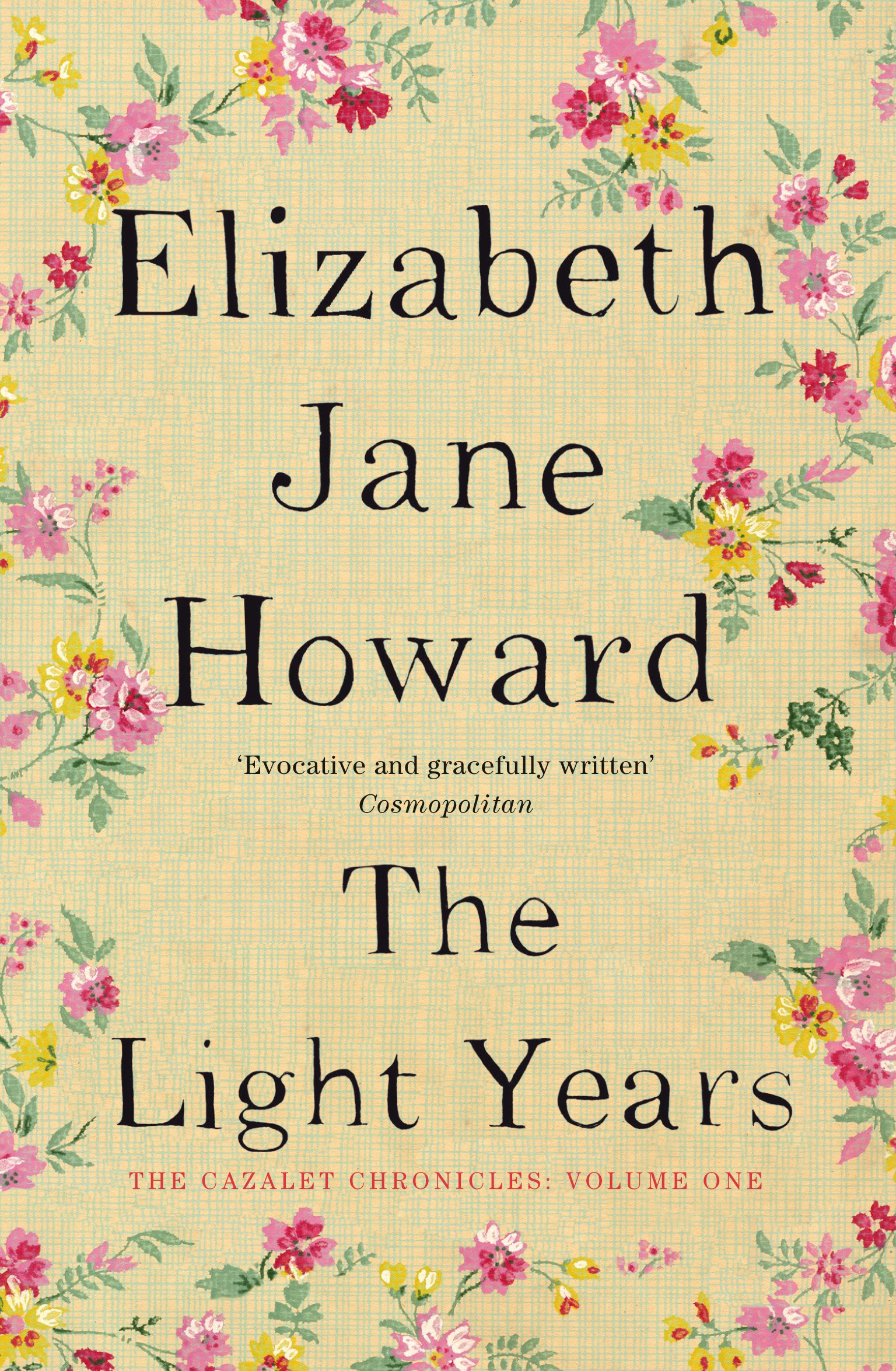
#BookReview ‘The Light Years’ by Elizabeth Jane Howard #historical #WW2

If you haven’t read The Light Years [it is the first in a series of five], you are in for a treat. Elizabeth Jane Howard died in 2014 at the age of 90 and this prompted me to buy her series ‘The Cazalet Chronicles’. I read them on holiday, back-to-back and know I will re-read them many more times. Elizabeth Jane HowardThis is a great family saga, a glimpse of upstairs and downstairs as World War Two threatens the Cazalet family. Over the course of these five books we see the changing social geography of England through the prism of this family, the changing lives of the women and servants, wartime privations, the threat to the family timber business as they face up to the reality of fear.
Oh how I gobbled up these novels. This, the first, introduces us to the family: the patriarch William and his wife The Duchy, their three sons – Hugh, Edward and Rupert, and their wives – and daughter Rachel. As a new war threatens, the hidden wounds of the Great War have not healed and there is no appetite for another. The family gathers at the Sussex house, Home Place, which is the hub of the action. It is the summer of 1937: Hitler has annexed Austria and has his eye of Czechoslovakia.
In these tense summer days at Home Place, we meet the family via the children. Louise, daughter of Edward, the second Cazalet son, is thirteen years old and wants to play the best Shakespearean roles, she starts with Hamlet. Her mother Viola, known as Villy, leads the life expected of her, as wife and mother. “She was not unhappy – it was just that she could have been much more.” One by one we are drawn into the lives of the children, their parents, of Duchy and the Brig, all the time knowing what they don’t: that in less than two years, the ‘peace with honour’ declared by Prime Minister Chamberlain is valueless.

Read my reviews of the other books in ‘The Cazalet Chronicles’:-
MARKING TIME #2CAZALET
CONFUSION #3CAZALET
CASTING OFF  #4CAZALET
ALL CHANGE #5CAZALET

And another novel by Howard, THE LONG VIEW.

If you like this, try:-
‘Freya’ by Anthony Quinn
‘At Mrs Lippincote’s’ by Elizabeth Taylor
‘After the Bombing’ by Clare Morrall

And if you’d like to tweet a link to THIS post, here’s my suggested tweet:
#BookReview THE LIGHT YEARS by Elizabeth Jane Howard http://wp.me/p5gEM4-1Bo via @SandraDanby

#BookReview ‘Midnight in Europe’ by Alan Furst #thriller #WW2

1938. Spain at war, Europe on the brink of war. Midnight in Europe by Alan Furst is the first World War Two novel I have read about the overlap of the two wars, the impact of one on the other, and the approaching shadow of fascism. Nothing happens in isolation. The Spanish Civil War is notoriously difficult to understand: so many factions, changing names etc. Sensibly, Furst concentrates on one aspect: the supply of weapons to the Republicans fighting the fascist army of Franco. Alan FurstA secret Spanish agency in Paris sources arms and ammunition for the Republicans. Cristián Ferrar, a Spanish lawyer living in Paris and working for a French law firm, is asked to help. Unsure what he is getting into, but resigned to help his mother country, he is soon looking over his shoulder to see if he is being followed – he doesn’t know who by, it could be the Spanish fascists, the Gestapo, the Russians. Inter-cut with Ferrar’s story are excerpts from the front line in Spain where preparations are being made to fight the Battle of the Ebro. The need for the weapons is desperate, as bullets are counted out for each soldier.
Working with an odd mixture of diplomats, gangsters and generally shady characters, Ferrar first travels to Berlin where there is a glimpse of the pre-war country which with hindsight gives us a chill. The Gestapo follows them at every step. Then there is a nail-biting train journey to Gdansk, as an arms shipment goes missing. The climax is a thrilling boat journey from Odessa to Valencia. Ferrar, is a lawyer not a spy, he is simply an ordinary man doing what he can to help. An ordinary man who is, meanwhile, having a sprinkling of love affairs which may or may not be authentic.
If you have been put off before at reading novels about the Spanish Civil War because the politics is confusing, you will enjoy this novel. The shadow of war in Europe is cast over every page, the sense of approaching doom however does not seem to affect the nightclubs of Paris, or the shops of New York where the cheerful atmosphere seems unreal. Ferrar faces moving his family from Louveciennes on the outskirts of Paris, the picturesque country west of the capital which was painted by the Impressionists, to the safety of New York.
This is the first novel by Alan Furst I have read, picked up at random in an airport bookshop. I will read many more.

Read my review of A HERO IN FRANCE, also by Alan Furst.

If you like this, try:-
‘Citadel’ by Kate Mosse
‘A Hero in France’ by Alan Furst
‘Dominion’ by CJ Sansom

And if you’d like to tweet a link to THIS post, here’s my suggested tweet:
#BookReview MIDNIGHT IN EUROPE by Alan Furst http://wp.me/p5gEM4-1ct via @SandraDanby

#BookReview ‘The Beekeeper’s Daughter’ by @SantaMontefiore #summer #contemporary

I haven’t read a book by Santa Montefiore before, and if I’d seen the cover of The Beekeeper’s Daughter in a bookshop I doubt I would have picked it up. Flowers, soft focus woman in a flowing dress, all a bit twee for me. But I didn’t see the cover, I downloaded the book on impulse. Which goes to show how a cover can deter as well as attract, because I enjoyed the book. In a ‘I need an unchallenging read for a hot summer day when my brain isn’t fully-functioning’ kind of way.
Santa MontefioreThe bees are drawn beautifully, the description of bees, the beekeeping, their role in Grace’s life. I could not say the same for the World War Two strand, in which war was a distant event: the women take over work at the Hall, and they have plenty of vegetables to eat. Likewise the Seventies, lightly drawn with sweeping pencil strokes. That’s why for me, the book is a lightweight read although it examines heavyweight topics and the characterization is strong. So I guess this will be labelled as Romance Genre.
Will I read another Montefiore novel? Maybe, it would be immensely comforting if I was ill or was facing an endless plane flight. If you hate romance, this is not for you. There’s lots of youthful longing, love won and lost, sad adultery and mature longing of long-lost loves. I can see why her novels sell by the bucket-load.
CLICK HERE TO READ MORE ABOUT THIS BOOK AT AMAZON

If you like this, try:-
Butterfly Barn’ by Karen Power
The Audacious Mendacity of Lily Green’ by Shelley Weiner
One Step Too Far’ by Tina Seskis

And if you’d like to tweet a link to THIS post, here’s my suggested tweet:
#BookReview THE BEEKEEPER’S DAUGHTER by @SantaMontefiore via @SandraDanby http://wp.me/p5gEM4-19W

#BookReview ‘Citadel’ by @katemosse #historical

I read a lot of books. Amongst those with the strongest sense of place, the ones that linger in my imagination, are the Languedoc trilogy by Kate Mosse. Citadel, the third novel in the series, is set in ad342 and 1942 during World War Two. Unusually with a trilogy, you don’t have to have read the other two books in order to enjoy this one. Certainly it is some years since I read Labyrinth and Sepulchre and the details are hazy, each book stands on its own. Kate MosseI enjoyed this book immensely. The story centres on a small group of women who fight against the Nazi regime and who, by the very fact that they are women, are able to slip unnoticed along the night-time streets of occupied Carcassonne. The Prologue describes ‘the woman known as Sophie’ and the reader is left to wonder, which of the women in the story is ‘Sophie’?
I must point out that the story is slow to get going, I had to be patient, but I trusted Mosse. It did make me question whether my attention span is shortening, I hope not. If it is I must read longer novels to re-stretch my brain.
A note in the 2014 edition, which I read, explains that the story was inspired by a plaque in a village near Carcassonne, commemorating the ‘martyrs of Baudrigues’. Days before the Languedoc was freed by its own people, as the Nazis were fleeing, 19 prisoners were killed, two women are to this day still unidentified. These facts started Mosse wondering who those women were: that was her starting point for Citadel.
It is clear that both time strands are set in the same place, the countryside of the Languedoc, the forests, the mountains, its people and language, and the weather, anchors the reader firmly in southern France. In ad342, Arinius is looking for a hiding place. You know not what for, only that it must be safe for ‘centuries’. “He had no particular destination in mind, only that he had to find somewhere distinctive and sheltered, somewhere where the pattern of the ridges and crests might retain their shape for centuries to come… Forests might be cut down or burn or drowned when a river bursts its banks. Fire and word and flood. Only the mountains stood firm.”
CLICK HERE TO READ MORE ABOUT THIS BOOK AT AMAZON

And here are my reviews of other novels by Kate Mosse:-
THE BURNING CHAMBERS #1JOUBERT
THE CITY OF TEARS #2JOUBERT
THE TAXIDERMIST’S DAUGHTER

If you like this, try:-
‘Dominion’ by CJ Sansom
‘Homeland’ by Clare Francis
‘Midnight in Europe’ by Alan Furst

And if you’d like to tweet a link to THIS post, here’s my suggested tweet:
#BookReview CITADEL by @katemosse ‏via @SandraDanby http://wp.me/p5gEM4-Xt

#BookReview ‘Dominion’ by CJ Sansom #WW2 #dystopian #thriller

You know that feeling, it happens once in a while, when you finish reading a book that was so good you want to go back to the beginning and start again? Well, it was like that for me with Dominion by CJ Sansom. CJ SansomIt was the premise that caught my attention as soon as I read the pre-publication reviews: an alternate history set in Britain in 1952, peace is made with Hitler in 1941 which changes the direction of World War Two. An alternative world. Previously I had read one Sansom novel, Winter in Madrid, which I enjoyed; three of his Matthew Shardlake mysteries sit on my to-read shelf. After Dominion, I will turn to them quickly.
The story focusses on four main characters, a scientist, a civil servant, the civil servant’s wife, and a Gestapo officer based at Senate House in London, the tall university building being the Gestapo’s London HQ with torture cells in the basement. This is a different Britain, where Jews are being rounded-up and transferred to camps in the country, where the Isle of Wight is occupied by the German army [which is still fighting in Russia], and where it is rumoured in Berlin that Hitler is either dead or dying.
To say more would risk spoiling the plot twists, of which there are plenty. The darkness of the time is shown symbolically by the Great Smog which actually happened in London, December 1952. It sheds a stifling blanket of choking fog which stops life and blinds everything more than a foot away. The smog is a metaphor of course for the blindness of the Government, and much of the population, who accept their situation with apathy and do nothing to aid the Resistance led, inevitably, by Churchill.
Sansom’s central message is about the danger of nationalism and xenophobia and what, in the extremes, they can lead to. A subject which, as he says in the Appendices, he fears is all too relevant in modern Europe.
A thought-provoking read.
CLICK HERE TO READ MORE ABOUT THIS BOOK AT AMAZON

And here are my reviews of CJ Sansom’s Shardlake detective series:-
DISSOLUTION #1SHARDLAKE
DARK FIRE #2SHARDLAKE
SOVEREIGN #3SHARDLAKE
REVELATION #4SHARDLAKE
HEARTSTONE #5SHARDLAKE
LAMENTATION #6SHARDLAKE

If you like this, try:-
‘The Aftermath’ by Rhidian Brook
‘Homeland’ by Clare Francis
The Bird in the Bamboo Cage’ by Hazel Gaynor

And if you’d like to tweet a link to THIS post, here’s my suggested tweet:
#BookReview DOMINION by CJ Sansom https://wp.me/p2ZHJe-4aP via @SandraDanby