Tag Archives: WW2

#BookReview ‘The Bone Church’ by @vicdougherty #war #WW2

The Bone Church was a difficult story to get into for me, which surprised me. The premise by Victoria Dougherty seems so good – Czechoslovakia, wartime, fugitive lovers, a faked religious icon, and a plot to assassinate Josef Goebbels – the promise of which kept me reading. But I found the time shifts, the point of view shifts, and the way the action changed from paragraph to paragraph quite confusing. Assuming this was a formatting issue with my Kindle copy, I kept reading. Victoria DoughertyThe story starts in Rome in 1956 in the Vatican City with a Cardinal and a man called Felix. Then we see Magdalena and her son Ales in Czechoslovakia, a man arrives and takes away her son. Then the action switched to 1943, as Felix and Magdalena are on the run in Prague. He is a famous hockey player, a celebrity, she is a Jew. By this point, the story should have gripped me but I’m afraid it didn’t, I hadn’t read enough about the two characters to care. I think my basic problem is the way the story was told, not the actual story itself; the writing is rich with description and the author certainly knows her history. Halfway through, things started to make a little more sense though at times the plot seemed unnecessarily complicated.
The best bit? An assassination scene, involving a birthday cake, a gun, and Josef Goebbels.

If you like this, try:-
‘Life After Life’ by Kate Atkinson
‘The Little Red Chairs’ by Edna O’Brien
‘Dominion’ by CJ Sansom

And if you’d like to tweet a link to THIS post, here’s my suggested tweet:
#BookReview THE BONE CHURCH by @vicdougherty http://wp.me/p5gEM4-1Bl via @SandraDanby

#BookReview ‘Inflicted’ by Ria Frances #WW2 #holocaust

Theo is sixteen, and unhappy. He stumbles into the life of an elderly neighbour, Anna. Together they share their secrets and Anna, by telling the story of her own life as a teenager, helps Theo face up to his difficult emotions. Inflicted is the debut novel of English author Ria Frances and, despite the unflinching approach to a difficult subject, is I think aimed at teenagers. Ria FrancesIt tells the story of Anna, a teenager in the Second World War, on the run with her parents from the German army. Her mother dies and Anna is separated from her father as they are taken to Theresienstadt, the city-turned-ghetto run by the Nazis. Anna’s story of hardship is a difficult emotional read, the author does not sweeten the hardships, but the central message is one of hope, courage and love amidst suffering.
I wanted to know how Anna’s story ended, even though the adult Anna was telling her own story, because I was curious about her journey from the Czech village of Lidice, to Theresienstadt, Berlin and finally to Sussex in 2010. Curiously, it was Anna’s story which drew me on not Theo’s.
I found the ending rather rushed and difficult to follow, perhaps in the author’s effort to tie-up all the loose ends. But I don’t mind some loose ends at the end of a novel, it leaves the story fresh in my mind and gives me something to consider.

If you like this, try:-
‘The Little Red Chairs’ by Edna O’Brien
‘The Bone Church’ by Victoria Dougherty
‘All The Broken Places’ by John Boyne

And if you’d like to tweet a link to THIS post, here’s my suggested tweet:
#BookReview INFLICTED by Ria Frances http://wp.me/p5gEM4-1q8 via @SandraDanby

#BookReview ‘The Corners of the Globe’ by Robert Goddard #WW2 #thriller

The Corners of the Globe is a very fast-moving sequel by Robert Goddard, second in his Wide World series. There’s a Scotland to London train chase complete with spies, a captured German warship, murder, kidnapping, secret codes and jumping on and off trains which would rival The 39 Steps [which Goddard playfully has one of his characters read in the restaurant car of one of the trains]. Robert GoddardGreat War flying hero James Maxted is in London, convinced that the death of his father [in the first book] is not as simple as it appeared. His investigations take him further into danger, into the dark and deadly preview of the Second World War. You really do need to read book one first [see the link below for my review] although there is a little exposition at the beginning in the form of a Secret Service report, but to be honest it functions more as a recap for the reader who has read the first book than as an introduction for a newcomer.
I failed to guess the ending of the first book, did I guess the ending of this one correctly? No.

Read my reviews of Goddard’s other books:-
THE WAYS OF THE WORLD #1 THE WIDE WORLD TRILOGY
THE ENDS OF THE EARTH #3 THE WIDE WORLD TRILOGY
PANIC ROOM
THE FINE ART OF INVISIBLE DETECTION #1UMIKOWADA
THIS IS THE NIGHT THEY COME FOR YOU #1SUPERINTENDENTTALEB

If you like this, try:-
Corpus’ by Rory Clements
The Second Midnight’ by Andrew Taylor
Noonday’ by Pat Barker

And if you’d like to tweet a link to THIS post, here’s my suggested tweet:
#BookReview THE CORNERS OF THE GLOBE by Robert Goddard via @SandraDanby http://wp.me/p5gEM4-19H

#BookReview ‘The Ways of the World’ by Robert Goddard #WW2 #thriller

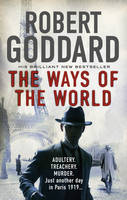
I’ve been a fan of Robert Goddard since reading his first novel Past Caring in 1986. He is a hard-working author producing regular novels, and I admit I got out of the habit of buying them. Until I picked up The Corners of the Globe which I quickly realised was part two of a series. So to book one, The Ways of the World. I wasn’t disappointed. Not for nothing is Robert Goddard called ‘the king of the triple-cross.’ Robert GoddardThe setting is post-Great War, pre-World War Two. Max, aka James Maxted, goes to Paris to investigate the strange circumstances of his father’s death. He stumbles into a melee of Government secrets, inter-war political wrangling, love affairs and assassinations. I warmed to Max straight away and just as quickly disliked his brother. It is a time of high politics, politicians are jostling to make their mark, and there is already a sense that war may come again.
Suffice to say, that by the end of book 1, various ends are left untied, new questions posed, and I was left wanting to read more. So after finishing this, I quickly started reading The Corners of the Globe again.

Read my reviews of Goddard’s other books:-
THE CORNERS OF THE GLOBE #2WIDEWORLD
THE ENDS OF THE EARTH #3WIDEWORLD
PANIC ROOM
THE FINE ART OF INVISIBLE DETECTION
THIS IS THE NIGHT THEY COME FOR YOU

If you like this, try:-
A Hero in France’ by Alan Furst
The Aftermath’ by Rhidian Brook
Dominion’ by CJ Sansom

And if you’d like to tweet a link to THIS post, here’s my suggested tweet:
#BookReview THE WAYS OF THE WORLD by Robert Goddard http://wp.me/p5gEM4-19t via @SandraDanby 

#BookReview ‘After the Bombing’ by Clare Morrall #WW2

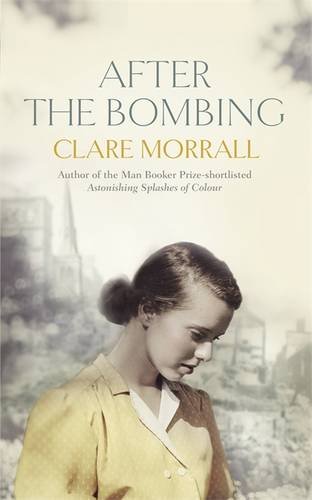
I am a huge Clare Morrall fan and wasn’t disappointed by After the Bombing.  As with all Morrall’s novels, the observations of character are spot-on and so poignant. She peoples her novels with characters who feel real. Clare MorrallTwin story strands tell the story of Alma Braithwaite, before and after the bombing of her school near Exeter in May 1942, and in 1963 in a modern world which has moved on from the war. But Alma still remembers. “She’s conscious of sitting on a swing that has been steady for a long time and is starting to move again, gently but perceptibly, backwards and forwards, disturbing her equilibrium.”
The novel opens with the British bombing of Lübeck in March 1942, the raid which famously made Hitler pick up a copy of the Baedecker tourist guide and select at random the English cities of Bath, Norwich, York, Canterbury, and Exeter. That is how 15-year old Alma and her schoolfriends Curls, Giraffe and Natalie are forced to run from Merrivale, the boarding house at their girls’ school Goldwyns on the outskirts of Exeter, to the bomb shelter. When they emerge, Merrivale has gone.
The four girls, in that unspecified limbo between girl and woman, lodge in a mens’ hall of residence at the nearby university, living alongside male students for the first time. The influences there change their lives just as much as the bombing did, with freedoms they have never guessed exist, and the gentle presence of mathematics lecturer Robert Gunner. They are introduced by the men to the Lindy Hop, a vibrant, energetic dance which the girls, though initially nervous and suspicious, come to love dancing.
War is ever-present, a character of its own. There is a poignant scene where Alma and her brother Duncan, on a brief visit home from the war in an unspecified hot country, go back to their family home in Exeter after their parents’ death. Searching for some semblance of normality, they try to play tennis on the grass court. The grass has grown too long but they play anyway, and in their diving for the balls and their laughter, the reader gets a glimpse of their pre-war life and a sign of how everything is now different… after the bombing.
There are parallels in the 1942 and 1963 storylines: a concert which never takes place, flirtations, unexpected death and unexpected love. One of those books which, when I finished it, I wanted to re-read immediately.
CLICK HERE TO READ MORE ABOUT THIS BOOK AT AMAZON

Read my review of these other novels by Clare Morrall:-
NATURAL FLIGHTS OF THE HUMAN MIND
THE LANGUAGE OF OTHERS
THE LAST OF THE GREENWOODS
THE MAN WHO DISAPPEARED
THE ROUNDABOUT MAN

Read the first paragraph of ASTONISHING SPLASHES OF COLOUR here.

If you like this, try:-
Freya’ by Anthony Quinn
At Mrs Lippincote’s’ by Elizabeth Taylor
The Aftermath’ by Rhidian Brook

And if you’d like to tweet a link to THIS post, here’s my suggested tweet:
#BookReview AFTER THE BOMBING by Clare Morrall via @SandraDanby http://wp.me/p5gEM4-W4

#BookReview ‘The Aftermath’ by @Rhidianbrook #WW2

1946. Post-war Germany, Hamburg. The Aftermath by Rhidian Brook is a gentle novel with an emotionally difficult core: the adjustment of two families, one German one English, to the landscape of rubble a year after the end of the Second World War. Broken country, broken families, broken minds. The title refers to the aftermath of the war and also to the aftermath of events in the lives of both families. Both are grieving and are in new territory, geographically and emotionally. They are proud and unsure. Together, will they heal? Rhidian BrookThe English family: Colonel Lewis Morgan is occupied with the Occupied while his newly-arrived wife Rachael prevaricates, “I don’t know. It was suffix and prefix to her every other thought. This indecision was becoming her signature.” Their son Edmund has no such doubts, facing a challenging encounter with the teenage girl upstairs involving a glimpse of knickers and a steaming pisspot, he then ventures beyond the house’s garden into forbidden territory and meets the local feral youth.
The German family: Herr Lubert, a widower, and his daughter move upstairs when the Morgans arrive in the requisitioned house. Ironically Stefan Lubert is an architect, surrounded by broken buildings, but works instead in a factory while waiting for his papers to arrive which will allow him to practise again. School is closed so Frieda is on the ‘rubble runs’, clearing bricks and rubbish, where she mixes with the feral youth.
They all make their own adjustments to the new situation and for a while it is a quiet, polite tussle for power. Rachael makes changes in the house; she moves plants and drapes a modest cloth over a nude sculpture. She sets herself rules about not fraternising with the Germans, who she believes need punishing. She disagrees with Herr Lubert about a Mies van der Rohe chair which he explains is a Bauhaus design, functionality stripped to simplicity. She says it is uncomfortable.
It is as if each family is trying the other on for size, it is a fascinating observation of ordinary people in extraordinary times. Lewis reflects on the logic of the tasks he must perform: “They blow up a soap factory which employed two thousand Germans, made something everyone needed and had no military value whatsoever and, in return, the Russians send the Germans bread. It was like balancing Hell’s ledger.”
The cover of the book is an attractive, calm monotone and the story is also told in a calm tone; but underneath the emotions are building. As the initial discomfort eases, passion rises.

Read my review of another Rhidian Brook novel:-
THE TESTIMONY OF TALIESIN JONES

If you like this, try:-
The Translation of Love’ by Lynne Kutsukake
Homeland’ by Clare Francis
The Ways of the World’ by Robert Goddard

And if you’d like to tweet a link to THIS post, here’s my suggested tweet:
#BookReview THE AFTERMATH by @Rhidianbrook via @SandraDanby http://wp.me/p5gEM4-So

#BookReview ‘Life After Life’ by Kate Atkinson #WW2

It’s a while since I read a book I didn’t want to put down, a book that made me continue reading in bed gone midnight. Life After Life by Kate Atkinson is that book. Kate AtkinsonAtkinson manages the macro settings and the micro details with ease, from the petty sibling squabbles at Fox Corner to the camaraderie of the ARP wardens in the Blitz. Before I started reading Life after Life I read the phrase ‘Groundhog Day’ a few times in reviews, which belittles the intricate weaving of Ursula Todd’s lives. In the way that Logan Mountstuart’s life runs parallel to the great historical moments of the last century, Ursula’s life stories are book-ended by the approach and aftermath of the First and Second World Wars. Ursula, little bear, is an engaging character we see born and die, again and again through her own personal déjà vu.  I wasn’t sure how this was going to work but once I stopped worrying about it and surrendered myself to Ursula, I was transfixed.
This is another work of art, as mesmerising as her first Behind the Scenes at the Museum. It is such an ambitious novel, that I can only guess at the intricacy of the writing process and admire her for it.

Read my reviews of these other novels by Kate Atkinson:-
A GOD IN RUINS
BIG SKY #5JACKSONBRODIE
DEATH AT THE SIGN OF THE ROOK #6JACKSONBRODIE
NORMAL RULES DON’T APPLY
SHRINES OF GAIETY
TRANSCRIPTION
… and try the #FirstPara of EMOTIONALLY WEIRD

If you like this, try:-
Homeland’ by Clare Francis
‘The Aftermath’ by Rhidian Brook
‘The Translation of Love’ by Lynne Kutsukake

And if you’d like to tweet a link to THIS post, here’s my suggested tweet:
#BookReview LIFE AFTER LIFE by Kate Atkinson via @SandraDanby https://wp.me/p2ZHJe-4aw