Yearly Archives: 2020

#BookReview ‘The Second Midnight’ by @AndrewJRTaylor #WW2

In The Second Midnight, Andrew Taylor unpicks the connections between a group of people – a dysfunctional family, spies, ordinary people – before, during and after World War Two in England and Czechoslovakia. Essentially it is a novel of relationships wrapped up in the parcel of wartime spying, lies and romance. In its scope it reminds me of Robert Goddard’s Wide World trilogy, except Taylor covers the subject in one book rather than three. Andrew TaylorIt is 1939 and twelve year old Hugh Kendall is bullied by his father, sighed over by his harried mother, ignored by his older brother and manipulated by his older sister. Hugh retreats into imaginative games with his toy soldiers. His father, failing glass importer Alfred Kendall, is recruited by the Secret Services as a courier on a glass-buying trip to Czechoslovakia. In tow is Hugh, recently expelled from school, a nuisance to his father. Alfred is not a natural spy, though he thinks he is. When things get sticky and Alfred must return to England, the Czech Resistance keeps Hugh as collateral to ensure his father’s quick return. But Hugh finds himself alone in Prague after the German invasion, unsure who to trust, unsure if he will be rescued. He quickly learns to live on his wits. This for me was the best section of the book.
The thing that makes this story stand apart for me is Hugh. He makes an uncanny narrator, giving us a view of life in an occupied country, stranded from everything that is safe and familiar. Adept at languages, Hugh quickly becomes familiar with Czech and German allowing him to assume a false identity as Rudi Messner, a Czech-Hungarian boy.  Cared for by a German officer, Colonel Helmut Scholl, Hugh works as the gardener’s boy at Scholl’s mansion in Prague and meets the colonel’s children, Heinz and Magda. These relationships weave across the years and the pages into the post-war years and the fight against communism.
The significance of the title left me wondering if I had missed something. It is set up with an intriguing connection between two characters, then abandoned. The connection with the Prologue was also lost on me as it is only mentioned again at the end and I had forgotten what happened; ends neatly tied without adding understanding. Taylor knows how to tell a page turning story, I read this quickly. This is a fascinating read over a complex time period, but an enormous subject; I wish it had been given the space of three books to explore fully.
CLICK HERE TO READ MORE ABOUT THIS BOOK AT AMAZON

Read my reviews of Andrew Taylor’s ‘Marwood & Lovett’ series that starts on the night of the Great Fire of London:-
THE ASHES OF LONDON #FIREOFLONDON1… and read the first paragraph of THE ASHES OF LONDON.
THE FIRE COURT #FIREOFLONDON2
THE KING’S EVIL #FIREOFLONDON3
THE LAST PROTECTOR #FIREOFLONDON4
THE ROYAL SECRET #FIREOFLONDON5
THE SHADOWS OF LONDON #FIREOFLONDON6

If you like this, try:-
Corpus’ by Rory Clements
The Ways of the World’ by Robert Goddard
Five Days of Fog’ by Anna Freeman

And if you’d like to tweet a link to THIS post, here’s my suggested tweet:
#BookReview THE SECOND MIDNIGHT by @AndrewJRTaylor https://wp.me/p5gEM4-4gC via @SandraDanby
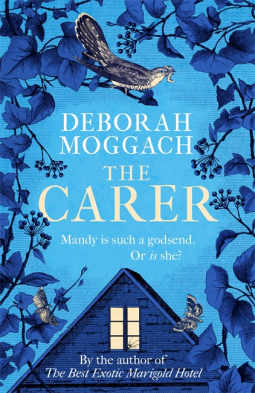
#BookReview ‘The Carer’ by Deborah Moggach #humorous #familydrama

At first I didn’t know what to make of The Carer by Deborah Moggach. She travels a fine comic line nudging towards simplistic or tasteless stereotypes. But then, as she did in These Foolish Things, the novel finds its stride. In two parts, Moggach takes her original portrayal of this family, shows it through different eyes, and turns it upside down. Deborah MoggachIn Part One we meet widower James Wentworth, OBE, 85, retired particle physicist, living downstairs in his home after breaking a hip; and his live-in carer Mandy, 50, from Solihull. ‘Mandy hummed show tunes as the kettle boiled. Blood Brothers was her favourite, about two boys separated at birth. She said she had seen it three times and blubbed like a baby.’ Mandy is fat, jolly, is a chatterer, and says it as she finds it.
Part One is told from the alternating viewpoints of James’ children. Unfulfilled artist Phoebe, 60, lives in a Welsh village in the area where she had many happy childhood holidays. Robert, 62, former City trader, is now writing a novel in his garden shed in Wimbledon, while married to a television newsreader. Our first impressions of their father, and of Mandy, are filtered through their middle class worries and prejudices. Both harbour resentments about their father’s absences when they were children when he travelled the world for work; resentments that straight-talker Mandy tells them they should have got over years ago.
Mandy is truly a catalyst of change, not just for James but for Robert and Phoebe too.
The situation is a believable one faced in today’s society as we all live longer. James in his eighties needs full-time care, his children are already retired. A succession of carers has come and gone, each unsatisfactory in one way or another. When Mandy arrives she seems an angel. Initially, Phoebe and Robert put aside the class differences as Mandy cares for their father so well. The daily walk to the nearby donkey sanctuary or trip to Lidl for pots of flavoured mousse, soon become day trips to Bicester Village and eating at Nando’s. Initially thriving under Mandy’s care with daily scratchcards and a chirping kitchen clock, James seems more forgetful so when Robert’s daughter sees the papers from James’ desk upstairs in a mess, they fear the worst. Why is Mandy looking in their father’s private documents. Can she be trusted. And what has prompted James’ sudden mental and physical decline. The twist which comes halfway through is masterful.
Part Two is James’ story, starting from his life as a young father and married to Anna. One day he attends a conference in Cardiff. What happens there affects the rest of his life, but in ways even he cannot have predicted. At the end there is one more twist, unexpected, that once again casts Robert and Phoebe’s understanding of their lives into a whirlwind.
At the heart of this novel is the question, can you ever really know someone. Whether with a stranger or a long-loved family member, don’t we all sub-consciously present different faces to different people. It is easy to assume we know someone because of the public face they present to the world, but the inner thoughts of other people, even our closest relatives – and often their marriages – are always a mystery.
Littered with throwaway quotes from Shakespeare, this is on the surface a quick, contemporary read (only 272 pages) which also casts a light on the prejudices, snobberies and problems of modern society. It is billed as a comic novel but it did not make me laugh. I was left feeling vaguely disappointed.
CLICK HERE TO READ MORE ABOUT THIS BOOK

Read my review of these other novels by Deborah Moggach:-
SOMETHING TO HIDE
THE BLACK DRESS
TULIP FEVER

Read the first paragraph of THESE FOOLISH THINGS [now THE BEST EXOTIC MARIGOLD HOTEL] here.

If you like this, try:-
Crow Blue’ by Adriana Lisboa
In the Midst of Winter’ by Isabel Allende
The Only Story’ by Julian Barnes

And if you’d like to tweet a link to THIS post, here’s my suggested tweet:
#BookReview THE CARER by Deborah Moggach https://wp.me/p5gEM4-45Q via @SandraDanby

A poem to read in the bath… ‘Dunt’ by Alice Oswald #poetry

‘Dunt: A Poem for a Dried-Up River’ by Alice Oswald won the Forward Prize for the best single poem in 2007. A water nymph tries unsuccessfully to conjure a river from limestone. Punctuated by the refrain ‘try again’ it feels like a wail against climate change and our changing rural landscapes. The water nymph is real, rather it is an artefact found by Oswald in a local West Country museum.

Alice Oswald

Alice Oswald [photo Pako Mera]

Because of copyright restrictions I am unable to reproduce the poem in full, but please search it out in an anthology or at your local library.

‘Very small and damaged and quite dry,
a Roman water nymph made of bone
tries to summon a river out of limestone

very eroded faded
her left arm missing and both legs from the knee down
a Roman water nymph made of bone
tries to summon a river out of limestone’

BUY THE BOOK

Alice Oswald

Read this interview in The Guardian as Oswald talks about this collection.

Read these other excerpts, and perhaps find a new poet to love:-
Winter Song’ by Wilfred Owen
My Heart Leaps Up’ by William Wordsworth
Tulips’ by Wendy Cope

And if you’d like to tweet a link to THIS post, here’s my suggested tweet:
A #poem to read in the bath: ‘Dunt’ by Alice Oswald https://wp.me/p5gEM4-3Rf via @SandraDanby

#BookReview ‘The Sleeping Beauty’ by Elizabeth Taylor #classic #love

Reading this novel is like taking a long deep breath of air when your lungs are bursting. The Sleeping Beauty by Elizabeth Taylor is about beauty and is loosely based on the fairy story – a man rescuing a woman – but with real people who have faults, irritations, fantasies and vanities, whose prejudices and past lives inconveniently do not go away. Elizabeth Taylor In the small seaside town of Seething, Vinny Tumulty visits an old friend, Isabella, whose husband has recently died. He wants to support her through difficult times, but Isabella fancies she is falling in love with him. Vinny, however, sees a stranger walking on the beach and, without seeing her clearly, knows she is beautiful. We learn later that Emily’s face has been reconstructed, plastic surgery necessary after a car accident caused by her drunken brother-in-law. Emily’s widowed sister Rose tells Vinny that, since her accident, Emily looks and behaves like a completely different person. To Rose, Emily’s face is untrue; to Vinny, it is beautiful.  He becomes obsessed with her. ‘My plans for today are to hang about hoping for a glimpse of her, to have my heart eaten away by the thought of her; to feel my blood bounding maddeningly, ridiculously, like a young boy’s; to despair; to realise the weight of my misery and hunger with each step I take.’
Vinny is in his fifties but behaves as if this is his first love. In contrast, Isabella’s son twenty-something Laurence picks up a girl at the cinema. Not knowing how to make the first move and kiss her, he experimentally takes Betty’s hand. ‘Her skin was rough, her nails so short that he wondered if she bit them, and hoped she did. He did not want a young lady too tranquil, too defined.’ This scene is mirrored later when Emily is top-and-tailing gooseberries; she puts her hand into the basket as Vinny does too, and they touch. ‘He felt the involuntary tremor before the tension, the shocked leap of her blood which she could not control. ‘Even her arms are blushing,’ he thought.’
Is Laurence falling in love with reality, and Vinny with an image? Neither knows the woman he is courting, has hardly had a conversation with her. It is halfway through the novel before Emily says more than a single sentence at a time. Taylor shows the gradual, patient steps that Vinny takes towards Emily; brief words exchanged, moments of silence stretching ahead. It is a cautious middle-aged love where hope of finding love has long passed. There is a sensuality, a thin seedling struggling to grow despite the aridity of the earth.
As usual, Taylor is excellent on everyday detail of people and things. ‘The streets were almost empty. An obviously betrothed couple stood looking in at the lighted window of a furniture shop at a three-piece suite labelled ‘Uncut Moquette’.’ And I loved the scene where Isabella and her friend Evalie are checking the racing results and doing tapestry badly, with their faces covered with clay face packs; and Laurence enters the room, bemused. This is a slow, contemplative novel, beautifully written, which in places made me stop and smile.
CLICK HERE TO READ MORE ABOUT THIS BOOK AT AMAZON

Read my reviews of other books by Elizabeth Taylor:-
A VIEW OF THE HARBOUR
A WREATH OF ROSES
ANGEL
AT MRS LIPPINCOTE’S
IN A SUMMER SEASON

If you like this, try:-
‘Mobile Library’ by David Whitehouse
‘A Life Between Us’ by Louise Walters
‘The Gustav Sonata’ by Rose Tremain

And if you’d like to tweet a link to THIS post, here’s my suggested tweet:
#BookReview THE SLEEPING BEAUTY by Elizabeth Taylor https://wp.me/p5gEM4-3ru via @SandraDanby