Monthly Archives: March 2022

#BookReview ‘The Women of Troy’ by Pat Barker #historical #myths

The Women of Troy is the second of the Trojan War novels by Pat Barker, telling the post-war story of Trojan woman Briseis, a trophy of war owned by Achilles. I loved the first, The Silence of the Girls, but wanted to hear the stories of more of the women. That’s what we get in this second book. Pat BarkerBriseis, now pregnant with Achilles’ child, is again narrator along with a new male voice, that of Pyrrhus, eldest son of Achilles and Briseis’ stepson. Now Achilles is dead Briseis belongs to Alcimus, charged by Achilles before his death with caring for his unborn child.
The story starts with Pyrrhus inside the wooden horse, constructed by the Greeks, to trick the Trojans. ‘Inside the horse’s gut: heat, darkness, sweat, fear. They’re crammed in, packed as tight as olives in a jar.’ It is Pyrrhus who kills Priam, king of the Trojans, and that murder echoes throughout The Women of Troy. As storms rage – punishment of the victorious Greeks by the Gods for their impious behaviour – the army and its captives are now trapped on the beach waiting for a chance to sail home. This enclosure at close quarters raises emotions, tensions, jealousies and pride. As Alcimus arranges games – chariot racing, archery, spear throwing, wrestling – Briseis acts as a mother-figure for the other women, all now slaves.
Barker explores the after-effects of war on the Trojan women during these empty days – Hecuba, widow of Priam, and Cassandra, her daughter; Andromache, wife of Hector now concubine to Pyrrhus – high-born Trojan women now slaves in the households of their Greek victors, as concubines, whores, cooks and housemaids.
The story is about survival on the edge of despair when women are secondary creatures deemed without opinions or rights, exploring how women individually and collectively find ways to live. There is bravery, despair, foolishness, obsession and madness. When the actions of Pyrrhus are questioned, Briseis must remember the events of one night when Achilles was alive. ‘Both of us [Briseis and Cassandra, another witness] were women – and a woman’s testimony is not considered equal to a man’s. In a court of law, if a man and woman disagree it’s almost invariably his version of events that’s accepted. And that’s in a courtroom – how much more so in this camp where all the women were Trojan slaves and the only real law was force.’
But this is also the story of Pyrrhus, a young man who struggles to match the reputation of a father he never felt close to, a father lauded as a God. These were brutal times when small mistakes were punished by death and Pyrrhus, who has few friends, takes risks and makes bad decisions.
This book works as a standalone story as well as companion to The Silence of the Girls. Both are magnificent examples of storytelling by an author at the peak of her writing. Faithful to the myths, Barker is an inventive writer who adds her own interpretations and twists.
Excellent, I whizzed through this in no time. Will there be a third novel? I hope so.

Read my reviews of other Pat Barker novels:-
THE SILENCE OF THE GIRLS #1WOMENOFTROY
LIFE CLASS #1LIFECLASS
TOBY’S ROOM #2LIFECLASS
NOONDAY #3LIFECLASS
DOUBLE VISION
ANOTHER WORLD
BLOW YOUR HOUSE DOWN
UNION STREET

If you like this, try:-
These Dividing Walls’ by Fran Cooper
A Thousand Acres’ by Jane Smiley
Vinegar Girl’ by Anne Tyler

And if you’d like to tweet a link to THIS post, here’s my suggested tweet:
#BookReview THE WOMEN OF TROY by Pat Barker https://wp.me/p5gEM4-5sm via @SandraDanby
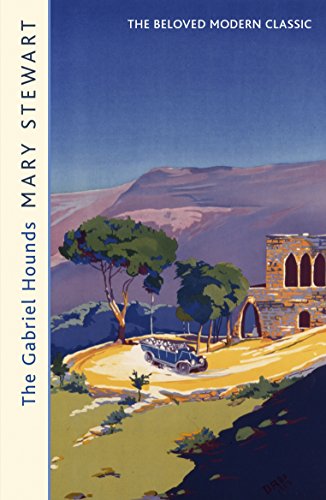
#BookReview ‘The Gabriel Hounds’ by Mary Stewart #mystery #suspense

A rollicking, sensuous tale set at a rundown Lebanese palace involving two cousins, an eccentric great-aunt, various chases and subterfuge, The Gabriel Hounds by Mary Stewart is a classic 20th century suspense romance. The hounds of the title are a legend saying that when the dogs run howling around the palace of Dar Ibrahim in the gloriously-named Adonis Valley, death is sure to follow. Mary Stewart Christy Mansel leaves her guided tour of Syria and Lebanon to visit the palace of her Great-Aunt Harriet. When she arrives at the beguiling, almost Gothic building, she finds a staff who are incommunicative and protective of their boss who prefers her solitude and will not receive visitors until dark. Waiting to hear if her relative will see her, Christy sets out to explore the passages, gardens, walls and secret places, trying to ignore the glares of the servants and avoid the saluki hounds she has been warned are guard dogs and aggressive to strangers.
The descriptions of Lebanon make the story come alive as do the stories of legends researched by the great-aunt’s assistant, John Lethman. Published in 1967, the story develops slowly compared with current publishing tastes but the settings are luscious and the pace picks up in the second half when the vague suspicions of Christy and her cousin Charles that all at Dar Ibrahim is not as it seems begin to feel real.
This is Beirut and the Lebanon pre-Civil War, pre-the kidnappings of John McCarthy and Brian Keenan, pre-Isis. In creating the character of Great-Aunt Harriet and Dar Ibrahim, Stewart acknowledges her debt to the real life of Lady Hester Stanhope, 19th century traveller and adventurer. ‘She finally seems to have believed in her own mystical destiny as Queen of the East who would one day ride crowned into Jerusalem at the side of the new Messiah.’
I read Mary Stewart as a teenager and remember my delight at the romantic, other-worldly stories in destinations so far from my own life. The Gabriel Hounds is definitely worth re-visiting.
CLICK HERE TO READ MORE ABOUT THIS BOOK AT AMAZON

Click the title to read my reviews of other Mary Stewart novels:-
MY BROTHER MICHAEL
THE IVY TREE
THIS ROUGH MAGIC
THORNYHOLD
TOUCH NOT THE CAT

If you like this, try these:-
The Seventh Miss Hatfield’ by Anna Caltabiano
The Forgotten Sister’ by Nicola Cornick
The Silent Companions’ by Laura Purcell

And if you’d like to tweet a link to THIS post, here’s my suggested tweet:
#BookReview THE GABRIEL HOUNDS by Mary Stewart https://wp.me/p5gEM4-5s3 via @SandraDanby

#BookReview ‘The Blue Afternoon’ by William Boyd #historical

Having recently read and enjoyed Waiting for Sunrise by William Boyd, I checked to see how many of his books I have read. I’ve been a fan from the beginning and have read everything from the first, A Good Man in Africa in 1981 to Brazzaville Beach in 1990. Then there’s a gap between Brazzaville Beach and Any Human Heart in 2002. So, this year I plan to read the books in the intervening years. William Boyd First up is The Blue Afternoon. Published in 1993 and winner of the ‘Sunday Express Book of the Year’ and the ‘Los Angeles Book Prize for Fiction’, I had no idea of its subject. Boyd is like Rose Tremain, no book is like any other. Every one is an adventure.
The first part, set in Los Angeles in 1936,‪ suggests this is the story of a battle between two arguing architects. But it turns into something rather different. When Kay Fischer visits the site of her latest project, a perfectly proportioned house on a sloping site at 2265 Micheltorino, she notices an elderly man. Later at home, the same man pays her a visit and announces that he is her father. He asks for her help, to track down a person called Paton Bobby. He doesn’t explain why.
This is the story of Dr Salvador Carriscant’s life as a surgeon in Manila at the turn of the 20th century, a story also of murder, love, friendship and the building of an early flying machine. In 1902, Carriscant is a celebrated surgeon at the San Jeronimo hospital, a pioneer of the antiseptic methods of Joseph Lister. Meanwhile his anaesthetist, Pantaleon Quiroga, is building a flying machine in his nipa barn. Both are obsessives. When Carriscant falls in love, his obsession turns from surgery to Delphine Sieverance, the married object of his fantasies. This atmosphere of contentment and positivity is shattered when Paton Bobby, the local chief of police, asks Carriscant to attend the body of a murder victim. When the victim is identified as an American soldier, the case becomes political. The country is now ruled by the US after the recent Philippine-American war but guerrilla groups are active in rural areas. There is prejudice against the locals, suspicion of the Americans, poverty, ex-pat aristocracy and exploitation, but this is also a time of dynamic advances at the beginning of a new century.
Not Boyd’s best book but enjoyable none the less. There are slow passages where Boyd’s enthusiasm for the description of tiny details goes too far. In places I could have done with less technical information about architecture, surgery and the aerodynamics of flying. The story really gets going in the second, and largest section, set in Manila. The first and third parts in 1936 are almost irrelevant bookends and some of the final explanations stretch credibility.
But my, Boyd does write beautifully. ‘Inland, continents of dark plum-grey clouds were building, threatening the rain that João had promised, while out west, over the Atlantic, the afternoon sun shone with that silvery flinty brilliance you find over big oceans, light reflecting back from the huge expanse of shifting waters.’ And in an instant, I was sitting there too, a glass of cold, yellow wine in my hand.

My copy of The Blue Afternoon is a used, signed hardback, the Sinclair-Stevenson edition, with a rather lovely cover. William Boyd Here are my reviews of other books by William Boyd:-
ANY HUMAN HEART
LOVE IS BLIND
NAT TATE: AN AMERICAN ARTIST 1928-1960
ORDINARY THUNDERSTORMS
SWEET CARESS
THE DREAMS OF BETHANY MELLMOTH
TRIO
WAITING FOR SUNRISE
… and try the first paragraph of ARMADILLO.

If you like this, try these:-
Islands of Mercy’ by Rose Tremain
Barkskins’ by Annie Proulx
The Gustav Sonata’ by Rose Tremain

And if you’d like to tweet a link to THIS post, here’s my suggested tweet:
#BookReview THE BLUE AFTERNOON by William Boydhttps://wp.me/p5gEM4-5rC via @SandraDanby

#BookReview ‘Lamentation’ by CJ Sansom #Tudor #detective

The Matthew Shardlake series by CJ Sansom is now my joint favourite series, along with Elizabeth Jane Howard’s Cazalet Chronicles. The two series could not be different but they have one key thing in common: both are densely textured with social history that enlivens the story of such well-drawn characters. CJ SansomLamentation is sixth in the Shardlake series, set at a critical time for the politics of England’s religion and for its ailing ruler, Henry VIII. The king is slowly dying. Surrounded by loyal courtiers who disguise the true reality of his incapacity from the public, a power battle is underway for the influence of the king’s heir, his eight-year-old son Edward. As always at this time, we see Protestant versus Catholic set against the background of recovery from war the previous year with France when the Mary Rose was sunk in battle at Portsmouth. Heretics are being burned, an amnesty of banned books is announced and the haters of reformers such as Queen Catherine Parr attempt to smear her reputation. When Shardlake is called to Whitehall Palace to meet the Queen’s uncle, Lord Parr, he can never have expected the mess the Queen has got herself into. She has written a religious pamphlet ‘Lamentation of a Sinner’ which, if it falls into the wrong hands might see her burnt at the stake. She has kept it secret, even from her quixotic husband who may burn her if she tells him or burn her if she keeps it hidden from him. She hesitates, thinking it safely locked in a chest. But the document has vanished. The Queen asks Shardlake to retrieve it and save her honour, and her life.
Shardlake’s trail takes him back and forth across London from royal palaces to printers in the backstreets and meeting houses for radicals. Unwilling to draw his assistant Jack Barack into danger, he enlists the help of his young pupil Nicolas Overton. And all the time, Shardlake can’t shake the feeling he is being watched. As well as seeking the ‘Lamentation’, Shardlake has other difficulties. An ongoing case representing Isabel Slanning in a probate battle with her brother is turning toxic, Matthew’s relationship with Doctor Guy Malton is awkward as religious differences – Guy is a Catholic, Matthew is no longer sure what he believes in – widen, and his new steward does his job but is not likeable. And all the time he is working for the Queen, Shardlake entertains wistful romantic thoughts.
There are fascinating glimpses of characters we know from history who are key in the post-Henry VIII world. Prince Edward. The Princesses Mary and Elizabeth. Lord Cecil. Which makes the next book in the series, Tombland, particularly enticing.
The stakes are the highest yet. Magnificent.
CLICK HERE TO READ MORE ABOUT THIS BOOK AT AMAZON

And here are my reviews of other novels by CJ Sansom:-
DOMINION
DISSOLUTION #1SHARDLAKE
DARK FIRE #2SHARDLAKE
SOVEREIGN #3SHARDLAKE
REVELATION #4SHARDLAKE
HEARTSTONE #5SHARDLAKE

If you like this, try:-
Blackberry and Wild Rose’ by Sonia Velton
The Last Hours’ by Minette Walters
The Wonder’ by Emma Donoghue

And if you’d like to tweet a link to THIS post, here’s my suggested tweet:
#BookReview LAMENTATION by CJ Sansom #Tudor #detective https://wp.me/p5gEM4-5qW via @SandraDanby

#BookReview ‘The Last Daughter’ by @NicolaCornick #historical

A modern-day disappearance is combined with myths and a famous historical mystery, knit together in The Last Daughter by Nicola Cornick. Nicola CornickThis is a time-slip story involving true characters in history, a magical stone – the Lovell Lodestar – and the legend of The Mistletoe Bride. The latter is story of sorrow and grief attributed to many English mansions and stately homes in which a bridegroom and his bride, tired of dancing at their wedding, play hide and seek. She disappears and is never found until a skeleton is discovered many years later. It is eleven years since Caitlin Warren disappeared, presumed dead. Her twin sister Serena still struggles to move on from her loss, a feeling magnified by the lack of evidence and Serena’s worry that the cognitive amnesia she has suffered since that night may obscure the truth. When a skeleton is discovered during an archaeological dig at Minster Lovell, the country house where the sisters’ grandparents lived and where Caitlin disappeared, the memories come flooding back. Told in two timelines – Serena, present day; and Anne FitzHugh in the 15th century. Anne’s mother is from the powerful Neville family, a major power during the Wars of the Roses. Five-year old Anne is to be betrothed to eight-year-old Francis Lovell, best friend of Richard of Gloucester, younger brother to the Yorkist King Edward IV. History combines with myth when Anne is told the ghostly story of The Mistletoe Bride who disappears into a different place, a different time.
Serena returns to Minster Lovell Hall in Oxfordshire in an attempt to confront her hidden memories and to be interviewed by the police. There she encounters old friends and visits her grandfather Dick, now suffering from dementia. How can Serena in the 21st century be connected to Anne FitzHugh and what bearing could this have on Caitlin’s disappearance?
A complex story full of so many twists, mysteries and myths that I occasionally floundered. When I surrendered to the flow of the story and stopped worrying about a few gaps and implausible connections, the pages flew by. I finished it wondering if the story would be stronger with slightly less myth and more of Anne and Francis.

Read my review of these other novels by Nicola Cornick:-
THE FORGOTTEN SISTER
THE OTHER GWYN GIRL
THE WINTER GARDEN

If you like this, try:-
The Dream Weavers’ by Barbara Erskine’
The Almanack’ by Martine Bailey
The Cursed Wife’ by Pamela Hartshorne

And if you’d like to tweet a link to THIS post, here’s my suggested tweet:
#BookReview THE LAST DAUGHTER by @NicolaCornick https://wp.me/p5gEM4-5ri via @SandraDanby

#BookReview ‘The Missing Sister’ by Lucinda Riley #romance

Well, what I thought would be the final book, the seventh in the wonderful Seven Sisters series by Lucinda Riley, turns out not to be the last after all. The Missing Sister will be followed later this year by Atlas: The Story of Pa Salt. So, I finished this latest book with many questions remaining. This is an example of a family saga that you want to run and run. The publication of the eighth book sadly follows Lucinda Riley’s death in 2021, so the forthcoming eighth book will be based on Lucinda’s draft and completed by her son Harry Whittaker. Lucinda RileyThe seven sisters of the myth were Maia, Alcyone, Asterope, Celaeno, Taygete, Electra, and Merope. Their parents were Atlas, a Titan commanded by the god Zeus to hold up the earth, and Pleione, the mythical protectress of sailors. The Missing Sister is the story of Merope – Mary, or Merry, as she is called in the book – though it’s unclear whether she is lost, or simply ‘missing’ from the family because Pa Salt didn’t adopt her. The confusion over the first name adds to the twists in a book packed with twists and turns when the missing D’Aplièse sister is identified as either a mother and daughter, both called Mary. The pursuit begins with the announcement by the family lawyer that the missing sister is in New Zealand. Mary can be identified by the distinctive diamond and emerald ring she wears.
The story is told in various timelines. In the present day we hear the voices of recently-widowed Merry McDougal who leaves New Zealand on a Grand Tour around the world, of her daughter Mary-Kate left at home to run the prize-winning winery, and of the six D’Aplièse sisters who follow the clues. Plus two historical timelines – of Nuala Murphy, a farmer’s daughter in the West of Ireland in July 1920, a critical time in Irish independence; and of Mary O’Reilly starting in October 1955 in the Irish valley of Argideen.
Riley, herself Northern Irish, tells of a chapter in Irish history with a fascinating insight into the impact on a small rural community, the bravery, secrecy, divisions, the betrayals and deprivations. New to me was the ‘Cumann na mBan’, the Irish women’s volunteer movement, and its role not simply in feeding and clothing the fighting men but as couriers delivering not only messages but weapons. An inspiration to the Irish is Michael Collins, from Clonakilty in West Cork, close to where Riley sets her story. ‘The Big Fellow’ rose to be director of intelligence for the Irish Republican Army. Another real person appearing in the story is local Clogagh fighter Charlie Hurley.
My mind swirled with all the options. First of all, is Pa Salt really dead? If he’s alive, why lie to everyone and put them through so much grief? The concept of the adopted sisters raises multiple questions: who is this man, Pa Salt, who collected babies from around the world to care for them. And why does the story of Merope feel different from the others? So many new hints are dropped in this seventh novel, things that don’t add up. Most certainly this is a book to read having read the rest of the series – read as a standalone it will only disappoint.
I finished it with mixed feelings. It’s a long book [the hardcover is 816 pages] with scenes included that might have been shortened or deleted. I found the sisters’ determined pursuit of Mary at best eager but often selfish and inconsiderate. But the Irish sections are wonderful. It’s clear these were close to Riley’s heart which adds emotional depth and understanding. If you enjoy dual-timeline historical fiction combined with the globetrotting glamour of Penny Vincenzi, please pick up The Seven Sisters and start reading this series.

Read my reviews of some of the other novels in Lucinda Riley’s ‘Seven Sisters’ series:-
THE SEVEN SISTERS
THE STORM SISTER
THE SHADOW SISTER
THE PEARL SISTER
THE MOON SISTER
THE SUN SISTER

… plus my reviews of these standalone novels by Lucinda Riley:-
THE LOVE LETTER
THE GIRL ON THE CLIFF
THE BUTTERFLY ROOM

If you like this, try:-
The House on the Shore’ by Victoria Howard
Brooklyn’ by Colm Tóibín 
On a Night Like This’ by Barbara Freethy

And if you’d like to tweet a link to THIS post, here’s my suggested tweet:
#BookReview THE MISSING SISTER by Lucinda Riley https://wp.me/p5gEM4-5qu via @SandraDanby