Monthly Archives: March 2024

#BookReview ‘The Last Lifeboat’ by @HazelGaynor #WW2

What an emotional rollercoaster this book is. I’ve read a lot of fiction set during World War Two but The Last Lifeboat by Hazel Gaynor is a new take on wartime conflict and its effect on ordinary people. Children are being evacuated on ships, sent to safety in Canada, travelling in convoy across the Atlantic where German u-boats wait to attack. When the worst happens, Gaynor asks what does it take to survive?Hazel GaynorEngland 1940. After a short first chapter set in the lifeboat immediately after the u-boat attack, the story tracks back four months earlier. Alice King is a schoolteacher-now-librarian in Kent, a quiet job in a quiet place, but she longs to do something with her life. In London, widow Lily Nicholls considers the hard decision to send her two children, Georgie ten and younger brother Arthur, on an evacuation ship to Canada. Invasion threatens and the Blitz is just beginning. Lily struggles with competing fears, that her children may be killed in the bombing expected in London or that having sent them away for their safety they may die en-route or stay in Canada so she will never see them again. Lily is a daily help at a household in Richmond. Her employer Mrs Carr has already sent her two eldest children privately to Canada and the third, Molly, will go as soon as she’s recovered from a horse-riding accident. Deciding to register Georgie and Arthur and decide nearer the time, Lily queues next to a woman who introduces herself as mother of five Ada Fortune.
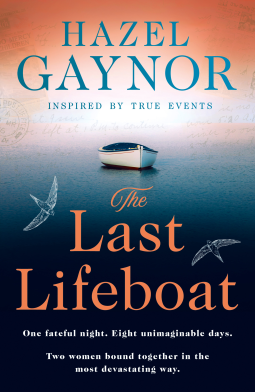
When Lily says goodbye to her children, she hands them into the care of ‘Auntie Alice,’ an escort with the Children’s Overseas Reception Board [CORB]. It is Alice’s first journey and she is excited, nervous, and worried about her pregnant sister Kitty left home alone. When the ship is torpedoed at night by a German u-boat there is enormous confusion. It is dark, disorientating, most people are asleep, distress drills forgotten. Alice finds herself the lone woman in a lifeboat of men and seven children, some from her own group, others are strangers. Thirty-five souls.
The story unfolds – and we already know Alice will be adrift in a lifeboat – through the eyes of Alice and Lily. It’s a slow mover at first as the scene is set but after the sinking, both women are waiting. One is hoping for rescue not daring to think of the alternative, the other hopeful then despairing, finally angry. Gaynor is especially good at writing the children, their characters, their influence on the adults, their bravery and ability to look beyond the horrible present up to the stars in the sky.
Inspired by the real life sinking in September 1940 of a vessel carrying ‘seavacuees,’ child refugees, Gaynor has brought new air to a story that made headlines and generated many letters of complaints when it happened, but is unfamiliar today. I’ve not been disappointed by a novel by Hazel Gaynor yet, she’s fast becoming one of my must-read authors.

Try the #FirstPara of THE LAST LIFEBOAT.

Read my reviews of these other novels by Hazel Gaynor:-
THE BIRD IN THE BAMBOO CAGE
THE COTTINGLEY SECRET

If you like this, try:-
The Collaborator’s Daughter’ by Eva Glyn
The Garden of Angels’ by David Hewson
A Beautiful Spy’ by Rachel Hore

And if you’d like to tweet a link to THIS post, here’s my suggested tweet:
#BookReview THE LAST LIFEBOAT by @HazelGaynor https://wp.me/p2ZHJe-7au via @SandraDanby

COMING SOON… THE NEXT BOOK I REVIEW WILL BE:- Suzanne Collins

#BookReview ‘Death at the Dance’ by @BrightVerity #cosymystery #crime

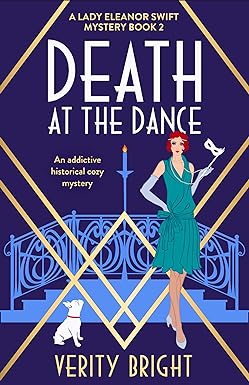
What will Ellie do when the man she is keen on is arrested as a murderer? Death at the Dance is second in the Lady Eleanor Swift series of 1920s historical cosy crime novels by Verity Bright. The first novel, A Very English Murder, set the scene and introduced the characters but Death at the Dance hits the ground running and is better for it. Verity BrightThe theme of acting runs throughout. Ellie, who feels she is still learning the role of a ‘lady,’ joins the local amateur dramatic society where she has trouble learning her lines. One of the suspects in A Very English Murder plays a key part in the play and turns out to be a very good actor. The death referred to in the title of this book coincides with a jewel theft, both take place at a fancy dress dance where everyone is in costume – a pirate, a harlequin, a Cleopatra, a bird of paradise. The pirate, Lord Lancelot Fenwick-Langham, is accused of theft and murder. There have been major jewel thefts in the area and a notorious gang is said to be responsible. Detective Chief Inspector Seldon, Ellie’s old nemesis, locks up Lancelot in the local police station.
Once again Ellie teams up with her logical, analytical and practical butler, Clifford, to prove Lancelot’s innocence. To gather evidence she goes out on the town with his friends, the Bright Young Things, including an Indian prince, two sisters, a quiet artist and a glamorous party boy. Apart from horrible hangovers and sore feet, Ellie gathers little proof except the sense that they are hiding something. Time is running out. Lancelot’s trial approaches and no evidence is found to prove his innocence. If convicted, he will hang.
There are some satisfying plot twists, surprises, suspicions that prove true, questionable decisions taken by Ellie and surprising talents shown by Clifford. All backed up with the excellent snuffling of Gladstone the bulldog, and tasty picnic food and breakfasts provided by Mrs Trotman, Henley Hall’s cook.
In my review of A Very English Murder I mentioned the lack of 1920 social, cultural and political references, but there are plenty in Death at the Dance. Suffragism, the partying Bright Young Things, drink and drug abuse.
Faster moving than the first instalment of the series, I’m loving the relationship between Ellie and her butler, the sparring with Clifford is fast, witty and funny.
Bring on the third in the series, A Witness to Murder.

Read my reviews of other books in the Lady Eleanor Swift series:-
A VERY ENGLISH MURDER #1LADYELEANORSWIFT
A WITNESS TO MURDER #3LADYELEANORSWIFT
MURDER IN THE SNOW #4LADYELEANORSWIFT
MYSTERY BY THE SEA #5LADYELEANORSWIFT
MURDER AT THE FAIR #6LADYELEANORSWIFT
A LESSON IN MURDER #7LADYELEANORSWIFT
DEATH ON A WINTER’S DAY #8LADYELEANORSWIFT
A ROYAL MURDER #9LADYELEANORSWIFT
THE FRENCH FOR MURDER #10LADYELEANORSWIFT
DEATH DOWN THE AISLE #11LADYELEANORSWIFT
MURDER IN AN IRISH CASTLE #12LADYELEANORSWIFT

If you like this, try:-
Fortune Favours the Dead’ by Stephen Spotswood [#1 Pentecost & Parker]
‘A Death in the Dales’ by Frances Brody [#7 Kate Shackleton]
The Cornish Wedding Murder’ by Fiona Leitch [#1 Nosey Parker]

And if you’d like to tweet a link to THIS post, here’s my suggested tweet:
#BookReview DEATH AT THE DANCE by @BrightVerity https://wp.me/p2ZHJe-6XT via @SandraDanby

COMING SOON… THE NEXT BOOK I REVIEW WILL BE:- Hazel Gaynor
#BookReview ‘My Brother Michael’ by Mary Stewart #mystery #WW2

‘Nothing ever happens to me,’ writes Camilla Haven on a postcard at the beginning of My Brother Michael by Mary Stewart. Longing for excitement on her solitary holiday in Greece, the inevitable happens. A case of mistaken identity takes Camilla to Delphi where statues of gods are found around every corner and ghostly lights move at night on the hills of Mount Parnassus. Mary StewartStewart has written a page-turning tale of death, art, handsome Greek gods [alive and stone], caves and smuggling. At the root of it all is what happened on these hills during the Second World War when Greek partisans were fighting the Nazis, and each other. Published in 1959, the story is set fourteen years after the war ended. This is pre-tourism Greece with goatherds on the slopes and donkeys following hillside tracks that have been used for thousands of years at a time, but when war’s mark is still evident daily. This is not a political post-war novel about a trouble, divided country, instead Stewart focuses on the people, their motivations and how history, ancient and recent, should never be forgotten.
Camilla is a cautious character in the first few chapters but as she, and we the readers, are drawn into adventure and mystery, her sense of right and wrong leads her onward towards risk and violence.
What a magical tale of mystery this is by a master storyteller. I read this first in the Seventies and this time around was just as gripped, reading into the night.
CLICK HERE TO READ MORE ABOUT THIS BOOK AT AMAZON

Click the title to read my reviews of other Mary Stewart novels:-
THE GABRIEL HOUNDS
THE IVY TREE
THIS ROUGH MAGIC
THORNYHOLD
TOUCH NOT THE CAT

If you like this, try these:-
‘THE COLLABORATOR’S DAUGHTER’ BY EVA GLYN
‘THOSE WHO ARE LOVED’ BY VICTORIA HISLOP
THE CAMOMILE LAWN’ BY MARY WESLEY

And if you’d like to tweet a link to THIS post, here’s my suggested tweet:
#BookReview MY BROTHER MICHAEL by Mary Stewart https://wp.me/p2ZHJe-789 via @SandraDanby

COMING SOON… THE NEXT BOOK I REVIEW WILL BE:- Verity Bright

#BookReview ‘Before the Fall’ by Noah Hawley #thriller #suspense

The premise for Before the Fall by Noah Hawley, also writer and producer of the Fargo television series, has a real hook. A private plane crashes into the sea and there are two survivors, JJ Bateman, a four-year old boy, and a man who rescues JJ and swims miles to reach land. Noah HawleyThis is a private jet plane in an alternate world of seriously wealthy, important people. The boy is the sole heir to his father’s huge media company. Scott, who rescues JJ, is a struggling artist. Also on board was a dodgy businessman about to be indicted for a criminal offence. Pressured to fill 24 hours of live news broadcasting, David Bateman’s own reporters start speculating about the crash, was it an accident or a terrorist attack. They also bug phones. News anchor Bill Milligan preys on the vulnerable. Scott, because his is poor, turns overnight from hero to suspect. Why was he on the plane in the first place? JJ is unable to talk, his Aunt Eleanor [his mother’s sister] who is caring for him refuses to talk to the press. The air and sea search for wreckage continues without success. The problem for the television channels is the void of things to say while rescuers search the seas. And so Milligan starts making things up, ‘…what we’re talking about here is nothing less than an act of terrorism, if not by foreign nationals, then by certain elements of the liberal media. Planes don’t just crash, people. This was sabotage. This was a shoulder-fired rocket from a speedboat. This was a jihadi in a suicide vest on board the aircraft, possibly one of the crew. Murder, my friends, by the enemies of freedom.’
Before the Fall is about suspicions, the spreading of false news online and television by disreputable media, the suppositions made by modern news gatherers and the public’s demand for salacious gossip, whether it is proven or not. And all of this amid tragedy.
Told from multiple viewpoints, the story of the flight from Martha’s Vineyard to New York gradually unfolds and some of the worst assumptions made by the media, and by people who thrive on gossip, turn out to be wrong. Some may be correct.
A character-led suspense thriller that I read in three days, racing through to the rather limp ending. Some of the phrasing is overtly American and I skipped the sections about American sport, but the emotions are universal. A morality tale for the modern world; beware the conspiracy theorists and television channels which run news stories based on speculation not fact. Often the simplest answer is the true one.

If you like this, try:-
Never’ by Ken Follett
Panic Room’ by Robert Goddard
The Partisan’ by Patrick Worrall

And if you’d like to tweet a link to THIS post, here’s my suggested tweet:
#BookReview BEFORE THE FALL by Noah Hawley https://wp.me/p2ZHJe-77I via @SandraDanby

COMING SOON… THE NEXT BOOK I REVIEW WILL BE:- Mary Stewart

#BookReview ‘Sparrow’ by James Hynes #historical #RomanEmpire

Sparrow by James Hynes is a unique novel. It is a harsh and unrelenting story, often harrowing to read, about a slave boy in a brothel in a Spanish city on the edge of the fading Roman Empire. It is a slow burner told in retrospective by the grown boy, now a man called Jacob. So, we know he survives but we don’t know how. James HynesIn the city of New Carthage [now Cartagena in Spain] towards the end of the Roman Empire, Pusus, the slave name for ‘boy,’ is growing up in Helicon, a taberna with a brothel upstairs. Pusus thinks this is the name he was given by his parents, until he learns that slave names refer to the job done by that slave. His nickname in the household is Mouse. He lives a hard life but the women of the taberna, particularly cook Focaria and wolf Euterpe [one of the whores] try to shield him. Euterpe tells him stories, in part to distract him, in part to educate him but as Pusus sees more of the world outside Helicon he’s unsure if her stories are true or not. As he is exposed to the harsh realities of slave life he begins to resent her untruthfulness.
One day Euterpe tells a story about a small bird, a sparrow, and Pusus realises he is like a sparrow who is ‘not excellent at anything, but just good enough at everything.’ Being a slave means his body, his time, his privacy and everything about him belongs to his Dominus, his master, and Audo, the bully who manages the brothel. Only his thoughts are still his own. So Pusus imagines himself as a sparrow flying high, flying free, up high in the sky, looking down at life in the taberna and the small thin slave boy below.
His first job is as house boy, scrubbing floors. The taberna and its enclosed garden are his world, he’s not allowed beyond the heavy wooden door to the street. Next, he is sent out to the local fountain to fill the heavy water buckets. Then he is trusted with money to visit local merchants and buy bread and fish and deliver dirty sheets to the laundry. With each new freedom comes a wakening awareness of the wider world of Carthago Nova. Until the day comes when Pusus is renamed Antinous and moves upstairs into his own cell amongst the wolves.
The story moves slowly, tiny detail built on tiny detail. It is told retrospectively by the elderly Jacob, how old he is we don’t know, as he reflects on the ups and downs of his life at Helicon. Jacob is educated, he reads the philosophers and histories and reflects on his life as a boy. The Roman Empire ended in AD476 but Sparrow’s life speaks also about today’s class distinctions, racism, selfishness and corruption. The detail of life in Carthago Nova is honest and tough, the sophistication of the mansions, the grinding poverty of the slaves and the free people who live hand to mouth. The neighbours of the taberna, tradesmen such as fullers and bakers, are often customers of the wolves upstairs. There is a clear strata to society which reminds me of the 1966 Frost Report sketch ‘I Know My Place’ featuring John Cleese, Ronnie Barker and Ronnie Corbett. Watch it at You Tube.
There is much pain, mental and physical, and always the threat that if Pusus doesn’t pick himself up he will be sold at the slave market. There is also sex, friendship, betrayal, abuse, violence, ambition and corruption. I honestly can’t say I enjoyed this story, it is too brutal for that, but it tells a story of a time long ago, and a time that is now.

If you like this, try:-
The Wolf Den’ by Elodie Harper #1WolfDen
A Traveller at the Gates of Wisdom’ by John Boyne
‘The Silence of the Girls’ by Pat Barker

And if you’d like to tweet a link to THIS post, here’s my suggested tweet:
#BookReview SPARROW by James Hynes https://wp.me/p2ZHJe-76L via @SandraDanby

COMING SOON… THE NEXT BOOK I REVIEW WILL BE:- Noah Hawley