Love Lane by Patrick Gale is a family story across three generations, two continents and five viewpoints but is disarmingly small-scale in its focus on the truths of this group of relatives. Family legends, gossip and anecdotes are repeated and assumed true, but can look very different when seen from another person’s perspective. 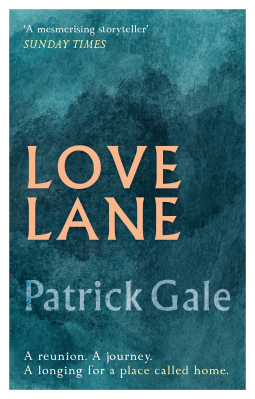 The five viewpoints we hear are Harry Cane, his daughter Betty, Betty’s husband Terry, Betty’s eldest daughter Pip and her husband Mike. Each person is hiding something that embarrasses or shames them, ignorant of how others in the family see them and the commonality that binds families together.
The story starts in Canada where Harry and Paul Slaymaker are neighbouring farmers, each living alone, growing wheat near the town of Winter on the empty Canadian prairie. For years they are secret lovers, their relationship easy to hide in the middle of nowhere. But when life moves on and Harry must sell his farm, he takes a ship to Liverpool to stay with the daughter he has never met. He is looking for a new home, a place to settle, but has no idea where this might be or indeed in which country. Betty, whose knowledge of her father is limited to family gossip passed on by her elderly aunts, and letters she has exchanged with Harry in recent years, frames him in her mind as the ‘Cowboy Grandpa.’ The bulk of the novel is set in England as Harry stays with one relative, and then another and Gale interleaves flashbacks to each person’s youth. Gradually a picture forms of each person, how they see themselves, how others see them, the things they think they hide, the things others guess. Everyone is uncomfortable with some part of their life, a sacrifice made, a compromise, a secret, a youthful adventure, a betrayal.
I admit to preferring the story when Harry is on the page, he lights up the story. There are large and small themes. Attitudes to male homosexuality throughout the first half of the 20th century are contrasted between the two countries. There is a case of sexual abuse by a doctor which is both surprising and casually brushed aside.
Only when I finished Love Lane did I discover that it is Gale’s second novel based loosely on his own family history, but I read it comfortably as a standalone without knowing A Place called Winter.
A gentle read about what it is to know yourself and finding a place to belong where you can be that person.
If you like this, try:-
‘Lean Fall Stand’ by Jon McGregor
‘Dangerous Women’ by Hope Adams
‘The Women’ by Kristin Hannah
And if you’d like to tweet a link to THIS post, here’s my suggested tweet:
#BookReview LOVE LANE by Patrick Gale @PNovelistGale https://wp.me/p2ZHJe-8Yo via @SandraDanby
COMING SOON… THE NEXT BOOK I REVIEW WILL BE:-