Told in two timelines, 1927 and 1940, this a story of love – between two people, and for an island and an endangered way of life. In The Lost Lights of St Kilda by Elisabeth Gifford, the beautiful yet harsh landscape of the island is made vividly alive. This is a delight to read, a novel about love, trust, betrayal and forgiveness. 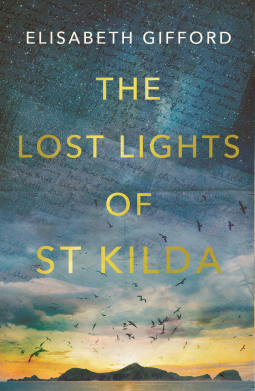 In 1940 Fred Lawson, a Scottish soldier from the 51st Highland Division, is imprisoned at Tournai, captured at St Valery in retreat as other soldiers were being evacuated at Dunkirk. Through the darkest moments of fighting, his memories of St Kilda sustain him. ‘It was your face that had stayed with me as we fought in France. It was you who’d sustained me when we were hungry and without sleep for nights as we fought the retreating action back towards the Normandy coast.’ Fred escapes and heads for Spain, forced to trust strangers, not knowing who is a friend and who is an informer, but drawn on by his memories of St Kilda.
At the same moment in Scotland, a teenage daughter longs to know more of her birth. Says Rachel Anne, ‘My mother says I am her whole, world, and she is mine, but all the same I would still like to know at least the name of my father.’
In 1927, geology student Fred travels to the remote Scottish island of St Kilda with his university friend Archie Macleod whose father owns the island. No one knows that three years later the island will be abandoned, the population on the edge of starvation. Archie, the laird’s son, has a privileged position on the island. As a teenage boy he played with the island children, play acting at the work their fathers do, learning their future trades – farming, catching puffins and fulmars – on the dangerous cliffs. And he flirts with Chrissie Gillies. But by the time Archie returns to the island in 1927 with Fred, he has developed an arrogance and a liking for whisky. Over the long summer months, Fred falls in love with the island and with Chrissie. Everything changes when tragedy strikes.
This is a beautiful read, contrasting the softness and closeness of romance with the harsh facts of life as the difficulties of island survival are laid bare. Life in the summer months seems an idyll of isolation and peace, a return to the basics of life that matter. But inevitably winter approaches and, as the real world is complicated, a misunderstanding occurs. But hope is never abandoned. Despite being separated by the years and by lies, Fred and Chrissie never forget each other.
Read my review of A WOMAN MADE OF SNOW also by Elisabeth Gifford.
If you like this, try:-
‘Days Without End’ by Sebastian Barry
‘Rush Oh!’ by Shirley Barrett
‘After the Party’ by Cressida Connolly
And if you’d like to tweet a link to THIS post, here’s my suggested tweet:
#BookReview THE LOST LIGHTS OF ST KILDA by Elisabeth Gifford @elisabeth04liz https://wp.me/p5gEM4-4yq via @SandraDanby


 Most quoted is the line from Invictus, “I am the master of my fate; I am the captain of my soul” which has inspired much popular culture. Nelson Mandela read the poem to his fellow inmates at Robben Island prison, as portrayed in the Clint Eastwood film, Invictus.


 A lonely woman spends a perfect night with a stranger, yet is their connection enough to make her realise life is worth living? Maya, a refugee, wears a bracelet strung with charms that are a lifeline to her past; when the past catches up with her, she has a difficult decision to make. Rowe’s life on the Yorkshire coast is already mapped out for him, but when there is an accident at the steelworks he knows he has to flee from an intolerable future. In the Costa prize-winning ‘Red’, Mollie is desperate to leave Oakridge Farm and her abusive stepfather, to walk free with the stray dog she has named Hal. These are stories filled with yearning and hope, the search for connection and the longing to escape. They transport the reader from India to Japan, from mid-west America to the north-east coast of England, from New York to London. Battered, bruised, jaded or jilted, the human heart somehow endures.
 What is a ‘Porridge & Cream’ book? It’s the book you turn to when you need a familiar read, when you are tired, ill, or out-of-sorts, where you know the story and love it. Where reading it is like slipping on your oldest, scruffiest slippers after walking for miles. Where does the name ‘Porridge & Cream’ come from? Cat Deerborn is a character in Susan Hill’s ‘Simon Serrailler’ detective series. Cat is a hard-worked GP, a widow with two children and she struggles from day-to-day. One night, after a particularly difficult day, she needs something familiar to read. From her bookshelf she selects