Category Archives: book reviews

#BookReview ‘The Garden of Evening Mists’ by Tan Twan Eng #Malaya

This is another enchanting novel by Malaysian author Tan Twan Eng. The Garden of Evening Mists focuses on the post-Second World War period in Malaya. Tan Twan EngThe Japanese occupiers have gone and local communist fighters are challenging British rule. In the hills of the Cameron Highlands, next to a tea plantation, lies a delicate Japanese garden created by Nakamura Aritomo, a man who was once gardener to the Emperor of Japan. Decades later when Yun Ling Teoh retires as a Supreme Court judge in Kuala Lumpur, she re-visits the garden at Yugiri. This is her story.
In the 1950s Emergency, the people who lived in Malaya’s hill villages grew to fear the communists. Homes were raided and destroyed, people killed, women raped. This is the setting in which Yun Ling first visits Yugiri to ask Aritomo to build a traditional Japanese garden in memory of her sister Yun Hong. This is a novel about memory, things remembered and things denied, and about loyalty. Yun Ling’s loyalty to her sister who was killed in a Japanese labour camp and her guilt that she could have done more to save her, and loyalty to Arimoto who she loved and thought she knew.
Judge Teoh returns to Yugiri as an old woman approaching death, many years after Arimoto walked into the jungle and never returned. She is forced to relive her past when a historian arrives to assess Arimoto’s engravings. As she relives the years of her imprisonment at the hands of the Japanese, and the post-war years when she first worked at Yugiri’s garden, Judge Teoh questions her perceptions of the past. This time, there is no avoiding the truth.
Tan Twan Eng discusses big issues. He explores the moral dilemmas of war and peace after war, considering the murderous actions of the Japanese at war, the same Japanese who love traditional gardens and the rituals of archery. This novel is rich in history, both of the Japanese Occupation of Malaya, the labour camps, lost war treasure, and of the Emergency. The lush countryside is offset by the tales of horror and abuse told. As with Tan Twan Eng’s first novel, The Gift of Rain, the beauty of the setting is juxtaposed with cruelty and violence.
A deep, thought-provoking and at times difficult novel, the writing is beautiful.

Read the first paragraph of THE GARDEN OF EVENING MISTS.

And here are my reviews of two other novels by Tan Twan Eng:-
THE GIFT OF RAIN
THE HOUSE OF DOORS

If you like this, try:-
‘The Aftermath’ by Rhidian Brook
‘Homeland’ by Clare Francis
‘The Book of Lies’ by Mary Horlock

And if you’d like to tweet a link to THIS post, here’s my suggested tweet:
#BookReview THE GARDEN OF EVENING MISTS by Tan Twan Eng http://wp.me/p5gEM4-2qf via @SandraDanby

First Edition: The Secret Garden

First published as a US serial in The American Magazine beginning in 1910, The Secret Garden by Frances Hodgson Burnett [below] was first published as a book in 1911. The American edition by Stokes [below] featured illustrations by Maria Louise Kirk, while illustrations in the British edition published by Heinemann were by Charles Heath Robinson. Burnett was born in Manchester, England in 1849 but after the death of her father, she emigrated with her family to the Knoxville, Tennessee, USA in 1865. Frances Hodgson BurnettRead more about the Stokes first edition at Bauman Rare Books.

The story
Mary Lennox, born at the turn of the twentieth century to wealthy British parents in India who do not want her, is cared for by servants. After the death of her parents she is sent to England to Yorkshire, to live with her Uncle Archibald at Misselthwaite Manor. There she is bad-tempered and dislikes everything about her new home until Martha, a maid, tells her the story of Mrs Craven who loved her private walled garden of roses. When his wife died, Mr Craven locked the garden and buried the key. As Mary wonders about the secret garden, her humour and behaviour improves and she makes friends with the gardener. When she finds the key, Mary’s brother Dickon helps Mary to learn about gardening, plants and wildlife. Then one night, exploring a cry in the night, she discovers a boy living in a hidden bedroom. This is Colin, her cousin, who has a damaged spine. She tells Colin of the secret garden and when they visit it together, Colin finds his weak legs can stand after all.

The film
The 1993 film The Secret Garden starred Kate Maberly, Heydon Prowse, Andrew Knott, John Lynch and Maggie Smith. Exterior shots of Misselthwaite Manor were shot at Allerton Castle in Yorkshire, internal scenes at Fountains Hall near Ripon. Watch the film trailer.

Other editions

Read here why The Secret Garden is the ‘Porridge & Cream’ comfort read of novelist Laura Wilkinson.

Frances Hodgson Burnett


‘The Secret Garden’ by Frances Hodgson Burnett [UK: Virago] Buy now

If you like old books, check out these:-
‘An Ice Cream War’ by William Boyd
‘The French Lieutenant’s Woman’ by John Fowles
‘Watership Down’ by Richard Adams

And if you’d like to tweet a link to THIS post, here’s my suggested tweet:
First Edition: THE SECRET GARDEN by Frances Hodgson Burnett #oldbooks http://wp.me/p5gEM4-2TQ via @SandraDanby

#BookReview ‘Shadow Baby’ by Margaret Forster #adoption

A slow-build read which, by halfway, Shadow Baby by Margaret Forster had me glued to the page. It is in part a story about unplanned pregnancy – choices, motherhood and how a girl grows to be a mother herself – and part social history. The history is the skeleton on which the flesh of the story hangs and inter-connects. Two young women fall pregnant, Leah in 1887 and Hazel in 1956. Both abandon their babies. Margaret ForsterThis is the story of Leah and her daughter Evie, Hazel and her daughter Shona. The circumstances are different – Evie is brought up first in a children’s home and then by reluctant relatives; Shona is adopted by a family desperate for a child with a mother whose care is suffocating – but the stories so similar. Both daughters are obsessed with their birth mothers.
From generation to generation, mistakes are uncannily mirrored. Attitudes from the 19th century reappear in the 20th. Shadow Baby is a thoughtful and measured exploration of how the nature of being a mother differs from woman to woman, expectations, fears, well-meaning but hurtful family and social pressure. And how, when the daughter grows into a woman who in turn becomes pregnant, the same fears, expectations and social pressures kick in. Forster is perceptive about the rejection felt by the daughters, and the shame of their mothers, shame which prompts denial and continued rejection. These women have to make hard decisions to survive, decisions a million miles away from how we live today in our comfortable 21st century lives but with a stark reminder of how the actions of a previous generation can affect the next.

If you like this, try:-
‘The Letter’ by Kathryn Hughes
‘Innocent Blood’ by PD James
‘Chosen Child’ by Linda Huber

And if you’d like to tweet a link to THIS post, here’s my suggested tweet:
#BookReview SHADOW BABY by Margaret Forster http://wp.me/p5gEM4-2dO via @SandraDanby 

#BookReview ‘House of Names’ by Colm Tóibín #Greekmyths #saga

I have a sketchy knowledge of Greek literature lost in the mist of time, and so approached House of Names by Colm Tóibín with a sense of trepidation combined with anticipation of reading something new. As always with Colm Tóibín’s novels, the writing is exquisite but House of Names did, for me, lack an emotional connection. And I’m not sure why. Colm TóibínThe novel begins with the story of Agamemnon, warrior king, who sacrifices his daughter Iphigenia to the gods in the hope of victory in battle. However this novel is not about the king but what happens next. Tóibín imagines the continuance of the story, of Agamemnon’s wife Clytemnestra, daughter Electra and son Orestes. As always with classical literature, it is easy to find parallels with modern life, in politics, war and television. Double-crossing, lies, scheming politicians, vengeful soldiers, royal disagreements, distrustful servants, sibling rivalry, kidnapping and violence.
We share Clytemnestra’s version of the story first, told in first person and more vivid for that, as her husband murders their daughter rather than celebrating her marriage. Clytemnestra broods and plans her revenge, revenge which she takes with her own hand. But the central question in this story is who is telling the truth. Did Clytemnestra arrange for the ‘safe-guarding’ of her son Orestes and the banishment to the dungeon of her daughter Electra? Or was it her new ally, the prisoner-turner-lover Aegisthus?
The story then switches to Orestes who is marched across country to be imprisoned with a group of kidnapped boys. The title of the novel comes from this section, told in the third person it moves slower. Orestes, with friend Leander, escapes captivity and wanders the barren countryside, on the edge of starvation, until they stumble on refuge in a cottage by the sea occupied by an elderly woman. With Electra’s viewpoint, the narration switches back to first person. Electra is the most enigmatic, conversing with spirits, moving silently, observing the plotting. Is she simply a watcher, or has she inherited the vengeful nature of her mother? Through Electra we finally put together the pieces of Agamemnon’s death and the subsequent intrigue, though it pays to be patient as some things only make sense as the end approaches. Somewhere through the tale the emphasis is placed on the violence of Clytemnestra’s revenge while the event which sparked her fury – her husband’s murder of Iphigenia – becomes blurred.
I did not research Aeschylus’ Oerestia before reading House of Names and there are other reviews online which efficiently compare the original with Tóibín’s re-imagining. However I do feel that an ignorance of the original is perhaps helpful when reading a novel such as this, I was able to relax into the story without worrying about changes made and diversions taken.
Colm Tóibín is one of my favourite authors and House of Names, though an experimental read for me, has not changed my mind.

Read my reviews of these other novels by Colm Tóibín:-
BROOKLYN
NORA WEBSTER

If you like this, try:-
The Silence of the Girls’ by Pat Barker
Stone Blind’ by Natalie Haynes
A Traveller at the Gates of Wisdom’ by John Boyne

And if you’d like to tweet a link to THIS post, here’s my suggested tweet:
#BookReview HOUSE OF NAMES by Colm Tóibín http://wp.me/p5gEM4-2NV via @SandraDanby

A poem to read in the bath… ‘The Death of the Hat’

Billy Collins is a favourite poet of mine, he is so good at making the ordinary everyday things suddenly become personal and touching. So true.

Billy Collins

[photo: poetryfoundation.org]

Because of copyright restrictions I am unable to reproduce the poem in full, but please search it out in an anthology or at your local library.

‘The Death of the Hat’
Once every man wore a hat.

In the ashen newsreels,
the avenues of cities
are broad rivers flowing with hats.

The ballparks swelled
with thousands of strawhats,
brims and bands,
rows of men smoking
and cheering in shirtsleeves.

Hats were the law.
They went without saying.
You noticed a man without a hat in a crowd.

I challenge you to read the very last stanza [not shown here] without a tear in your eye as he transitions from hats to the loss of a loved one.

Read two other poems by Billy Collins which I love:-
The Dead
On Turning Ten

Billy Collins


Taking Off Emily Dickinson’s Clothes’ by Billy Collins [UK: Picador] 

Read these other excerpts, and perhaps find a new poet to love:-
‘Japanese Maple’ by Clive James
‘My Heart Leaps Up’ by William Wordsworth
‘Oxfam’ by Carol Ann Duffy

And if you’d like to tweet a link to THIS post, here’s my suggested tweet:
A #poem to read in the bath: ‘The Death of the Hat’ by Billy Collins via @SandraDanby http://wp.me/p5gEM4-26r

SaveSave

#BookReview ‘The Crows of Beara’ by Julie Christine Johnson #contemporary #romance

The Crows of Beara by Julie Christine Johnson is a sensitive tale of two lost souls from opposite sides of the world who are in such pain they are unable to recognise a fresh chance for happiness. Annie Crowe, recovering addict and corporate PR specialist, flies from Seattle to Ireland to promote a new copper mine. When she meets Daniel Savage, an artist with a troubled past, both start to hear a mystical Gaelic voice whispering words of poetry. Julie Christine JohnsonThe west coast of Ireland is a bleak, beautiful, empty place. Jobs are thin on the ground so when a new copper mine is announced, the locals are divided: the economy, or nature. Annie arrives, determined to make a success of this last chance to get her career back on track. When she discovers the mine will endanger the nesting site of the Red-Billed Choughs, she must tell lies in the name of PR. She doesn’t expect it to make her acknowledge the lies she has been telling herself; about her failed marriage, her failing career, and her alcoholism.
Annie, flawed but vulnerable, is an easy character to like. Weighed down by her addiction and the knowledge she did shameful things she can’t remember, she moves forward step-by-step. You will her onwards. She soon falls in love with the beauty of Beara and the openness of the community. This causes a professional problem, how can she promote a copper mine which will damage this exquisite nature. As she wrestles with her conscience, she must also resist the temptation to pick up a glass of alcohol. In Annie and Daniel, Johnson has created two wounded characters who are not sorry for themselves, who face up to their pasts and their grief, who try to look forward. This is an uplifting story on so many levels.
As with In Another Life, Johnson’s debut novel, there is something mystical going on in The Crows of Beara. A skeleton of myth and legend underlies the Irish setting and runs throughout the story. The west coast of Ireland is certainly an extra character here; the descriptions of the Beara Peninsula, its mists, its cliffs, its Red-Billed Choughs [the crows of the title] are so beautifully written you will be getting out your hiking boots and googling hotel accommodation.

And here’s my review of IN ANOTHER LIFE, also by Julie Christine Johnson.

If you like this, try:-
‘Himself’ by Jess Kidd
‘The Little Red Chairs’ by Enda O’Brien
‘Nora Webster’ by Colm Tóibín

And if you’d like to tweet a link to THIS post, here’s my suggested tweet:
#BookReview THE CROWS OF BEARA by Julie Christine Johnson http://wp.me/p5gEM4-2Ok via @SandraDanby

My Porridge & Cream read: Caroline James

Today I’m delighted to welcome romance novelist Caroline James. Her ‘Porridge & Cream’ read is The Old Wives’ Tale by Arnold Bennett.

“First published in 1908 and set in the fictional town of Bursley in the Potteries, it traces the lives of two sisters, shy Constance and romantic Sophia, who are born into a secure world, supported by their parent’s drapery business.
Caroline James“I first discovered this book when I was a young girl working in London. My flat mates were into Jilly Cooper novels and couldn’t understand why I was reading such ‘an old book’. I was born close to the area where the narrative takes place and grew up on the borders of the five towns that comprise Stoke-on-Trent. As I read, I remember feeling that I was in a time warp, fantasising that I had walked the same streets as the sisters.

“I have always been in awe of Bennett’s writing. A male author who writes with such knowledge and clarity from a female perspective. The prose is exquisite and he makes every word count. Over the years, when far away from home, I re-read The Old Wives’ Tale. Despite being a period setting, written over a century ago, I am fondly reminded of the warmth and ways of Pottery folk, still retained today. Drawn to the book repeatedly, it feels like a hug from my mum. Bennett says, “No life is ever small to the person living it.” A phrase my mum might have said. The older I get the more this book speaks to me and reminds me to be respectful. Everyone was young once. Arnold Bennett is commemorated in the Stoke museum and I’ve studied his personal artefacts on many occasions, in awe of his brilliance and grateful that such an author is accessible to this day.”

Caroline James’ Bio
Caroline James has owned and run businesses encompassing all aspects of the hospitality industry – a subject that features in her novels. She is based in the UK and spends her time writing, climbing mountains and running a consultancy business. Caroline has a great fondness for the Caribbean and escapes to the islands whenever she can. She is a public speaker, reviewer and food writer and loves cooking and baking, especially cake.

Caroline James’ links
Twitter
Facebook
Website

Caroline James’ books
Caroline JamesSet in Cumbria and Barbados, Coffee, Tea, The Caribbean & Me follows the lives of Jo and Hattie who are flying solo in their middle years. Is there hope for the newly single baby boomers and can romance happen? Join the pair as they romp into their future and prove that anything is possible. Coffee, Tea, The Caribbean & Me is an Amazon best-seller and a ‘Top Recommended Read’ by Thomson Holidays.
Read how Caroline researched her second novel, So You Think You’re A Celebrity…Chef?

‘Coffee, Tea, The Caribbean & Me’ by Caroline James [UK: Ramjam Publishing]

Caroline James

What is a ‘Porridge & Cream’ book? It’s the book you turn to when you need a familiar read, when you are tired, ill, or out-of-sorts, where you know the story and love it. Where reading it is like slipping on your oldest, scruffiest slippers after walking for miles. Where does the name ‘Porridge & Cream’ come from? Cat Deerborn is a character in Susan Hill’s ‘Simon Serrailler’ detective series. Cat is a hard-worked GP, a widow with two children and she struggles from day-to-day. One night, after a particularly difficult day, she needs something familiar to read. From her bookshelf she selects ‘Love in A Cold Climate’ by Nancy Mitford. Do you have a favourite read which you return to again and again? If so, please send me a message via the contact form here.

Discover the ‘Porridge & Cream’ books of these authors:-
Carol Cooper
Claire Dyer
Lev D Lewis


‘The Old Wives’ Tale’ by Arnold Bennett [UK: Churnet Valley Books] 

And if you’d like to tweet a link to THIS post, here’s my suggested tweet:
Why does @CarolineJames12 love THE OLD WIVES’ TALE by Arnold Bennett via @SandraDanby http://wp.me/p5gEM4-2Pw #amreading

#BookReview ‘Shelter’ by Sarah Franklin #WW2

This book is full of trees. The Forest of Dean to be exact. Shelter by Sarah Franklin is the story of two outsiders who find themselves in the forest during World War Two. As they struggle to survive, to learn about their surroundings, how to get by from day to day, each finds a way to live the rest of their lives. Sarah FranklinEarly in 1944 in Coventry, Connie Granger’s life is changed in the course of one night. Escaping the bombing, city-girl Connie takes a job with the Women’s Timber Corps. Unable to follow her dreams, she resents the change of direction.  Sent to the Forest of Dean for her training, she turns out to be so good the manager keeps her on. Meanwhile, in the forest, a prisoner-of-war camp is built for Italian soldiers captured during fighting in Africa. Neither prisoner Seppe, nor Connie, know one tree from another but together they learn to fell trees and work timber. And they get to know each other.
The themes of nature, change and new birth are strong throughout Shelter, symbolised not just by the trees but by the growth of Joe, Connie’s baby, and the increasingly fluency of Seppe’s English. Both are odd-ones-out. Both feel they don’t ‘fit’. Except in the forest. Connie lodges in the cottage of farmer Amos, who worries for the life of his absent soldier son Billy. Seppe, though he lives in the camp, exploits the lax guards and spends more time amongst the trees. These three, with timber manager Frank and his wife Joyce, completes the cast of characters.
The story of the wartime lumberjills was fascinating. This is a well-written debut novel by a writer brave enough to allow Connie to be determined and selfish, unsure, selfish again, before working out what she wants. There is something honest in Connie’s selfishness which makes her seem real. The switching around of the timeline at the beginning was unnecessarily confusing, but after that the story swung along as Connie transforms from someone who doesn’t recognise bluebells as she walks through a wood, to a woman who stops to watch a hawk swoop in for the kill.

Read my review of HOW TO BELONG also by Sarah Franklin.

If you like this, try:-
‘Homeland’ by Clare Francis
‘Another You’ by Jane Cable
‘After the Bombing’ by Clare Morrall

And if you’d like to tweet a link to THIS post, here’s my suggested tweet:
#BookReview SHELTER by Sarah Franklin http://wp.me/p5gEM4-2MI via @SandraDanby 

#BookReview ‘I Found You’ by Lisa Jewell @lisajewelluk #thriller

Alice Lake sees a man sitting alone on a beach in the rain and invites him into her home. He has lost his memory. When Lily’s new husband doesn’t come home from work, she goes to the police for help and discovers he has a false name. A family from Croydon take a traditional English holiday by the sea. These are the three storylines in I Found You by Lisa Jewell. The common denominator is location: a northern seaside town called Ridinghouse Bay. Lisa JewellTwo inter-connected themes run throughout I Found You. Memory – the fugue of the man on the beach, and the dementia suffered by Alice’s parents – and identity, disguised, mistaken, forgotten. Jewell is so good at writing believable characters, good at exploring human nature in a simple, accessible way. And though there is evil in this story, there is also good, kindness, humanity, heart.
The menace is subtle, building slowly from the beginning even when the connections are unclear. It’s just a feeling. Gray watches his younger sister being chatted up by Mark, an older teenager, and feels uneasy: ‘There was something just off about him. Something shadowy and cruel. There were too many angles in his face. Too much thought behind each gesture, each word, each action. Even his hair colour was too uniform, Gray felt, as though he could tug at it and mark’s whole face would come off to reveal his true identity, like a Scooby Doo villain.’
Alice is too easy to trust, it has got her into trouble before. But her least-trusting dog likes the man from the beach, who her youngest daughter names ‘Frank’. But even Frank doesn’t know if he is trustworthy. How much do you need to know about someone before you trust them? Is it dangerous to rely on instinct? Or is that the most reliable test?
Two things in the story rang untrue for me – the police today use mobile phone records and CCTV to quickly trace missing people; and the behaviour of some characters in the intervening years seems far-fetched. But that aside, this is a satisfying puzzle to solve.

And here are my review of two other thrillers by Lisa Jewell:-
THE GIRLS
THEN SHE WAS GONE

If you like this, try:-
‘The House on Cold Hill’ by Peter James
‘The Good People’ by Hannah Kent
‘Summer House with Swimming Pool’ by Herman Koch

And if you’d like to tweet a link to THIS post, here’s my suggested tweet:
#BookReview I FOUND YOU by Lisa Jewell @lisajewelluk via @SandraDanby http://wp.me/p5gEM4-2Lg

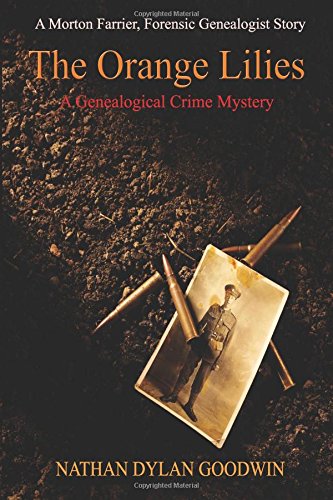
#BookReview ‘The Orange Lilies’ by Nathan Dylan Goodwin #familyhistory #crime #genealogy

The Orange Lilies by Nathan Dylan Goodwin is a novella, a short book which I wanted to be longer. Set at Christmas 2014 it revisits Christmas 100 years earlier, the first year of the Great War, and follows the story of one man in the trenches with the Royal Sussex Regiment. Third in the series about forensic genealogist Morton Farrier, it is a little different from its predecessors in that it focusses on Morton’s own story rather than that of a client. Nathan Dylan GoodwinMorton knows he is adopted but has recently discovered a complicated family secret. So in an effort to build bridges and learn more about his ancestors, he and girlfriend Juliette travel to Cornwall to visit his Aunty Margaret and Uncle Jim. Over the festive break, Morton and Margaret trace official documents telling the story of Morton’s great-grandfather Charles Farrier, who fought with the Second Battalion, the Royal Sussex Regiment. However as records are uncovered, more questions appear. At the same time we are told Charles’s story in 1914, with its own mysteries, contradictions and secrets. Unknown to Morton, old and modern mysteries are inter-linked.
I love the formula of the Morton Farrier books, the combination of present and past, secrets and lies, the hunt for truth and puzzles solved. This book is a little different, I think for two reasons. First, I longed in the first half for more dynamic detail of Charles’s story rather than dry factual reporting. At the front of the book, the author explains that two of his own relatives fought with this regiment. At the end of the book, the author explains that the movements of the Second Battalion are recorded as faithfully and accurately as possible. It feels as if the history bound the creative hands of the author. The second difference is that Morton is researching his own family and so the emotional attachment is different. Unlike when he is searching for clients, there is no immediate danger to his life, property or loved ones.
I raced through this book, intrigued by the mystery of Charles and his young wife Nellie. If you are new to the Morton Farrier books, you will appreciate this novella better if you have already read the first two in the series.

Read my reviews of the next books in the Morton Farrier series:-
HIDING THE PAST #1MORTONFARRIER
THE LOST ANCESTOR #2MORTONFARRIER
THE AMERICA GROUND #4MORTONFARRIER

If you like this, try:-
‘Pale as the Dead’ by Fiona Mountain
‘Blood Atonement’ by Dan Waddell
‘The Quarry’ by Iain Banks

And if you’d like to tweet a link to THIS post, here’s my suggested tweet:
#BookReview THE ORANGE LILIES by Nathan Dylan Goodwin http://wp.me/p5gEM4-2j2 via @SandraDanby