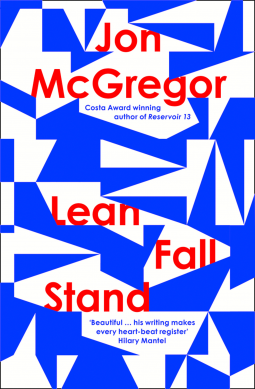
#BookReview ‘Lean Fall Stand’ by @jon_mcgregor #contemporary

Jon McGregor is one of the most original novelists I have read and Lean Fall Stand doesn’t disappoint. It is a novel of three parts, beginning thrillingly at an Antarctic research station when a storm suddenly separates the three expedition members. We know tragedy happens, but not what or how. Surviving expedition guide Robert ‘Doc’ Wright suffers a stroke and is unable to tell what happened on the ice. Jon McGregorLean Fall Stand is Doc’s story as he struggles to recover his ability to do the smallest daily personal tasks, to choose the right word and pronounce it correctly, to make himself understood. The change of pace between part 1 ‘Lean’ when the accident happens in Antarctica, and part 2 ‘Fall’ is abrupt and shocking. Through the viewpoint of Doc’s wife, Anna, we realise with a jolt just how bad his communication issues are and what this means for their marriage and family, his career, his work colleagues and the enquiry into the accident. Just as the three men are alone and lost in the Antarctic storm, Doc and Anna are alone and lost when he returns home from hospital. He cannot fasten his trousers; she is his carer. Each feels unable to connect with the other.
This is a beautifully written novel about a tough subject and McGregor does not flinch from making both Doc and Anna unreachable personalities at times. This is not a sentimental novel. It is a novel about communication and the lack of it, whether limited by geography, failed radio and communications equipment, aphasia [language deficits caused by damage to the brain], or simply not speaking to our loved ones about the things that matter. Part 3 ‘Stand’ sees the language connections beginning again as Doc begrudgingly attends speech therapy class. Anna, struggling not only with Doc but with her two children who upbraid her for her mono-syllabic conversation, takes refuge in the garden where winter is turning to spring.
I finished the book never understanding clearly what happened on the ice. The mystery that McGregor hints at – legal issues, failed equipment, bad decisions, corporate responsibility – felt like a plot technique to move the story along. As Doc is unable to express himself clearly, even at the end of the book, we will never know what really happened at Station K. It’s as if the novel ends part-way through Doc’s recovery and there is more to tell.
Thought-provoking. At times uncomfortable, and difficult to read about the process of stroke recovery. Skilfully, and beautifully, written.
CLICK HERE TO READ MORE ABOUT THIS BOOK

Read my review of McGregor’s RESERVOIR 13.

If you like this, try:-
Unsettled Ground’ by Claire Fuller
Doppler’ by Erlend Loe
The Man Who Disappeared’ by Clare Morrall

And if you’d like to tweet a link to THIS post, here’s my suggested tweet:
#BookReview LEAN FALL STAND by @jon_mcgregor https://wp.me/p5gEM4-5eP via @Sandra Danby
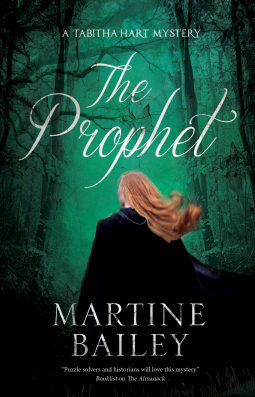
#BookReview ‘The Prophet’ by @MartineBailey #historical #mystery

When a dead body is found at the foot of an ancient oak, a tense plot begins. The Prophet is the second Martine Bailey novel to feature the characters of Tabitha and Nat De Vallory, first seen in The Almanack. The oak tree in question is not just any tree; it is the Mondren Oak, and nearby an evangelist preacher and his community have made an encampment in ancient woodland belonging to Nat’s father. Martine BaileyEighteenth-century England was a place of superstition and myth, of religious fervour and persecution. It was also a time of scientific study and enlightenment. The body of a young woman is found on May Day, 1753. The date is significant and the novel’s action winds up slowly in pace and tension towards Midsummer’s Day, coincidentally the due date for the arrival of Tabitha and Nat’s first baby. Baptist Gunn and his growing number of followers believe a new saviour will be born close to the oak tree on Midsummer’s Day. Gunn, a ‘sleeping prophet’, is gathering his congregation, and money, in preparation to sail for a new life in America.
Tabitha is a likeable protagonist, happy to be married and living in the place where she grew up, but challenged by the new monied life she leads. Her colourful background comes in handy when she determines to seek the woman’s murderer. Heavily pregnant, she makes an eye-catching amateur detective. Advised by her doctor to avoid shock, surprise, and the night-time attentions of her husband, Tabitha feels distanced from Nat. She distrusts the claims of Baptist Gunn and fears he is a fraudster. Meanwhile Nat seeks the preacher’s company, keen to run a scientific experiment studying the veracity of prophecies. Eager to support his ailing father and needing to establish his authority in the community as heir to the estate, Nat takes risks that Tabitha fears endanger their lives.
Are our lives governed by fate and can this be forseen by a privileged few? Why do some people trustingly accept claims and predictions without examination, while others demand proof and evidence? Bailey’s novel is a historical reminder to the 21st century not to believe everything you hear without an analysis of motivation, fact and context.
The Prophet is an unusual historical mystery rooted in an ancient Cheshire woodland. Bailey has created an authentic rural community which lightly bears the depth of her historical research. Watch out for the plot surprises, the secrets and lies.

And here are my reviews of other novels by Martine Bailey:-
THE ALMANACK #1 TABITHAHART
AN APPETITE FOR VIOLETS
THE PENNY HEART

If you like this, try this:-
The Wicked Cometh’ by Laura Carlin
The Confessions of Frannie Langton’ by Sara Collins
The Wonder’ by Emma Donoghue

And if you’d like to tweet a link to THIS post, here’s my suggested tweet:
#BookReview THE PROPHET by @MartineBailey https://wp.me/p5gEM4-5er via @SandraDanby

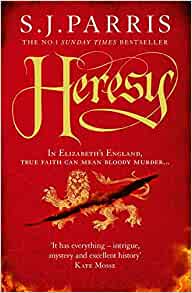
#BookReview ‘Heresy’ by SJ Parris @thestephmerritt #historical #crime

Including touches such as secret messages written in orange juice, ciphers and hidden codes, Heresy is the introduction to the Giordano Bruno series of historical mysteries by SJ Parris. Set in 1583, this is the English Reformation of Queen Elizabeth I and her spymaster, Sir Francis Walsingham, as they steer the country from catholicism to protestantism. Meanwhile, catholics continue to worship in secret. SJ ParrisFormer Italian monk turned heretic and philosopher Bruno rides out of London on a horse borrowed from the French ambassador, to meet with a royal party bound for Oxford. Accompanied by his friend, courtier poet and secret spy, Sir Philip Sidney, Bruno has two secret missions. The first, along with Sidney, is to expose a catholic conspiracy in the university city. The second is to find a heretical text, stolen long ago but rumoured to be in England, which states that the earth revolves around the sun. This second mission is the one, I suspect, that will continue beyond this book and through the whole series.
When the murders begin, Bruno’s position as an outsider at Lincoln College is both an advantage and disadvantage. His lack of foreknowledge gives him a clear vision of factual events and the awkward questions to ask, but his ignorance of the incestuous and competitive city’s petty squabbles, hidden feuds and flirtations puts him in the path of danger. He stumbles from incident to incident, working out who to believe and who to trust. Regarded as a foreigner and therefore a suspect by everyone else, Bruno’s difficulties reflect the turmoil of the times. The murders are brutal but so are the legal punishments for crimes.
A dense plot with an infinity of tentacles of historical fact and religious conflict that, at times, I found it hard to keep up. In the style of truly satisfying detective stories, when the villain was unveiled I thought ‘of course’ and was annoyed with myself for not guessing correctly.
Much-compared to CJ Sansom’s Matthew Shardlake series – which are set in the times of Elizabeth’s father King Henry VIII and his master fixer Thomas Cromwell – I found this book slower-moving and different in focus, but nevertheless enjoyable.
I do love finding a good series.
CLICK HERE TO READ MORE ABOUT THIS BOOK AT AMAZON

Read my reviews of other books in the series:-
PROPHECY #2GiordanoBruno
SACRILEGE #3GiordanoBruno

If you like this, try:-
Dissolution’ by CJ Sansom
The Ashes of London’ by Andrew Taylor
The Last Hours’ by Minette Walters

And if you’d like to tweet a link to THIS post, here’s my suggested tweet:
#BookReview HERESY by SJ Parris @thestephmerritt https://wp.me/p5gEM4-5dX via @SandraDanby

#BookReview ‘Tainted Tree’ by @jackieluben #saga #romance

American Addie Russell was adopted at birth after her single mother died. Always happy with her adoptive parents in Boston, USA, advertising copywriter Addie starts to ask questions when she inherits a house from a stranger in England. Tainted Tree by Jacquelynn Luben is an adoption mystery combined with romance,  threading together genealogical search and US/English differences with the joy and abandonment of teenage love. Jacquelynn Luben Addie arrives in England at the house she has inherited. Glad to cross the Atlantic and escape her job and the boss which whom she had an affair, she is determined to find out more about her birth mother Adrienne and perhaps identify her birth father. But the local lawyer handling the estate is cold and stand-offish, sending mixed signals that Addie doesn’t understand. Undeterred, she does her own research and traces her maternal grandparents but is shocked that they rejected her when she was born. Why did they hate her so?
The action moves back and forth between Addie’s new house in Surrey and the West Country, where her mother grew up. Although this story has a fair amount of romance, both in the modern story and that of Adrienne, it also has a dark streak of abuse and violence. There are some wonderful minor characters, Ada became a favourite. Luben is good at creating atmosphere and darker, threatening personalities.
I did want to see more of Adrienne’s viewpoint directly, rather than simply reading about Addie reading Adrienne’s diary entries. Her teenage love affair in the Sixties rang true and Luben populates the story with well-drawn supporting characters, particularly the three Amerys and the Graingers.
There were times in the first third when I felt bogged down with information overload and I got a couple of the historical characters muddled up, but as the middle section took off it started to become clearer. The action scenes really move things along though the pace does vary as Addie spends a fair amount of time reviewing what she knows and doesn’t know. Luben carefully handles a complex story, allowing Addie to discover contradictions and dead ends, unhelpful personalities and unexpected curve balls.
CLICK HERE TO READ MORE ABOUT THIS BOOK

If you like this, try:-
A Daughter’s Hope’ by Margaret Kaine
File Under Family’ by Geraldine Wall
The Letter’ by Kathryn Hughes

And if you’d like to tweet a link to THIS post, here’s my suggested tweet:
#BookReview TAINTED TREE by @jackieluben https://wp.me/p5gEM4-4WL via @SandraDanby

A poem to read in the bath… ‘Lark & Merlin’ by Tom Pickard #poetry #nature

Tom Pickard grew up in the working class suburbs of Newcastle upon Tyne and left school at fourteen. Three years later he met poet Basil Bunting and Pickard began his life as a poet. His background in the North East is the spine of his work, local words and slang inhabit his work, but two recent volumes have taken him to the isolated countryside of the Borders where England meets Scotland. Most magical of all this work is ‘Lark & Merlin’ is about the dance between a man and a woman; like the hunting/courting flight of two birds – the lark and the merlin – diving and flying, tossed in the wind as memories are tossed in the middle of the night.

Tom Pickard

Tom Pickard [photo: Charles Smith]

‘Lark & Merlin’ is included in Pickard’s Fiends Fell, a combination of journal entries and poems, telling of one year in his life on a bleak fell in Northern England. Pickard is now working on the second edition of Fiends Fell.

This poem is subject to copyright restrictions. Please search for the full poem in an anthology or at your local library.

‘Lark & Merlin’

a wren,

perched on a hawthorn

low enough to skip

the scalping winds,


sang a scalpel song


sea frets drift

sheer along shorelines

Listen to Tom Pickard read ‘Lark & Merlin’ here.
Tom Pickard BUY THE BOOK

Read the first lines of ‘After a Row’ by Tom Pickard.

Read these other excerpts and find a new poet to love:-
Sounds of the Day’ by Norman MacCaig 
‘A Shropshire Lad: loveliest of trees, the cherry now’ by AE Housman 
‘The Road not Taken’ by Robert Frost

And if you’d like to tweet a link to THIS post, here’s my suggested tweet:
A #poem to read in the bath: ‘Lark & Merlin’ by Tom Pickard https://wp.me/p5gEM4-4n4 via @SandraDanby

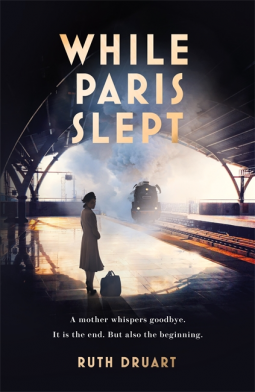
#BookReview ‘While Paris Slept’ by Ruth Druart #WW2

While Paris Slept by Ruth Druart is a World War Two story with a difference. It focusses on the lives of two couples and how one incident, a decision made in seconds, challenges the four people involved to define their own perception of true, selfless love and the heart-wrenching sacrifices this may mean. Ruth DruartThis is a dual-timeline story. It starts in 1953, California. One morning the police call at the home of Jean-Luc Beauchamp and take him in for questioning. He is unsurprised. His wife Charlotte and son Sam do not know what is happening.
Interleaved with the story unfolding in 1953, we see Jean-Luc as a young man in occupied Paris, 1944. He is conscripted as a rail maintenance worker based at the Drancy station from where French Jews were transported to Auschwitz. At weekends he travels home to see his mother in Paris but does not admit the things he sees and suspects. Ashamed that people may think he is a collaborator, he determines to do his part. He is injured in an attempt to damage the rail track and is taken to the German hospital where he is nursed by a young French girl, Charlotte. Charlotte, who took the job at the urging of her mother to do something useful, also wants to fight back against the occupiers. Then one day at Drancy a young woman on her way to Auschwitz, suspecting the fate awaiting her and her husband, thrusts her newborn baby into Jean-Luc’s arms. She says his name is Samuel. What follows is an exploration of the lengths people will go to for the true love of defenceless child. And at the heart of it all, subjected to the decisions made by adults, is Samuel.
It is a detailed story, slow to build, as the early pages add to the definition of the later events. At times I wanted to stay in one timeline for longer, rather than swapping between 1953 and 1944, but this is a powerful emotional story that is worth sticking with.
A strong story that doesn’t turn away from difficult issues; the rights, the wrongs and the hazy bits in between.

Click the title to read my review of THE LAST HOURS IN PARIS, another World War Two story by Ruth Druart.

If you like this, try:-
The Heat of the Day’ by Elizabeth Bowen
The Aftermath’ by Rhidian Brook
White Chrysanthemum’ by Mary Lynn Bracht

And if you’d like to tweet a link to THIS post, here’s my suggested tweet:
#BookReview WHILE PARIS SLEPT by Ruth Druart https://wp.me/p5gEM4-5cY via @SandraDanby

#BookReview ‘The Lamplighters’ by @StonexEmma #suspense

The Lamplighters by Emma Stonex is a difficult story both to describe and to compartmentalise in genre. I, mistaken by the Author’s Note at the beginning which refers to a true incident in 1900, thought I would be reading a historical story. The action is set in 1972 and 1992. The genre is variously described as horror, ghost, thriller, suspense and mystery. I saw no evidence of ghosts and it doesn’t feel to me like a thriller. It is a story of human emotions and the consequences of actions, set against the atmospheric backdrop of the sea. Emma StonexCornwall, 1972. The Maiden Rock, a lighthouse on a rock tower out at sea, is the scene of a mysterious disappearance. When the relief boat arrives, all three men who should have been on the rock have gone. Are they dead, kidnapped, drowned, or disappeared to start a new life? The story of principal keeper Arthur Black, assistant keeper Bill Walker, and supernumerary assistant keeper Vince Bourne is told in two timelines – the men’s stories in 1972 and that of their wives 20 years later when they answer the questions of a journalist researching a book about the disappearances. But why now? And what secrets does he think these women have hidden all these years?
Stonex writes beautifully about the sea, the rugged beauty, the loneliness it conjures in the minds of men alone, within sight of their loved ones on shore but a million miles from their touch. The men’s lives are driven by the sun and the moon, the regimen of keeping their light going. Arthur loves early morning the best; ‘The time I think of you the most is when the sun comes up. The moment before, the minute or two, when night yawns for morning and the sea starts to separate from the sky. Day after day the sun comes back. I don’t know why. I’ve had my light safe here, shining through the dark and I’ll keep it shining: the sun needn’t bother today. But still he comes and still come my thoughts of you.’
The three men are loners, they have to be to survive the rigours of their job and living conditions. Being a lighthouse keeper attracts a certain personality. Each man has his own way of coping with the empty time; Bill carves seashells, they all smoke constantly. They talk politics, the space race, the Cold War. Each man has his loves, regrets, secrets, guilts and griefs. Are these on-shore things irrelevant to life at the Maiden, or do real life events invade their isolated world-within-a-world? Each man dwells in his own mind and as the weather worsens, the mind begins to play tricks.
This is more a story about the three men on the Maiden and less a closed-room thriller, less a what-happened-here mystery. And I was drawn more to the characters of the three men – their life on the Maiden, the effect of their isolation surrounded by the might of the sea and weather – than on the three women ashore and the answer to the mystery.
CLICK HERE TO READ MORE ABOUT THIS BOOK AT AMAZON

If you like this, try:-
Wolf Winter’ by Cecilia Eckback
Little Deaths’ by Emma Flint
Himself’ by Jess Kidd

And if you’d like to tweet a link to THIS post, here’s my suggested tweet:
#BookReview THE LAMPLIGHTERS by @StonexEmma https://wp.me/p5gEM4-5cz via @SandraDanby

My Porridge & Cream read… @VMeadowsAuthor #books #romance

Today I’m delighted to welcome romance novelist Viki Meadows. Her ‘Porridge & Cream’ read is What I Did for a Duke by Julie Anne Long.

“As I write this it’s our second spring in lockdown. Never has my keeper-shelf been so needed and such a good friend as during this last year. Of all my favourite books which have found a home on that shelf, the one I go back to the most is the historical romance What I Did For A Duke by Julie Anne Long.

Viki Meadows

‘What I Did For a Duke’ by Julie Anne Long

“When I first picked this book up, in March 2011, I did so dubiously, thinking it was going to be a revenge seduction story. In fact, it isn’t that at all. It’s much more. It’s twisty, taking the reader down unexpected paths. But it’s more than the cleverness of plot and dialogue that kept me revisiting this during these interminable months of lockdown.

“Since life has become overshadowed by a pandemic-sized cloud of anxiety and fear I have taken it off the shelf to read at least three times. It’s hilarious in places and I found myself laughing out loud as the dry, sharp humour lifted my mood. Yet it did so without ever losing the essential characteristics of an exquisitely poignant, heart-warming romance. No matter how many times I read it the humour doesn’t get old and the emotional kick never fades. Like a bowl of porridge, it’s one of my favourites, a go-to staple that I can reach for whenever I need to feel comforted and reassured that delightful happy-ever-afters are possible.

“This story, with its vulnerable, lovable, honest characters is comfort food for the mind and heart- warm, funny, rich, and engaging. But it’s more than that. It might be a decadent bowl of porridge with lashings of cream, but it has pieces of fresh, tart strawberry sprinkled through it to keep you on your toes.“
BUY THE BOOK

Viki’s Bio
Viki has always loved writing and won her first prize for a short story when still at primary school. She’s an avid reader of romance and can usually be found with her nose in a book. The dynamics and sheer variety of human relationships fascinate her, and this is what she likes to explore in her writing. She lives in North Yorkshire with her husband and cat where she enjoys crafting and Tai Chi.

Viki’s links
Twitter
Facebook 

Viki’s latest book
Viki MeadowsWhen Minnie tells Villiers that she wants to break off their engagement, Villiers must face some unpleasant truths about himself and come to terms with past mistakes. His future happiness hinges on him not only winning Minnie’s forgiveness but also her heart. Will he succeed in making this the happiest of Christmases for them both? This is a short, sweet, historical romance.
BUY THE BOOK

Pic 4 P&C logo
What is a ‘Porridge & Cream’ book? It’s the book you turn to when you need a familiar read, when you are tired, ill, or out-of-sorts, where you know the story and love it. Where reading it is like slipping on your oldest, scruffiest slippers after walking for miles. Where does the name ‘Porridge & Cream’ come from? Cat Deerborn is a character in Susan Hill’s ‘Simon Serrailler’ detective series. Cat is a hard-worked GP, a widow with two children and she struggles from day-to-day. One night, after a particularly difficult day, she needs something familiar to read. From her bookshelf she selects ‘Love in A Cold Climate’ by Nancy Mitford. Do you have a favourite read which you return to again and again? If so, please send me a message.

Discover the ‘Porridge & Cream’ books of these authors:-
Maggie Cobbett’s choice is ‘The Beloved Vagabond’ by William J Locke
Kathryn Haydon chooses ‘The Prophet’ by Kahlil Gibran
The Talisman Ring by Georgette Heyer is chosen by Clare Rhoden

And if you’d like to tweet a link to THIS post, here’s my suggested tweet:
Why does romance novelist @VMeadowsAuthor re-read WHAT I DID FOR A DUKE by @JulieAnneLong? #books https://wp.me/p5gEM4-5aN via @SandraDanby

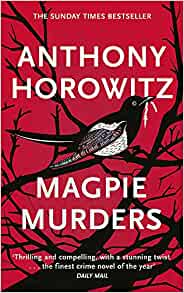
#BookReview ‘Magpie Murders’ by Anthony Horowitz @AnthonyHorowitz #crime

In the tradition of the theatrical play-within-a-play, Magpie Murders by Anthony Horowitz is a detective-mystery-within-a-detective-mystery. First in the Susan Ryeland series, more of her later, Horowitz has written a page-turner laced intricately with clues, delivered by a fictional detective in the Poirot tradition. Anthony HorowitzSusan Ryeland is head of fiction at Cloverleaf Books whose star writer is Alan Conway, author of the hugely successful Atticus Pünd crime series. Reading the manuscript of his latest submission, Magpie Murders, Susan is surprised to find the last chapters are missing. The murderer remains unnamed. Worse, Alan Conway has committed suicide. If Ryeland and her boss Charles Clover don’t find the missing chapters they can’t publish the book. And with no future books to come from Conway, the company may go bust.
The first half of the book is dedicated to Conway’s story of his fictional private detective, Pünd, who investigates one accidental death and one murder which take place in the same West Country village within days of each other. The victims knew each other. There must be a connection. In classic Agatha Christie style, the possibilities, lies and secrets are discovered by Pünd but he keeps his conclusions to himself.
The second half of the book tells how Ryeland first sets out to find the missing part of the manuscript. But increasingly puzzled by inconsistencies and lies in those surrounding Conway, she begins to suspect his death was not suicide. And that the answer lies in the manuscript of Magpie Murders. Did Conway fear for his life, and did he leave clues behind for his killer to be brought to justice.
This is such a clever beginning to what is a new detective series from Horowitz, who has written extensively for television including Midsomer Murders and Poirot. All the tropes of the classic detective novel are here – family arguments, a crook going straight, injustice, jealousy and rivalry, mixed up with the tensions of a local community where everyone knows everyone else’s secrets… or do they? Why is the vicar so hesitant when answering Pünd’s questions? Why did a son tell his mother he wished she were dead? Who stole a dangerous drug from the GP’s surgery and what did they do with it?
I’ve read some good books recently but none that kept me reading into the dark of the night until my eyes drooped. Oh, and I guessed wrong the wrong murderer.
Good fun.

Read my review of MOONFLOWER MURDERS, second in the Susan Ryeland crime series.

If you like this, try:-
A Death in the Dales’ by Frances Brody #7KATESHACKLETON
The Art of the Imperfect’ by Kate Evans #1SCARBOROUGHMYSTERIES
The Guest List’ by Lucy Foley

And if you’d like to tweet a link to THIS post, here’s my suggested tweet:
#BookReview MAGPIE MURDERS by Anthony Horowitz @AnthonyHorowitz https://wp.me/p5gEM4-5bC via @SandraDanby

A poem to read in the bath… ‘Poor Girl’ by Maya Angelou #poetry #women

I can hear the sorrow in every word of this woman who feels cheated, cynical in her understanding that she loved a wrong ‘un. This is ‘Poor Girl’ by Maya Angelou. She is angry, talking directly to a former lover who has betrayed her.

Maya Angelou

[photo: Wikipedia]

It has a simple structure, a repetition that reflects the sense of inevitability as he finds a new love; and the inevitability that this new love will soon turn into another old love, another poor girl, as yet again he uses then moves on. In her poetry Angelou loves men, but she also trashes badly behaved disrespectful unloving men.

This poem is subject to copyright restrictions. Please search for the full poem in an anthology or at your local library.

‘Poor Girl’
You’ve got another love
            and I know it
Someone who adores you
            just like me
Hanging on your words
            like they were gold
Thinking she understands
            your soul
Poor Girl
            Just like me

Maya Angelou BUY THE BOOK

Read these other excerpts and find a new poet to love:-
My Father’ by Yehuda Amichai 
Sometimes and After’ by Hilda Doolittle
‘I Loved Her Like the Leaves’ by Kakinonoto Hitomaro

And if you’d like to tweet a link to THIS post, here’s my suggested tweet:
A #poem to read in the bath: Poor Girl’ by Maya Angelou https://wp.me/p5gEM4-4kX via @SandraDanby