#BookReview ‘Unsettled Ground’ by Claire Fuller #contemporary

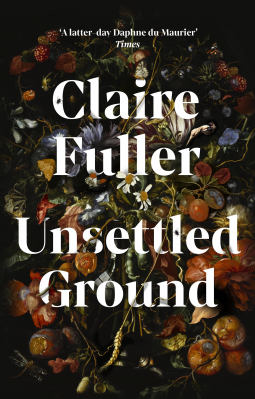
The title is well chosen. From the first page, Unsettled Ground by Claire Fuller is unsettling. An eclectic mixture of setting and detail make the timeframe difficult to pin down, it seems other-worldly. An ordinary world, but not quite. This is a world of Google and internet banking, of smartphones and digital life. Claire FullerFuller writes about twins Julius and Jeanie who, aged 51, still live with their mother in a remote rural cottage. They scratch a living, cash-in-hand earned from odd jobs, vegetables and eggs sold at the garden gate and the local deli, money kept in a tin rather than a bank account. Everything changes when their mother, Dot, dies suddenly and they realise how she protected them and kept them safe. But with Dot gone, their familiar world collapses. Their routines don’t work, the difficulties their mother smoothed are now rocky, and they are evicted from their home.
This is a novel about relationships – sibling, parental and with the local community – both supportive and dismissive. As the twins attempt to cope with the paperwork following their mother’s death, their isolation from modern society becomes evident to them. Many people step aside from their helplessness, finding them strange and ignorant, people make assumptions and take the easy option of turning away. Jeanie is mortified to find out that other people know more about her life and family history than she does, how neighbours silently colluded in a scenario either from a sense of helplessness, a misguided assumption they are helping, or malicious sniggering. Unsettled Ground is an uncomfortable but at the same time uplifting read.
As Julius and Jeanie confront each revelation about the life they have been living, they begin to question each other’s loyalty. Jeanie finds emotional strength she didn’t know she had, despite a heart complaint she’s had since childhood. She sneaks back home and finds solace in the abandoned garden, harvesting vegetables. This is an uncomfortable depiction of modern poverty in a society where money exchange is cashless and application for help depends on literacy. Both find a way to cope but inevitably they need each other despite their grumbles and disagreements. At times of stress, they pick up their guitars and sing folk songs as their parents taught them.
When the truth slowly emerges about their father’s accidental death and Dot’s subsequent struggle as a single mother, they realise that deep down they had always had suspicions. This is a powerful story about the strength of human nature and the bonds of family, about fighting back against bullies and finding light in the future.

If you like this, try:-
The Midnight Library’ by Matt Haig
In the Midst of Winter’ by Isabel Allende
The Lie of the Land’ by Amanda Craig

And if you’d like to tweet a link to THIS post, here’s my suggested tweet:
#BookReview UNSETTLED GROUND by Claire Fuller https://wp.me/p5gEM4-5a0 via @SandraDanby

#BookReview ‘The Fine Art of Invisible Detection’ by Robert Goddard #thriller

I always look forward to a new Robert Goddard book but wasn’t sure what to expect from his latest, The Fine Art of Invisible Detection. Partly, I think, because the blurb seemed more a detective novel than a thriller. Actually, this is both. Goddard has creative a heart-warming, realistic new hero, Umiko Wada, known simply as Wada. I raced through this book, full of Goddard’s clever twisty plotting, emotional dilemmas, should-I-shouldn’t-I moments. Robert GoddardWada is a 47-year-old secretary at a detective agency in Tokyo, making tea, writing reports for her technology-incompetent boss Kodaka. Widowed after her husband was killed in the Sarin gas attack on the Tokyo subway in 1995, Wada is quiet, efficient and invisible. But burning deep is a sense of righteousness. So when her boss asks for her help with a new case, she agrees to go to London to pose as the client who wants to find out if her father really committed suicide almost three decades earlier, or if he was murdered. From this point on, Wada’s life becomes unpredictable and her talent for being invisible becomes a lifesaver. Her boss dies in a car accident. The man she is due to meet in London has gone missing. Always logical, she follows the one clue she has.
Nick Miller is also due to meet the same man in London. Nick, a 41-year-old Londoner, is hoping to learn more about the father he has never met. Nick and Wada’s paths keep missing each other as they separately follow the trail of mystifying clues about the past. The action moves from Tokyo to London, Rekyjavik and the wilds of Iceland to Cornwall. There is a high-technology fraud, plus hints of terrorism and Japanese gang warfare, but this is not a violent read.
Wada is at the heart of this novel. Her logic and calm reasoning drive the narrative forward in that just-one-more-chapter way that makes this book a quick and fulfilling read. She is ordinary but extraordinary. I hope she returns in another novel.

Read my reviews of Goddard’s other books:-
PANIC ROOM
THE WAYS OF THE WORLD #1 THE WIDE WORLD TRILOGY
THE CORNERS OF THE GLOBE #2 THE WIDE WORLD TRILOGY
THE ENDS OF THE EARTH #3 THE WIDE WORLD TRILOGY
THIS IS THE NIGHT THEY COME FOR YOU #1SUPERINTENDENTTALEB

If you like this, try:-
Exposure’ by Helen Dunmore
The Accident’ by Chris Pavone
The Second Midnight’ by Andrew Taylor

And if you’d like to tweet a link to THIS post, here’s my suggested tweet:-
#BookReview THE FINE ART OF INVISIBLE DETECTION by Robert Goddard https://wp.me/p5gEM4-5as via @SandraDanby

My Porridge & Cream read… @jane_fenwick60 #books #historical

Today I’m delighted to welcome historical novelist Jane Fenwick.  Her ‘Porridge & Cream’ read is Ross Poldark by Winston Graham.

Ross Poldark was first published in 1946. It’s surprisingly ‘modern’ and fresh even today. I first read it in the 1970s after the saga was made into a TV series. I was intrigued to see how different the two versions were. They were massively different as it turns out, the book being far better.

Jane Fenwick“There are twelve books in all but the first, Ross Poldark, is the one I reread time and time again. I’ve lost count exactly how many times I’ve read it. I go back to it time and time again because it’s like putting on a comfortable pair of old shoes. It always makes me feel better. Also, each time I read it I see something new, some scene which for some reason has new significance, some word choice which adds depth, some character detail I’d missed.

“I’m drawn to this book for two reasons; firstly the main character and secondly the writing style. The central character, Ross Poldark is not a hero, he’s flawed. He makes mistakes but has a conscience and a strong moral compass. Sometimes he is his own worst enemy but you understand his point of view because the reader is witness to not only his actions but his internal dialogue. He’s beautifully drawn.

“Winston Graham was a brilliant writer. The Poldark saga, set in eighteenth/nineteenth century Cornwall, is historically well researched and accurate. As a writer of historical fiction, I find this aspect of his writing very satisfying. WG manages to write unsentimentally about the times but with such warmth and insight that the reader becomes immersed in the story and the lives of the characters. Ross Poldark is the start of the journey and once read it’s impossible not to read the other eleven books in the series. But for me Ross Poldark is my favourite.”
Jane FenwickBUY THE BOOK

Jane’s Bio
Jane Fenwick lives in Settle in Yorkshire, England. She studied education at Sheffield University gaining a B Ed (Hons) in 1989 and going on to teach primary age range children. Jane decided to try her hand at penning a novel rather than writing school reports as she has always been an avid reader, especially enjoying historical and crime fiction. She decided to combine her love of both genres to write her first historical crime novel Never the Twain. Jane has always loved the sea and although she lives in the Yorkshire Dales she is particularly drawn to the North East coast of Yorkshire and Northumberland. This coastline is where she gets her inspiration. As she has always loved history, she finds the research particularly satisfying.

When she isn’t walking on Sandsend beach with her dog Scout, a Patterdale “Terrorist” she is to be found in her favourite coffee shop gazing out to sea and dreaming up her next plot.
Jane is currently writing a historical series again set on the North East coast beginning in 1765. The first two books, My Constant Lady and The Turning Tides were well received. Look out for the third and last in the series Safe Harbour in May 2021.

Jane’s links
Website
Facebook 

Jane’s latest book
Jane FenwickGabriel Reynolds and his stunning red-haired wife Eleanor have settled happily into married life at Westshore… or have they? A woman with a loaded gun, a servant with a grudge, and a buccaneering Irish sea captain seem intent on rocking the boat. When Caroline Hodgeson makes what her ex-fiancé Gabriel sees as an unsuitable match, it sets off a chain of events which will change all their lives. And not for the better.
The Turning Tides, second in the Reynolds seafaring saga, is a tale of jealousy and jeopardy, mistrust and malice. The continuing tale of one man’s love for an unconventional woman.
BUY THE BOOK

What is a ‘Porridge & Cream’ book? It’s the book you turn to when you need a familiar read, when you are tired, ill, or out-of-sorts, where you know the story and love it. Where reading it is like slipping on your oldest, scruffiest slippers after walking for miles. Where does the name ‘Porridge & Cream’ come from? Cat Deerborn is a character in Susan Hill’s ‘Simon Serrailler’ detective series. Cat is a hard-worked GP, a widow with two children and she struggles from day-to-day. One night, after a particularly difficult day, she needs something familiar to read. From her bookshelf she selects ‘Love in A Cold Climate’ by Nancy Mitford. Do you have a favourite read which you return to again and again? If so, please send me a message.

Discover the ‘Porridge & Cream’ books of these authors:-
Sue Johnson’s choice is ‘Jamaica Inn’ by Daphne du Maurier
Sue Moorcroft chooses ‘A Town Like Alice’ by Nevil Shute
Chocolat’ by Joanne Harris is chosen by Kate Frost

And if you’d like to tweet a link to THIS post, here’s my suggested tweet:
Why does @jane_fenwick60 re-read ROSS POLDARK by Winston Graham #books https://wp.me/p5gEM4-58D via @SandraDanby

#BookReview ‘The Evening and the Morning’ by @KMFollett #historical

I absolutely loved The Evening and the Morning by Ken Follett. It is thirty years since Follett published his monster hit The Pillars of the Earth and this novel is his prequel to what became the Kingsbridge series. Set in Southern England in the year 997 at the end of the Dark Ages – so called because the lack of historical documents and archaeological remains from the time means our knowledge of the era is thin – it was a period of unrest and war. Viking raids, skirmishes with the Welsh, the law allows violence against slaves while power-hungry local rulers disobey the rules of King Ethelred. Ken FollettThe story is told by three principal characters – a French noblewoman, a young English boatbuilder and an English monk. Each is smart, ambitious and honest but they are confronted by violence, cruelty, law-breaking, jealousy and betrayal.
In the west country village of Combe, eighteen-year old boatbuilder Edgar waits on the beach for his true love. She is married and the pair are going to run away together. But as Edgar waits, he sees the arrival of a Viking ship and his life changes. The town is destroyed. Three powerful brothers arrive to examine the damage – Wilwulf, ealdorman of local region Shiring; Bishop Wynstan of Shiring; and Wilgelm, thane of Combe – each will lose income because of the raid. It is decided a visit to Normandy is necessary to ask for support from Count Hubert, a Norman lord in Cherbourg who has influence with the Vikings.
In Normandy, Hubert receives two English visitors, a monk and a priest. The monk, Brother Aldred, has a chest of books he has bought in a French abbey. His plan is to create a library, a scriptorium, at Shiring Abbey. Hubert’s daughter Ragna is under pressure from her parents to marry a local lord she dislikes. She wishes Guillaume was educated like Aldred who, being a monk, is celibate. But when English lord Wilwulf arrives, she quickly falls in love.
Ragna travels to England where she will marry Wilfulf. En route she arrives at Dreng’s Ferry and meets Edgar. His family now lives on a farm at this, a poor, lawless place where the local dean and clergy live life to their own rules.  This is the beginning of a long friendship that will last many years. Though life as the wife of an English ealdorman is not what she expected, Ragna is supported by the presence in Shiring of Aldred who also becomes a friend.
This is an endlessly fascinating story, with so many twists and turns, achievements and horrific setbacks for the three friends that it’s easy to get lost in the ups and downs of their lives. The structure of the story may be predictable at times but the characters are strongly written, the historical setting is believable and the themes of friendship and perseverance are uplifting.
As soon as I finished reading it – and it’s a long book, 832 pages – I wanted to start at the beginning again. The last time I felt like that was when I finished The Pillars of the Earth.

Click the titles to read my reviews of other Follett novels:-
THE PILLARS OF THE EARTH #1KINGSBRIDGE
WORLD WITHOUT END #2KINGSBRIDGE
A COLUMN OF FIRE #3KINGSBRIDGE
THE ARMOUR OF LIGHT #4KINGSBRIDGE
NEVER

If you like this, try:-
The Almanack’ by Martine Bailey
Days Without End’ by Sebastian Barry
The Signature of All Things’ by Elizabeth Gilbert

And if you’d like to tweet a link to THIS post, here’s my suggested tweet:
#BookReview THE EVENING AND THE MORNING by @KMFollett https://wp.me/p5gEM4-59F via @SandraDanby

Great Opening Paragraph 132 ‘Love in the Time of Cholera’ #amreading #FirstPara

“It was inevitable: the scent of bitter almonds always reminded him of the fate of unrequited love. Dr Juvenal Urbino noticed it as soon as he entered the still darkened house where he had hurried on an urgent call to attend a case that for him had lost all urgency many years before. The Antillean refugee Jeremiah de Saint-Amour, disabled war veteran, photographer of children, and his most sympathetic opponent in chess, had escaped the torments of memory with the aromatic fumes of gold cyanide.”
Gabriel Garcia Marquez From ‘Love in the Time of Cholera’ by Gabriel Garcia Marquez 

Try one of these #FirstParas & discover a new author:-
The Pursuit of Love’ by Nancy Mitford
A Good Man in Africa‘ by William Boyd
Gilead’ by Marilynne Robinson 

And if you’d like to tweet a link to THIS post, here’s my suggested tweet:
#Books #FirstPara LOVE IN THE TIME OF CHOLERA by Gabriel Garcia Marquez https://wp.me/p5gEM4-4eK via @SandraDanby

#BookReview ‘Yield’ by @ClaireDyer1 #poetry #gender

Yield is the third poetry collection by poet and novelist Claire Dyer. An essentially personal examination of a mother and son as the son becomes a daughter. Incredibly honest, Dyer conjures up scenes of private moments from birth to clinic visits, sorting clothes, tea at the Ritz, the parental pain of feeling unable to help, the parental pride in a child’s courage and honesty. Claire DyerThe word honest is key to this experience, shared with us by poet and mother. When I finished reading this slim collection I was left with a sense of the overwhelming love of a family and individuals where gender at the same time matters totally, and not at all. What matters are child and parent.
My favourite three poems? For exuberance, ‘Doing Cartwheels at the Ritz’. For heart-rending practicality, ‘Wardrobe’. For the goblin, ‘Body Clock III’.
And the line that stayed with me for days afterwards… ‘If I’d been braver, wiser, kinder…’ which features in the series of ‘Clinic’ poems. Isn’t that the best of poetry, when it echoes in our thoughts, when it brings previously undiscovered perspectives on life, when it puts us into someone else’s shoes for just a moment.
A powerful, moving, sometimes startling collection which opens a privileged window for us into the world of a private transformation. Joyous, difficult, full of love.

Read my reviews of Claire Dyer’s novels, THE PERFECT AFFAIR and THE LAST DAY.

If you like this, try:-
Sentenced to Life’ by Clive James
Ghost Pot’ by John Wedgwood Clarke
Hold Your Own’ by Kate Tempest

And if you’d like to tweet a link to THIS post, here’s my suggested tweet:
#BookReview YIELD by @ClaireDyer1 https://wp.me/p5gEM4-58l via @SandraDanby

#BookReview ‘The Killings at Kingfisher Hill’ by @sophiehannahCB1 #crime

Red herrings, twists and turns, lots of lies, confusing motivations and a long list of characters make The Killings at Kingfisher Hill by crime writer Sophie Hannah the type of book you need to read when fully alert. Fourth in Hannah’s series of continuation Hercule Poirot mysteries, I finished it with mixed feelings. Sophie Hannah Direct comparisons of Hannah and Christie seem unfair as these are continuation novels. Christie was a highly accomplished author who balanced likeable characters with dense but ultimately solveable crimes, while at the same time making the novels appealingly comfortable to read. If The Killings at Kingfisher Hill were a standalone novel featuring an unknown detective, it would be free of these comparisons. I enjoyed The Mystery of Three Quarters, third of Hannah’s Poirot novels, and will continue to read this series. It has also given me renewed impetus to re-read the Christie originals.
The complications start at the beginning. Poirot and Inspector Edward Catchpool are about to board a char-a-banc for Surrey and the exclusive Kingfisher Hill development, when they encounter not one but two women passengers behave strangely. One fears she is about to be murdered on the bus if she sits in a specific seat. The second woman confesses she has killed someone. Christie’s novels always have options – for victim, and murderer – but the options here did seem rather full-on with numerous characters introduced or mentioned in quick succession with none fully-formed in my mind. At one point I felt as Inspector Catchpool does, ‘My mind blurred, then went blank.’ So many possibilities in quick succession made me long for Christie’s more leisurely pace. True to character, Poirot is totally in charge of his investigation. He tells Catchpool, ‘Once one has a point of focus, all of the other details start to arrange themselves around it.’
Throughout I felt two steps away from the action because the murder has happened before the book begins. We are told the story of Poirot’s investigation by Catchpool and hear much of the necessary information as told to Poirot by third parties. Hearsay. I longed to be in the moment as it actually happened, or at the very least immediately afterwards – I think here of Poirot in Murder on the Orient Express, Evil Under the Sun and Death on the Nile.
The Killings at Kingfisher Hill wasn’t quite what I expected.

And here’s my review of another Sophie Hannah Poirot book:-
THE MYSTERY OF THREE QUARTERS #3POIROT

If you like this, try:-
No Other Darkness’ by Sarah Hilary
Cover Her Face’ by PD James
The Secrets of Gaslight Lane’ by MRC Kasasian

And if you’d like to tweet a link to THIS post, here’s my suggested tweet:
#BookReview THE KILLINGS AT KINGFISHER HILL by @sophiehannahCB1 https://wp.me/p5gEM4-58W via @Sandra Danby

My Porridge & Cream read… @JamesSteptowe #childrensbooks

Today I’m delighted to welcome children’s author James Steptowe. His ‘Porridge & Cream’ read is The Two Farms by Mary E Pearce.

James Steptowe

James’ copy of ‘The Two Farms’ by Mary E Pearce

“It is a book I first read in 2018 on my honeymoon in Italy. My wife (who is Italian) and I asked our wedding guests to buy us a book that was special to them for a present. A close friend of mine from university gave us The Two Farms. He told us he had had to search hard for it as it was not in print anymore and inside, he left us a note saying, “the story in this book is very simplistic, but the sentiment behind it has a lot of meaning – love is the source of happiness”. We loved the thought he had put into it, so we packed it in our bag for our honeymoon. When I started reading it, I could not stop. It is not a long book and I think I read it in a day, on the beach, under the scorching Italian sun. The story is simple; predictable even, but so captivating and the description of the English countryside is enchanting.
“I now live in Italy and it is the book I go to when I just want to read a lovely story. It is the book I go to when I want to be reminded of the rolling English countryside (particularly poignant and powerful in these strange times we are living in). And it is the book I go to when I want to read without stopping. The review on the front of my copy from a reviewer called James Herriot says, “Sheer Country Magic” and frankly I could not agree more with Mr Herriot.”
James SteptoweBUY THE BOOK

James’s Bio
James SteptoweJames is a children’s book author and teacher originally from Essex, but now living in Italy. In May 2019 he published his debut book, Raid of the Ratskull Rodents, while living in Horsforth, Yorkshire. Chase for the Championship, a football story for girls and boys, followed in 2020. He has lived in Italy since January 2020 with his wife, daughter, cat and two chickens, and currently teaches at a bilingual school just outside Monza. When not teaching or writing, he loves hiking, reading a good book and spending time with his family.

James’s links
Website
Facebook
Twitter
Instagram

James’s latest book
James SteptoweA football story for girls and boys, formatted and written for struggling or reluctant readers. Sarah Saunders, striker for Lingerfield FC, and Yonis Ganim, goalkeeper for SLS United, are locked in a tight battle for their under-eleven championship title. Only 1 point separates their teams at the midway point in the season. However, as the chase for the championship heats up, both Sarah and Yonis realise there are much more important things in life than just football…
BUY THE BOOK

What is a ‘Porridge & Cream’ book? It’s the book you turn to when you need a familiar read, when you are tired, ill, or out-of-sorts, where you know the story and love it. Where reading it is like slipping on your oldest, scruffiest slippers after walking for miles. Where does the name ‘Porridge & Cream’ come from? Cat Deerborn is a character in Susan Hill’s ‘Simon Serrailler’ detective series. Cat is a hard-worked GP, a widow with two children and she struggles from day-to-day. One night, after a particularly difficult day, she needs something familiar to read. From her bookshelf she selects ‘Love in A Cold Climate’ by Nancy Mitford. Do you have a favourite read which you return to again and again? If so, please send me a message.

Discover the ‘Porridge & Cream’ books of these authors:-
Alex Marchant’s choice is Over Sea, Under Stone’ by Susan Cooper
Kelly Clayton chooses ‘Naked in Death’ by JD Robb
The Wind in the Willows’ by Kenneth Grahame is chosen by Rob V Biggs

And if you’d like to tweet a link to THIS post, here’s my suggested tweet:
Why does @JamesSteptowe re-read THE TWO FARMS by Mary E Pearce #books https://wp.me/p5gEM4-57m via @SandraDanby

#BookReview ‘Death and the Brewery Queen’ by @FrancesBrody #cosycrime

Death and the Brewery Queen, twelfth in the Kate Shackleton 1930s detective series by Frances Brody, is a story of two halves and two murders. As always, sensible Kate is on hand to bring calm and control to a messy situation. Frances BrodyKate and her sidekick Jim Sykes are employed by a brewery owner to sort out some business irregularities at Barleycorn Brewery in Masham, North Yorkshire. Is it a matter of employee pilfering, aggressive competitors, inefficiency or fraud? This is a low-key beginning, a gentle start which allows Brody to establish a wide cast of characters. The portrayal of the brewery and the town is the foundation for the series of linked crimes that follow. Threaded throughout the book is the story of Barleycorn’s wages clerk, Ruth Parnaby, and her quest to be crowned Northern Breweries’ beauty queen. The story is told in multiple viewpoints – Kate’s voice is first person, but in the voices of Mr Sykes, Harriet and Ruth we gather information that Kate doesn’t know. It does seem rather a long wait for the first death, after which the story speeds up and the false clues and connections begin to make sense.
Kate is a memorable, admirable heroine. She is firm and managerial when she needs to be, determined and unafraid of confronting male officialdom but also well-connected which helps break down barriers and find information possibly quite difficult to confirm quickly at that time. And she’s not afraid to take risks. She also proves empathetic to the struggles of the grindingly poor people involved in the outer circles of the story. Kate, a widow, has her own close family – niece Harriet, employee Mr Sykes, housekeeper Mrs Sugden, and of course her bloodhound Sergeant Dog – who each bring different but essential skills when on the hunt for a murderer.
This is a stop-start read, in contrast to the previous Kate Shackleton books I’ve read, but enjoyable nonetheless. Brody excels at drawing her 1920s and 1930s settings, so realistic and believable. A special mention for the scenes in Scarborough’s Grand Hotel, which I visited as an awestruck child.

Read my reviews of these other Kate Shackleton novels:-
DYING IN THE WOOL #1KATESHACKLETON
A DEATH IN THE DALES #7KATESHACKLETON
A SNAPSHOT OF MURDER #10KATESHACKLETON
A MANSION FOR MURDER #13KATESHACKLETON

If you like this, try:-
Murder at Catmmando Mountain’ by Anna Celeste Burke
The Art of the Imperfect’ by Kate Evans
Due Diligence’ by DJ Harrison

And if you’d like to tweet a link to THIS post, here’s my suggested tweet:
#BookReview DEATH AND THE BREWERY QUEEN by @FrancesBrody https://wp.me/p5gEM4-58h via @SandraDanby

A poem to read in the bath… ‘My Father’ by Yehuda Amichai #poetry

I came across this very short poem – only six lines – in an anthology. The book has been on my shelf for quite a while and every now and then I pick it up and flick through at random. One day, the page fell open at this exquisite poem by Israeli poet Yehuda Amichai, translated from the Hebrew by Azila Talit Reisenberger. Written as an adult, in this scant lines Amichai captures the ongoing love of child for parent, caught in a tiny everyday familiar detail.

Yehuda Amichai

[photo: Layle Silbert]

Said Ted Hughes of Amichai, “I’ve become more than ever convinced that Amichai is one of the biggest, most essential, most durable poetic voices of this past century–one of the most intimate, alive and human, wise, humorous, true, loving, inwardly free and resourceful, at home in every human situation. One of the real treasures.”

Amichai died in 2000. His poems, written in Hebrrew, have been translated into 40 languages. All poetry is political, Amichai told the Paris Review: “This is because real poems deal with a human response to reality, and politics is part of reality, history in the making. Even if a poet writes about sitting in a glass house drinking tea, it reflects politics.”

This poem is subject to copyright restrictions. Please search for the full poem in an anthology or at your local library.

‘My Father’

The memory of my father is wrapped up in
white paper, like sandwiches taken for a day at work.

Yehuda AmichaiBUY THE BOOK

Read these other excerpts and find a new poet to love:-
Poems’ by Ruth Stone
‘Cloughton Wyke 1’ by John Wedgwood Clarke
We Needed Coffee But…’ by Matthew Welton

And if you’d like to tweet a link to THIS post, here’s my suggested tweet:
A #poem to read in the bath: ‘My Father’ by Yehuda Amichai https://wp.me/p5gEM4-4cn via @SandraDanby