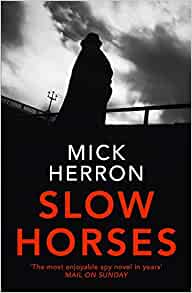
#BookReview ‘Slow Horses’ by Mick Herron #spy #thriller

Always on the lookout for a new thriller series to sink into, I am a late discoverer of the Jackson Lamb books by Mick Herron. Soon to be filmed as ‘Slough House’ and starring Gary Oldman as Lamb, it seemed a good time to start with book one, Slow Horses. Mick HerronLamb is the quixotic leader of Slough House, the place where British spies go when they have messed up. They work in a scruffy non-descript building doing boring, repetitive, desk-based jobs and dream of going on ‘ops.’ The reason for each person’s banishment is not spoken by some pact of olvidado but they are all intensely curious about each other. Very much on the outside, they are derided at the Park, the Regent’s Park MI5 headquarters run by ‘dogs’ and ‘achievers.’ The book is littered with spy language, at first confusing, but soon accepted without a second thought.
As always, the first book in a series can be slow to progress, given the need to establish characters, setting and world. And there are a lot of characters, some of whom were cardboard cut-outs with names. The action really gets moving with Hassan, a student who has been kidnapped by three white racists. His beheading is scheduled to take place live and be broadcast on the internet. Members of Slough House are pulled into an op which threatens to go badly wrong, not helped by the intense secrecy and rivalry of everyone involved. Not to mention lots of chips on shoulders. This is not a team and Lamb is not a leader, instead he sits in his top-floor office and is rarely seen.
Slow Horses features a bunch of dysfunctional characters who are unattractive and secretive and the link of the spies to Hassan’s plight is slow to appear. When it does, the story takes off as the team are yanked from their torpidity, told to use their initiative and become the spies they were trained to be. I can’t say I ended the book feeling I had access to Lamb’s character but then he is a spy and so inaccessible, opaque, contradictory. He is also irreverent, funny, disgusting, authority-hating, rude and strangely likeable. Interesting characters I want to see more of include Slough House agent River Cartwright, his grandfather the ‘OB’ who is retired and lives in Tonbridge, and slimy politician PJ who has a wonderful basement kitchen.
Next in the seven-book ‘Slough House’ series is Dead Lions which I will read soon in the expectation that Jackson Lamb’s past will be revealed.

Click the title to read my reviews of the other books in the Slough House series:-
DEAD LIONS #2SLOUGHHOUSE
REAL TIGERS #3SLOUGHHOUSE
SPOOK STREET #4SLOUGHHOUSE
LONDON RULES #5SLOUGHHOUSE
JOE COUNTRY #6SLOUGHHOUSE
SLOUGH HOUSE #7SLOUGHHOUSE
BAD ACTORS #8SLOUGHHOUSE

If you like this, try:-
Panic Room’ by Robert Goddard
The Travelers’ by Chris Pavone
The Farm’ by Tom Rob Smith

And if you’d like to tweet a link to THIS post, here’s my suggested tweet:
#BookReview SLOW HORSES by Mick Herron https://wp.me/p5gEM4-57J  via @SandraDanby

#BookReview ‘A Prince and a Spy’ by Rory Clements #thriller #WW2

Rory Clements is fast becoming an author I turn to when I need a page-turning read to relax into. A Prince and a Spy is fifth in his Tom Wilde Second World War series and it doesn’t disappoint. Woven into true history of the conflict – the fatal crash in Scotland of the Duke of Kent’s plane, the holocaust – Clements adds real and fictional characters, intrigue and competing spies, to make this an enjoyable read. Rory ClementsWhen history professor Wilde returns by train home to Cambridge he bumps into a former student. Cazerove seems distracted, distressed, munching on a bag of sweets. Before the train reaches its destination, Cazerove dies of poisoning. So begins a typical Clements thriller – strong characters, true history and a string of unrelated incidents. When the Duke of Kent’s plane crashes on a remote hill in Scotland, the public is told his plane came down in heavy fog when taking off for Iceland on operational duties. In the world of A Prince and a Spy, the flying boat was returning from a secret diplomatic mission in Sweden where the Duke met his German cousin, a former member of the Nazi party. Wilde, working for the newly-established American secret intelligence service, OSS, is sent to Scotland to sniff around at the crash site and ask questions on behalf of his president. FDR wants to know why the plane crashed, was Prince George at the controls, was it shot down, and how did one person survive?
A keynote of this series is the multi-layering of rival spy agencies in the UK – the British, the Americans – the infiltration of Nazi agents, Soviet agitators and, in this book, a secret society. Clements is excellent at showing history through the eyes of fictional characters, a challenging task, and I particularly liked the Scottish segment with fisherman Jimmy Orde. A continuing thread from book to book is Wilde’s relationship with his partner Lydia, and Philip Eaton, the British spy who first involved Wilde in espionage. Clements twists reality in this book so Wilde doesn’t know who to trust, who to believe, and who is spying on him. So much so that at times, I lost track too.
An excellent weekend read.

Click the title to read my reviews of the other books in the Tom Wilde series:-
CORPUS #1TOMWILDE
NUCLEUS #2TOMWILDE
NEMESIS #3TOMWILDE

HITLER’S SECRET #4TOMWILDE
THE MAN IN THE BUNKER #6TOMWILDE
THE ENGLISH FUHRER #7TOMWILDE

And from the Sebastian Wolff series:-
MUNICH WOLF #1SEBASTIANWOLFF

If you like this, try:-
Life After Life’ by Kate Atkinson
The Aftermath’ by Rhidian Brook
Midnight in Europe’ by Alan Furst

And if you’d like to tweet a link to THIS post, here’s my suggested tweet:
#BookReview A PRINCE AND A SPY by Rory Clements https://wp.me/p5gEM4-574 via @SandraDanby

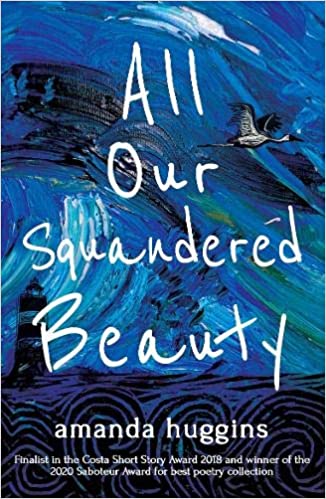
#BookReview ‘All Our Squandered Beauty’ by Amanda Huggins @troutiemcfish #grief

At 122 pages, All Our Squandered Beauty by Yorkshire writer Amanda Huggins packs a powerful punch. It is a sensitively managed novella of a teenager navigating young love, relationships and sex while pulled underwater by grief for the father who died when she was young. His disappearance at sea has never been explained, his body never found; but gossip is becoming history. Kara Bradshaw, believing he would never leave her, hangs on to memories of time they spent together, sure of his love. Amanda HugginsIt is 1978 at Elmwick Bay in Yorkshire. Kara’s youth was punctuated by life beside the sea, gathering sea glass from the sand, identifying the birds flying overhead, watching stars in the night sky, tales of local legends and folklore. All occupations she enjoyed with her father. Now as a seventeen-year-old, Kara hangs out with bikers at Charelli’s café and the amusement arcade but fancies her art teacher, Leo. A thread running throughout the book is that all is not always as it seems, something Kara must understand if she is to accept the past and move on into adulthood. But first she must acknowledge her grief and let her father go.
A promising artist, Kara cannot wait to leave school for university in London. But her best friend Louise seems happy to settle for a life at home with her boyfriend, and Kara’s mother has moved inland where the sea is out of sight. Kara knows her boyfriend Marty would like to marry her and have babies, but she wants more. More love, more life, just more. Huggins writes with delicacy about a fragile teenager who knows what she wants but not why, seeking a path of learning without a father to guide her. Seven years have passed since villagers gossiped that Ged Bradshaw hadn’t really died at sea but ran away with Lola Armitage. Kara sees Lola everywhere, follows her only to discover it is someone she has never seen before.
Kara, unable to understand she still grieves for her father in hundreds of small ways, is seeking definitive answers to unanswerable questions. She looks for escape and finds it in art teacher Leo who offers her place at a summer art school in Greece, funded by the Philip Patou Art Foundation. Kara jumps at the chance. What she finds in Greece is not what she expected. Huggins is a successful travel writer and her description of the island of Lyros is beautiful, seen through the eyes of artist Kara who compares it with her seaside hometown.
This coming-of-age story passes quickly, I read it in two sittings and was left curious. I longed to see more – of Kara’s childhood and of the woman she will become. All Our Squandered Beauty is the story of one summer in her life, interwoven with reminiscences of her father. Huggins’ writing is, as always, delightful, her technical skill invisible on the page leaving the reader to dwell on the emotions. The short fiction form doesn’t allow the exploration in depth of all Huggins’ themes, and hopefully she is turning her attention to a novel.

Read my reviews of other work by Amanda Huggins:-
Novellas
CROSSING THE LINES
THE BLUE OF YOU
Short stories
AN UNFAMILIAR LANDSCAPE
BRIGHTLY COLOURED HORSES
EACH OF US A PETAL
SCRATCHED ENAMEL HEART
SEPARATED FROM THE SEA
Poetry
THE COLLECTIVE NOUNS FOR BIRDS

If you like this, try:-
A Week in Paris’ by Rachel Hore
The Last Day’ by Claire Dyer
The Cheesemaker’s House’ by Jane Cable

And if you’d like to tweet a link to THIS post, here’s my suggested tweet:-
#BookReview ALL OUR SQUANDERED BEAUTY by Amanda Huggins @troutiemcfish https://wp.me/p5gEM4-56j via @SandraDanby

#BookReview ‘Jack’ by Marilynne Robinson #classic #Americanwriters

Jack by Marilynne Robinson is fourth in her Gilead series, following Gilead, Home and Lila and is a love story. Jack Boughton is the troubled son of Presbyterian minister, and Della, the attractive, black, high school teacher, daughter of a Methodist minister. This is a novel about the quality of love, its consequences, and whether sometimes loving someone means saying goodbye. Marilynne Robinson The story starts with such a brave scene for any author to write – a two-hander between Jack and Della as they meet accidentally at night. They are locked in a graveyard in St Louis and spend the night walking in conversation about life, their families, themselves, the world. A disreputable white man and a successful attractive black woman, in 1950s America. The conversation ebbs and flows, jumping from subject to subject as a real discussion does. They do not talk about love, but throughout the course of a number of chaste meetings, they fall in love.
It is sublime prose to sink into and absorb. Such small, familiar detail brings Jack and Della instantly to life. They are real and you care for them. The graveyard scene is long, so long I wondered if it took up the whole book.
We have heard of both these characters in the earlier Gilead books. We know Jack is a bad ‘un, as told by others. This is the first time we see into his head.
Robinson has a beautiful way of summarising truths that are easy to identify with. When Jack is with Della in the cemetery, he thinks, ‘Forever after, the thought of her would be painful, because it had been pleasant. Strange how that is.’ Jack is a mixture of insecurities, resentments, injuries and injustices brought upon himself and also by his strict religious upbringing by his pious pastor father.
Not a long book or a quick read, but absorbing. I totally understand why Jack falls for Della, wanting to save and protect her; I’m less sure why she loves him given the risks and dangers of a mixed marriage at that time. He loves his wisecracks and makes jokes at inappropriate times, misjudging the mood and causing silences. Their discussions range from Hamlet to theology, end-of-life world scenarios to poetry.
If you are new to Gilead, please don’t start with this book. Read them in order to get the most enjoyment of these complex stories of the Boughton and Ames families from Gilead, Iowa.
CLICK HERE TO READ MORE ABOUT THIS BOOK AT AMAZON

Read my reviews of Robinson’s other novels:-
GILEAD
HOME
HOUSEKEEPING
Try the #FirstPara of GILEAD here.

If you like this, try:-
Offshore’ by Penelope Fitzgerald
The Gustav Sonata’ by Rose Tremain
Time Will Darken It’ by William Maxwell

And if you’d like to tweet a link to THIS post, here’s my suggested tweet:
#BookReview JACK by Marilynne Robinson https://wp.me/p5gEM4-561 via @SandraDanby

Great Opening Paragraph 131 ‘The Go-Between’ #amreading #FirstPara

“The past is a foreign country: they do things differently there.”
LP HartleyFrom ‘The Go-Between’ by LP Hartley

Try one of these #FirstParas & discover a new author:-
Peter Pan’ by JM Barrie
A Month in the Country’ by JL Carr
To Have and Have Not’ by Ernest Hemingway

And if you’d like to tweet a link to THIS post, here’s my suggested tweet:
#Books #FirstPara THE GO-BETWEEN by LP Hartley https://wp.me/p5gEM4-4eG via @SandraDanby

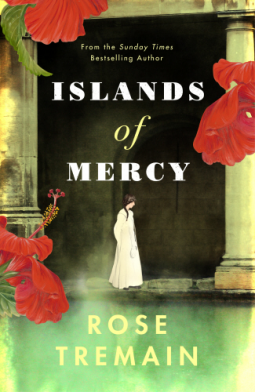
#BookReview ‘Islands of Mercy’ by Rose Tremain #historical

In Bath, England in 1865, such are Jane Adeane’s nursing skills that she is known as the Angel of the Baths. Islands of Mercy by Rose Tremain is about Jane’s destiny to make something of herself, a journey which involves choosing between a tempestuous love affair with another woman and marriage to a respectable doctor. Being the Angel of the Baths is not enough for her and this impacts on the lives of everyone around her. Rose Tremain Islands of Mercy is in fact three stories in one, lightly linked together by the merest connection and fleeting physical meeting. The story starts with Clorinda Morrissey who arrives in Bath from Ireland. ‘She was not beautiful, but she had a smile of great sweetness and a soft voice that could soothe and calm the soul’. By selling a ruby necklace, a family heirloom, Clorinda sets up what becomes a highly popular tea room. It is in this tea room that she first sees Jane Adeane who is taking tea with a man. Jane leaves abruptly and Clorinda is curious why. The man concerned is Doctor Valentine Ross, medical partner of Jane’s father Sir William Adeane and brother of naturalist Edmund Ross, currently pursing butterflies in the Malay Archipelago. In this scene, all three storylines are kickstarted.
The narrative moves back and forth from Bath to London, Dublin and Ireland’s west coast to Borneo. Each place is drawn vividly, Tremain is excellent at settings. In her descriptions of heterosexual and homosexual relationships, she explores the social limitations of the time on the free expression of love for men and women. While Jane can explore her own feelings for another woman only in extreme secrecy and risk of rejection by society, in Borneo a rich ‘rajah’ and his dependent servant live openly. Can Jane make her own way in the world or must she be conventional and marry a man. And can Clorinda’s independence at the tea shop continue or will she come to regret her sale of the ruby necklace. Is money necessary for happiness.
This is an unpredictable read. As Jane’s father Sir William comments, ‘We are overtaken by flashes of lightning and brilliant storms, and we can only submit.’ All the characters act on impulse and not all their decisions make sense, in particular Valentine’s behaviour changes so rapidly he seems a different man.
I was left with mixed feelings. As a Tremain fan dating back to The Colour, I wanted to enjoy this book more than I did. The writing, as always, is of the highest quality but it feels like three novels squeezed into one. I wanted to read more about Clorinda’s story, or concentrate on Jane, rather than go to Borneo which felt like an interruption to the main narrative.
CLICK HERE TO READ MORE ABOUT THIS BOOK AT AMAZON

Read my reviews of these other novels by Rose Tremain:-
LILY
THE GUSTAV SONATA

If you like this, try:-
At Mrs Lippincote’s’ by Elizabeth Taylor
Stanley and Elsie’ by Nicola Upson
Blackberry and Wild Rose’ by Sonia Velton

And if you’d like to tweet a link to THIS post, here’s my suggested tweet:
#BookReview ISLANDS OF MERCY by Rose Tremain https://wp.me/p5gEM4-55D via @SandraDanby

My Porridge & Cream read… @CarmenRadtke1 #books #cozymysteries

Today I’m delighted to welcome Carmen Radtke, writer of cozy historical mysteries. Her ‘Porridge & Cream’ read is Carpe Jugulum by Terry Pratchett.

“Picking my “Porridge & Cream” book made me realise how many writers give me endless comfort and entertainment. In the end, Terry Pratchett prevailed (sorry, Georgette Heyer, Agatha Christie, Joan Hess and Bill Bryson). At least half a dozen of his witches and night watch novels have seen me through richer and poorer, sickness and health. But the one I reread most often is Carpe Jugulum, although The Fifth Elephant, Feet of Clay and Jingo come a close second.

Carmen Radtke

‘Carpe Jugulum’ by Terry Pratchett – Carmen’s edition

“I discovered it aged twenty on my new boyfriend’s bookshelf. Two hours later he complained that I was still reading. Yeah, right … What makes this (and its companions) so irresistible is the sheer fun and inventiveness of the Discworld, its hilarious characters and madcap situations. But underneath the comedy lurks a darker side which itself contains a world of wisdom, a sense of justice and how life could be. In Carpe Jugulum, the witches of Lancre find themselves up against a new breed of vampires who’ve been invited by Lancre’s idealistic king. But once you have vampires – or vampyres – in the castle, they’re almost impossible to defeat. As with most of Terry Pratchett’s later novels, there is that sense of anger and despair underneath the funny façade. It’s the same kind of anger that propels most of my own writing, in the best possible way. I must have read this novel eight times or more and it still holds me spellbound. This isn’t just a book, it’s a treasure.”

Carmen Radtke

‘Carpe Jugulum’ by Terry Pratchett – current Corgi edition

BUY THE BOOK

Carmen’s Bio
Carmen Radtke is a published novelist and short story writer. She writes mostly cozy historical mysteries, although she’s also working on a contemporary cozy.

Carmen’s links
Website
Twitter
Facebook
BookBub
Goodreads

Carmen’s latest book
Carmen Radtke1931. A sea voyage from Australia to England is a dream come true for Jack, Frances, and Uncle Sal – until murder most foul stirs up a storm.
BUY THE BOOK

What is a ‘Porridge & Cream’ book? It’s the book you turn to when you need a familiar read, when you are tired, ill, or out-of-sorts, where you know the story and love it. Where reading it is like slipping on your oldest, scruffiest slippers after walking for miles. Where does the name ‘Porridge & Cream’ come from? Cat Deerborn is a character in Susan Hill’s ‘Simon Serrailler’ detective series. Cat is a hard-worked GP, a widow with two children and she struggles from day-to-day. One night, after a particularly difficult day, she needs something familiar to read. From her bookshelf she selects ‘Love in A Cold Climate’ by Nancy Mitford. Do you have a favourite read which you return to again and again? If so, please send me a message.

Discover the ‘Porridge & Cream’ books of these authors:-
Lizzie Chantree’s choice is ‘The Hobbit’ by JRR Tolkien
Rhoda Baxter chooses ‘Night Watch’ by Terry Pratchett
The Hitchhiker’s Guide to the Galaxy by Douglas Adams is chosen by Lexi Rees

And if you’d like to tweet a link to THIS post, here’s my suggested tweet:
Why does #cozymysteries author @CarmenRadtke1 re-read CARPE JUGULUM by Terry Pratchett? #books https://wp.me/p5gEM4-529 via @SandraDanby

#BookReview ‘The Winter of the Witch’ by @arden_katherine #fantasy #folklore

What a barnstorming end to a trilogy this is. The Winter of the Witch is the final part of the Winternight trilogy by Katherine Arden, a bewitching at times bewildering combination of Russian history, folklore, magic and fantasy. It’s the sort of book with depths that reward re-reading, weaving connections with the first two books into a finale that is both satisfying and heart-wrenching. Katherine ArdenThese are books about fitting in, and not fitting in, of being different, and finding your own way in a complicated sometimes mystifying world. Arden sets her tale in medieval Russia, adds layers of magic and Russian myth, woven together with the true story of the Battle of Kulikovo in 1380. She handles such a complex mixture with an assured, inspired hand. In my 2017 review of the first book, The Bear and the Nightingale, I described it as ‘not an easy read, but rewarding’ and I repeat that again for The Winter of the Witch. You have to pay attention, make connections, take fictional leaps of imagination, but you are rewarded.
As Vasya’s magical powers grow, so do the dangers to the traditional ways of life in old ‘Rus. No longer a girl but a hardened fighter, a young woman determined to do what is right, but still not immune to doubt, indecision and to love. As she performs more magic she knows she is danger of losing her grip on real life, of descending into madness, but must decide whether to save herself or to save those she loves. Vasya is an inspiring heroine, throwing herself into adventures against the will and advice of those around her, finding allies in unexpected places and facing enemies with a brave heart. My favourite characters included Solovey, Vasya’s magnificent bay stallion, and Ded Grib, the tiny mushroom chyert.
Moscow is burning and Vasya is to be burnt at the stake as a witch. If she can escape, she must leave behind everyone and everything she loves. Meanwhile a dark priest in Moscow is evangelising the people against the old ways and the chyerti, the folklore spirits,  while the Tatars are threatening war against ‘Rus. Grand Prince Dimitri must unite the Russian princes to defend their lives.
I’m sad to finish these books but now I will revisit them again, this time reading them back-to-back in the hope of understanding more of the complex layers of folklore. The world-building reminds me of Tolkien and Pullman in its depth and breadth.

Read my reviews of the other books in this trilogy:-
THE BEAR AND THE NIGHTINGALE #1WINTERNIGHT
THE GIRL IN THE TOWER #2WINTERNIGHT

If you like this, try:-
Children of Blood and Bone’ by Tomi Adeyemi
La Belle Sauvage’ by Philip Pullman
In Another Life’ by Julie Christine Johnson

And if you’d like to tweet a link to THIS post, here’s my suggested tweet:
#BookReview THE WINTER OF THE WITCH by @arden_katherine https://wp.me/p5gEM4-54J via @SandraDanby

A poem to read in the bath… ‘What I Learned From My Mother’ by Julia Kasdorf #poetry

Written in 1992 by American poet Julia Kasdorf, What I Learned From My Mother is a poem that crosses time, languages, cultures and continents. Its message is familiar to all women. The rituals of death and grieving, of condolence, of a kind word, flowers and chocolate cake and the blessing of your presence. Julia Kasdorf

This poem is subject to copyright restrictions. Please search for the full poem in an anthology or at your local library.

‘What I Learned From My Mother’

I learned from my mother how to love
the living, to have plenty of vases on hand
in case you have to rush to the hospital
with peonies cut from the lawn, black ants
still stuck to the buds. I learned to save jars
large enough to hold fruit salad for a whole
grieving household, to cube home-canned pears
and peaches, to slice through maroon grape skins
and click out the sexual seeds with a knife point.

Julia KasdorfBUY THE BOOK

Read these other excerpts and find a new poet to love:-
‘Invictus’ by WE Henley 
Runaways’ by Daniela Nunnari
Valediction’ by Seamus Heaney 

And if you’d like to tweet a link to THIS post, here’s my suggested tweet:
A #poem to read in the bath: ‘What I Learned From My Mother’ by Julia Kasdorf  https://wp.me/p5gEM4-4ch via @SandraDanby

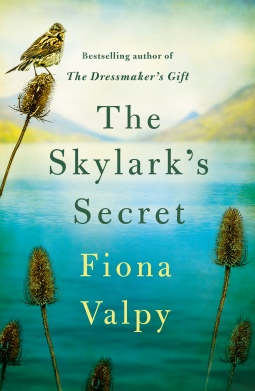
#BookReview ‘The Skylark’s Secret’ by @FionaValpy #WW2

Aultbea, a small fishing village on the shores of Loch Ewe on the west coast of Scotland, was transformed during World War Two into a Royal Navy base for the Arctic convoys. Into this true history Fiona Valpy weaves the fictional story of Flora Gordon in The Skylark’s Secret. Fiona ValpyIn 1977, Lexie Gordon returns to Loch Ewe from London after the death of her mother Flora. Lexie arrives home a single mother to baby Daisy, her West End singing career broken because of her damaged vocal chords. She feels a failure, gossiped about by the locals, seen as an outsider. Living in her mother’s cottage, she becomes curious about the father she never met and who her mother never spoke freely about.
In this dual timeline story, the narrative alternates clearly between Lexie in the Eighties and Flora in 1940-1944. Flora lives with her widowed father, Iain, gamekeeper for local estate Ardtuath House, in a quiet village where the toughest enemy is the weather. Then one day a fleet of warships arrive, the first of many. Loch Ewe is to become the temporary base for the Home Fleet. As thousands of navy ratings and officers arrive, Iain and Flora hope her brother Ruaridh will be aboard one of the destroyers. The convoys are to change life by the loch forever. Flora and her two friends Bridie and Mairi enlist in the Wrens as drivers. Laird’s son Alec also returns home with an English girlfriend. When Alec admits his lifelong love for Flora, the two young people must face the disapproval of the intimidating laird. With both Alec and Ruaridh on separate ships accompanying the Arctic convoy of merchant ships sailing for Russia, Flora fears for their lives. Meanwhile, a group of evacuees arrive from Glasgow, including two ragamuffins who lodge with bossy but kind-hearted Moira Carmichael.
Valpy unravels the story of Flora’s war years, the hardships, the danger, the exhilarating moments of freedom when the two young men arrive home safe. But always on the horizon is the next convoy which must face the twin dangers of Arctic ice and marauding U-boats. In 1978, Lexie must make a place for herself and Daisy in the community which includes her mother’s old friend Bridie, Lexie’s schoolfriend Elspeth, and fisherman Davy. She feels a stranger and takes to walking the hills, remembering times with her mother, trying to find her place in the world.
This is a story of wartime courage, romantic entanglements, fear, grief and gratitude for sacrifices made. A well-researched book that shows that research with a light hand on the page, allowing the fictional story room to breathe. Excellent.

If you like this, try:-
Mrs Sinclair’s Suitcase’ by Louise Walters
The Paying Guests’ by Sarah Waters
Another You’ by Jane Cable

And if you’d like to tweet a link to THIS post, here’s my suggested tweet:
#BookReview THE SKYLARK’S SECRET by @FionaValpy https://wp.me/p5gEM4-53P via @SandraDanby