
What a delicious first chapter there is to Miss Austen by Gill Hornby. Elderly Cassandra Austen arrives unannounced to visit a family friend in Kintbury, endures a parsimonious supper and a difficult evening without much conversation. Why, I wondered, is Cassandra there. And then at bedtime, comes a hint at her reason. 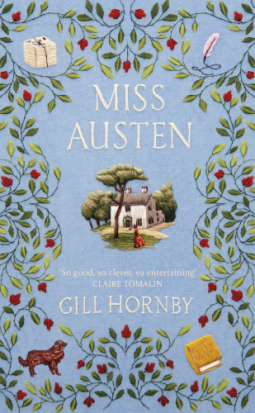 Cassandra visits Isabella, a family friend who is grieving the death of her father. Cassandra’s objective, is to retrieve any incriminating letters between her sister Jane and Isabella’s mother, Eliza, before Isabella leaves the family vicarage. With both letter writers dead, and knowledge of the novelist Jane Austen more widely sought than ever before, Cassandra is anxious to protect Jane’s legacy.
What follows is a gentle telling of the sisters’ relationship as Hornby pieces together the real letters of the Austen sisters and the known biography of the family, combined with events and dialogue of her own imagination. This is a meandering read without a real focus, there is the imagined threat to Jane’s reputation as Cassandra searches for the missing letters under threat of exposure by her sister-in-law Mary. But this threat is not wholly formed and the story goes back and forth between Cassandra reading the letters at the dead of night, to key times in the life of Jane.
Not until three-quarters of the way through does the dilemma becomes personal to Cassandra. Until this point, it is oddly numb. Cassandra has been seeking private – and very personal – letters written to Eliza but instead finds letters that cast what she, Cassandra, believes to be a bad light on her own life. Not Jane’s. The stakes are raised and I wanted to see more than a snapshot of the man involved and don’t really care if he was a real person or the author’s invention.
Cassandra in her old age is dismissive of those who do not read or don’t appreciate the art of her sister’s books, and has a lack of interest in anyone not an Austen. ‘Those other mortals, whose poor veins must somehow pulse with no Austen blood in them, always appeared to her comparatively pale’. This quote reminded me of Marianne’s dismissal of Edward’s underwhelming reading of Shakespeare sonnets and made me want a 360 degree picture of Cassandra’s own life.
I finished Miss Austen reflecting on the difficulty of writing this novel. What an awkward task it is for an author, to balance biography and real letters with invention and how strong must be the impulse to stick with the truth. I longed for Hornby to take a bigger risk and show us more of the life, and loves, Cassandra may have had.
If you like this, try:-
‘After Leaving Mr Mackenzie’ by Jean Rhys
‘The Confessions of Frannie Langton’ by Sara Collins
‘Amy Snow’ by Tracy Rees
And if you’d like to tweet a link to THIS post, here’s my suggested tweet:
#BookReview MISS AUSTEN by Gill Hornby @GillHornby https://wp.me/p5gEM4-4iB via @SandraDanby



 Death is not always the end. King Richard III. Betrayed, defeated and savagely slain but Fate is not quite finished with him. He regains consciousness on Bosworth’s bloody field and concludes that the Almighty has granted him another chance to fight for his throne. About to leave the battlefield to head North, Richard is forced to take cover by the arrival of Henry Tudor and his men who are searching for his body to put on display. Suddenly the cry goes up ‘We have found the king!’ He sees Henry Tudor standing triumphant over a mauled and battered corpse and hears him whisper ‘It is done. England is mine.’ How could this be when he is not dead? Richard sidles closer; to his utter horror finds himself looking at his own body. The appearance of the mysterious monk Father Gilbert, convinces him that he is dead and now in Purgatory – and so begins Richard’s harrowing journey through the Hereafter. Through his recollections in the Afterlife, reader is witness to the key events that lead to his violent end. The man behind the myths is revealed, as is the torment of a soul who believes that his honour and reputation have been forever destroyed by the malign propaganda of the Tudors. When at last Richard learns that this has not reigned supreme through the ages, he faces a decision that will affect his soul throughout eternity.
 What is a ‘Porridge & Cream’ book? It’s the book you turn to when you need a familiar read, when you are tired, ill, or out-of-sorts, where you know the story and love it. Where reading it is like slipping on your oldest, scruffiest slippers after walking for miles. Where does the name ‘Porridge & Cream’ come from? Cat Deerborn is a character in Susan Hill’s ‘Simon Serrailler’ detective series. Cat is a hard-worked GP, a widow with two children and she struggles from day-to-day. One night, after a particularly difficult day, she needs something familiar to read. From her bookshelf she selects



 SANDRA DANBY'S BOOK REVIEWS