
The Orange Lilies by Nathan Dylan Goodwin is a novella, a short book which I wanted to be longer. Set at Christmas 2014 it revisits Christmas 100 years earlier, the first year of the Great War, and follows the story of one man in the trenches with the Royal Sussex Regiment. Third in the series about forensic genealogist Morton Farrier, it is a little different from its predecessors in that it focusses on Morton’s own story rather than that of a client. 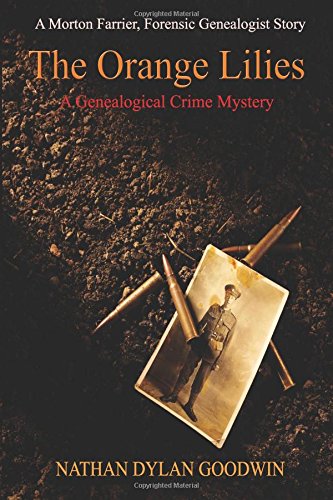 Morton knows he is adopted but has recently discovered a complicated family secret. So in an effort to build bridges and learn more about his ancestors, he and girlfriend Juliette travel to Cornwall to visit his Aunty Margaret and Uncle Jim. Over the festive break, Morton and Margaret trace official documents telling the story of Morton’s great-grandfather Charles Farrier, who fought with the Second Battalion, the Royal Sussex Regiment. However as records are uncovered, more questions appear. At the same time we are told Charles’s story in 1914, with its own mysteries, contradictions and secrets. Unknown to Morton, old and modern mysteries are inter-linked.
I love the formula of the Morton Farrier books, the combination of present and past, secrets and lies, the hunt for truth and puzzles solved. This book is a little different, I think for two reasons. First, I longed in the first half for more dynamic detail of Charles’s story rather than dry factual reporting. At the front of the book, the author explains that two of his own relatives fought with this regiment. At the end of the book, the author explains that the movements of the Second Battalion are recorded as faithfully and accurately as possible. It feels as if the history bound the creative hands of the author. The second difference is that Morton is researching his own family and so the emotional attachment is different. Unlike when he is searching for clients, there is no immediate danger to his life, property or loved ones.
I raced through this book, intrigued by the mystery of Charles and his young wife Nellie. If you are new to the Morton Farrier books, you will appreciate this novella better if you have already read the first two in the series.
Read my reviews of the next books in the Morton Farrier series:-
HIDING THE PAST #1MORTONFARRIER
THE LOST ANCESTOR #2MORTONFARRIER
THE AMERICA GROUND #4MORTONFARRIER
If you like this, try:-
‘Pale as the Dead’ by Fiona Mountain
‘Blood Atonement’ by Dan Waddell
‘The Quarry’ by Iain Banks
And if you’d like to tweet a link to THIS post, here’s my suggested tweet:
#BookReview THE ORANGE LILIES by Nathan Dylan Goodwin http://wp.me/p5gEM4-2j2 via @SandraDanby
 I do have a long list of books I want to re-read, headed by Donna Tartt’s
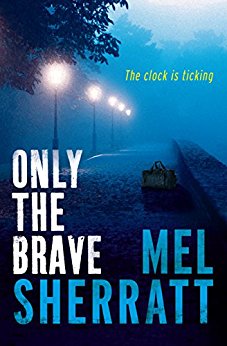
  When Frank Bale was a lawyer, he wore Savile Row suits. Now he has holes in his trousers and serves papers for other, successful, lawyers. Life is bleak but he is kept going by a Philip Marlowe obsession and a longing to prove himself. When a student winds up dead, he gets the chance to investigate a real crime, relying on advice found in an old Tradecraft Manual and the sayings of his nan. But neither the manual nor his nan nor Marlowe prepare him for handling the slimiest of London’s underbelly, jellyfish, who hit back first with fists, then with golf clubs and finally with guns. Can Frank stay alive long enough to find the killer – and get the girl?

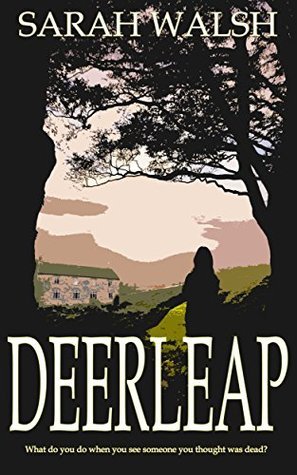
 The 1984 film, directed by David Lean, featured Alec Guinness, Dame Peggy Ashcroft and Victor Banerjee. It won two Oscars: Dame Peggy Ashcroft [Mrs Moore], Best Actress in a Supporting Role; and Maurice Jarre for Best Music, Original Score.
 The current Penguin edition features a detail from ‘English Women visiting caves near Bangalore’ [c. 1880s]. Photograph courtesy of The British Library.
 As a classic, A Passage to India has been published in many editions and languages. Here is a selection of some of the covers. The Italian cover is particularly dashing.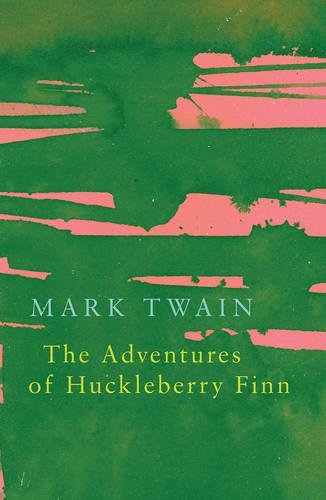
 I do recall that my mother and I had recently arrived in the United States and were living in a studio apartment in Washington, DC, while she struggled to make ends meet. The book is a series of articles on Jean Kerr’s life as a playwright and parent, and each of the pieces made me roar with laughter at a time when real life wasn’t that funny. When I first read the book, I found it hugely entertaining on such subjects as diets, doctors, family, fashion, moving house, and the rest of everyday suburban life. It was only decades later that I could identify with Kerr’s situation as a writer working from home, and as the harassed mother of irrepressible boys.
 It’s the sweltering summer of 2013 and the lives of six Londoners get complicated. As the temperature soars, they’re grappling with money worries, whining children, ailing parents, panic attacks, relationship woes, and temptations along the way. Emotions rise to boiling point, forcing decisions they could regret.



 SANDRA DANBY'S BOOK REVIEWS