Tag Archives: Anthony Quinn

#BookReview ‘Molly & the Captain’ by Anthony Quinn #historical #art

Three timelines, three studies of artist families. Molly & the Captain by Anthony Quinn is the story of one painting via three families across three centuries. It starts in Georgian Bath with the artist William Merrymount and his two daughters. His portrait of the two girls, ‘Molly & the Captain,’ intrigues through the centuries and ends up in North London in the current time. Anthony QuinnEach of the three parts stands alone, the connections revealing themselves in the final pages. In 1758, Merrymount is a renowned artist. His elder daughter Laura is a promising student and it is she who tells the family’s story through letters to her cousin. When her emotionally brittle sister Molly falls in love with the man Laura had thought to marry, their lives change. Things are not as they appear, secrets are well-hidden even within their household and Laura discovers facts she perhaps would prefer to remain unknown.
In 1889, artist Paul Stransom makes a living painting pictures of his local area, preferring to paint landscapes in parks rather than portraits. Tempted to venture abroad, perhaps to Normandy where colleagues are having success, his plans change when in Kensington Gardens he sees a mother and two young daughters, all dressed in white. When he approaches them, they disappear. Meanwhile his sister Maggie is faced with choosing to marry a man with the means to support her, or the poor man she loves.
In modern-day North London, artist Nell is preparing for an exhibition, a retrospective of her work which should bring long-overdue recognition. Her actress daughter Billie meets a young musician who she is to work with in a film. Horrified by the squat where Robbie lives, Billie suggests her mother take him into her house to replace the lodgers currently moving out of her loft. The consequences impact on all their lives.
This is a book about families, love and loyalty, about how creativity impinges on the privacy of family members and how the conflicts of success are just as difficult to deal with now as in Georgian times. Life – romance, loyalty, self-sacrifice, betrayal, opportunities, failure – always seem to get in the way.
It took me longer to read than I expected although it is not a particularly long book. The pace is slow, Quinn takes times to describe his settings with characteristic care of detail. Essentially this is a gentle mystery, a question runs throughout the three sections: what happened to the painting ‘Molly & the Captain’?
The ending has a wonderful, but gentle, twist. A thoughtful read and one I expect to gain more from on re-reading.
CLICK HERE TO READ MORE ABOUT THIS BOOK

Read my reviews of these other novels also by Anthony Quinn:-
CURTAIN CALL
FREYA
HALF OF THE HUMAN RACE
OUR FRIENDS IN BERLIN
THE RESCUE MAN
THE STREETS

If you like this, try:-
‘The Doll Factory’ by Elizabeth Macneal
The Mermaid and Mrs Hancock’ by Imogen Hermes Gowar
The Ballroom’ by Anna Hope

And if you’d like to tweet a link to THIS post, here’s my suggested tweet:
MOLLY & THE CAPTAIN by Anthony Quinn #BookReview https://wp.me/p2ZHJe-6if via @SandraDanby

COMING SOON… THE NEXT BOOK I REVIEW WILL BE:- Renita D'Silva

#BookReview ‘The Streets’ by Anthony Quinn #historical #sociology

The Streets by Anthony Quinn is part sociology, part history, part mystery, part political discussion. Set in the 1880s, it sets a fictional tale within true history, the sort of thing hated by historians themselves who fear that readers will believe it is all true. They should credit we readers with the ability to recognize fiction from fact. This is a story encompassing poverty, pride, crime, corruption, community and, almost, eugenics. Anthony QuinnDavid Wildeblood has a new job. He is an inspector, a fact-collector, charged with touring the North London borough of Somers Town, conducting interviews and collating information to be published in Henry Marchmont’s weekly news sheet The Labouring Classes of London; living conditions, work, income, religion, diet, pastimes, crime, health etc. Marchmont is based on Henry Mayhew’s London Labour and the London Poor and Charles Booth’s Life and Labour of the People of London. At first Wildeblood is an outsider and woefully naïve, until he stumbles on costermonger Jo. Soon Wildeblood learns the argot, the alleys to avoid, and how to best submit his report to Marchmont’s loyal assistant Mr Rennert. Then he stumbles onto a scheme in which criminal landlords defraud their tenants, refuse to repair their properties then clear the streets for redevelopment leaving the inhabitants homeless. When a local man organizes a protest, he is later found drowned in the river. Wildeblood is warned by a reporter friend, Clifford Paget of The Chronicle, that his life may be in danger but he continues to investigate.
Wildeblood’s time in Somers Town is juxtaposed with his, albeit tenuous, relationship with his wealthy godfather Sir Martin Elder and Kitty, his daughter. The two stories come together as he recognizes a connection between a social charity providing poor city dwellers with a day trip to the countryside, and what is happening in Somers Town. The tentacles of property exploitation, fraud and social engineering spread around London. At times the sociology and politics of the author intruded into my head and the exposition distracted me from the story but, like all Quinn’s novels, the characters are a delight.
The description of The Streets as a ‘thriller’ though, is misleading. This is a thoughtful considered novel. Well-researched, it feels as if this book is close to the author’s heart; perhaps too close. For me, it was a slower, worthy read, compared with his other novels and less accessible.
CLICK HERE TO READ MORE ABOUT THIS BOOK

Read my reviews of these other novels also by Anthony Quinn:-
CURTAIN CALL
FREYA
HALF OF THE HUMAN RACE
MOLLY & THE CAPTAIN
OUR FRIENDS IN BERLIN
THE RESCUE MAN

If you like this, try:-
‘The Walworth Beauty’ by Michèle Roberts
‘The Penny Heart’ by Martine Bailey
‘Birdcage Walk’ by Helen Dunmore

And if you’d like to tweet a link to THIS post, here’s my suggested tweet:
#BookReview THE STREETS by Anthony Quinn https://wp.me/p5gEM4-3e2 via @SandraDanby

SaveSave

#BookReview ‘The Rescue Man’ by Anthony Quinn #WW2 #historical

The Rescue Man, debut novel of Anthony Quinn, is slow moving tale of a man changed by war. Set in Liverpool throughout World War Two, it is clearly a love letter to the city by Liverpool-born Quinn. It focusses on a love triangle between a historian and two photographers. Anthony Quinn Tom Baines is a quiet architectural historian in his late thirties. He lives in the past, researching a book about Liverpool’s buildings which he somehow never manages to finish. In 1939, his mentor recommends he research a misunderstood Liverpool architect, Peter Eames who mysteriously committed suicide leaving his work never properly recognised.
When war breaks out Baines volunteers as a rescue man, working in teams to extract people and bodies from the bombed buildings he was supposedly cataloguing for his book. This experience, and the people he works with, have a profound impact and slowly his life changes. His language coarsens, thanks to mixing with the men on his team, and in response to his publisher’s request to speed up his research of the city’s buildings before they are destroyed by bombs, he meets husband and wife photographers Richard and Bella.
The romance is a long time coming and the first half of the book seems to meander along without urgency, Tom is a quiet, academic unassuming man and I had to work at sticking with the book. I wondered what there was in him which attracted the bright flower, Bella.
Tom Baines says, ‘It was only when war came and I started doing rescue woke that I sort of… woke up.’ Unfortunately the book is a third through before we reach 1940 and the bombing of Liverpool and two-thirds through before the pace picks up. There is a sense of time being suspended until the final quarter of the book is reached and, as the brutality of the bombing clears street after Liverpool street and many of the historic buildings Baines was meant to catalogue are reduced to rubble, Tom hits crisis point.
The pace is not helped as the story of Peter Eames is told via diary extracts which are stop start with substantial gaps. The themes of wartime destruction – not only of buildings, but of trust between family, lovers and friends – are mirrored between the Eames and Baines timelines. Architect Eames builds, rescue man Baines negotiates the rubble left by the Luftwaffe’s bombing raids. And both are key players in love triangles where trust is betrayed and marriage vows broken.
This is Anthony Quinn’s debut novel and though thoughtful like his later books, it lacks their narrative pace. If you are familiar with Liverpool, which I’m not, it will be a more fulfilling read. There is no doubt about Quinn’s beautiful writing, simply that the subject – and the perhaps over-use of the Liverpool setting – did not hold me. Not his best book but well worth reading if you know his later work such as Freya.

Read my reviews of these other books by Anthony Quinn:-
CURTAIN CALL
FREYA
HALF OF THE HUMAN RACE
MOLLY & THE CAPTAIN
OUR FRIENDS IN BERLIN
THE STREETS

If you like this, try:-
The Slaves of Solitude’ by Patrick Hamilton
‘Homeland’ by Clare Francis
Life After Life’ by Kate Atkinson

And if you’d like to tweet a link to THIS post, here’s my suggested tweet:
#BookReview THE RESCUE MAN by Anthony Quinn https://wp.me/p5gEM4-4Gx via @SandraDanby

#BookReview ‘Half of the Human Race’ by Anthony Quinn #WW1 #suffragette

Half of the Human Race by Anthony Quinn is a gem of a novel, one to keep and re-read. The front cover illustration suggests it is another Great War love story, but it is so much more than that. In fact the warfare occupies only a hundred or so pages. Rather, it is a character study of England before the war, of suffragettes and cricketers, of a different time, when the demands put on love were extreme. Anthony QuinnA new king is being crowned and the protestations of votes for women are taking a violent turn. Set against this background in 1911, we meet the key characters at a cricket match. Connie Calloway is a former medical student who now works in a bookshop after her father’s suicide left her family poorer than they expected to be. Will Maitland is a young county cricketer rubbing shoulders with the great ‘Tam’, AE Tamburlain, as popular as WG Grace. A flicker of attraction carries the pair throughout this story as both consider questions of loyalty and belief and where love fits into the mix. When the ageing Tam’s place in the M−Shire team is threatened, Will must consider whether to support his friend or risk losing his captaincy of the team. Connie, at once thrilled and intimidated as her friend Lily is imprisoned in Holloway for a suffragette demonstration, considers the strength of her belief in votes for women and how far she is prepared to go. When she meets an old school friend, she also must make a decision. The decisions they take govern the direction of their lives as times change and the country edges towards war. Will their attraction burgeon into romance and love? Connie is hardly Will’s mother’s idea of the girl he should marry. She is outspoken and independent, perhaps too much so for Will? Connie’s personality is juxtaposed with her older sister Olivia who, Connie fears, is trading her independence for a rich husband.
Quinn creates two characters of their time and beyond it, that are totally believable, with a surrounding cast of characters including the fascinating Tam, artist Denton Brigstock, cousin Louis and friend Lily. Quinn, obviously a cricket fan, writes with a light hand about the sport and this should not be off-putting for any readers who do not like cricket. It is a key part of the plot and offers a view of a gentleman’s world where codes of behavior and manners are assumed, where tradition rules; similar values are on show later in the book when Will, now Captain Maitland, is waiting for the next big push. When he confronts his commanding officer to query a battle plan, he is more like Connie than he would ever realize.

Click the title below to read my reviews of other books by Anthony Quinn:-
CURTAIN CALL
FREYA
MOLLY & THE CAPTAIN
OUR FRIENDS IN BERLIN
THE RESCUE MAN
THE STREETS

If you like this, try:-
‘My Dear, I Wanted to Tell You’ by Louisa Young
‘Stay Where You Are and Then Leave’ by John Boyne
‘A Long Long Way’ by Sebastian Barry

And if you’d like to tweet a link to THIS post, here’s my suggested tweet:
#BookReview HALF OF THE HUMAN RACE by Anthony Quinn https://wp.me/p5gEM4-33j via @SandraDanby

#BookReview ‘Our Friends in Berlin’ by Anthony Quinn #WW2

Our Friends in Berlin by Anthony Quinn tells a story of London in World War Two seldom told. It is a spy novel but not a thriller. It focuses on the individuals concerned and has a deceptive pace which means the threats, when they come, are more startling. Jack Hoste is not who he seems to be. He is not a tax inspector; he is not looking for a wife. He is a special agent who tracks down Nazi spies. And at night he is an ARP warden. Anthony Quinn The juxtaposition of Hoste’s life of secrets is set nicely against that of Amy Strallen who works at the Quartermaine Marriage Bureau. Ordinary life does go on in London during the Luftwaffe bombing and Amy must match clients together, a matter of instinct rather than calculation. In order to be matched with the right person, clients are asked to tell the truth about what they are seeking, truths which may have been disguised or hidden until now. Client requests include ‘a lady with capital preferred’ and ‘not American’. Then one day she meets a new client who seems oddly reluctant to explain what he is looking for. The client is Jack Hoste and he doesn’t want a wife, he is searching for Marita Pardoe, a suspected Nazi sympathiser and friend of Amy in the Thirties. What unfolds is a story of spying, gentle romance, betrayal, fanaticism and the life of living in a bombed city.
Jack and Amy seem to run on parallel tracks, veering towards and then away from each other, both romantically unsure, both allow the real world to get in the way. And get in the way it does, in the shape of Marita. Quinn is excellent at building characters, he makes you care for them and that’s what keeps you reading. In a time of war, decisions are often made recklessly but Jack and Amy draw back from doing this. Both are people of honour, making the secrets they must keep and the lies they must tell all the more pertinent. The nature of truth is a theme wriggling its way through every page.
Anthony Quinn is a favourite author of mine, his novels are each quite different and I will read everything he writes. I read this one quickly.

Read my reviews of these other novels also by Anthony Quinn:-
CURTAIN CALL
FREYA
HALF OF THE HUMAN RACE
MOLLY & THE CAPTAIN
THE RESCUE MAN
THE STREETS

If you like this, try:-
‘Mrs Sinclair’s Suitcase’ by Louise Walters
‘The Paying Guests’ by Sarah Waters
‘The Heat of the Day’ by Elizabeth Bowen

And if you’d like to tweet a link to THIS post, here’s my suggested tweet:
#BookReview OUR FRIENDS IN BERLIN by Anthony Quinn https://wp.me/p5gEM4-3pl via @SandraDanby

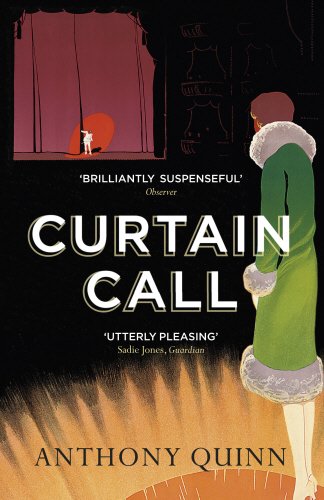
#BookReview ‘Curtain Call’ by Anthony Quinn #historical #1930s

The 1930s come alive in Curtain Call by journalist Anthony Quinn, I stepped into his world and felt as if I was there. An effortless read, I was plunged into the worlds of Stephen Wyley, artist; Nina Land, actress; the gloriously-named Madeline Farewell, hostess; Jimmy Erskine, theatre critic; and Tom Tunner, Erskine’s assistant. Anthony Quinn The setting is a time of looming war, royal crisis, blackshirts and strict homosexuality laws. It is not an easy novel to categorize: there are murders, but it is not a detective novel; we see the world of art and theatre and prostitution, but it is not a novel about art etc. Packed with period detail, with not one detail too many, this is written with a light hand and a clever plot. It starts with a romantic assignation and chance encounter in a hotel with a murderer, known in the newspapers as the Tiepin Killer. This meeting of only seconds, brings together the key characters and kickstarts the murder plotline.
Curtain Call is the predecessor, not prequel, to Quinn’s novel Freya.

Click the titles to read my review of other novels by Anthony Quinn:
FREYA
HALF OF THE HUMAN RACE
MOLLY & THE CAPTAIN
OUR FRIENDS IN BERLIN
THE RESCUE MAN
THE STREETS

If you like this, try:-
‘The Light Years’ by Elizabeth Jane Howard
At Mrs Lippincote’s’ by Elizabeth Taylor
The Heat of the Day’ by Elizabeth Bowen

And if you’d like to tweet a link to THIS post, here’s my suggested tweet:
#BookReview CURTAIN CALL by Anthony Quinn http://wp.me/p5gEM4-1Xu via @Sandra Danby

#BookReview ‘Freya’ by Anthony Quinn #historical

When I finished reading Freya I wanted to shout out to everyone around me to read it. Why? It is a story of friendship and love, truth and honesty, loyalty and betrayal. Anthony Quinn captures Freya immaculately – he seems to intuit so much women’s stuff so well – so much better than other male novelists recently writing from a female point of view. It is such a refreshing read, I hope it sells loads and wins loads. It deserves it. If you can, read it next. Anthony QuinnFreya is the story of Freya Wyley from VE Day to the 1960s via Oxford, Nuremberg, Italy and mostly London. Recently demobbed from the Wrens, at which she achieved a senior position as bomb plotter in a world with few men, she goes up to Oxford unsure if she is too ‘old’ at the age of 21 to return to study. There she finds that pre-war expectations of women re-apply again and with her customary cussedness she fights against it. With the glimmer of an opportunity, she sets out to get a break as a journalist by interviewing a reclusive war reporter who will be attending the Nuremberg war trials. She calls in a favour from her father, lies, manipulates and bravely goes forth, setting foot into the ruins of the bombed city where she is later told she should not have ventured. But that is Freya: undaunted. She is strong, true, speaks without thinking and gets into trouble because of it. Of course it is the few times in which she is not honest, either with herself or with her best friend Nancy – who she met on the night of VE day when they got ‘stinko’ together – that make the most fascinating reading.
It is a joy to read a female character who is not nice all the time, who feels real, and who I can identify with more than some sugar-sweet modern protagonists. This book fairly fizzes along, read in two days on holiday, I found myself irritated when my Kindle’s battery died because I ignored the ‘battery low’ warning.
Quinn’s sense of time is perfect, he moves seamlessly from wartime to the Sixties. All his characters have depth, flaws and are believable, and his balance of action, contemplation and setting is exact. He covers a wide variety of subjects of the time – morality and art, homosexuality offences, celebrity, political rigour – by simply allowing Freya to investigate and report. The technique of covering Freya’s investigation of an article, followed by the published article, acts as a semi-colon before the next segment of her life.
CLICK HERE TO READ MORE ABOUT THIS BOOK

Click the title below to read my reviews of other books by Anthony Quinn:-
CURTAIN CALL
HALF OF THE HUMAN RACE
MOLLY & THE CAPTAIN
OUR FRIENDS IN BERLIN
THE RESCUE MAN
THE STREETS

If you like this, try:-
Sweet Caress’ by William Boyd
The Secrets We Kept’ by Lara Prescott
Fatal inheritance’ by Rachel Rhys

And if you’d like to tweet a link to THIS post, here’s my suggested tweet:
#BookReview FREYA by Anthony Quinn https://wp.me/p2ZHJe-1TV via @SandraDanby