Tag Archives: book review

#BookReview ‘The Heiress’ by @MollyJGreeley #historical #romance

An intriguing premise for this second novel by Molly Greeley which re-imagines the story of a minor character in Jane Austen’s Pride and Prejudice. In The Clergyman’s Wife it was Charlotte Collins, in The Heiress it’s the turn of Anne de Bourgh. Molly GreeleyWell-written in a slightly modernised style of Austen, it is easy to slip into the head of Lady Catherine de Bourgh’s sickly daughter who at first sight seems an unpromising protagonist. But keep reading. Greeley starts with the birth of a daughter to a young married couple. In order for this book to work you have to both forget Austen’s portrayal of Anne, to sink yourself into the life of this delicate child, but also to remember the original. That is the path to enjoying the asides, thoughts and occasionally darting but puzzling urges that Anne experiences growing up. Scenes I looked forward to, critical in Pride and Prejudice, were skirted over here in favour of new material. Familiar characters occur, some more importantly than others – Darcy, Colonel Fitzwilliam, Mr Collins – but this is 100% Anne’s story.
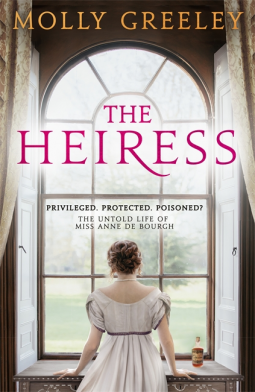
Sickly from birth, Anne is dosed twice daily with laudanum drops. She is protected from exertion, emotions and unspecified dangers of the outside. Playing the piano is too strenuous, novels and poetry too emotional. Then when she is twelve after an unsuccessful treatment of sea bathing, Anne’s life change when a governess arrives. This is not yet the nodding Mrs Jenkinson from Austen but Miss Hall, a young woman determined to teach her unschooled young pupil what she needs to know to be the future mistress of Pemberley and Rosings.
This is a story of laudanum addiction, the tentacles of the drug’s control preventing any small rebellion by Anne, any protestation that she feels healthy before her curative drops are administered and only weak afterwards. Cocooned from emotion, her true personality smothered, Anne lives at a distance from those closest to her. An article in a newspaper is to be the catalyst for change. But change of any kind takes immense courage, needing a confrontation with her controlling mother. Greeley gives Lady Catherine a moment of redemption though as we, and Anne, catch a glint of history that explains the elderly woman portrayed by Austen and challenged so gleefully by Lizzie Bennet.
For Anne to fulfill Miss Hall’s objective of being a fit mistress of the estate of Rosings, she must do more than break free of drugs. She must discover the truth of who she is.
A fascinating exploration of one woman’s search for freedom in a time of female subjugation to men, when females were labelled as delicate with little diagnosis or review, when many women were unable to live alone or manage their own inheritance. At times surprising, the detail of The Heiress is Austen-like but the emotions are of the twenty-first century.

Click here to read my review of THE CLERGYMAN’S WIFE, also by Molly Greeley.

If you like this, try:-
Cecily’ by Annie Garthwaite
The Cottingley Secret’ by Hazel Gaynor
The Almanack’ by Martine Bailey

And if you’d like to tweet a link to THIS post, here’s my suggested tweet:
#BookReview THE HEIRESS by @MollyJGreeley https://wp.me/p5gEM4-5l4 via @SandraDanby
#BookReview ‘Here We Are’ by Graham Swift #theatre #Brighton

What a delightful slim story is Here We Are by Graham Swift. On the surface it’s a simple tale of a summer season at the theatre at the end of Brighton Pier in 1959. It’s a tale about a magician and his assistant. It’s also a tale about perception and delusion, truth and lies, what is real and an illusion. Graham Swift When young magician Ronnie Deane gets a job for a seaside summer season, he advertises for an assistant. Evie White has experience in the chorus line but has never worked for a magician before. They are both on a steep learning curve. Their guide in Brighton is Ronnie’s friend Jack Robbins, compere, listed on the bill as Jack Robinson. ‘Some patter, some gags, some of them smutty, a bit of singing, some dancing, some tapping of his heels.’ As Ronnie and Evie, listed as ‘Pablo & Eve’, perfect their act, work their way up the bill, they go out as a foursome in the evenings with Jack and his latest girl. They change so frequently Evie can’t keep track of their names, instead thinking of them simply as ‘the Floras’.
This is principally Ronnie’s story, how at the age of eight he left his mother and was evacuated to safety in Oxford. There he found a new home, new parents and a magician to share all the secrets and tricks of the trade. By the end of the war, when Ronnie returns home to London and to his mother, he is a man who knows what job he wants to do.
Like all Swift’s stories, this can be read on many levels. At its simplest it is about a love triangle.
Only 208 pages, it is a short novel. The language is beautiful with not an unnecessary word. Not much may happen, but as the events of 1959 unfold Swift tells us the story of Ronnie’s childhood and how it impacts on the man he has become. The lies told to prevent hurt, the lies told for self-protection, lies told for unknown reasons, and some lies which may actually be the truth. As unknowable as Ronnie’s Famous Rainbow Trick. Unpretentious, at its heart lies a mystery that is in itself mysterious.
CLICK HERE TO READ MORE ABOUT THIS BOOK AT AMAZON

Here’s my review of Swift’s MOTHERING SUNDAY.

If you like this, try:-
A View of the Harbour’ by Elizabeth Taylor
The Gustav Sonata’ by Rose Tremain
Redhead by the Side of the Road’ by Anne Tyler

And if you’d like to tweet a link to THIS post, here’s my suggested tweet:
#BookReview HERE WE ARE by Graham Swift https://wp.me/p5gEM4-5iB via @SandraDanby

#BookReview ‘Amy & Isabelle’ by Elizabeth Strout @LizStrout #contemporary

The mother and daughter portrayed in Amy & Isabelle by Elizabeth Strout are at odds with each other. The events of one long sweltering summer in Shirley Falls are simple, familiar across the ages, but are told with a hefty emotional punch. So strong is this book it’s difficult to see that it was Strout’s first novel, published in 2000 to be followed only eight years later by her Pulitzer Prize-winning Olive Kitteridge. Strout is adept at peeling away the layers of character and events to show the raw emotion, shame, guilt and pain beneath. Elizabeth StroutWhen Isabelle Goodrow arrived in Shirley Falls with her baby daughter, she took a job at the local mill. Now, in a time that feels like 1970s America, Amy is sixteen and has a summer job in the same office as her mother. They sit and fume at each other, barely talking, brushing past each other without a word. Amy, who has fallen in love with her maths teacher, believes her upright, unemotional mother, has no idea of what she is feeling right now. Isabelle despairs of her daughter’s behaviour. Told in absorbing detail, switching between the two viewpoints, the trauma of the two women is revealed. Shirley Falls is an evocative setting, an industrial town with a river flowing through it. As the temperature rises, the river begins to stink adding to the stresses not just on the Goodrows but on the small community in which they exist. Strout excels at portraying the circle of characters which make the world of a novel so believable – Amy’s friend Stacy, Fat Bev and Dottie Brown at the mill, Isabelle’s boss Avery Clark.
Isabelle finds it difficult to fit in, has always felt like an outsider. As she judges others, she assumes others judge her. This is more about her own experience and inadequacies than about anyone else. As the summer days plod on and Amy’s affair unravels, we see hints of the truth of Isabelle’s past that go some of the way to explaining why she is as she is.
Difficult to put down, I enjoyed Amy & Isabelle very much. Both women are so real, their situations are real, you want to slap them both and hug them both. Strout writes in an extraordinarily perceptive manner about ordinary people in ordinary places, so real you feel you are in the room too.

Read my reviews of these other books by Elizabeth Strout:-
ANYTHING IS POSSIBLE
LUCY BY THE SEA
MY NAME IS LUCY BARTON
OH WILLIAM!
OLIVE KITTERIDGE
OLIVE, AGAIN
TELL ME EVERYTHING

If you like this, try:-
‘If I Knew You Were Going to be This Beautiful, I Never Would Have Let You Go’ by Judy Chicurel
The Museum of You’ by Carys Bray
When All is Said’ by Anne Griffin

And if you’d like to tweet a link to THIS post, here’s my suggested tweet:
#BookReview AMY & ISABELLE by Elizabeth Strout @LizStrout https://wp.me/p5gEM4-5id via @SandraDanby

#BookReview ‘A Room Made of Leaves’ by Kate Grenville #historical

When she is 21, a moment’s dalliance in a bush forces orphan Elizabeth to marry soldier John Macarthur. The story of their marriage in 1788, journey to the colony of Australia on board a convict ship and life in the new settlement called Sydney Town, is told in A Room Made of Leaves by Kate Grenville. Kate GrenvilleElizabeth was a real woman but little is known of her, though her husband features in Australia’s history books as the British army officer who became a politician, legislator and pioneer of the Australian wool industry. Grenville is free to imagine what life must have been like as a white settler, and a woman, in a rough, uncultured town where the native people are viewed as animals.
Very quickly Elizabeth finds her new husband is a bully and her new home is a brutal, unforgiving, judgmental place. She spends much time alone with her sickly son and survives by disguising how clever she is, particularly from her husband. More children quickly follow and she bonds more with the convicts who work for her as servants, than she does with the wives of her husband’s friends. An outlier, she decides to improve her learning and seeks lessons on astronomy from an officer in her husband’s corps. What follows changes her understanding of her new country and her place in it.
The pacing seems at times off kilter, a trifle slow in places and rushed at the end, but the writing is as beautiful as I remember from Grenville’s earlier books. Of the book’s two halves, I wanted less of the first half and more of the second about Elizabeth’s role in developing breeds of sheep suited to the wool trade.
Essentially this is a delicately-written story of a young woman who, after making one mistake, is trapped in a loveless marriage far away from her Devon home. She learns how to manage her husband without him realising he is being managed, she tempers his outbursts and steers him out of trouble. Perhaps this fictional account of Elizabeth’s life will mean more to Australians who have grown-up with the historical story of the real John Macarthur.
A good read but not my favourite Grenville book.

Read my review of another Kate Grenville book, RESTLESS DOLLY MAUNDER.

If you like this, try:-
Dangerous Women’ by Hope Adams
The Pearl Sister’ by Lucinda Riley
Rush Oh!’ by Shirley Barrett

And if you’d like to tweet a link to THIS post, here’s my suggested tweet:
#BookReview A ROOM MADE OF LEAVES by Kate Grenville https://wp.me/p5gEM4-5jI via @SandraDanby

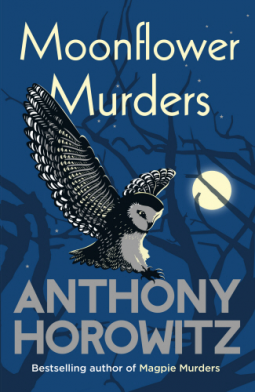
#BookReview ‘Moonflower Murders’ by Anthony Horowitz @AnthonyHorowitz #crime

Moonflower Murders by Anthony Horowitz is a sandwiching together of two mysteries – one murder, one disappearance – that take place eight years apart in the same place. Second in Horowitz’s crime series featuring literary agent Susan Ryeland and Atticus Pünd, the fictional hero of her client Alan Conway’s 1950s detective books – are you keeping up? – this is at the same time a page-turning read and a mystifying Rubik’s Cube challenge. Definitely a book that will reward re-reading. Anthony HorowitzSusan’s, now deceased, author Conway loved word play and riddled his short novels with in-jokes, complicated clues and witticisms. Many of these only make sense at the very end of Horowitz’s book. Susan, now living in Crete with boyfriend Andreas, running the just-surviving Hotel Polydorus, is asked by the owners of Branlow Hall hotel in Suffolk to investigate the disappearance of their daughter Cecily. Eight years earlier, one of the hotel’s staff was convicted of murdering a guest, Frank Parris. Shortly after the trial, Conway visited the hotel after which he wrote, Atticus Pünd Takes the Case. The book was edited by Susan who knew nothing about the links to the real-life crime.
Cecily, who manages Branlow Hall with her sister, reads Conway’s novel and is certain the wrong man was convicted of the crime. And then she disappears. How did Conway use the real crime in his fictional Atticus Pünd mystery to reveal the true murderer? What did Cecily see in the book that convinced her of the convict’s innocence? How can Susan unravel the clues and fit together two completely separate stories? And what has happened to Cecily?
The story is littered with clues, everyone has something to hide and it seems everyone is lying. Alongside the detecting we have the continuing story of Susan’s life – did she do the right thing in moving from London to Crete, should she marry Andreas or leave him, can she really be happy running a hotel and not editing books? And like the first in the series, Magpie Murders, there is also a book-within-a-book; we also get to read Atticus Pünd Takes the Case.
Layer upon layer, at times there are so many twists and turns it seems tortuous. Yes, there are coincidences and convenient secrets but if you enjoy Miss Marple and Hercule Poirot you will enjoy spotting the Christie links. If you go-with-the-flow and don’t get caught up on keeping track of the details, this is a fun read.

Read my review of MAGPIE MURDERS, first in the Susan Ryeland crime series.

If you like this, try:-
The Mystery of Three Quarters’ by Sophie Hannah #3POIROT
A Gift of Poison’ by Bella Ellis #4BRONTEMYSTERIES
Lord John and the Private Matter’ by Diana Gabaldon

And if you’d like to tweet a link to THIS post, here’s my suggested tweet:
#BookReview MOONFLOWER MURDERS by Anthony Horowitz @AnthonyHorowitz https://wp.me/p5gEM4-5j9  via @SandraDanby

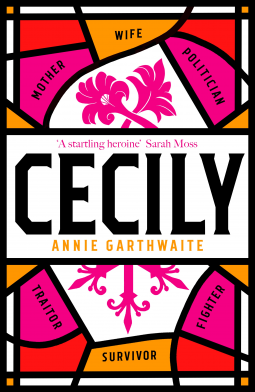
#BookReview ‘Cecily’ by @anniegarthwaite #historical

Cecily by Annie Garthwaite was a gradual falling-in-love process for me as I became so immersed in the story and fell in fascination with the character of Cecily Neville. What a wonderful fictionalised account of the Duchess of York it is. Mother of two kings, equal partner to her husband Richard, mother, politician, diplomat, kingmaker. Annie GarthwaiteI started knowing nothing more of her than that she was mother to both Edward IV and Richard III. Garthwaite paces herself in the telling of Cecily’s story and there were times when the [necessary] exposition of England’s 15th century politics and the seemingly endless battles and arguments of the Wars of the Roses, seemed to pause the narrative. But as the pages turn, the tension builds as you wonder how the family will survive. The politics and family connections of the time were intricately linked and can be confusing, so the exposition is a necessary part of the novel.
Cecily is a gift of a character who was somehow overlooked in the history books, as Garthwaite explains in her afterword, ‘Writing Cecily’. “Cecily lived through eighty years of tumultuous history, never far from the beating heart of power. She mothered kings, created a dynasty, brought her family through civil war…. Last woman standing.”
This does not feel like a debut novel. Cecily comes alive off the page and it’s clear that Garthwaite lived and breathed in Cecily’s shoes. She creates a modern woman, a strong woman in a man’s world which, given Cecily’s history, she must have been to survive. This is an epic story starting in 1431 as the teenage Cecily watches as Joan of Arc burns at the stake, ending with the coronation of her eldest son as King Edward IV. On the way, family alliances are sundered, friends become traitors, battles are won and lost and Cecily gives birth to thirteen children. Through it all, she believes her husband has a stronger claim to the throne than the current king, Henry VI. The tension between husband and wife ebbs and flows throughout the years as Cecily encourages and pushes Richard to claim his rightful place.
There are so many twists, betrayals, secrets and threats that I found myself just reading one more page, one more chapter, even as my eyes closed late at night. I did not want this book to end.
And what a stunning cover!

Here’s my review of THE KING’S MOTHER, also by Annie Garthwaite

If you like this, try:-
Orphans of the Carnival’ by Carol Birch
Dangerous Women’ by Hope Adams
Rush Oh!’ by Shirley Barrett

And if you’d like to tweet a link to THIS post, here’s my suggested tweet:
#BookReview CECILY by @anniegarthwaite https://wp.me/p5gEM4-5it via @SandraDanby

#BookReview ‘Waiting for Sunrise’ by William Boyd #WW1 #spy

Determined to deal with my overflowing to-read shelf, I picked up Waiting for Sunrise by William Boyd. Thoughtful with a twisty plot, we follow actor Lysander Rief from Vienna to the trenches as he tries to identify a traitor passing war secrets to the enemy. William BoydIt is Vienna 1913. Actor Lysander Rief has gone to Vienna seeking help for an intimate problem. In the waiting room he encounters two people who will determine the course of Rief’s life in the forthcoming Great War. Rief falls head over heels in lust with Hettie Bull but when Rief is thrown into prison charged with rape, he feels abandoned. He is extricated from Austria thanks to the help of a shadowy British government officer and Rief’s own ingenuity. But he owes a debt and is drawn into the shadowy world of wartime spies. Someone is sending coded messages about essential infrastructure, supply and troop movements to the enemy, and Rief is charged with hunting down the traitor.
Boyd is one of my favourite writers, his writing flows and there are multiple layers to consider long after finishing the book. All concocted with a skilful touch of humour in the right place. It all starts in the consulting room of Dr Bensimon who suggests that Rief’s delicate problem, based on an unfortunate but funny episode in his youth, can be solved not by drugs or hypnosis but by his own theory of Parallelism. Rief must revisit his memory of the incident and reconstruct the story of what happened so that today his dreams are about the changed story and his little problem stops happening. Smoke and mirrors. Rief, as an actor, is adept at pretending to be what he is not and there are countless characters he meets who do the same. He is good at spotting some people who are acting, but misses others. But unlike on stage, missing the clues can lead to hurt, separation and death. And at stake in the bigger picture of the war are the lives of allied soldiers.
This is a book about deception; lies to others, lies told to oneself. Small lies told for convenience. Big lies told to disguise treason. Along the way, people get hurt.
So much more than a conventional spy thriller from a master author. 4* for me rather than 5* because of the slow beginning. It pays to be patient.

Here are my reviews of other books by William Boyd:-
ANY HUMAN HEART
LOVE IS BLIND
NAT TATE: AN AMERICAN ARTIST 1928-1960
ORDINARY THUNDERSTORMS
SWEET CARESS
THE BLUE AFTERNOON
THE DREAMS OF BETHANY MELLMOTH
TRIO
… and try the first paragraph of ARMADILLO.

If you like this, try:-
Wake’ by Anna Hope
The Lie’ by Helen Dunmore
Corpus’ by Rory Clements #1TOMWILDE

And if you’d like to tweet a link to THIS post, here’s my suggested tweet:
#BookReview WAITING FOR SUNRISE by William Boyd https://wp.me/p5gEM4-5hB via @SandraDanby

#BookReview ‘The City of Tears’ by @katemosse #historical

Steeped in the historical detail of sixteenth-century religious tension and war in France, The City of Tears by Kate Mosse continues the story started in The Burning Chambers. Through the eyes of Minou and Piet we experience the Saint Bartholomew’s day massacre of Huguenots and its aftermath as the story moves from Paris and Chartres to Amsterdam, home to refugees and a protestant uprising. Kate MosseIt is 1572 and the action starts in Puivert, Languedoc, where the Reydons have found a fragile peace from Catholic persecution of the Huguenots. Minou and Piet take their family to Paris to witness the diplomatically-sensitive royal wedding of catholic King Charles’s sister Marguerite to the protestant Henry of Navarre. Unknown to the Reydons their old enemy Cardinal Valentin, also known as Vidal du Plessis, is in Paris planning to kill Huguenots. What follows drives the old enemies together and sets in motion Mosse’s story. The Reydons are forced to flee to save their lives, leaving behind one daughter possibly dead or missing. They run to Amsterdam where they establish a new life though their grief for Marta ruptures their previous marital harmony. But religious extremism follows them and once again they must face the threat of violence. As Piet’s past catches up with him, an uncomfortable family secret is revealed. The need to find the truth once and for all takes them to Chartres and the home of a hunter of religious relics.
These books need be read with full concentration. This period of history is a gap in my knowledge, which made The City of Tears an interesting read. The story lacked drama, though I find it difficult to pin down why. Minou is the heart of this book and it is she who pulled me on through some of the heavy historical detail. I settled into the book better when I gave up trying to remember the historical fact and let Minou’s fictional story take over.
As in The Burning Chambers, the Prologue is set in South Africa two centuries later. And still the woman featured in 1862 is a mystery. The City of Tears is set at a time of change in French Protestantism and the birth of the Dutch Republic and is one of a series of novels covering 300 years of religious turmoil in Europe. Mosse follows the geographical movement of the Huguenot refugees from sixteenth-century France and Amsterdam to the Cape of Good Hope in the eighteenth and nineteenth centuries. No word on how many novels this series will finally comprise.
I think I will always prefer Labyrinth.
CLICK HERE TO READ MORE ABOUT THIS BOOK

And here are my reviews of other novels by Kate Mosse:-
CITADEL [#3LANGUEDOC]
THE BURNING CHAMBERS #1JOUBERT
THE TAXIDERMIST’S DAUGHTER

If you like this, try:-
The Ashes of London’ by Andrew Taylor
The Witchfinder’s Sister’ by Beth Underdown
The Last Hours’ by Minette Walters

And if you’d like to tweet a link to THIS post, here’s my suggested tweet:
#BookReview THE CITY OF TEARS by @katemosse https://wp.me/p5gEM4-5gU via @SandraDanby

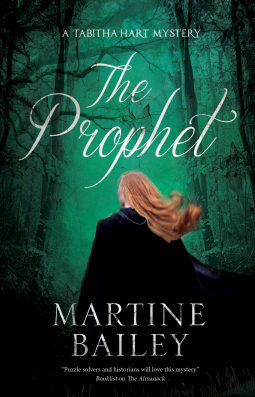
#BookReview ‘The Prophet’ by @MartineBailey #historical #mystery

When a dead body is found at the foot of an ancient oak, a tense plot begins. The Prophet is the second Martine Bailey novel to feature the characters of Tabitha and Nat De Vallory, first seen in The Almanack. The oak tree in question is not just any tree; it is the Mondren Oak, and nearby an evangelist preacher and his community have made an encampment in ancient woodland belonging to Nat’s father. Martine BaileyEighteenth-century England was a place of superstition and myth, of religious fervour and persecution. It was also a time of scientific study and enlightenment. The body of a young woman is found on May Day, 1753. The date is significant and the novel’s action winds up slowly in pace and tension towards Midsummer’s Day, coincidentally the due date for the arrival of Tabitha and Nat’s first baby. Baptist Gunn and his growing number of followers believe a new saviour will be born close to the oak tree on Midsummer’s Day. Gunn, a ‘sleeping prophet’, is gathering his congregation, and money, in preparation to sail for a new life in America.
Tabitha is a likeable protagonist, happy to be married and living in the place where she grew up, but challenged by the new monied life she leads. Her colourful background comes in handy when she determines to seek the woman’s murderer. Heavily pregnant, she makes an eye-catching amateur detective. Advised by her doctor to avoid shock, surprise, and the night-time attentions of her husband, Tabitha feels distanced from Nat. She distrusts the claims of Baptist Gunn and fears he is a fraudster. Meanwhile Nat seeks the preacher’s company, keen to run a scientific experiment studying the veracity of prophecies. Eager to support his ailing father and needing to establish his authority in the community as heir to the estate, Nat takes risks that Tabitha fears endanger their lives.
Are our lives governed by fate and can this be forseen by a privileged few? Why do some people trustingly accept claims and predictions without examination, while others demand proof and evidence? Bailey’s novel is a historical reminder to the 21st century not to believe everything you hear without an analysis of motivation, fact and context.
The Prophet is an unusual historical mystery rooted in an ancient Cheshire woodland. Bailey has created an authentic rural community which lightly bears the depth of her historical research. Watch out for the plot surprises, the secrets and lies.

And here are my reviews of other novels by Martine Bailey:-
THE ALMANACK #1 TABITHAHART
AN APPETITE FOR VIOLETS
THE PENNY HEART

If you like this, try this:-
The Wicked Cometh’ by Laura Carlin
The Confessions of Frannie Langton’ by Sara Collins
The Wonder’ by Emma Donoghue

And if you’d like to tweet a link to THIS post, here’s my suggested tweet:
#BookReview THE PROPHET by @MartineBailey https://wp.me/p5gEM4-5er via @SandraDanby

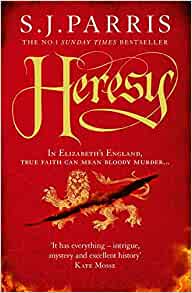
#BookReview ‘Heresy’ by SJ Parris @thestephmerritt #historical #crime

Including touches such as secret messages written in orange juice, ciphers and hidden codes, Heresy is the introduction to the Giordano Bruno series of historical mysteries by SJ Parris. Set in 1583, this is the English Reformation of Queen Elizabeth I and her spymaster, Sir Francis Walsingham, as they steer the country from catholicism to protestantism. Meanwhile, catholics continue to worship in secret. SJ ParrisFormer Italian monk turned heretic and philosopher Bruno rides out of London on a horse borrowed from the French ambassador, to meet with a royal party bound for Oxford. Accompanied by his friend, courtier poet and secret spy, Sir Philip Sidney, Bruno has two secret missions. The first, along with Sidney, is to expose a catholic conspiracy in the university city. The second is to find a heretical text, stolen long ago but rumoured to be in England, which states that the earth revolves around the sun. This second mission is the one, I suspect, that will continue beyond this book and through the whole series.
When the murders begin, Bruno’s position as an outsider at Lincoln College is both an advantage and disadvantage. His lack of foreknowledge gives him a clear vision of factual events and the awkward questions to ask, but his ignorance of the incestuous and competitive city’s petty squabbles, hidden feuds and flirtations puts him in the path of danger. He stumbles from incident to incident, working out who to believe and who to trust. Regarded as a foreigner and therefore a suspect by everyone else, Bruno’s difficulties reflect the turmoil of the times. The murders are brutal but so are the legal punishments for crimes.
A dense plot with an infinity of tentacles of historical fact and religious conflict that, at times, I found it hard to keep up. In the style of truly satisfying detective stories, when the villain was unveiled I thought ‘of course’ and was annoyed with myself for not guessing correctly.
Much-compared to CJ Sansom’s Matthew Shardlake series – which are set in the times of Elizabeth’s father King Henry VIII and his master fixer Thomas Cromwell – I found this book slower-moving and different in focus, but nevertheless enjoyable.
I do love finding a good series.
CLICK HERE TO READ MORE ABOUT THIS BOOK AT AMAZON

Read my reviews of other books in the series:-
PROPHECY #2GiordanoBruno
SACRILEGE #3GiordanoBruno

If you like this, try:-
Dissolution’ by CJ Sansom
The Ashes of London’ by Andrew Taylor
The Last Hours’ by Minette Walters

And if you’d like to tweet a link to THIS post, here’s my suggested tweet:
#BookReview HERESY by SJ Parris @thestephmerritt https://wp.me/p5gEM4-5dX via @SandraDanby