Tag Archives: books

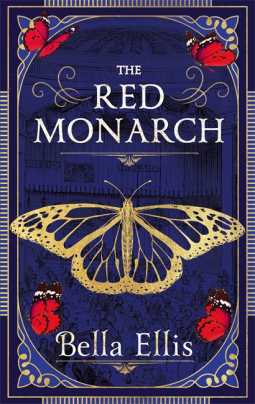
#BookReview ‘The Red Monarch’ by Bella Ellis #historical #crime

I’ve loved both of the Bella Ellis’s Brönte Mysteries series to date and the latest, The Red Monarch, is my favourite so far. If I could give it 6*, I would. It ticks so many boxes. Fast action, thoughtful detecting, literary and Brönte references, romance, the dirty violent underworld of London, dastardly baddies to defeat and wrongs to be righted. Bella EllisWhen Lydia Roxby runs into trouble in London, she writes to her former governess Anne Brönte appealing for help. Lydia’s actor husband Harry has been imprisoned by a violent gang, accused of stealing a jewel. Heavily pregnant Lydia is given seven days to return the jewel or Harry will be killed. The four Brönte siblings rush to London and find Lydia living in an attic room at the Covent Garden Theatre, run by Harry’s father.
The first problem for the Bröntes is how to find a jewel when no information is available. Lydia knows nothing and either people are ignorant or frightened to speak. The streets around Covent Garden are run by a gangster, Noose, and his network of thugs and spies. So, naturally, the first thing the Bröntes do is seek a face-to-face meeting with Noose.
Operating out of their comfort zone but driven by a clear determination of what is right, backed up by their love for each other, Charlotte, Emily, Anne and Branwell must negotiate the dangerous streets of the slums, adopting disguises, refusing to be cowed by threats and bluster, taking risks on who to trust. The more they find out, the clearer it is that they must confront the crime boss who terrifies everyone. But the so-called Red Monarch is so feared that no one dare say his name for fear of being overheard by one of his spies and subsequently killed as a traitor. The whole area exists in an atmosphere of fear and exploitation.
This is an original concept and a plot that, like its two predecessors, combines genres effortlessly. With witty asides and foreshadowing of the Bröntes’ writings – as this novel starts, the sisters’ first edition of poetry is published – this is both familiar and unfamiliar territory. Like comfort food, but surprisingly different. As the thoughtful, literary siblings pursue criminals, we see the strengths and weaknesses of each. Who would have imagined Emily carrying a sword?
Loved it. Oh, and another beautiful cover.

Click the title below to read my reviews of these other Bella Ellis novels:-
THE VANISHED BRIDE #1BRONTEMYSTERIES
THE DIABOLICAL BONES #2BRONTEMYSTERIES
A GIFT OF POISON #4BRONTEMYSTERIES

And one by Rowan Coleman [aka Bella Ellis]:-
THE GIRL AT THE WINDOW 

If you like this, try:-
A Death in the Dales’ by Frances Brody #7KATESHACKLETON
Hiding the Past’ by Nathan Dylan Goodwin #1MORTONFARRIER
Cover Her Face’ by PD James #1ADAMDALGLIESH

And if you’d like to tweet a link to THIS post, here’s my suggested tweet:
#BookReview THE RED MONARCH by Bella Ellis https://wp.me/p5gEM4-5wo via @SandraDanby

#BookReview ‘In a Summer Season’ by Elizabeth Taylor #classic #love

What a painful, heart-wrenching read is In a Summer Season by Elizabeth Taylor. It is about love – giddying heart-spinning young love, the intensity of teenage crush, the love and companionship of friendship, parental love, second love, age-gap love, tragic love and lust-love. Elizabeth Taylor Widow Kate is seen by friends and family to have married again, unwisely, to a younger man, the charming and feckless Dermot. Kate’s sixteen-year-old daughter Louise hates the way Dermot speaks to her mother, while Kate’s son Tom struggles to make his way in his grandfather’s business and retired teacher Aunt Ethel fears for the new marriage which she believes is founded solely on sex. As Kate adopts new hobbies to fit in with her husband – going to the races, the pub – Dermot feels excluded by the things he doesn’t know, and by Kate’s shared experience with first husband Alan. The household exists in an uneasy alliance. For the first half of the book, this calm is layered with a troubling current eventually brought to the surface by the arrival of Alan’s oldest friend, Charles, and his beautiful daughter Araminta. Tom becomes too caught up in his own calf love for Minty to worry about his mother, Lou falls for the local curate, while Ethel tells all in sensational letters to her friend Gertrude. ‘Ethel had a way of bending her head at closed doors, not listening, as she told herself, but ascertaining.’
None of the characters are endearing. Their paths to the truth, or not, about love – their own love and that of others – their assumptions, misjudgements and blindness, are beset with challenges. Some I forsaw, others I didn’t. Elizabeth Taylor draws a delicately coloured picture of life in a middle-class English family in the Home Counties in the fifties. Times are changing, post-war, particularly the role of women. Kate drifts, used as she was to being the junior partner to her first husband Alan, now she finds herself acting as both mother and lover to her second, younger, husband. Neither are truthful to the other.
More a story of consecutive scenes than a novel with increasing tension, In a Summer Season was published in 1961 and so combines the slower classic style of the older novel, injected with the new sexual tension appropriate to the times. The ending, so long awaited, finally arrived abruptly. My favourite Taylor novel, to date, is A View of the Harbour.
CLICK HERE TO READ MORE ABOUT THIS BOOK AT AMAZON

Read my reviews of other books by Elizabeth Taylor:-
A WREATH OF ROSES
A VIEW OF THE HARBOUR
ANGEL
AT MRS LIPPINCOTE’S
THE SLEEPING BEAUTY

If you like this, try:-
Touch Not the Cat’ by Mary Stewart
My Dear, I Wanted to Tell You’ by Louisa Young
The Confession’ by Jessie Burton

And if you’d like to tweet a link to THIS post, here’s my suggested tweet:
#BookReview IN A SUMMER SEASON by Elizabeth Taylor https://wp.me/p5gEM4-5tQ via @SandraDanby

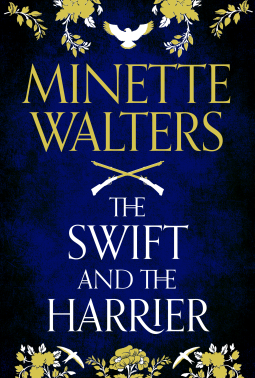
#BookReview ‘The Swift and the Harrier’ by Minette Walters #historical

The latest historical novel from former thriller writer Minette Walters is an absolute cracker. I raced through The Swift and the Harrier which is a fabulous mixture of dramatic history, medicine, family divisions and romance, all set in the English Civil War. Minette Walters Three days before the English Civil War begins in 1642, a Catholic priest is hung in Dorset for treason. Gentleman’s daughter and physician Jayne Swift is introduced to us in the public crush on Dorchester’s streets as people press to see the action. To avoid confrontation, Jayne steps into a doorway and finds herself drawn into the house by a thin-lipped elderly woman. They are strangers and in the current political unrest, all strangers must be mistrusted. This meeting is the catalyst for a narrative which takes us through the twists and turns of this war which sets brother against brother, where unpaid soldiers are ordered by superiors to loot and ransack civilian property, where small towns are attacked under siege for little gain and where men choose sides on blind belief rather than an understanding of the facts. Disguise and dissimulation are necessary to avoid the attention of whichever band of soldiers are encountered.
Jayne is a wonderful heroine. Plucky, bloody-minded, honest and fair, with a strong belief of a medic’s neutrality in time of war despite her staunchly Royalist father, she concentrates on treating the sick and wounded. This gets her into trouble numerous times. During the execution in Dorchester, Jayne encounters so many arrogant and boorish men, dismissive not just of women but of anyone whose views or experience are different to their own. She manages to evade arrest, and worse, thanks to some examples of honourable men. The role of women and the lack of freedoms is a theme running throughout the book, not just Jayne’s own medical career but a gentlewoman’s hidden proficiency as an artist, cousin Ruth’s marriage to a domineering violent man, and the bravery and efficiency of the women of Lyme Regis during its siege by Royalty forces. At the heart of it all – the war, the political and religious divide, marriage, work and family relationships and inheritance – is the right of everyone, man or woman, rich or poor, to the freedom of choice.
In the first action scene in Dorchester, Jayne is aided by William, a footman to Lady Alice Stickland, the elderly lady whose doorway in which Jayne takes shelter. And here is the first romantic thread which is stitched to the end of the book. Who is William? Why does his appearance change and why does he tell a different story every time Jayne sees him? Is he trustworthy?
A book I didn’t want to end. My knowledge of the Civil War is superficial and I particularly enjoyed the passages about the siege of Lyme Regis, a place I know.

Read my reviews of the two ‘Black Death’ historical novels, also by Minette Walters:-
THE LAST HOURS #1BLACKDEATH
THE TURN OF MIDNIGHT #2BLACKDEATH

If you like this, try:-
The Evening and the Morning’ by Ken Follett #PREQUELKINGSBRIDGE
The Pillars of the Earth’ by Ken Follett #1KINGSBRIDGE
World Without End’ by Ken Follett #2KINGSBRIDGE

And if you’d like to tweet a link to THIS post, here’s my suggested tweet:
#BookReview THE SWIFT AND THE HARRIER by Minette Walters https://wp.me/p5gEM4-5wd via @SandraDanby

#BookReview ‘A Change of Circumstance’ by @susanhillwriter #crime

Lafferton, the small town at the heart of the Simon Serrailler crime novels by Susan Hill, has until now only known small-scale drugs crime. In A Change of Circumstance, a young local man is found dead of a presumed overdose in a flat above the Chinese pharmacy in neighbouring hippy village Starley. County lines drug gangs are using local Lafferton children and people are beginning to die. This is the eleventh instalment of this excellent series. Susan HillHill’s Serrailler novels are always a delight to read, thoroughly grounded in the town of Lafferton with familiar characters and landmarks set against beautiful countryside. A reminder that crime happens in pretty places too. I wasn’t so sure about the veracity of some of the police procedure but the stories of Brookie and Olivia feel real enough, both children from fractured families pulled into crime by lies and bribes. A Change of Circumstance is a horrible portrayal of the manipulation and abuse of children but lacking in the narrative drive of earlier books. I finished it quickly but it is short – 315 pages compared with first in the series The Various Haunts of Men which is 448 pages long.
As always, a network of minor storylines add depth and colour to the main themes and Simon’s sister Cat is the beating heart of the drama. Now a GP for a private doctors’ service, she is called out to an elderly man who refuses to go into hospital. Her Yorkie terrier Wookie goes missing while son Sam is home from medical school and being secretive about his study plans. Small details that add to the real life feeling of the series, typical family life.
It’s an odd ending to the drugs case, almost as if a television drama stopped five minutes before the end. I felt slightly let down in not seeing the arrest of the guilty party, instead it is more a hint than an action scene and I missed that final feeling of justice done. The ending to Simon’s story is the change of circumstance of the title. I’m still not quite convinced but it will add a new angle to the next Serrailler story.

Read my reviews of the previous ten novels in this series:-
THE VARIOUS HAUNTS OF MEN #1SIMONSERRAILLER
THE PURE IN HEART #2SIMONSERRAILLER
THE RISK OF DARKNESS #3SIMONSERRAILLER
THE VOWS OF SILENCE #4SIMONSERRAILLER
THE SHADOWS IN THE STREET #5SIMONSERRAILLER
THE BETRAYAL OF TRUST #6SIMONSERRAILLER
A QUESTION OF IDENTITY #7SIMONSERRAILLER
THE SOUL OF DISCRETION #8SIMONSERRAILLER
THE COMFORTS OF HOME #9SIMONSERRAILLER
THE BENEFIT OF HINDSIGHT #10SIMONSERRAILLER

And also by Susan Hill, HOWARD’S END IS ON THE LANDING

If you like this, try:-
Magpie Murders’ by Anthony Horowitz #1SUSANRYELAND
The Killings at Kingfisher Hill’ by Sophie Hannah #4POIROT
The Killing Lessons’ by Saul Black

And if you’d like to tweet a link to THIS post, here’s my suggested tweet:
#BookReview A CHANGE OF CIRCUMSTANCE @susanhillwriter https://wp.me/p5gEM4-5vO via @SandraDanby

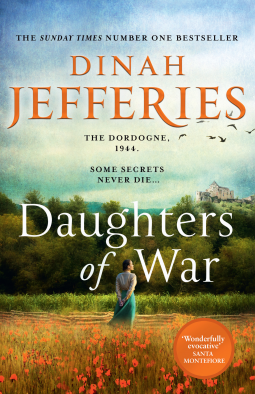
#BookReview ‘Daughters of War’ by @DinahJefferies #WW2 #adventure

It’s a while since I read a book in gulps, not wanting to put it down, not wanting to leave the story. Daughters of War by Dinah Jefferies is the first of a World War Two trilogy about three sisters. And what characters they are, each individual, quirky, vulnerable, stubborn, brave and refreshing. I lurched from having one favourite, then another. At the end I was equally drawn to each. Dinah JefferiesIn the Dordogne live three sisters – Hélène, Élise and Florence – alone in their mother’s house during the German occupation. Hélène is the eldest, a nurse, the mother hen, the worrier. Élise is the rebel, helping the Resistance, disappearing at night. Florence, the youngest, is a gardener, a cook, a nature lover. They are tired of the war, terrified by the Germans and their increasingly violent and indiscriminate reprisals, desperate for a normal life without remembering what that might be.
Backstory is important and there are many mysteries, unspoken memories and fears, which can only by explained when something happens to trigger understanding. We see the girls’ mother Claudette, in England for the war, only through their memories but she is a pivotal character nonetheless.
The story opens in spring 1944 when the girls’ quiet life at their stone cottage in the woods is altered by two arrivals. Jack, a British Special Operations soldier, has parachuted in with orders to train the Resistance in preparation for the invasion. Tomas, a young German soldier, has deserted and is found hiding in their garden shed. What follows is a tale of innocence, love, bravery, cruelty, loyalty and honour.
Jefferies’ descriptions of the French countryside – the trees, the birds, the wildflowers, the Dordogne scenery, coupled with the descriptions of Florence’s cooking – work as a shocking juxtaposition to the horror of war in this oh so beautiful tranquil place.
A page-turner.

Here are my reviews of the next books in the series:-
THE HIDDEN PALACE #2DAUGHTERSOFWAR
NIGHT TRAIN TO MARRAKECH #3DAUGHTERSOFWAR

Read my reviews of these standalone novels by Dinah Jefferies:-
THE SAPPHIRE WIDOW
THE TEA PLANTER’S WIFE
THE TUSCAN CONTESSA

If you like this, try these:-
Dangerous Women’ by Hope Adams
The Blue Afternoon’ by William Boyd
Birdcage Walk’ by Helen Dunmore

And if you’d like to tweet a link to THIS post, here’s my suggested tweet:
#BookReview DAUGHTERS OF WAR by @DinahJefferies https://wp.me/p5gEM4-5vI via @SandraDanby

#BookReview ‘The Diary of a Nobody’ by George & Weedon Grossmith #humour

An escape from the modern world, The Diary of a Nobody by George & Weedon Grossmith may have been published in the 1890s but it still made me chuckle out loud. Especially the parent-child irritations and misunderstandings. First published in Punch magazine, it is written by the brothers with illustrations by Weedon. George & Weedon GrossmithMr Charles Pooter is a clerk at a prestigious London bank where he has been overlooked for promotion. Just like Bridget Jones, he decides to write a diary of his life. What follows is a record of the ordinary life of an ordinary man who aspires to be more than he is. Pooter’s frequent attempts to be recognised as higher-class lead to embarrassments and misunderstandings, his jokes awful though he thinks they are hilarious. Pooter’s daily meanderings through life, his need to keep on good terms with his boss, his confusion at his son’s modern language and interests, are all familiar today. His pomposity and sometimes stupid things he does – the incident with the black enamel paint come to mind – are identifiable today. Particularly funny are the discrepancies between Pooter and his son Lupin, who doesn’t know what he wants to do, struggles to hold down a regular job and brings home his fiancé, a rather unsuitable young woman. Pooter’s wife Carrie remains serene through it all, patient with his absurdities, smoothing ruffled feathers. My favourite scene is the séance.
This is an easy, funny read, the diary format making it easy to read a day or a week at a time. And I’ve heard good things about the audio book version, read by Arthur Lowe. If you are looking for something refreshing that will take you away from the 21st century and make you smile, try this.
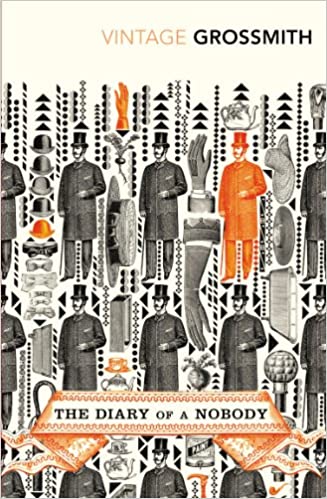
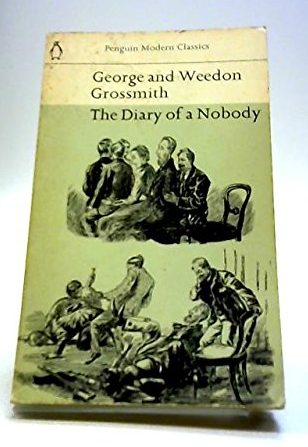
I love the illustration on the cover of the current Vintage edition. The references to dress coats, bow ties, gloves, hats and canes will make sense once you read the story. My own fragile secondhand copy is an old Penguin Modern Classics edition [below] featuring some of Weedon’s illustrations.
George & Weedon GrossmithIf you like this, try:-
Highland Fling’ by Nancy Mitford
How to Stop Time’ by Matt Haig
Trio’ by William Boyd

And if you’d like to tweet a link to THIS post, here’s my suggested tweet:
#BookReview THE DIARY OF A NOBODY by George & Weedon Grossmith  https://wp.me/p5gEM4-5dy via @SandraDanby

#BookReview ‘Prophecy’ by SJ Parris @thestephmerritt #historical #crime

Prophecy is the second instalment of the Giordano Bruno books by SJ Parris, based on the real-life Italian philosopher. Parris has taken some of the known facts about the real Bruno and enhanced rumour into fact, making him a spy for Queen Elizabeth I’s spymaker and Secretary of State, Sir Francis Walsingham. SJ Parris The result is a delicious mix of proven historical fact, betrayals, plots and assignations with a healthy dose of invention and a charismatic character to root for. The real Bruno was also a cosmologist, proclaiming that the universe was infinite and that the stars in the sky were suns, like ours, circled by their own planets, and this theme runs throughout the books. To our modern eyes, Bruno appears a scientist; in his time, he was deemed a heretic. In Prophecy, Bruno must play a dangerous game on behalf of Walsingham, living in the house of the French ambassador and party to a plot to put Mary Queen of Scots on the English throne. Always an outsider – Bruno is a religious exile, a renegade monk who escaped his Italian friary in search of sanctuary from the Inquisition – and has learned to be an observer amongst dangerous factions in order to survive. He has also learned to defend himself with his fists.
Queen Elizabeth makes herself vulnerable to influence through her burgeoning interest in prophecies and astrology. When a maid in the queen’s household is found dead, her body branded with astrological signs, fear stalks the streets. Pamphlets about with fantasy and rumour are sold freely. Bruno is charged by Walsingham to identify the murderer. The pace of the story ramps up when Bruno makes a connection with the men plotting in support of the Scottish Queen. As the various parties dance elegantly around each other, stepping into shadows and dissembling in full light, Bruno must unravel true friends from false.
Second in the series, this book moved much quicker for me than the first, Heresy. Key characters are already established as is the historical context, political manipulation and religious conflict [intricate at the best of times]. There are plenty of traitorous suspects, dodgy meeting places, ill-advised assignations and dark alleyways to furnish twists and surprises a plenty.
Prophecy was a 4* read for me. My first love is CJ Sansom’s Matthew Shardlake series, but this runs it a close second.
CLICK HERE TO READ MORE ABOUT THIS BOOK AT AMAZON AT AMAZON

Read my reviews of other books in the series:-
HERESY #1GiordanoBruno
SACRILEGE #3GiordanoBruno

If you like this, try:-
Dangerous Women’ by Hope Adams
The Other Eden’ by Sarah Bryant
The Confessions of Frannie Langton’ by Sara Collins

And if you’d like to tweet a link to THIS post, here’s my suggested tweet:
#BookReview PROPHECY by SJ Parris @thestephmerritt https://wp.me/p5gEM4-5ub via @SandraDanby

#BookReview ‘Lily’ by Rose Tremain #historical #foundling #orphan

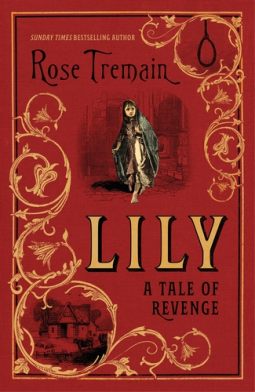
The sub-title of Lily by Rose Tremain is ‘A Tale of Revenge’ and on the first page we learn that sixteen-year-old Lily Mortimer is a murderer and expects to die soon. It is a compelling beginning. Rose Tremain This is the story of Lily’s life from when as a baby she was found abandoned in a sack being attacked by wolves. Found by a police officer she is taken to London’s Foundling Hospital from where she is placed with a foster family at Rookery Farm in Suffolk. A beautiful telling of a difficult childhood, softened by Tremain’s exquisite writing, Lily shows Victorian London where charitable works sometimes work for the orphaned child and sometimes against. It explores the nature of happiness in a rural life, often hard, but surrounded by love. At the age of six, Lily is returned to London and forbidden contact with her foster parents, Nellie and Perkin Buck, who were paid for their care of her and, after delivering her, collect a new foster baby. Lily is courageous, pragmatic, rebellious and, throughout the harsh years that follow, is sustained by the memory of Nellie’s love. And so starts the cycle of Lily’s life, of hope followed by despair.
Lily’s friendship with fellow orphan Bridget is very touching. It reminded by of Jane Eyre’s friendship with Helen Burns at Lowood, a story that has stayed with me ever since first reading the novel as a teenager.
The almost-adult Lily, dreaming of her death, wonders, ‘Whyever did I struggle so long and so hard to make my way in a place which was bent on my destruction ever since I came into it? Why did I not surrender to death when I was a child, for children’s pictures of death are fantastical and full of a strange beauty?’ The story changes pace when Lily realises she cannot put the past behind her, she must face what she did and why.
The timeline flits back and forth a bit between Lily as a child, in Suffolk and at the Hospital where she is trained for menial employment, and as an adult when she works at the gloriously named and imagined Belle Prettywood’s Wig Emporium which makes wigs for opera and stage productions. It is in the older voice that we learn more about the murder she committed. This is not a murder mystery or a whodunnit, it’s not even a who-was-it-done-to. It’s about a girl who survives an abusive, neglectful childhood by giving and receiving love, kindness and compassion, who learns how to survive alone in the world. Yes, Lily is vulnerable. She longs to love and be loved, but she’s also resilient, despite everything.
Compelling, difficult to put down. Beautifully written.
CLICK HERE TO READ MORE ABOUT THIS BOOK AT AMAZON

Read my reviews of these other novels by Rose Tremain:-
ISLANDS OF MERCY
THE GUSTAV SONATA

If you like this, try:-
The Rose Garden’ by Tracy Rees
The Walworth Beauty’ by Michèle Roberts
The Quick’ by Lauren Owen

And if you’d like to tweet a link to THIS post, here’s my suggested tweet:
#BookReview LILY by Rose Tremain https://wp.me/p5gEM4-5t5 via @SandraDanby

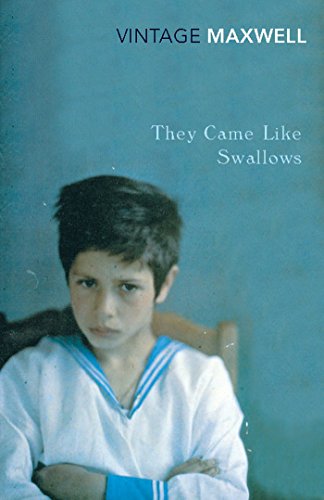
#BookReview ‘They Came Like Swallows’ by William Maxwell #historical #classic

Bunny Morison is eight years old and his mother Elizabeth is the centre of his life. Published in 1937, They Came Like Swallows is the second novel by William Maxwell. An autobiographical novella based on the 1918 flu epidemic seen through the eyes of Bunny, Robert and their father James, it’s a sensitive portrayal of the depths of family love not always outwardly expressed. William Maxwell This is a quiet character-led story about love, anxiety and grief, beautifully-written. I most enjoyed Bunny’s viewpoint, the simplicity and power of the love of a small child who sees things he doesn’t understand while sensing a significance. Thirteen-year-old Robert, first seen through Bunny’s eyes, seems a bully but is revealed in his own section as a boy approaching adulthood, protective of his pregnant mother and desperate to please his emotionally-absent father. And finally, James’s section shows the reasons for this distance. Each character is teetering on the edge of change, immersed in his own fears and hopes.
As the story unfolds we are introduced to the Morison’s wider family. Bunny dwells on his aunt Irene, Elizabeth’s sister. ‘… their hands felt entirely different and looked entirely different. From Irene’s hands he drew excitement, and from his mother’s the fact that she loved him. Irene and his mother were as different as the two faces of a coin. And yet they never seemed conscious of the difference.’ When their mother must go away to have her baby, Bunny and Robert go to stay with Aunt Clara, Uncle Wilfred and their Grandmother Morison. Robert, rubbing up against the house rules and being told he can’t do the things he wants to do, finds a dictionary hidden beneath the living room table. ‘Finding the wrong kinds of words in the dictionary was not a crime. They couldn’t put him in jail for it, but it was a thing he would not want to be caught doing, especially by Aunt Clara. It was like telling lies or listening to people who didn’t know he was there.’
A classic.
The title is from a Yeats poem:-
They came like swallows and like swallows went,
And yet a woman’s powerful character
Could keep a swallow to its first intent;
And half a dozen in formation there,
That seemed to whirl upon a compass-point,
Found certainty upon the dreaming air…
From ‘Coole Park, 1929’ by WB Yeats

Try my reviews of these other novels by William Maxwell:-
BRIGHT CENTER OF HEAVEN
THE FOLDED LEAF
TIME WILL DARKEN IT

And read the first paragraphs of TIME WILL DARKEN IT and THE CHATEAU.

If you like this, try:-
Anything is Possible’ by Elizabeth Strout
A Town Called Solace’ by Mary Lawson
The Pull of the Stars’ by Emma Donoghue

And if you’d like to tweet a link to THIS post, here’s my suggested tweet:
#BookReview THEY CAME LIKE SWALLOWS by William Maxwell https://wp.me/p5gEM4-5sD via @SandraDanby

#BookReview ‘The Women of Troy’ by Pat Barker #historical #myths

The Women of Troy is the second of the Trojan War novels by Pat Barker, telling the post-war story of Trojan woman Briseis, a trophy of war owned by Achilles. I loved the first, The Silence of the Girls, but wanted to hear the stories of more of the women. That’s what we get in this second book. Pat BarkerBriseis, now pregnant with Achilles’ child, is again narrator along with a new male voice, that of Pyrrhus, eldest son of Achilles and Briseis’ stepson. Now Achilles is dead Briseis belongs to Alcimus, charged by Achilles before his death with caring for his unborn child.
The story starts with Pyrrhus inside the wooden horse, constructed by the Greeks, to trick the Trojans. ‘Inside the horse’s gut: heat, darkness, sweat, fear. They’re crammed in, packed as tight as olives in a jar.’ It is Pyrrhus who kills Priam, king of the Trojans, and that murder echoes throughout The Women of Troy. As storms rage – punishment of the victorious Greeks by the Gods for their impious behaviour – the army and its captives are now trapped on the beach waiting for a chance to sail home. This enclosure at close quarters raises emotions, tensions, jealousies and pride. As Alcimus arranges games – chariot racing, archery, spear throwing, wrestling – Briseis acts as a mother-figure for the other women, all now slaves.
Barker explores the after-effects of war on the Trojan women during these empty days – Hecuba, widow of Priam, and Cassandra, her daughter; Andromache, wife of Hector now concubine to Pyrrhus – high-born Trojan women now slaves in the households of their Greek victors, as concubines, whores, cooks and housemaids.
The story is about survival on the edge of despair when women are secondary creatures deemed without opinions or rights, exploring how women individually and collectively find ways to live. There is bravery, despair, foolishness, obsession and madness. When the actions of Pyrrhus are questioned, Briseis must remember the events of one night when Achilles was alive. ‘Both of us [Briseis and Cassandra, another witness] were women – and a woman’s testimony is not considered equal to a man’s. In a court of law, if a man and woman disagree it’s almost invariably his version of events that’s accepted. And that’s in a courtroom – how much more so in this camp where all the women were Trojan slaves and the only real law was force.’
But this is also the story of Pyrrhus, a young man who struggles to match the reputation of a father he never felt close to, a father lauded as a God. These were brutal times when small mistakes were punished by death and Pyrrhus, who has few friends, takes risks and makes bad decisions.
This book works as a standalone story as well as companion to The Silence of the Girls. Both are magnificent examples of storytelling by an author at the peak of her writing. Faithful to the myths, Barker is an inventive writer who adds her own interpretations and twists.
Excellent, I whizzed through this in no time. Will there be a third novel? I hope so.

Read my reviews of other Pat Barker novels:-
THE SILENCE OF THE GIRLS #1WOMENOFTROY
LIFE CLASS #1LIFECLASS
TOBY’S ROOM #2LIFECLASS
NOONDAY #3LIFECLASS
DOUBLE VISION
ANOTHER WORLD
BLOW YOUR HOUSE DOWN
UNION STREET

If you like this, try:-
These Dividing Walls’ by Fran Cooper
A Thousand Acres’ by Jane Smiley
Vinegar Girl’ by Anne Tyler

And if you’d like to tweet a link to THIS post, here’s my suggested tweet:
#BookReview THE WOMEN OF TROY by Pat Barker https://wp.me/p5gEM4-5sm via @SandraDanby