
One thing you know to expect from a DI Helen Grace book; the first theory and suspect she comes up with will not be the killer, usually the second one isn’t either. And you believe her each time. So just when you are wondering who the killer can possibly be, the book races to its conclusion and you never guessed it though the clues are there. Down to the Woods is the eighth in the Grace series by MJ Arlidge. He is expert at twisting, turning, somersaulting the plot and part of the fun as a reader is figuring out the puzzle he has set. 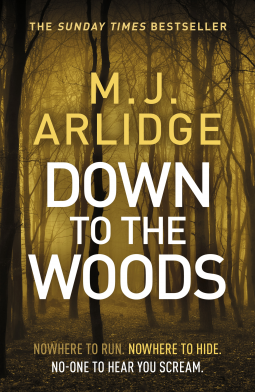 In the New Forest, campers are disappearing from their tents and being chased through the isolated woods before being killed. I didn’t dwell on the gruesome bits; I prefer the puzzle part of crime novels, the answers are always with the people. Apart from PD James and Susan Hill, this is the series of crime novels I keep on reading. Why? Because Helen Grace is an unusual heroine; she is strong but vulnerable, confident yet quaking inside, spiky but desperate for companionship. For the moment that support comes from her team. The secondary story of her DS, Charlie Brooks, continues. Charlie’s daughter Jessie is having nightmares and the household is short on sleep, while Charlie’s husband Steve wants another baby. And there is a new DS, tall, dark, motorbike riding DS Hudson. Local reporter Emilia Garanita is pushing for the big story, overstepping the line, being a nuisance, endangering herself, as usual.
Just when I was beginning to think Helen was less of a livewire, running into danger without thinking first, when she does exactly that. Down to the Woods is perhaps a little less explosive than the earlier books, but this is now a mature crime series and Helen is 45. The challenge for Arlidge is to come up with stories that keep us guessing right until the end without relying totally on Helen. Female characters – Helen, Charlie and Emilia – are undoubtedly Arlidge’s strength and it will be interesting to see if DS Joseph Hudson joins the team on a permanent basis.
One thing disappointed me. More than any previous book, there seemed to be a lot of repetition of stuff the reader can work out for herself; of the ‘if this happens then that might be next’ sort of question. No need for the summarising.
Read my reviews other books in this series:-
EENY MEENY #1HELENGRACE
POP GOES THE WEASEL #2HELENGRACE
THE DOLL’S HOUSE #3HELENGRACE
LIAR LIAR #4HELENGRACE
LITTLE BOY BLUE #5HELENGRACE
HIDE AND SEEK #6HELENGRACE
LOVE ME NOT #7 HELENGRACE
If you like this, try:-
‘Wolf’ by Mo Hayder
‘Nightfall’ by Stephen Leather
‘Hiding the Past’ by Nathan Dylan Goodwin
And if you’d like to tweet a link to THIS post, here’s my suggested tweet:
#BookReview DOWN TO THE WOODS by @mjarlidge https://wp.me/p5gEM4-3z6 via @SandraDanby


 “Miss Marple is one of my favourite characters. She looks like a fluffy old lady but underneath that outward appearance is a core of steel and a very quick brain. I love the way she solves the crime by using just her wits and her experiences of living in a quiet country village. Her knowledge of the psychology of human behaviour is what makes her so formidable. I also love Lucy Eyelesbarrow, quietly competent and determined and more than a match for the Crackenthorpe brothers (and father!).
 Local news reporter Dan Sullivan scents a story in the local council planning department and he begins to ask questions. But when his source dies in mysterious circumstances, Dan is implicated. He is quickly drawn into a world of lies, ambition and avarice as he fights to clear his name. The more he digs, the more someone tries to stop the story from ever seeing the light of day. Dan must decide what’s more important to him…the story, or his life.
 What is a ‘Porridge & Cream’ book? It’s the book you turn to when you need a familiar read, when you are tired, ill, or out-of-sorts, where you know the story and love it. Where reading it is like slipping on your oldest, scruffiest slippers after walking for miles. Where does the name ‘Porridge & Cream’ come from? Cat Deerborn is a character in Susan Hill’s ‘Simon Serrailler’ detective series. Cat is a hard-worked GP, a widow with two children and she struggles from day-to-day. One night, after a particularly difficult day, she needs something familiar to read. From her bookshelf she selects ‘





 “I first came upon this little book in the mid 1990’s. Quite by chance, really – although what is chance and what is really synchronicity? While doing a counselling course with the Exeter branch of the W.E.A., I attended a residential weekend on the edge of Dartmoor. We (students) were invited to bring along a special poem to read out, or a few lines from a book to share with the group. It didn’t matter what, so long as the words had significance and meaning. Someone read from The Prophet – I forget who – and I was spellbound. This is a flavour of what I heard:
 Palliative care nurse, Melanie Smythe is focussed on two things: the job she loves at Greenways Hospice and helping care for her twin nieces. There is no room for romance. In the past she’s been let down and the experience has left her wary. Melanie fears history will repeat itself. Then a chance encounter with new locum GP, Luke McGrath makes her think maybe he’s the one to change all that. There are differences between them, but the smouldering hot doc makes her pulse race. However, Melanie is holding something back and this leads to a misunderstanding. Angry and hurt, Luke severs their relationship. Will they be able to fix what’s been broken?
 SANDRA DANBY'S BOOK REVIEWS