Tag Archives: crime fiction

#BookReview ‘Big Sky’ by Kate Atkinson #crime #Yorkshire

I hesitate to express some disappointment with Big Sky, the fifth Jackson Brodie instalment by Kate Atkinson, but the feeling grew as I read deeper into the book. I realize this disappointment is based on my incredibly, probably infeasibly high expectations of this author. Kate AtkinsonI have loved Jackson since his first outing in Case Histories. The darkly comic tone is the same in Big Sky but I struggle to pin down what is different this time. The crime is sex trafficking. The action is told through a wide variety of viewpoints. The cast list is very long and the tying up of ends involves characters I had long ceased to remember. Some of the ends were tied up quickly in the last thirty or so pages.
There are still many things to love. The Yorkshire Coast setting – Atkinson was born in York and clearly knows the area well – is at times both realistically beautiful and sordid. And there are so many rough diamond characters to spend time with: Crystal Holroyd; her stepson Harry; the wonderfully named drag queen Bunny Hops, Harry’s co-worker at the Palace Theatre; and the inept Vince Ives. Jackson has moved to the coast and is working as a private detective on a number of small seemingly irrelevant cases; staying with him are his ex-partner’s dog Dido, and their teenage son Nathan. The story is anchored in the historic sex crimes case of Bassani and Carmody. Bassani is dead but Carmody is rumoured to be about to spill some names. Various people are being threatened. Two police detectives are investigating the cold case and how it links to the ‘magic circle’ but they have little luck in finding answers. Two Polish girls arrive in England. Four friends play golf, and one of them feels like an outsider.
Halfway through, the two sides of the story come together as Brodie is employed by Crystal Holroyd to find out who is following her in a silver BMW. After their first meeting, a warning is left for Crystal: a photo of her young daughter. ‘Keep your mouth shut, Christina’. The first hint of a former life for the expensively polished wife of Tommy Holroyd. This is a book in which the present catches up with the past, where past horrors are finally acknowledged.
I finished this book with mixed feelings. Jackson is still a character I want to spend time with, but the plot this time didn’t work for me. Also I put my hand up to say that, as an East Yorkshire girl, I was bamboozled by Atkinson’s mangling of East Coast geography [which she admits in ‘Acknowledgements’ at the end] which took me away from the page but won’t matter a jot if you’ve never been to Brid. That said, Atkinson is one of our best living writers and Jackson Brodie is not a typical fictional detective.

Read my review of another Jackson Brodie book:-
DEATH AT THE SIGN OF THE ROOK #6JACKSONBRODIE

And here are my reviews of other novels by Kate Atkinson:-
A GOD IN RUINS
LIFE AFTER LIFE
NORMAL RULES DON’T APPLY
SHRINES OF GAIETY
TRANSCRIPTION
… and try the #FirstPara of EMOTIONALLY WEIRD

If you like this, try:-
‘Eeny Meeny’ by MJ Arlidge #1HELENGRACE
The Art of the Imperfect’ by Kate Evans #1SCARBOROUGHMYSTERIES
The Vanished Bride’ by Bella Ellis #1BRONTEMYSTERIES

And if you’d like to tweet a link to THIS post, here’s my suggested tweet:
#BookReview BIG SKY by Kate Atkinson https://wp.me/p5gEM4-4Hq via @SandraDanby

#BookReview ‘The Cornish Village Murder’ by Fiona Leitch #crime #cosycrime

The Cornish Village Murder by Fiona Leitch is the second Nosey Parker cosy mystery and the first I’ve read, in fact I read it when it was originally called A Brush with Death. Jodie Parker, ex-Metropolitan police officer, and newly single mum has returned home to Cornwall. It’s the week of Penstowan’s inaugural arts festival and Jodie, no longer working for the police, is doing the catering. The festival’s main attraction is painter Duncan Stovall, famous for his Penstowan series of sea paintings. Fiona Leitch This is a story with instant fizz. Written in the first person, Jodie’s, I loved the sly sometimes saucy asides that pull you straight into the jokes, the personalities and the action. If it were an item of food on a menu catered by Jodie, this book would be a mash-up of a Cornish saffron bun slathered with butter and clotted cream, a mug of steaming tea and a glass of scrumpy. Cornwall is a part of the book’s DNA, not just the dialect of the Penstowan residents or the food but the wonderful descriptions of coastal scenery that make you want to get into the car and head south on the M5.
When a visiting author is found dead at the bottom of the cliffs Jodie can’t resist sticking her nose in and asking questions, much to the annoyance of DCI Nathan Withers and the irritation of Jodie’s daughter Daisy and mum Shirley.
This is a silky read, one of the best of its genre I’ve read. A brilliant community of family, friends and townspeople, a beautiful seaside setting, with a witty detective, plotted on two levels. The foundation is Jodie’s life settling into the town of her childhood, a triangular-shaped romantic entanglement, and her burgeoning new catering business. Overlaying this is the case in which she becomes entangled; the art world, not just the creation of art but the finance, promotion, sales and investment.
I particularly enjoyed the joshing with childhood friends Debbie and Tony, including lots of cultural references from the Eighties that are lightly handled without huge signposts saying ‘laugh here’.
Read it and chuckle.

Here are my reviews of other books in the Nosey Parker series:-
THE CORNISH WEDDING MURDER #1NOSEYPARKER
THE PERFECT CORNISH MURDER #3NOSEYPARKER
A CORNISH CHRISTMAS MURDER #4NOSEYPARKER
A CORNISH RECIPE FOR MURDER #5NOSEYPARKER
A CORNISH SEASIDE MURDER #6NOSEYPARKER
THE CORNISH CAMPSITE MURDER #7NOSEYPARKER

If you like this, try:-
Magpie Murders’ by Anthony Horowitz #1SUSANRYELAND
A Deadly Discovery’ by JC Kenney #4ALLIE COBB
Tea for Two at the Little Cornish Kitchen’ by Jane Linfoot #2LITTLECORNISHKITCHEN

And if you’d like to tweet a link to THIS post, here’s my suggested tweet:
#BookReview THE CORNISH VILLAGE MURDER by Fiona Leitch https://wp.me/p5gEM4-5lq via @SandraDanby

#BookReview ‘A Deadly Discovery’ by @JCKenney1 #cosycrime #crime

Needing a change one day, as I sometimes crave a calming walk in the green countryside, I picked up cosy mystery A Deadly Discovery by JC Kenney. Knowing the book was fourth in a series, I didn’t know what to expect. JC KenneyLiterary agent Allie Cobb lives in Rushing Creek, Indiana where her life revolves around her clients, their manuscripts, taking her cat Ursi for a walk, family and friends. Having previously investigated local murders, and being injured in the process, before this book starts Allie had promised her nearest and dearest that she would drop her private investigating. But when a body turns up in the local woods, everyone wonders if it could be a girl who disappeared twenty ago. As Allie asks questions around town, tensions with the police department arise with suspicions of clues missed at the time of the original disappearance.
This is a different style of whodunnit in that the story is firmly anchored and clues processed in the head of detective Allie. This is a tell-don’t-show style that sinks us into Allie’s daily life and concerns, the reader must unravel the clues from the seemingly ordinary. Of course this is a mystery story so clues, and red herrings, can be anywhere.
Diving into a series mid-way has its benefits and issues. I’m sure I missed lots of references to characters and past stories that would help my reading of Allie’s detecting and understanding of Rushing Creek. From page one a lot of names and relationships are introduced, featured in the previous novels, that I struggled to remember. A character cast at the beginning would help.
Kenney has created a believable small-town world at Rushing Creek where lives, secrets, resentments and loves have been entwined since birth. It reminded me of Charlotte Hinger’s Lottie Albright genealogical mystery series, set in another American small town. When everyone knows everyone else, secrets are not simply embarrassing or shameful. They can be deadly.
An easy, gentle read without a confusing tangle of multiple suspects. I guessed the murderer well before Allie’s big reveal scene, which owed much to the trend of Poirot. I finished it feeling curiously unattached from the people involved, perhaps because Allie dominates the story so thoroughly.
CLICK HERE TO READ MORE ABOUT THIS BOOK AT AMAZON

If you like this, try:-
Deadly Descent’ by Charlotte Hinger
‘Agatha Raisin and the Quiche of Death’ by MC Beaton
Murder at Catmmando Mountain’ by Anna Celeste Burke

And if you’d like to tweet a link to THIS post, here’s my suggested tweet:
#BookReview A DEADLY DISCOVERY by @JCKenney1 https://wp.me/p5gEM4-5lg via @SandraDanby
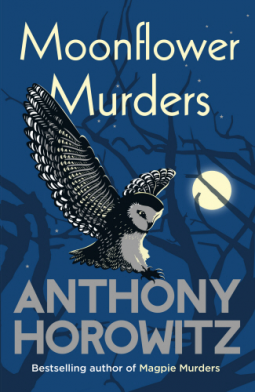
#BookReview ‘Moonflower Murders’ by Anthony Horowitz @AnthonyHorowitz #crime

Moonflower Murders by Anthony Horowitz is a sandwiching together of two mysteries – one murder, one disappearance – that take place eight years apart in the same place. Second in Horowitz’s crime series featuring literary agent Susan Ryeland and Atticus Pünd, the fictional hero of her client Alan Conway’s 1950s detective books – are you keeping up? – this is at the same time a page-turning read and a mystifying Rubik’s Cube challenge. Definitely a book that will reward re-reading. Anthony HorowitzSusan’s, now deceased, author Conway loved word play and riddled his short novels with in-jokes, complicated clues and witticisms. Many of these only make sense at the very end of Horowitz’s book. Susan, now living in Crete with boyfriend Andreas, running the just-surviving Hotel Polydorus, is asked by the owners of Branlow Hall hotel in Suffolk to investigate the disappearance of their daughter Cecily. Eight years earlier, one of the hotel’s staff was convicted of murdering a guest, Frank Parris. Shortly after the trial, Conway visited the hotel after which he wrote, Atticus Pünd Takes the Case. The book was edited by Susan who knew nothing about the links to the real-life crime.
Cecily, who manages Branlow Hall with her sister, reads Conway’s novel and is certain the wrong man was convicted of the crime. And then she disappears. How did Conway use the real crime in his fictional Atticus Pünd mystery to reveal the true murderer? What did Cecily see in the book that convinced her of the convict’s innocence? How can Susan unravel the clues and fit together two completely separate stories? And what has happened to Cecily?
The story is littered with clues, everyone has something to hide and it seems everyone is lying. Alongside the detecting we have the continuing story of Susan’s life – did she do the right thing in moving from London to Crete, should she marry Andreas or leave him, can she really be happy running a hotel and not editing books? And like the first in the series, Magpie Murders, there is also a book-within-a-book; we also get to read Atticus Pünd Takes the Case.
Layer upon layer, at times there are so many twists and turns it seems tortuous. Yes, there are coincidences and convenient secrets but if you enjoy Miss Marple and Hercule Poirot you will enjoy spotting the Christie links. If you go-with-the-flow and don’t get caught up on keeping track of the details, this is a fun read.

Read my review of MAGPIE MURDERS, first in the Susan Ryeland crime series.

If you like this, try:-
The Mystery of Three Quarters’ by Sophie Hannah #3POIROT
A Gift of Poison’ by Bella Ellis #4BRONTEMYSTERIES
Lord John and the Private Matter’ by Diana Gabaldon

And if you’d like to tweet a link to THIS post, here’s my suggested tweet:
#BookReview MOONFLOWER MURDERS by Anthony Horowitz @AnthonyHorowitz https://wp.me/p5gEM4-5j9  via @SandraDanby

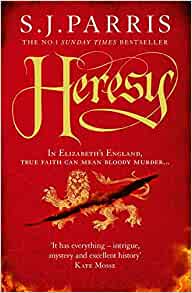
#BookReview ‘Heresy’ by SJ Parris @thestephmerritt #historical #crime

Including touches such as secret messages written in orange juice, ciphers and hidden codes, Heresy is the introduction to the Giordano Bruno series of historical mysteries by SJ Parris. Set in 1583, this is the English Reformation of Queen Elizabeth I and her spymaster, Sir Francis Walsingham, as they steer the country from catholicism to protestantism. Meanwhile, catholics continue to worship in secret. SJ ParrisFormer Italian monk turned heretic and philosopher Bruno rides out of London on a horse borrowed from the French ambassador, to meet with a royal party bound for Oxford. Accompanied by his friend, courtier poet and secret spy, Sir Philip Sidney, Bruno has two secret missions. The first, along with Sidney, is to expose a catholic conspiracy in the university city. The second is to find a heretical text, stolen long ago but rumoured to be in England, which states that the earth revolves around the sun. This second mission is the one, I suspect, that will continue beyond this book and through the whole series.
When the murders begin, Bruno’s position as an outsider at Lincoln College is both an advantage and disadvantage. His lack of foreknowledge gives him a clear vision of factual events and the awkward questions to ask, but his ignorance of the incestuous and competitive city’s petty squabbles, hidden feuds and flirtations puts him in the path of danger. He stumbles from incident to incident, working out who to believe and who to trust. Regarded as a foreigner and therefore a suspect by everyone else, Bruno’s difficulties reflect the turmoil of the times. The murders are brutal but so are the legal punishments for crimes.
A dense plot with an infinity of tentacles of historical fact and religious conflict that, at times, I found it hard to keep up. In the style of truly satisfying detective stories, when the villain was unveiled I thought ‘of course’ and was annoyed with myself for not guessing correctly.
Much-compared to CJ Sansom’s Matthew Shardlake series – which are set in the times of Elizabeth’s father King Henry VIII and his master fixer Thomas Cromwell – I found this book slower-moving and different in focus, but nevertheless enjoyable.
I do love finding a good series.
CLICK HERE TO READ MORE ABOUT THIS BOOK AT AMAZON

Read my reviews of other books in the series:-
PROPHECY #2GiordanoBruno
SACRILEGE #3GiordanoBruno

If you like this, try:-
Dissolution’ by CJ Sansom
The Ashes of London’ by Andrew Taylor
The Last Hours’ by Minette Walters

And if you’d like to tweet a link to THIS post, here’s my suggested tweet:
#BookReview HERESY by SJ Parris @thestephmerritt https://wp.me/p5gEM4-5dX via @SandraDanby

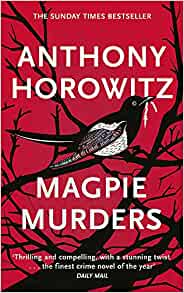
#BookReview ‘Magpie Murders’ by Anthony Horowitz @AnthonyHorowitz #crime

In the tradition of the theatrical play-within-a-play, Magpie Murders by Anthony Horowitz is a detective-mystery-within-a-detective-mystery. First in the Susan Ryeland series, more of her later, Horowitz has written a page-turner laced intricately with clues, delivered by a fictional detective in the Poirot tradition. Anthony HorowitzSusan Ryeland is head of fiction at Cloverleaf Books whose star writer is Alan Conway, author of the hugely successful Atticus Pünd crime series. Reading the manuscript of his latest submission, Magpie Murders, Susan is surprised to find the last chapters are missing. The murderer remains unnamed. Worse, Alan Conway has committed suicide. If Ryeland and her boss Charles Clover don’t find the missing chapters they can’t publish the book. And with no future books to come from Conway, the company may go bust.
The first half of the book is dedicated to Conway’s story of his fictional private detective, Pünd, who investigates one accidental death and one murder which take place in the same West Country village within days of each other. The victims knew each other. There must be a connection. In classic Agatha Christie style, the possibilities, lies and secrets are discovered by Pünd but he keeps his conclusions to himself.
The second half of the book tells how Ryeland first sets out to find the missing part of the manuscript. But increasingly puzzled by inconsistencies and lies in those surrounding Conway, she begins to suspect his death was not suicide. And that the answer lies in the manuscript of Magpie Murders. Did Conway fear for his life, and did he leave clues behind for his killer to be brought to justice.
This is such a clever beginning to what is a new detective series from Horowitz, who has written extensively for television including Midsomer Murders and Poirot. All the tropes of the classic detective novel are here – family arguments, a crook going straight, injustice, jealousy and rivalry, mixed up with the tensions of a local community where everyone knows everyone else’s secrets… or do they? Why is the vicar so hesitant when answering Pünd’s questions? Why did a son tell his mother he wished she were dead? Who stole a dangerous drug from the GP’s surgery and what did they do with it?
I’ve read some good books recently but none that kept me reading into the dark of the night until my eyes drooped. Oh, and I guessed wrong the wrong murderer.
Good fun.

Read my review of MOONFLOWER MURDERS, second in the Susan Ryeland crime series.

If you like this, try:-
A Death in the Dales’ by Frances Brody #7KATESHACKLETON
The Art of the Imperfect’ by Kate Evans #1SCARBOROUGHMYSTERIES
The Guest List’ by Lucy Foley

And if you’d like to tweet a link to THIS post, here’s my suggested tweet:
#BookReview MAGPIE MURDERS by Anthony Horowitz @AnthonyHorowitz https://wp.me/p5gEM4-5bC via @SandraDanby

#BookReview ‘The Fine Art of Invisible Detection’ by Robert Goddard #thriller

I always look forward to a new Robert Goddard book but wasn’t sure what to expect from his latest, The Fine Art of Invisible Detection. Partly, I think, because the blurb seemed more a detective novel than a thriller. Actually, this is both. Goddard has creative a heart-warming, realistic new hero, Umiko Wada, known simply as Wada. I raced through this book, full of Goddard’s clever twisty plotting, emotional dilemmas, should-I-shouldn’t-I moments. Robert GoddardWada is a 47-year-old secretary at a detective agency in Tokyo, making tea, writing reports for her technology-incompetent boss Kodaka. Widowed after her husband was killed in the Sarin gas attack on the Tokyo subway in 1995, Wada is quiet, efficient and invisible. But burning deep is a sense of righteousness. So when her boss asks for her help with a new case, she agrees to go to London to pose as the client who wants to find out if her father really committed suicide almost three decades earlier, or if he was murdered. From this point on, Wada’s life becomes unpredictable and her talent for being invisible becomes a lifesaver. Her boss dies in a car accident. The man she is due to meet in London has gone missing. Always logical, she follows the one clue she has.
Nick Miller is also due to meet the same man in London. Nick, a 41-year-old Londoner, is hoping to learn more about the father he has never met. Nick and Wada’s paths keep missing each other as they separately follow the trail of mystifying clues about the past. The action moves from Tokyo to London, Rekyjavik and the wilds of Iceland to Cornwall. There is a high-technology fraud, plus hints of terrorism and Japanese gang warfare, but this is not a violent read.
Wada is at the heart of this novel. Her logic and calm reasoning drive the narrative forward in that just-one-more-chapter way that makes this book a quick and fulfilling read. She is ordinary but extraordinary. I hope she returns in another novel.

Read my reviews of Goddard’s other books:-
PANIC ROOM
THE WAYS OF THE WORLD #1 THE WIDE WORLD TRILOGY
THE CORNERS OF THE GLOBE #2 THE WIDE WORLD TRILOGY
THE ENDS OF THE EARTH #3 THE WIDE WORLD TRILOGY
THIS IS THE NIGHT THEY COME FOR YOU #1SUPERINTENDENTTALEB

If you like this, try:-
Exposure’ by Helen Dunmore
The Accident’ by Chris Pavone
The Second Midnight’ by Andrew Taylor

And if you’d like to tweet a link to THIS post, here’s my suggested tweet:-
#BookReview THE FINE ART OF INVISIBLE DETECTION by Robert Goddard https://wp.me/p5gEM4-5as via @SandraDanby

#BookReview ‘The Killings at Kingfisher Hill’ by Sophie Hannah @sophiehannahCB1 #crime

Red herrings, twists and turns, lots of lies, confusing motivations and a long list of characters make The Killings at Kingfisher Hill by crime writer Sophie Hannah the type of book you need to read when fully alert. Fourth in Hannah’s series of continuation Hercule Poirot mysteries, I finished it with mixed feelings. Sophie Hannah Direct comparisons of Hannah and Christie seem unfair as these are continuation novels. Christie was a highly accomplished author who balanced likeable characters with dense but ultimately solveable crimes, while at the same time making the novels appealingly comfortable to read. If The Killings at Kingfisher Hill were a standalone novel featuring an unknown detective, it would be free of these comparisons. I enjoyed The Mystery of Three Quarters, third of Hannah’s Poirot novels, and will continue to read this series. It has also given me renewed impetus to re-read the Christie originals.
The complications start at the beginning. Poirot and Inspector Edward Catchpool are about to board a char-a-banc for Surrey and the exclusive Kingfisher Hill development, when they encounter not one but two women passengers behave strangely. One fears she is about to be murdered on the bus if she sits in a specific seat. The second woman confesses she has killed someone. Christie’s novels always have options – for victim, and murderer – but the options here did seem rather full-on with numerous characters introduced or mentioned in quick succession with none fully-formed in my mind. At one point I felt as Inspector Catchpool does, ‘My mind blurred, then went blank.’ So many possibilities in quick succession made me long for Christie’s more leisurely pace. True to character, Poirot is totally in charge of his investigation. He tells Catchpool, ‘Once one has a point of focus, all of the other details start to arrange themselves around it.’
Throughout I felt two steps away from the action because the murder has happened before the book begins. We are told the story of Poirot’s investigation by Catchpool and hear much of the necessary information as told to Poirot by third parties. Hearsay. I longed to be in the moment as it actually happened, or at the very least immediately afterwards – I think here of Poirot in Murder on the Orient Express, Evil Under the Sun and Death on the Nile.
The Killings at Kingfisher Hill wasn’t quite what I expected.

And here are my reviews of other Poirot books by Sophie Hannah:-
THE MONOGRAM MURDERS #1POIROT
THE MYSTERY OF THREE QUARTERS #3POIROT

If you like this, try:-
No Other Darkness’ by Sarah Hilary #2MARNIEROME
Cover Her Face’ by PD James #1ADAMDALGLIESH
The Secrets of Gaslight Lane’ by MRC Kasasian #4GOWERDETECTIVE

And if you’d like to tweet a link to THIS post, here’s my suggested tweet:
#BookReview THE KILLINGS AT KINGFISHER HILL by Sophie Hannah @sophiehannahCB1 https://wp.me/p5gEM4-58W via @Sandra Danby

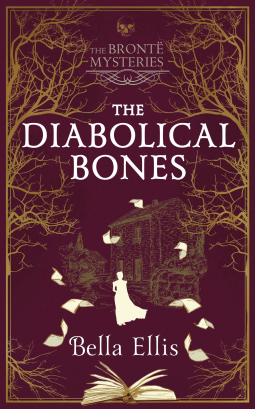
#BookReview ‘The Diabolical Bones’ by Bella Ellis #historical #crime

If you’ve never read a novel by one of the Brontë sisters, it doesn’t matter. There is plenty to enjoy about the Brontë Mysteries by Bella Ellis without figuring out the innumerable references to Wuthering Heights, Jane Eyre and The Tenant of Wildfell Hall. The Diabolical Bones is second in the crime series after the impressive first, The Vanished Bride. This one is better, and darker. Bella EllisWhen bones are found interred in the walls of a local house on the moor, the three detecting sisters and reluctant brother Branwell set out to confirm the child’s identity so it can be respectfully buried. There are few clues; the location of the find, the father and son who live in the house, the age of the child, and a medallion found with the bones. Top Withens, the remote house concerned, is said to be Emily’s inspiration for the house of the Earnshaw family, Wuthering Heights.
Ellis has constructed a convincing world for the sisters; the parsonage, their blind father, housekeeper Tabby, the villagers in Haworth and wider circle of acquaintances. The charm of this portrayal of the Brontës is the strength of the series. Branwell’s presence is key as in 1852, lone women could not venture out as the sisters do here without the company of a man. The portrayal of the sisters is fascinating, the dynamic between the three, the shared history and understanding of each other, the irritations and the love, their intellectual capabilities, their doubts and bravery. Each has differing strengths which lend weight to the investigations. Emily is impulsive and inspired, Anne is calm and logical, Charlotte is clever but insecure. As Anne says, ‘Detecting does seem to involve a great deal of time looking for something that might not exist.’
It is winter and freezing cold and as the sisters wrap themselves in cloaks to adventure outdoors, the atmosphere is dark and Gothic. Social issues are addressed; the exploitation of orphan children, the plight of urban and rural poor, the prejudice against Irish immigrants, the privilege of wealth.
Of course, the reward when reading crime novels is to spot the murderer early in the tale. I admit to thinking ‘surely it’s not…’ This plot is well constructed; read it and see if you spot any early clues. The story skips along at a fair pace and when I put the book down, I was always longing to read just another chapter.
The series is fast becoming a favourite. Brilliant escapism.

Click the title below to read my reviews of these other Bella Ellis novels:-
THE VANISHED BRIDE #1BRONTEMYSTERIES
THE RED MONARCH #3BRONTEMYSTERIES
A GIFT OF POISON #4BRONTEMYSTERIES

And one by Rowan Coleman [aka Bella Ellis]:-
THE GIRL AT THE WINDOW 

If you like this, try:-
‘A Death in the Dales’ by Frances Brody
The Mystery of Three Quarters’ by Sophie Hannah
Yuki Chan in Bronte Country’ by Mick Jackson

And if you’d like to tweet a link to THIS post, here’s my suggested tweet:
#BookReview THE DIABOLICAL BONES by Bella Ellis https://wp.me/p5gEM4-4YZ via @SandraDanby

#BookReview ‘The Guest List’ by Lucy Foley #crime #thriller

The Guest List by Lucy Foley is a cracking crime mystery set on an isolated Irish island. The guests are there for the wedding of the year – magazine entrepreneur Jules Keegan is marrying reality TV star Will Slater. What follows is a closed room mystery recognisable from Agatha Christie novels. From the beginning you wonder, who in this group of thirty-somethings is going to be killed? Who is the killer and why? Lucy FoleyFoley expertly plays with our expectations, manipulating our first impressions of the characters as they are introduced. Old friends. Family. School days rituals. Hidden jealousies. Secret wrongs. The atmosphere on the exposed windswept island with its treacherous bogs, cliffs, caves and haunting churchyard is cranked up to full notch. We experience the weekend wedding almost hour by hour as each key character tells their own story, with the narrative chopping forwards to the present during the ceremony and reception. This switching of viewpoint and timeframe can be very sudden but it does ramp up the tension. The murder takes place quite late in the timeline making this more a psychological thriller, building up to the killing you know will happen.
The basic plot questions are – how well does Jules know her husband-to-be? What exactly happened on the stag weekend? What were the rituals at the public school attended by the groom and ushers? And why is Olivia, Jules’s sister and bridesmaid, clearly not coping with life? The options for victim and murderer are extended beyond the bridal group with Charlie, Jules’ best friend, and his wife Hannah; and bridal organiser and host Aoife and chef husband Freddie. Foley presents lots of hints about the past and secret resentments, I guessed a couple quite early on but this didn’t stop me turning the pages.
Read this over a weekend when you need an easy-to-read distraction.

Read my reviews of these other Lucy Foley novels:-
THE INVITATION
THE PARIS APARTMENT

If you like this, try:-
The Animals at Lockwood Manor’ by Jane Healey
Chosen Child’ by Linda Huber
Summer House with Swimming Pool’ by Herman Koch

And if you’d like to tweet a link to THIS post, here’s my suggested tweet:
#BookReview THE GUEST LIST by Lucy Foley https://wp.me/p5gEM4-4M2  via @SandraDanby