Tag Archives: Emma Donoghue

#BookReview ‘The Pull of the Stars’ by Emma Donoghue #historical

In Dublin, 1918, it is a time of immense global and social change. Emma Donoghue’s latest novel The Pull of the Stars takes place almost exclusively in a cramped three-bed fever ward in an understaffed hospital. All patients are pregnant and quarantined while the world is racked by war and influenza. Both of these are unpredictable, killing at random, lasting longer than predicted and classless. This is an at times breath-taking, touching and emotional novel that sucks you into a feverish dream so you want to read on and on.Emma Donoghue
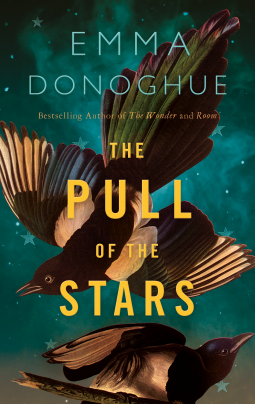
Taking place over three days, Nurse Power arrives for work to find herself temporarily in charge. Donoghue excels at the ordinary detail of Julia’s life, her journey to work, the arbitrary rules of the matron, the needs at home of her war-damaged soldier brother Tim who is now mute. On the day the story stars, Julia’s only help comes from an untrained young volunteer, Bridie McSweeney, who acts as a runner to find doctor or orderly as required. The figure of three recurs – three beds, three days, three key characters. The third, Doctor Kathleen Lynn, is a real person, her history documented. She was arrested during the 1916 Easter Rising and in The Pull of the Stars is wanted by the police as a rebel. Power and McSweeney are Donoghue’s inventions. Every character, major and minor, is touched by the twin enemies of war and flu.
Gradually we fall under the spell of Donoghue’s story as Julia and Bridie attend to the needs of their patients in the room with its handwritten note on the door, Maternity/Fever. As temperatures rise and coughs hack, labour pains rise and fall. Donoghue doesn’t skimp on the detail of labour, this isn’t for the squeamish, but she writes with such skill that makes you care for her patients too.
This novel pulls you into its drama and won’t let you go until the end. The ebb and flow of each patient’s condition, Julia’s never-ending fight to help them despite the lack of support, the joy of birth and grief of death, the irreverence and youth brought into the room by Bridie, the quiet and resolute calm of Doctor Lynn, are woven together to create a micro portrayal in this small room of the world in 1918. And bound into every page is the strength and hope of love. I read this book in two sittings.
Researched and written prior to Covid-19, this book is an eerie glimpse into how the Spanish Flu epidemic ravaged through a world at war a century ago, distracted and ill-equipped to deal with it.
A small grumble – I find the lack of speech marks jarring.

Read my reviews of these books by Emma Donoghue:-
AKIN
FROG MUSIC
THE WONDER

And read the first paragraph of ROOM.

If you like this, try:-
A Single Thread’ by Tracy Chevalier
Life Class’ by Pat Barker
A Long Long Way’ by Sebastian Barry

And if you’d like to tweet a link to THIS post, here’s my suggested tweet:
#BookReview THE PULL OF THE STARS by Emma Donoghue https://wp.me/p5gEM4-4Ub via @SandraDanby

#BookReview ‘Akin’ by Emma Donoghue #WW2 #contemporary

Noah Selvaggio, a widower and retired chemistry professor, is about to leave New York for Nice, France, on an 80th birthday trip to discover his childhood roots. He expects to travel alone. Except in Akin by Emma Donoghue, Noah finds himself in temporary charge of his 11-year old great nephew Michael. The trip to Nice goes ahead, the old man and the boy learn new things about themselves, each other, and about the world. Emma DonoghueThis is effectively a road trip in a book, more of a ‘holiday trip’. The unlikely travelling companions are quite sparky, irritating each other, each reacting wildly to the other’s strange cultural habits. Donoghue does an excellent job with the Nice setting, effortlessly bringing it alive; the gardens, the architecture, the food, the carnival, the French themselves. I loved the grumpiness that both characters demonstrate. Michael’s weary ‘dude’ when Noah tries to educate him about something – ‘it’s a selfie, dude’, ‘eyebleach, dude’; Noah’s repeated requests that Michael eat a proper meal that includes vegetables. Any adult who is not natural with children and who has spent uncomfortable time with an awkward teenager, will identify with Noah’s dilemma. Michael can be gentle, inquisitive, cocky, snide, exhausting and infuriating. Noah needs frequent naps, prefers education to circuses, but he makes an effort because Michael’s father is dead, his mother in prison, and his grandmother has just died. Noah is the nearest relative who can be found. It doesn’t matter that they have never met, and that Noah is 79. Michael is grieving for his grandmother, and the absence of his mother Amber; Noah is grieving for his wife Joan, who pops up occasionally with acid asides when his handling of Michael backfires.
The mismatch between these two males – their ages, education, class, life chances – sounds like a recipe for disaster but the mixture of two opposites causes a chemical reaction involving respect, support, empathy and disagreement about mobile phones. Noah left Nice at the age of four, leaving behind his mother who was caring for her photographer father, to join his father in the USA. When Margot arrived in New York after the war, nothing much was said about the war years. This trip is Noah’s chance to find some answers. So as they identify the locations in Margot’s photographs taken in Nice during the war, Noah and Michael attempt to piece together her life. Was she simply her father’s photography assistant, or something else? A member of the Resistance, a forger of documents for Jewish orphans; or a snitch who betrayed her neighbours to save her family. Is there anyone in Nice who can help Noah and Michael find the truth?
This is a slow-burn book about the relationship between an old man and a pre-teen boy from very different worlds, and is told exclusively from the adult viewpoint. It is about families across generations facing difficult choices, taking risks in the hope of helping family, paying the consequences if things don’t work out; and above all, about the similarities. ‘He and this boy were quite alien to each other, he decided. Yet, in an odd way, akin.’
For me, this is another Donoghue hit.

Read my reviews of these other Donoghue novels:-
FROG MUSIC
THE PULL OF THE STARS
THE WONDER

Read the first paragraph of ROOM.

If you like this, try:-
Days Without End’ by Sebastian Barry
The Ballroom’ by Anna Hope
Summertime’ by Vanessa Lafaye

And if you’d like to tweet a link to THIS post, here’s my suggested tweet:
#BookReview AKIN by Emma Donoghue https://wp.me/p5gEM4-436 via @SandraDanby

#BookReview ‘The Wonder’ by Emma Donoghue #Irish #faith

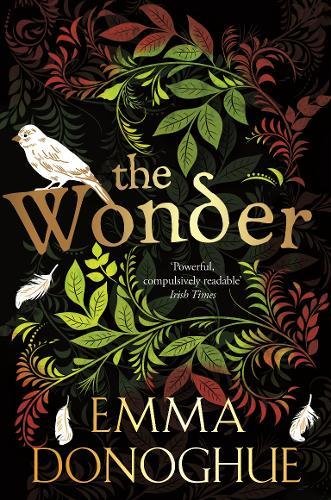
What a compulsive read this is, starting slowly until its questions had me sneaking a few pages when I should have been working. The premise of The Wonder by Emma Donoghue sounds straightforward: a nurse and a nun are employed to observe and accompany an eleven-year old girl in rural Ireland who is surviving on ‘manna from heaven’. Is she a miracle or a fraud? Emma DonoghueThis story is very far from straightforward. The task of Nurse Elizabeth Wright, who trained under Miss Nightingale at Scutari during the Crimean War, is to watch and and ensure no food is secretly passing the child’s lips. Strangely, for a nurse, Lib is not responsible for the health of the girl. A local committee, set-up to establish if Anna O’Donnell is secretly eating or if there is a religious wonder living in their village, pays the wages of two nurses, Lib and Sister Michael, for two weeks.
Accepting nothing until she can prove it herself, Lib approaches her task with professional thoroughness, observing, measuring, weighing. Feeling isolated in a cramped home, surrounded by a religion she does not practise or understand, Lib gets little help from local doctor Mr McBrearty or priest Mr Thaddeus. Not knowing who she can trust, she trusts no one; turning away visitors to the O’Donnell home who want to see the holy girl, visitors who donate alms to a collecting box near the door. When a journalist from Dublin says it is clearly a hoax and accuses Lib of speeding Anna’s death – that the all-day watch is denying her the morsels of food she must have been earlier fed – she is horrified and is forced to reassess her role.
The first half is a slow slow build but so worth it for the second half; with an ending I didn’t expect. This story has many layers. Lib, with her scientific approach to religion, is appalled at what she sees as inconsistencies and fantasies of the O’Donnell family’s Catholic beliefs. They accept and do not question. As the story progresses, Lib untangles Anna’s beliefs and in the process re-examines her own.
Not an easy read, The Wonder tackles the emotional subjects of religion and abuse set within the context of rural Ireland in the 1850s. Donoghue is an author who defies description; each novel is so different from its predecessor. With The Wonder, she has again confounded my expectations. Excellent.

Read my reviews of these other Donoghue novels:-
AKIN
FROG MUSIC
THE PULL OF THE STARS

Read the first paragraph of ROOM.

If you like this, try:-
‘Birdcage Walk’ by Helen Dunmore
‘Day’ by AL Kennedy
‘House of Names’ by Colm Tóibín

And if you’d like to tweet a link to THIS post, here’s my suggested tweet:
#BookReview THE WONDER by Emma Donoghue http://wp.me/p5gEM4-2Z1 via @SandraDanby

#BookReview ‘Frog Music’ by Emma Donoghue #historical

I came to Frog Music knowing nothing about it other than it was written by Emma Donoghue who wrote Room. So it was something of a surprise to discover Frog Music is a historical crime story set in San Francisco in 1876 and loosely based on true events. Emma DonoghueI loved it. Every page pulses with the colour of the time. In the summer of 1876, San Francisco is a vibrant and bustling city living through an intense heatwave and smallpox epidemic. Donoghue starts her story with the murder of Jenny Bonnet, frog-catcher, who is shot through an open window. Her friend Blanche Beunon, a burlesque dancer, must find the murderer and avoid being killed herself, whilst tracking down her own missing baby. The pace is fast and San Francisco is portrayed as a third character; switching from the bawdy House of Mirrors where Blanche dances, to smelly noisy Chinatown where she lives.
The notion of chance is explored. What if the two women had never met. One day, Blanche is knocked down in the street by a young man on a bicycle. “Black anterlish handbars, that’s all she has time to glimpse before the gigantic spokes are swallowing her skirts.” Except it is not a young man, it is a young woman wearing trousers. Jenny continues to dress this way despite being pursued by the law and attracting disapproval wherever she goes. To the end, Jenny remains a bit of a mystery to Blanche and to the reader, “…As if Jenny has a prickly city self who gets into slanging matches in bars, and a country self who’s at rest, somehow.”
Donoghue tells the story in two parallel threads which alternate. First is the story of Jenny’s death at San Miguel Station, a dusty settlement outside the city, and Blanche’s struggle to identify the murderer. The second narrative tells how the two women met and the events which occurr before they arrive at the rural saloon where the murder takes place. Blanche is not an amateur detective, she is simply a woman who sees her friend murdered. She is determined to find the murderer, before the murderer kills her.
Blanche moves in a world on the edge of society, just a day’s work from hunger or homelessness. The line between hunger and honesty, deceit or crime and a full stomach, is one Blanche becomes familiar with. She wants a better life, as a woman she is ambitious and saves her money, but her life choices make her vulnerable and her decisions come back to haunt her.
This is a very assured creation of a colourful period in history, peppered with French influence, dialect and songs.

Read my reviews of these other Donoghue novels:-
AKIN
THE PULL OF THE STARS
THE WONDER

Read the first paragraph of ROOM.

If you like this, try:-
Barkskins’ by Annie Proulx
The Last Runaway’ by Tracy Chevalier
Summertime’ by Vanessa Lafaye

And if you’d like to tweet a link to THIS post, here’s my suggested tweet:
#BookReview FROG MUSIC by Emma Donoghue http://wp.me/p5gEM4-TH via @SandraDanby

Great Opening Paragraph….35

room - GOP 5-6-13
“Today I’m five. I was four last night going to sleep in Wardrobe, but when I wake up in Bed in the dark I’m changed to five, abracadabra. Before that I was three, then two, then one, then zero. ‘Was I minus numbers?’ “
‘Room’ by Emma Donoghue

Great Opening Paragraph 35… ‘Room’ #amreading #FirstPara

“Today I’m five. I was four last night going to sleep in Wardrobe, but when I wake up in Bed in the dark I’m changed to five, abracadabra. Before that I was three, then two, then one, then zero. ‘Was I minus numbers?’”
Emma Donoghue From ‘Room’ by Emma Donoghue 

Read my reviews of these other novels by Emma Donoghue:-
AKIN
FROG MUSIC
THE PULL OF THE STARS
THE WONDER

Try one of these #FirstParas & discover a new author:-
‘The Heart is a Lonely Hunter’ by Carson McCullers
‘Family Album’ by Penelope Lively
‘These Foolish Things’ by Deborah Moggach

And if you’d like to tweet a link to THIS post, here’s my suggested tweet:
#Books #FirstPara ROOM by Emma Donoghue https://wp.me/p5gEM4-kw via @SandraDanby