Tag Archives: historical

#BookReview ‘Winter of the Heart’ by EG Parsons #historical #romance

Winter of the Heart by EG Parsons is a good old-fashioned romance about bad choices and second chances involving a heroine who is afraid to love again, a widower grieving for what he has lost and a violent husband, set in post-Civil War South Carolina. EG Parsons In 1876,Megan Connors starts a new life as a schoolteacher on a ranch at Willow Creek. Finding the children eager to learn, she hopes her dreams of a good life are coming true. Except for her boss, the rude ranch owner Charles Donavan, glamorous neighbour Alicia who expects to marry Charles, and a ghostly presence. When romance starts to blossom, Megan must admit she is not free to marry. When her former husband William arrives to claim her, Megan must leave with him and return to their home in Clearwater, Virginia.
The second half of the novel is a tale of survival. Megan plans her escape from William’s house but with winter approaching she gets lost and wanders into the mountains. Encounters with a bear, bandits and snow leave her almost dead. Meanwhile Charles realises his behaviour to Megan was harsh. He leaves his ranch and with the help of confidential investigator James Marshall, investigates Megan’s story. Marshall sends a man into the mountains to search for Megan but, growing impatient, Charles follows. Is Megan dead, or is she sheltering in one of the remote homesteads cut off by snow until spring comes.
I read this quickly on a plane and thoroughly enjoyed it.
CLICK HERE TO READ MORE ABOUT THIS BOOK

If you like this, try:-
‘Barkskins’ by Annie Proulx
The Knife with the Ivory Handle’ by Cynthia Bruchman
‘Summertime’ by Vanessa Lafaye

And if you’d like to tweet a link to THIS post, here’s my suggested tweet:
#BookReview WINTER OF THE HEART by EG Parsons https://wp.me/p5gEM4-3yz via @Sandra Danby

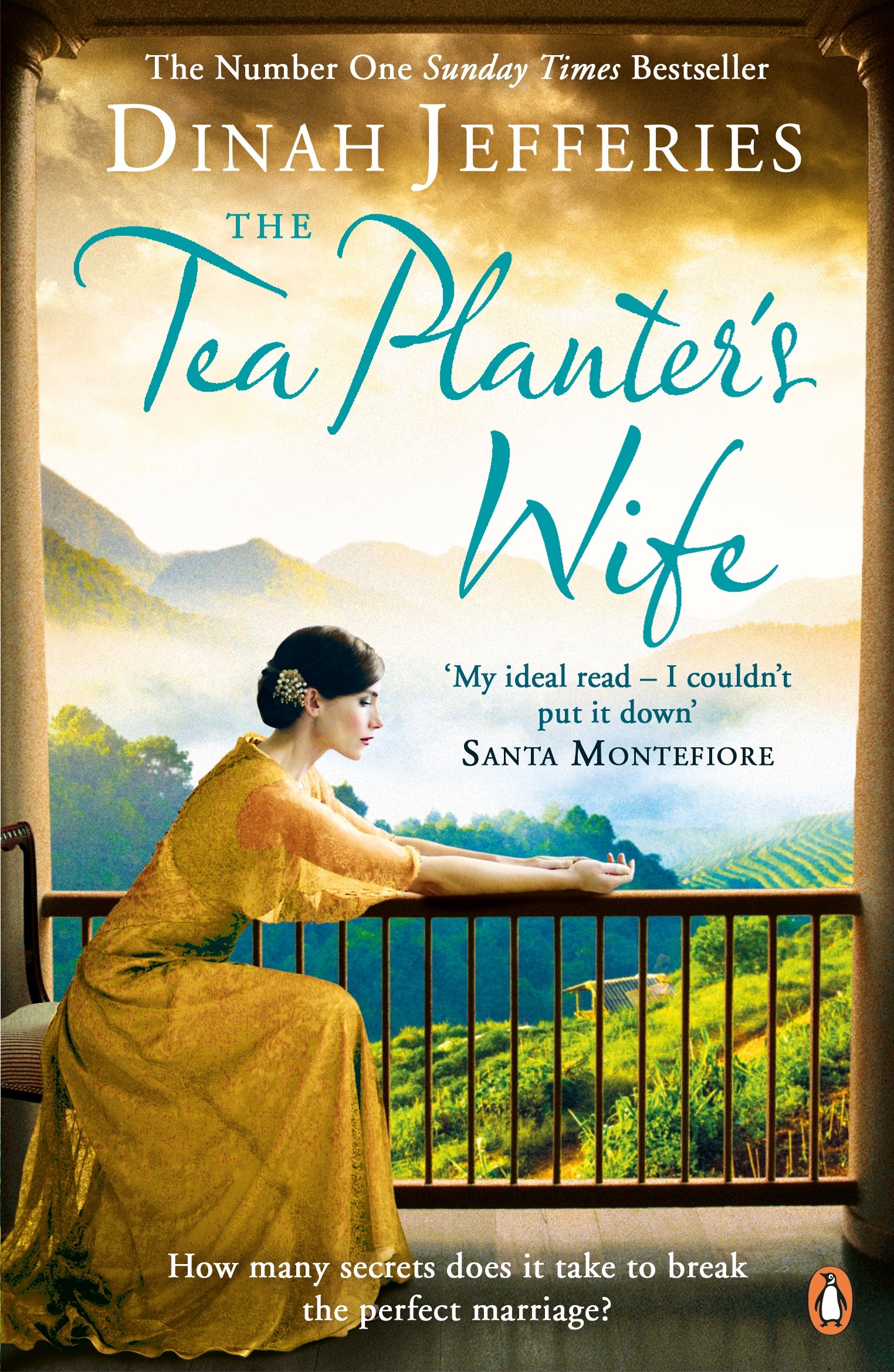
#BookReview ‘The Tea Planter’s Wife’ by @DinahJefferies #romance

In Ceylon, between the First and Second World Wars, pre-Independence, a young wife arrives from England to join her new husband on his tea plantation. The Tea Planter’s Wife by Dinah Jefferies is a portrayal of an island riven by racial differences, a marriage riven by an inability to be honest, concluding that in the end skin colour should not matter. Dinah JefferiesAs her ship from England docks in Colombo, Gwen Hooper feels faint and is helped by a charming dark-skinned man. This is our introduction to Savi Ravasinghe, a pivotal character, a Sinhalese portrait painter who paints the rich in Ceylon, England and America. At this first meeting, Gwen demonstrates her naivety of racial tensions between Ceylon’s native Sinhalese population and the Tamil workers brought to the island by the British tea planters to work on the plantations. Soon after, trying to help an injured worker, she tramples over old sensitivities and the Raj way of doing things. I found Gwen both fascinating and a little irritating. The story is told totally from her viewpoint and, for me, her husband Laurence is rather remote. When Gwen gives birth to twins, the first, a boy, is christened Hugh. The second is a dark-skinned girl. In fear of accusations of infidelity with Savi, and rejection by her husband, Gwen panics. Her ayah Naveena takes the child to be cared for in a nearby village. Conveniently, the birth took place with only the ayah present so secrecy is assured. But Gwen lives on, haunted by her lies to her husband and her failings to her daughter.
This story hangs on the premise that Gwen feels unable to question her husband about the death of his first wife and child. When we finally get the answer in the last few pages, it seems obvious. Except of course the book is set in the late 1920s early 1930s so though obvious to a modern reader, it would not be widely known or understood at that time. To say more would give away the plot. This aside, I enjoyed this fragrant tale of the Hooper tea plantation, the difficulties faced after the Wall Street Crash, the changing times, the fashions and foods. There is a particularly unlikeable sister-in-law Verity, American vamp Christina, and bright and charming cousin-from-home Fran. The story felt alive in Ceylon. Jefferies cultivates a believable world from another time w ith the scents of cinnamon, sandalwood and jasmine combined with bullock dung, grease and rotting fish, servants dressed in white, and glamorous balls danced to the music of jazz. In contrast the short section in New York when Laurence and Gwen meet bankers and advertising men to launch the Hoopers Tea brand, seems remote and it was a relief to return to the lushness and complications of Ceylon.
CLICK HERE TO READ MORE ABOUT THIS BOOK

And here are my reviews of some of Dinah Jefferies’ other novels:-
DAUGHTERS OF WAR [#1 DaughtersOfWar]
THE HIDDEN PALACE [#2 DaughtersOfWar]

And these standalone novels:-
THE SAPPHIRE WIDOW
THE TUSCAN CONTESSA

If you like this, try these:-
‘The Gift of Rain’ by Tan Twan Eng
‘A Mother’s Secret’ by Renita d’Silva
‘The Garden of Evening Mists’ by Tan Twan Eng

And if you’d like to tweet a link to THIS post, here’s my suggested tweet:
#BookReviewTHE TEA PLANTER’S WIFE by @DinahJefferies http://wp.me/p5gEM4-2Rh via @SandraDanby

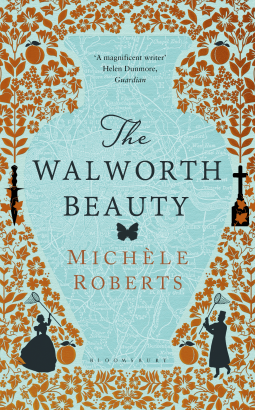
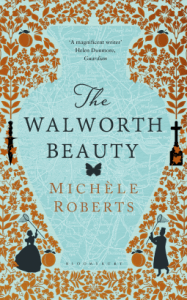
#BookReview ‘The Walworth Beauty’ by Michèle Roberts #historical

From the first page, I knew this was going to be one of those reads rich in historical scents and sensations, a story to lose yourself in. The Walworth Beauty by Michèle Roberts is set in the London district of Walworth, just south of the River Thames and part of the Borough of Southwark. It tells the story of Joseph Benson in 1851 and Madeleine in 2011, 160 years apart but experiencing so many similar things. Michèle RobertsMadeleine loses her job as a lecturer of English literature, as a result she moves to a garden flat in Apricot Place, Walworth. She is delicately attuned to the history of London, walking its streets and seeing Virginia Woolf walking ahead of her, Hilda Doolittle passing her by, and, in a basement kitchen in Lamb’s Conduit Street, a mistress instructing her new housemaid. Just how closely Madeleine is connected to the past becomes clearer in the second half of the story as she explores Walworth, researching its local history and meeting her new neighbours.
Joseph and his family live in a rented house in Lamb’s Conduit Street. He works for sociologist Henry Mayhew, researching the working conditions and social backgrounds of prostitutes in Walworth. Joshua is a contradictory character, perhaps a man of his time with contemporary attitudes and assumptions about women. Still mourning his idolised first wife Nathalie, he is outwardly respectable but has money problems. He is a spendthrift and betrays Cara his second wife [and Nathalie’s older sister] by visiting prostitutes, viewing it as a necessity so Cara will not conceive again, rather than unfaithfulness. His research takes him to a house in Apricot Place where he meets landlady Mrs Dulcimer, an exotic brown-skinned woman who Joshua mistakes for a madam but who in fact helps struggling young women to establish themselves with jobs and homes.
The theme of classification runs throughout this novel, the formal type of labelling as in Mayhew’s study and the Dewey Decimal labelling system for libraries, but also the informal way of labelling people, pre-judging, jumping to conclusions. Mayhew classifies prostitutes as criminals and it is with this view that Joseph conducts his first research. In meeting Mrs Dulcimer, however, he learns the true stories of struggle and abandonment in the lives of many of the women he labels so easily as whores. He is an unreliable judge of women’s characters, however, even those closest to him.
We see similar classifications in Madeleine’s story in modern-day Walworth. There are themes of grief, longing for what is out of reach, women’s position in society and men’s attitudes towards women and sexuality. Judgements based on class and sex. The two storylines are connected in places by hints of ghosts or presences, which I found a little unsatisfactory. This is a novel about the different parts of society, some isolated, some overlapping like a Venn diagram, and as true today as in Victorian London.
I enjoyed unpicking the connections between 1851 and 2011, handled so delicately that it would be easy to pass them by. Such as Mrs Dulcimer’s missing earring, surrendered as an identifying token at the Foundling Hospital when she handed in her baby, is seen by Madeleine in a display at the Foundling Museum. There are countless examples like this of mirrored details and parallel experiences, connecting Joseph and Mrs Dulcimer with Madeleine.
The Walworth Beauty is one of the most enjoyable books I have read this year and is worth re-reading to absorb the beautiful detail written by a novelist entwined with her story and subject.
CLICK HERE TO READ MORE ABOUT THIS BOOK AT AMAZON

Read my review of FAIR EXCHANGE also by Michèle Roberts, and try the First Paragraph here.

If you like this, try:-
‘Frog Music’ by Emma Donoghue
‘Birdcage Walk’ by Helen Dunmore
The Western Wind’ by Samantha Harvey

And if you’d like to tweet a link to THIS post, here’s my suggested tweet:
#BookReview THE WALWORTH BEAUTY by Michèle Roberts http://wp.me/p5gEM4-2SQ via @SandraDanby


#BookReview ‘The Distant Hours’ by Kate Morton #historical #romance #WW2

If ever there was a novel in which a house plays the role of a character, this is it. The Distant Hours by Kate Morton is told in two strands, World War Two and the Nineties, involving the three Blythe sisters in Kent at Milderhurst Castle and a South London mother and daughter, Meredith and Edie. They all are connected by the war, the house, and the truth of what really happened when Juniper Blythe was abandoned by her lover in 1941. Kate Morton This is a brick of a book [678 pages], like Morton’s other novels. A little too long for me, the story meanders at times through past and present until it works towards the final mystery. What a mystery, an ingenious storyline and an unpredictable final twist. The story starts when a letter arrives for Edie’s mother, a letter lost for decades, a letter dating from wartime when Meredith was a schoolgirl evacuated to Kent. Edie is fascinated by her mother’s history, but her mother does not talk of it. They are not close, and Edie feels unable to press for information. So she sets off to investigate on her own.
At the centre of the story is the house, and what a house it is: beautiful, crumbling, representative of a time past. When Edie visits the castle in 1992 for the first time, she thinks: ‘Have you ever wondered what the stretch of time smells like? I can’t say I had, not before I set foot inside Milderhurst Castle, but I certainly know now. Mould and ammonia, a pinch of lavender and a fair whack of dust, the mass disintegration of very old sheets of paper. And there’s something else, too, something underlying it all, something verging on rotten or stewed but not. It took me a while to work out what that smell was, but I think I know now. It’s the past.’ Living there, Edie finds the three Blythe sisters, alone after the death of their father.
Morton writes brilliantly about the war years, conjuring up life at this vast castle and in the village of the same name. Running throughout is a mysterious, ghostly, spooky thread based on Raymond Blythe’s best-selling book The True History of the Mud Man. ‘The moat has begun to breathe. Deep, deep, mired in the mud, the buried man’s heart kicks wetly.’
Is the book set at Milderhurst Castle? Is the Mud Man based on a true story? The book is yet another connection between Edie and the castle, she loved it as a child after being given a library copy when ill by her mother. And so the concentric circles tighten.
CLICK HERE TO READ MORE ABOUT THIS BOOK AT AMAZON

And here’s my review of another novel by Kate Morton:-
THE CLOCKMAKER’S DAUGHTER

If you like this, try these books with atmospheric houses:-
‘A Sudden Light’ by Garth Stein
A Traveller at the Gates of Wisdom’ by John Boyne
‘The Other Eden’ by Sarah Bryant

And if you’d like to tweet a link to THIS post, here’s my suggested tweet:
#BookReview THE DISTANT HOURS by Kate Morton http://wp.me/p5gEM4-1YD  via @SandraDanby

#BookReview ‘Mothering Sunday’ by Graham Swift #historical

The title of Mothering Sunday by Graham Swift refers to the day on which the story takes place, rather to any essay about motherhood. It is March 30, 1924, Mothering Sunday, when servants are given the day off to visit their mothers. A young woman, an orphan and servant, meets a young man from a neighbouring house, who is betrothed to another woman. It is to be their last assignation before his marriage. Graham SwiftThis is a slim book, a novella, beautifully-written. I wasn’t sure at the beginning, I found the first page and the reference to Fandango the racehorse a little odd. But once I got past that, I read it in one sitting on an airplane.
It is a story about telling stories. This story is told by a novelist in her nineties who is used to be interviewed and asked repetitively about her life as a writer: when did she become a writer? The answer lies on Mothering Sunday in 1924. This is a treatise about the class system of the time, about sex and sensuality, about rebellion and about bucking the system. Jane – the housemaid and novelist – is a keen reader and with the permission of her master, she borrows books from his library. She prefers boys’ stories, adventure tales, and then she stumbles on Joseph Conrad and is smitten. Her reading sets her apart from her master, and her lover Paul. The Mothering Sunday on which the events happen takes place at a time of great transition between the wars, as the role of women was widening. Books give Jane a route out of her servile world, away from sex with the master’s son without hope of subsequent marriage, to a job as an assistant in a bookshop.
We only see the story from Jane’s point of view, Young Jane and Old Jane. Is she telling the truth, embroidering the story for fictional effect, layering on the emotions of the tragedy that occurs that sunny March afternoon?
A masterpiece, again by Swift. It stayed with me and will be re-read.
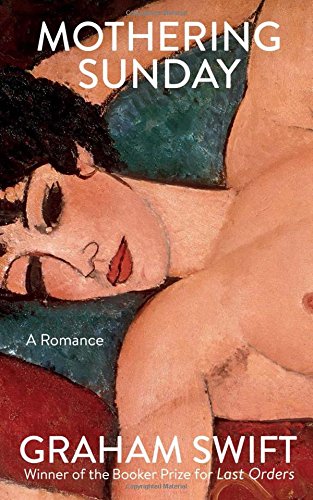
An aside, this hardback edition has the most wonderful cover design: a detail from Reclining Nude [red nude] 1917-18 by Modigliani. It will look well on my bookshelves for years to come.
CLICK HERE TO READ MORE ABOUT THIS BOOK AT AMAZON

Here’s my review of Swift’s HERE WE ARE.

If you like this, try:-
The Whereabouts of Eneas McNulty’ by Sebastian Barry
My Name is Lucy Barton’ by Elizabeth Strout
Lean Fall Stand’ by Jon McGregor

And if you’d like to tweet a link to THIS post, here’s my suggested tweet:
#BookReview MOTHERING SUNDAY by Graham Swift via @SandraDanby http://wp.me/p5gEM4-1XD