Tag Archives: Kate Mosse

#BookReview ‘The City of Tears’ by @katemosse #historical

Steeped in the historical detail of sixteenth-century religious tension and war in France, The City of Tears by Kate Mosse continues the story started in The Burning Chambers. Through the eyes of Minou and Piet we experience the Saint Bartholomew’s day massacre of Huguenots and its aftermath as the story moves from Paris and Chartres to Amsterdam, home to refugees and a protestant uprising. Kate MosseIt is 1572 and the action starts in Puivert, Languedoc, where the Reydons have found a fragile peace from Catholic persecution of the Huguenots. Minou and Piet take their family to Paris to witness the diplomatically-sensitive royal wedding of catholic King Charles’s sister Marguerite to the protestant Henry of Navarre. Unknown to the Reydons their old enemy Cardinal Valentin, also known as Vidal du Plessis, is in Paris planning to kill Huguenots. What follows drives the old enemies together and sets in motion Mosse’s story. The Reydons are forced to flee to save their lives, leaving behind one daughter possibly dead or missing. They run to Amsterdam where they establish a new life though their grief for Marta ruptures their previous marital harmony. But religious extremism follows them and once again they must face the threat of violence. As Piet’s past catches up with him, an uncomfortable family secret is revealed. The need to find the truth once and for all takes them to Chartres and the home of a hunter of religious relics.
These books need be read with full concentration. This period of history is a gap in my knowledge, which made The City of Tears an interesting read. The story lacked drama, though I find it difficult to pin down why. Minou is the heart of this book and it is she who pulled me on through some of the heavy historical detail. I settled into the book better when I gave up trying to remember the historical fact and let Minou’s fictional story take over.
As in The Burning Chambers, the Prologue is set in South Africa two centuries later. And still the woman featured in 1862 is a mystery. The City of Tears is set at a time of change in French Protestantism and the birth of the Dutch Republic and is one of a series of novels covering 300 years of religious turmoil in Europe. Mosse follows the geographical movement of the Huguenot refugees from sixteenth-century France and Amsterdam to the Cape of Good Hope in the eighteenth and nineteenth centuries. No word on how many novels this series will finally comprise.
I think I will always prefer Labyrinth.
CLICK HERE TO READ MORE ABOUT THIS BOOK

And here are my reviews of other novels by Kate Mosse:-
CITADEL [#3LANGUEDOC]
THE BURNING CHAMBERS #1JOUBERT
THE TAXIDERMIST’S DAUGHTER

If you like this, try:-
The Ashes of London’ by Andrew Taylor
The Witchfinder’s Sister’ by Beth Underdown
The Last Hours’ by Minette Walters

And if you’d like to tweet a link to THIS post, here’s my suggested tweet:
#BookReview THE CITY OF TEARS by @katemosse https://wp.me/p5gEM4-5gU via @SandraDanby

#BookReview ‘The Burning Chambers’ by @katemosse #historical

The story starts in winter, 1562, in the South of France. In a prison in Toulouse, a man is being tortured, while in Carcassonne a young woman awakes from a bad dream, a sad memory. The Burning Chambers by Kate Mosse is heavy on atmosphere and historical detail and, like Mosse’s Languedoc trilogy, is slow to start. Despite my confusion, and I admit to being confused in parts for two-thirds of the book, I read on because Mosse is an expert storyteller who spins a tale and reels you in so you sit up late at night reading just one more chapter. Sometimes though, I wished she would cut some of the detail. Kate MosseThis is a story of religious war, of prejudice and violence, of loyalty and love, and principally a woman and a man who find themselves on opposite sides of the religious divide. Minou Joubert is a Catholic, the daughter of a bookseller who believes in selling books of all faiths for everyone to buy freely. When she receives an anonymous letter, sealed with a family insignia she does not recognize and comprising only five words ‘SHE KNOWS THAT YOU LIVE’, she is mystified. That same day, fate crosses her path as Huguenot convert Piet Reydon flees capture. And so starts this spiraling and twisting story of a fight for control of Toulouse between Catholics and Huguenots, the mysterious quest of Minou’s fragile father Bernard, Minou’s mysterious letter, a Bible, traitors who smile and friends who are taciturn. Letter forgotten, Minou and her young brother Aimeric are sent to Toulouse for their safety. There they stay with their mother’s aunt but find themselves in a bad-tempered house where Huguenots are hated and their uncle is a political agitator. Toulouse seems more dangerous than Carcassonne or is the danger following Minou?
Minou is a great heroine and I await the next installment of the series with curiosity. The Prologue and Epilogue hint that this is not a standalone book, set in 1862 in South Africa, a woman is seeking answers in a graveyard. Is this the beginning of book two?
CLICK HERE TO READ MORE ABOUT THIS BOOK

And here are my reviews of other novels by Kate Mosse:-
CITADEL [#3LANGUEDOC]
THE CITY OF TEARS #2JOUBERT
THE TAXIDERMIST’S DAUGHTER

If you like this, try:-
‘In Another Life’ by Julie Christine Johnson
Fair Exchange’ by Michèle Roberts
The French Lesson’ by Hallie Rubenhold

And if you’d like to tweet a link to THIS post, here’s my suggested tweet:
#BookReview THE BURNING CHAMBERS by @katemossehttps://wp.me/p5gEM4-3wV via @SandraDanby

#BookReview ‘The Taxidermist’s Daughter’ by Kate Mosse #historical

I will say up front that the taxidermy sections in The Taxidermist’s Daughter were too much for me, too much gory detail. That aside, this is a mystery set in the South Coast marshes of Fishbourne in 1912. In fact it seemed timeless, difficult to place the action only two years prior to the outbreak of the Great War. The weather is ever-present to set the tone of the story: wind, rain and storms and Fishbourne is a real place. Author Kate Mosse, a Chichester resident, uses her local knowledge to good effect. But, I struggled to connect with the story and cannot put my finger on why. Kate MosseThe storyline focuses on 22-year old Connie Gifford and her father, the taxidermist and his daughter, who live in an isolated house on the marshes at Fishbourne. In the Prologue, the village gathers in the churchyard to celebrate the Eve of St Mark. At the end of the evening, a woman is dead. So, already there is one dead woman and some secrets. Connie, it turns out, had an accident 10 years earlier and she has no memory either of what happened that day or of her life prior to the accident… more secrets. Are the two events, 10 years apart, connected? Are the same people involved? And if Connie’s memory returns, will she have the answer to the odd goings-on?
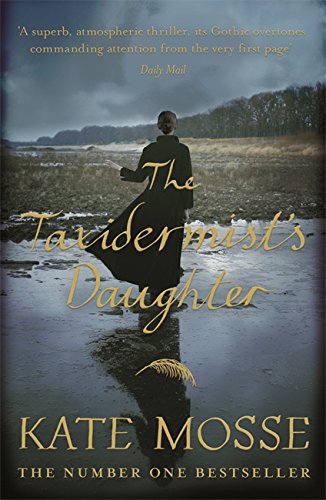
I admit to losing track of some of the peripheral characters who, unlike the atmospheric setting, are not fully-rounded. It is a strange book, taxidermy is a rather odd subject [and risky in that it will deter some readers from even picking up the book] although it adds to the theme of reality versus false reality. There are lies between family and friends, lies between rich and poor; it is not only the guilty who lie, there are also secrets meant to protect the innocent. Amnesia is a difficult plot technique to use, too often it leaves the reader feeling cheated. I found the story rather drawn-out, the longer it went on the less mysterious it got. Kate MosseA note about front cover design. My hardback copy [above] has a beautiful design of feathers and a solitary bird skull, but perhaps the bird skull was decided to be too gory. The paperback edition [top] is more in keeping with the atmospheric seaside setting. Interesting also that the cover line ‘In death there can be beauty’ is missing from the paperback, to me the line felt incongruous given that the novel deals with murder, assault and torture.

And here are my reviews of other novels by Kate Mosse:-
CITADEL #3LANGUEDOC
THE BURNING CHAMBERS #1JOUBERT
THE CITY OF TEARS #2JOUBERT

If you like this, try:-
‘The Threshold’ by Anita Kovacevic
‘The House on Cold Hill’ by Peter James
The Little Red Chairs’ by Edna O’Brien

And if you’d like to tweet a link to THIS post, here’s my suggested tweet:
#BookReview THE TAXIDERMIST’S DAUGHTER by Kate Mosse via @SandraDanby http://wp.me/p5gEM4-1Rx

#BookReview ‘Citadel’ by @katemosse #historical

I read a lot of books. Amongst those with the strongest sense of place, the ones that linger in my imagination, are the Languedoc trilogy by Kate Mosse. Citadel, the third novel in the series, is set in ad342 and 1942 during World War Two. Unusually with a trilogy, you don’t have to have read the other two books in order to enjoy this one. Certainly it is some years since I read Labyrinth and Sepulchre and the details are hazy, each book stands on its own. Kate MosseI enjoyed this book immensely. The story centres on a small group of women who fight against the Nazi regime and who, by the very fact that they are women, are able to slip unnoticed along the night-time streets of occupied Carcassonne. The Prologue describes ‘the woman known as Sophie’ and the reader is left to wonder, which of the women in the story is ‘Sophie’?
I must point out that the story is slow to get going, I had to be patient, but I trusted Mosse. It did make me question whether my attention span is shortening, I hope not. If it is I must read longer novels to re-stretch my brain.
A note in the 2014 edition, which I read, explains that the story was inspired by a plaque in a village near Carcassonne, commemorating the ‘martyrs of Baudrigues’. Days before the Languedoc was freed by its own people, as the Nazis were fleeing, 19 prisoners were killed, two women are to this day still unidentified. These facts started Mosse wondering who those women were: that was her starting point for Citadel.
It is clear that both time strands are set in the same place, the countryside of the Languedoc, the forests, the mountains, its people and language, and the weather, anchors the reader firmly in southern France. In ad342, Arinius is looking for a hiding place. You know not what for, only that it must be safe for ‘centuries’. “He had no particular destination in mind, only that he had to find somewhere distinctive and sheltered, somewhere where the pattern of the ridges and crests might retain their shape for centuries to come… Forests might be cut down or burn or drowned when a river bursts its banks. Fire and word and flood. Only the mountains stood firm.”
CLICK HERE TO READ MORE ABOUT THIS BOOK AT AMAZON

And here are my reviews of other novels by Kate Mosse:-
THE BURNING CHAMBERS #1JOUBERT
THE CITY OF TEARS #2JOUBERT
THE TAXIDERMIST’S DAUGHTER

If you like this, try:-
‘Dominion’ by CJ Sansom
‘Homeland’ by Clare Francis
‘Midnight in Europe’ by Alan Furst

And if you’d like to tweet a link to THIS post, here’s my suggested tweet:
#BookReview CITADEL by @katemosse ‏via @SandraDanby http://wp.me/p5gEM4-Xt