
From the first page, I knew this was going to be one of those reads rich in historical scents and sensations, a story to lose yourself in. The Walworth Beauty by Michèle Roberts is set in the London district of Walworth, just south of the River Thames and part of the Borough of Southwark. It tells the story of Joseph Benson in 1851 and Madeleine in 2011, 160 years apart but experiencing so many similar things. 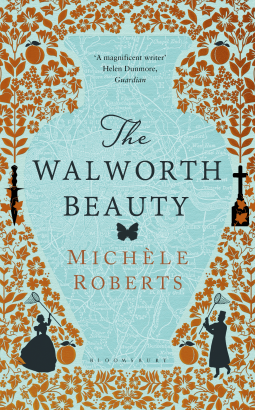 Madeleine loses her job as a lecturer of English literature, as a result she moves to a garden flat in Apricot Place, Walworth. She is delicately attuned to the history of London, walking its streets and seeing Virginia Woolf walking ahead of her, Hilda Doolittle passing her by, and, in a basement kitchen in Lamb’s Conduit Street, a mistress instructing her new housemaid. Just how closely Madeleine is connected to the past becomes clearer in the second half of the story as she explores Walworth, researching its local history and meeting her new neighbours.
Joseph and his family live in a rented house in Lamb’s Conduit Street. He works for sociologist Henry Mayhew, researching the working conditions and social backgrounds of prostitutes in Walworth. Joshua is a contradictory character, perhaps a man of his time with contemporary attitudes and assumptions about women. Still mourning his idolised first wife Nathalie, he is outwardly respectable but has money problems. He is a spendthrift and betrays Cara his second wife [and Nathalie’s older sister] by visiting prostitutes, viewing it as a necessity so Cara will not conceive again, rather than unfaithfulness. His research takes him to a house in Apricot Place where he meets landlady Mrs Dulcimer, an exotic brown-skinned woman who Joshua mistakes for a madam but who in fact helps struggling young women to establish themselves with jobs and homes.
The theme of classification runs throughout this novel, the formal type of labelling as in Mayhew’s study and the Dewey Decimal labelling system for libraries, but also the informal way of labelling people, pre-judging, jumping to conclusions. Mayhew classifies prostitutes as criminals and it is with this view that Joseph conducts his first research. In meeting Mrs Dulcimer, however, he learns the true stories of struggle and abandonment in the lives of many of the women he labels so easily as whores. He is an unreliable judge of women’s characters, however, even those closest to him.
We see similar classifications in Madeleine’s story in modern-day Walworth. There are themes of grief, longing for what is out of reach, women’s position in society and men’s attitudes towards women and sexuality. Judgements based on class and sex. The two storylines are connected in places by hints of ghosts or presences, which I found a little unsatisfactory. This is a novel about the different parts of society, some isolated, some overlapping like a Venn diagram, and as true today as in Victorian London.
I enjoyed unpicking the connections between 1851 and 2011, handled so delicately that it would be easy to pass them by. Such as Mrs Dulcimer’s missing earring, surrendered as an identifying token at the Foundling Hospital when she handed in her baby, is seen by Madeleine in a display at the Foundling Museum. There are countless examples like this of mirrored details and parallel experiences, connecting Joseph and Mrs Dulcimer with Madeleine.
The Walworth Beauty is one of the most enjoyable books I have read this year and is worth re-reading to absorb the beautiful detail written by a novelist entwined with her story and subject.
CLICK HERE TO READ MORE ABOUT THIS BOOK AT AMAZON
Read my review of FAIR EXCHANGE also by Michèle Roberts, and try the First Paragraph here.
If you like this, try:-
‘Frog Music’ by Emma Donoghue
‘Birdcage Walk’ by Helen Dunmore
‘The Western Wind’ by Samantha Harvey
And if you’d like to tweet a link to THIS post, here’s my suggested tweet:
#BookReview THE WALWORTH BEAUTY by Michèle Roberts http://wp.me/p5gEM4-2SQ via @SandraDanby

 SANDRA DANBY'S BOOK REVIEWS