Tag Archives: mystery

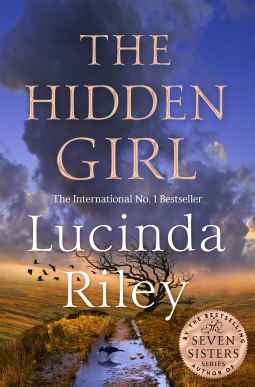
#BookReview ‘The Hidden Girl’ by Lucinda Riley & Harry Whittaker #suspense #mystery

The Hidden Girl by Lucinda Riley & Harry Whittaker is a story of family secrets across the generations, love and shame, jealousy and courage. Sweeping from the wild and beautiful Yorkshire moors to the horrors of occupied Poland in World War Two, it covers huge themes. Lucinda Riley & Harry WhittakerTwo teenage girls grow up as neighbours on the wild Yorkshire moors. Fifteen when the story begins, Leah Thompson is quiet and shy. She loves the moors, the Brontës, the wildness and doesn’t realise how beautiful she is. Desperate to help her mother Doreen support her father, who is crippled by arthritis and unable to work, Leah helps out at the nearby farmhouse where Rose Delancey is attempting to restart her career as an artist. Rose has two children. Miles, a dark-haired loner who haunts the moors with his camera when he’s home from university. His adopted younger sister Miranda, who is at school with Leah, is brash but vulnerable, and longs to escape the boring moors. Into this rural world, Rose’s nephew Brett arrives for the summer holidays. Travelling from his school at Eton, Miles and Miranda are unaware of their cousin’s existence. They’ve never met his father David Cooper, Rose’s estranged brother, who is a wealthy businessman. Teenage hormones become entangled and hearts are broken.
When a chance encounter catapults Leah into the glamorous international world of modelling, Miranda is determined to find wealth and success too. Ironically both women find themselves the focus of controlling, possessive men; a disturbing theme throughout the book. The story sweeps from Yorkshire to the South of France, New York to Milan, taking in the worlds of international modelling, photography and art. This is a story of the misuse of power, abuse, betrayal and violence that travels across the generations to the modern day. Told through the eyes of Leah and Miranda, and of brother and sister David and Rosa in World War Two Poland, this is an immersive novel to sink into. It reminded me of Penny Vincenzi’s doorstop-sized novels which lock you into the world of the characters so you can’t stop turning the pages. Except this has a harder edge.
The first Lucinda novel I’ve read since her death, The Hidden Girl is a rewrite by her son Harry of an earlier Lucinda novel. It has the clear identity of a Lucinda book, her voice is clear throughout. There is though more looseness in storyline with some of the most important action reported rather than shown directly, which makes it feel rushed and at a distance. The themes are familiar from the Seven Sisters series: truth in relationships, abuse of power, family secrets, hidden pasts and repressed violence. With myriad twists, turns, misunderstandings and betrayals, it filled an entire weekend’s reading.

Read my reviews of the first seven novels in Lucinda Riley’s ‘Seven Sisters’ series:-
THE SEVEN SISTERS #1SEVENSISTERS
THE STORM SISTER #2SEVENSISTERS
THE SHADOW SISTER #3SEVENSISTERS
THE PEARL SISTER #4SEVENSISTERS
THE MOON SISTER #5SEVENSISTERS
THE SUN SISTER #6SEVENSISTERS
THE MISSING SISTER #7SEVENSISTERS

… plus my reviews of these standalone novels, also by Lucinda Riley:-
THE BUTTERFLY ROOM
THE LOVE LETTER
THE GIRL ON THE CLIFF

If you like this, try:-
Inheritance’ by Nora Roberts #1LOSTBRIDETRILOGY
‘Water’ by John Boyne #1ELEMENTS
‘Nutshell’ by Ian McEwan

And if you’d like to tweet a link to THIS post, here’s my suggested tweet:
#BookReview THE HIDDEN GIRL by Lucinda Riley & Harry Whittaker https://wp.me/p2ZHJe-8ya via @SandraDanby

COMING SOON… THE NEXT BOOK I REVIEW WILL BE:- Susanna Kearsley

#BookReview ‘The Briar Club’ by @Kate_Quinn #thriller #mystery

Oh what a tangle this story is, in a good way. The Briar Club by Kate Quinn is about the women renting rooms at Briarwood House, a down-at-heel all-female boarding house in Washington DC. Starting off as a group of individuals, they slowly bond at their Thursday supper night. Kate QuinnThe story starts on the night Thanksgiving in 1954 with a prologue in the voice of the house. There’s a dead body in the attic and there is blood everywhere. Police are questioning witnesses. The narrative then backtracks four years. Set in the post-war McCarthy era when communists are reported by friends, family, neighbours and colleagues, at the time of this story no one feels immune from threat of denunciation. Not Bea, the former baseball player with a dodgy knee. Not Fliss, mother of baby Angela, both waiting for Fliss’s doctor husband Dan to come home from the Korean war. Not Nora, secretary at the National Archives, whose police officer brother steals her rent money.
At first The Briar Club seems long and languorous, taking its time to tell the background story of each female lodger one at a time. This is a clever device that first shows each woman as the others see them, the assumptions made, prejudices assumed, judgements taken; then the real person is revealed in their own viewpoint, the experiences that made them who they are today, the twists and turns of life that made them behave and speak as they do. But then there is a dead body in the attic apartment and the tangles become twisted, knotted and dangerous to everyone. Is it a lover’s tiff or something more sinister? Is it the reds? This is the time of the HUAC [House Un-American Activities Committee] investigations, set against a rough Washington background of gangsters, sleaze, knife crime and wife-beating. The Thursday night Briar Club get-together gives the women a safe place to be themselves.
The first voice we hear in 1950 doesn’t belong to one of the lodgers but to Pete Nilsson, son of the landlady. When Pete is on the front stoop mending the screen door, he is interrupted by a tall woman wearing a red beret. She enquires about a room to rent and 13-year old Pete instantly falls in love. Grace March takes the dingy room, as big as a shoebox with dull green walls. Grace is the sun around which the lodgers and the story revolve. She is both at the centre of everything, seemingly all-knowing, all-seeing, but remaining an enigma. It is Grace who suggests a Thursday night supper club, it is Grace who encourages the other ladies to club together to buy spectacles for Pete’s younger sister Lina, and it is Grace who first encourages Lina’s attempts at baking despite the frequent burnt offerings. She is the bringer of light and flowers into a grubby house, the one who notices everything and knows how to keep a secret.
The stately telling of a complicated story, slow for the first 60% until the strands become entwined, character connections are made and deeply-held secrets and opinions are unveiled. From the beginning this is a consummate picture of the lives of women in 1950s Washington DC at the time of the communist witch hunts. Opportunities for women are changing post-war though many are still trapped by marriage, racism, expectations and low wages. The story starts with a mystery that becomes consuming as the paths of the fictional women cross with real-life historical people and events. And I loved that the house is given its own voice, because Briarwood House too seems a member of the Briar Club.
Very good. Slower in parts than the other Quinn novels I’ve read. All are different and I’ve enjoyed every one of them. The Briar Club morphed from a 4* to a 5* towards the end as I realised I wanted to go back to the beginning and start all over again.

Here are my reviews of two other novels by Kate Quinn:-
THE DIAMOND EYE
THE ROSE CODE

If you like this, try:-
Shrines of Gaiety’ by Kate Atkinson
Before the Fall’ by Noah Hawley
The Chase’ by Ava Glass #1ALIASEMMA

And if you’d like to tweet a link to THIS post, here’s my suggested tweet:
#BookReview THE BRIAR CLUB by @Kate_Quinn https://wp.me/p2ZHJe-8mt via @SandraDanby

COMING SOON… THE NEXT BOOK I REVIEW WILL BE:- Heather Marshall

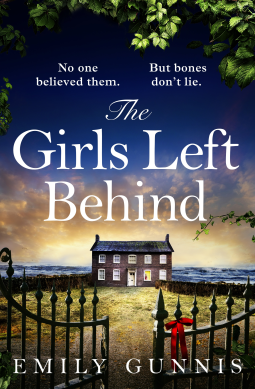
#BookReview ‘The Girls Left Behind’ by @EmilyGunnis #mystery #suspense

Emily Gunnis is a new author for me and I wasn’t sure what to expect from The Girls Left Behind. With triple timelines – World War Two, the Seventies/Eighties and the Noughties – it’s a complicated mixture to handle and there are a lot of personalities and twists to hang on to. Emily GunnisIn the Prologue it is 1975. A month ago WPC Jo Hamilton attended the beach where a young girl had fallen from the cliffs and died. Gemma Smith, fifteen, lived at Morgate House, a children’s home in an imposing Victorian building on the cliffs at Saltdean. The ‘Morgate children’ are generally regarded locally as wild. Now Jo is called to a ‘domestic’ at a house in Wicker Street. When violence turns to fire, Jo rescues two young sisters from the blaze. They are the only survivors. She takes Holly and Daisy to Morgate House. The Girls Left Behind is the story of the Morgate girls, vulnerable teenagers open to exploitation and whose tragedies are woven into the life of a young policewoman.
In 2015 and now a superintendent, Jo Hamilton is in her last week at work before retirement. When human remains are found it takes Jo back to a case she worked on as a young policewoman, a case that was emotionally difficult to handle, when she felt her voice was ignored by the top brass. Jo has carried regrets with her all her career. Her week becomes extra intense when her elderly mother is moved from her care home to palliative care. Her relationship with her mother Olive, is prickly; she is close to her older brother and fellow police officer Charlie; with her daughter Megan, things are changeable.
Intertwined with the two slices of Jo’s life, is the story of her mother Olive who during World War Two worked at Bletchley Park as a motorcycle courier trusted with top secret packages. Olive lodges in the village with Lorna, another Bletchley girl who she met on the train journey. Olive’s world is small, just Lorna, her boss Commander Travis, Geoff Price, manager of the bike workshop, and a few of her fellow motorcycle couriers. Then Olive falls in love for the first time.
A slow-mover for me. The two girls, Gemma and Holly, and their similar storylines merged together. The frequent summarising and repetition meant I reluctantly skipped paragraphs. But oh my, at about 70% and in one of Olive’s sections, the story took off and didn’t stop until the end.
A good mystery thriller which would benefit from a reduced character list and from being cut in length with shorter snappier chapters to increase the tension. A sad story with dark complex characters, hidden secrets and lies told to protect important people.

If you like this, try:-
Stolen Child’ by Laura Elliot
Then She Was Gone’ by Lisa Jewell
The Guest List’ by Lucy Foley

And if you’d like to tweet a link to THIS post, here’s my suggested tweet:
#BookReview THE GIRLS LEFT BEHIND by @EmilyGunnis https://wp.me/p2ZHJe-7FP via @SandraDanby

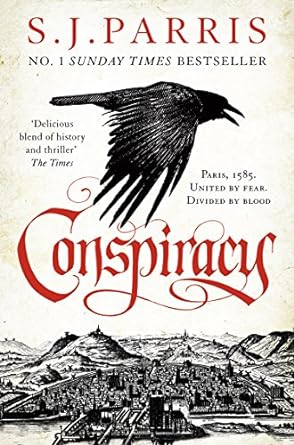
COMING SOON… THE NEXT BOOK I REVIEW WILL BE:- SJ Parris

#BookReview ‘My Brother Michael’ by Mary Stewart #mystery #WW2

‘Nothing ever happens to me,’ writes Camilla Haven on a postcard at the beginning of My Brother Michael by Mary Stewart. Longing for excitement on her solitary holiday in Greece, the inevitable happens. A case of mistaken identity takes Camilla to Delphi where statues of gods are found around every corner and ghostly lights move at night on the hills of Mount Parnassus. Mary StewartStewart has written a page-turning tale of death, art, handsome Greek gods [alive and stone], caves and smuggling. At the root of it all is what happened on these hills during the Second World War when Greek partisans were fighting the Nazis, and each other. Published in 1959, the story is set fourteen years after the war ended. This is pre-tourism Greece with goatherds on the slopes and donkeys following hillside tracks that have been used for thousands of years at a time, but when war’s mark is still evident daily. This is not a political post-war novel about a trouble, divided country, instead Stewart focuses on the people, their motivations and how history, ancient and recent, should never be forgotten.
Camilla is a cautious character in the first few chapters but as she, and we the readers, are drawn into adventure and mystery, her sense of right and wrong leads her onward towards risk and violence.
What a magical tale of mystery this is by a master storyteller. I read this first in the Seventies and this time around was just as gripped, reading into the night.
CLICK HERE TO READ MORE ABOUT THIS BOOK AT AMAZON

Click the title to read my reviews of other Mary Stewart novels:-
THE GABRIEL HOUNDS
THE IVY TREE
THIS ROUGH MAGIC
THORNYHOLD
TOUCH NOT THE CAT

If you like this, try these:-
‘THE COLLABORATOR’S DAUGHTER’ BY EVA GLYN
‘THOSE WHO ARE LOVED’ BY VICTORIA HISLOP
THE CAMOMILE LAWN’ BY MARY WESLEY

And if you’d like to tweet a link to THIS post, here’s my suggested tweet:
#BookReview MY BROTHER MICHAEL by Mary Stewart https://wp.me/p2ZHJe-789 via @SandraDanby

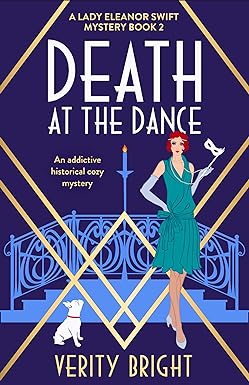
COMING SOON… THE NEXT BOOK I REVIEW WILL BE:- Verity Bright
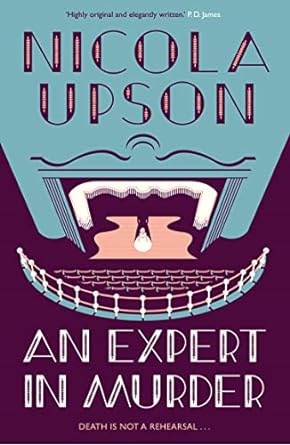
#BookReview ‘An Expert in Murder’ by @nicolaupsonbook #JosephineTey #crime #mystery

An Expert in Murder by Nicola Upson is an intriguing concept and the first in a series. A historical crime novel based on a real person – mystery novelist Josephine Tey, pseudonym of author Elizabeth MacKintosh – Upson places Tey in London’s theatreland where her successful play Richard of Bordeaux is drawing the crowds. This stage success happened for real, but Upson adds a murder. Or two. Nicola UpsonHow will a writer of crime and mystery novels deal with murder so close, so threatening? Will her creative imagination help friend Detective Inspector Archie Penrose find the murderer. And what happens when someone you know becomes a suspect. More a character-led mystery than a detective or crime story.
A mixture of fact and fiction – Tey was real, the role of John Terry was in reality played by John Gielgud – the story is slow to get going after the initial death. Partly this is the curse of the first instalment of a series, characters must be drawn, relationships established, clues laid for storylines which will run throughout future novels. The 1930s theatre setting is full of colourful characters though not much action actually happens in the New Theatre itself. The story kept me guessing but at times I lost track of the labyrinthine connections between people dating from the Great War and worried that I had missed something. In places there is so much new information I had to re-read. I particularly wanted to know more about Archie Penrose but perhaps that will come in the next book.
The period between the two world wars is a fascinating time with enormous social change but still retaining a straitjacket of Edwardian social conventions, which is fertile territory for a novelist. However there were moments when language and behaviour seemed a little too modern for the Thirties setting.
This is a slow to start to the series but intriguing enough to make me want to give it another chance. Perhaps I’ll try a novel later in the series [at the time of writing there are 11]. Ultimately, more a mystery than a detective or crime story.

Read my reviews of these other books by Nicola Upson:-
ANGEL WITH TWO FACES #2JOSEPHINETEY
STANLEY AND ELSIE

And here’s my review of BRAT FARRAR by the real-life author Josephine Tey.

If you like this, try:-
Curtain Call’ by Anthony Quinn
Shrines of Gaiety’ by Kate Atkinson
Fortune Favours the Dead’ by Stephen Spotswood #1Pentecost&Parker

And if you’d like to tweet a link to THIS post, here’s my suggested tweet:
#BookReview AN EXPERT IN MURDER by @nicolaupsonbook https://wp.me/p2ZHJe-71K via @SandraDanby

COMING SOON… THE NEXT BOOK I REVIEW WILL BE:- Elodie Harper
#BookReview ‘Old God’s Time’ by Sebastian Barry #contemporary #grief

Old God’s Time by Sebastian Barry is a sensitively and quietly written tale of family tragedy and loss. Beautiful, so subtle, with moments of extreme grief and love, flashes of helplessness and impending trouble. A difficult read but also enjoyable, Barry is a master of his craft. Sebastian BarryThe pace starts slowly, gently with Barry tightening the screw of perception as newly-retired policeman Tom Kettle [what a great name] is forced to remember what he has buried so deep. You may think, as I did, oh please not another story about abusive Irish priests; but this is about Tom and his beloved wife June, their children Winnie and Joe, not about the clergy. Barry dallies with our perception of what the story is about. He shows us Tom adjust to his existence without work, his flat, the changeable Irish weather, the coastline, at the same time exploring the nature of memory, lived memory, what is true and what is perception or presumption, while increasing the mystery of Tom’s past. The misty, stormy changing weather echoes this visibility/invisibility of personal truth.
Tom’s new routine is disturbed by a visit from two young detectives, uncomfortable in his presence, unsure of how to behave with such a venerable retired detective. Tom makes them cheese on toast and gives them a bed for the night. But their absence lingers in his mind as memories of an old crime resurface.
Is Tom Kettle a reliable or unreliable narrator? Is his truth believable and reliable – who is alive now, and who dead – or the confusion of an ageing memory? He sees real people, and ghosts, which suggests he is older than he is, confused, fading, vulnerable. As Tom revisits his memories again for the detectives, and in private moments on his own, the emotional story comes together. The responsibilities of husband and father stay with him, all of his time, ‘Things happened to people, and some people were required to lift great weights that crushed you if you faltered just for a moment. It was his job not to falter. But every day he faltered.’
A novel about the depth of love, it defines genre description. It is mystery, suspense, tragedy, gentle humour, contemporary, Irish history and crime but is ultimately a story of mourning lives lost and innocence destroyed. A dark read about lasting trauma, it is slow at times but please persist with it.

Read my reviews of these other novels by Sebastian Barry:-
A LONG LONG WAY
DAYS WITHOUT END #1DAYSWITHOUTEND
A THOUSAND MOONS #2DAYSWITHOUTEND
THE WHEREABOUTS OF ENEAS MCNULTY

If you like this, try:-
A History of Loneliness’ by John Boyne
Last Stories’ by William Trevor
Did You Ever Have a Family’ by Bill Clegg

And if you’d like to tweet a link to THIS post, here’s my suggested tweet:
#BookReview OLD GOD’S TIME by Sebastian Barry https://wp.me/p2ZHJe-6Nb via @SandraDanby

COMING SOON… THE NEXT BOOK I REVIEW WILL BE:- Mick Herron

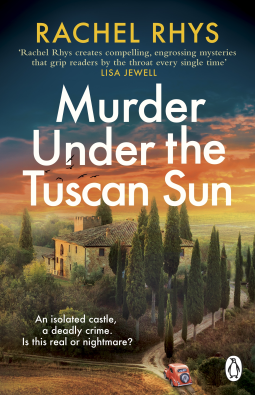
#BookReview ‘Murder Under the Tuscan Sun’ by Rachel Rhys #mystery #suspense

Against her son’s wishes, widow Constance Bowen travels to Tuscany to take a job as companion to an ill English gentleman in the Castello di Roccia Nera just outside Florence. Murder Under the Tuscan Sun by Rachel Rhys is set in an exquisitely beautiful place and the change of scenery is exactly what Constance believes she needs. It is very different from Pinner. Rachel RhysCarrying with her a double grief – for her husband, dead a year, and daughter Millie, five years earlier – Constance is wracked with nerves and doubt. Her patient, stroke-sufferer William North, proves irascible and sparing in his conversation. Constance has been employed by William’s niece, Evelyn Manetti. A flighty beautiful creature devoted to her Italian-American husband Roberto, Evelyn seems less enchanted with Nora, her daughter with her first husband.
The setting is voluptuous and it’s easy to fall for the delights of this Tuscan summer, as Constance quickly does. But all is not happy in this beautiful place and there are occasional unkindnesses and cruelty that make it uncomfortable. It is 1927 and fascism is rising. The castle is said to be haunted by a young girl, a talented violinist, denounced as a witch and bricked up alive in the castle walls.
The community of locals and ex-pats is populated with a collection of likeable and objectionable characters. When spooky things start to happen – mysterious music at night, the vision of a disappearing child dressed in white – which only Constance witnesses, I wanted to shout ‘leave now.’ The story is told in its entirety from Constance’s point of view. Her confusion at what she sees and experiences, and her inability or unwillingness to challenge anyone, becomes repetitive until her son James arrives and asks difficult questions of his mother.
So the title is misleading, this is not a thriller, not a crime novel. More a mystery suspense story in the vein of Mary Stewart or Daphne du Maurier. A strong sense of unease permeates the castle, something is not quite right – is Constance ill, vulnerable, suffering from exhaustion, or is there evil at work.
CLICK HERE TO READ MORE ABOUT THIS BOOK

And here’s my review of FATAL INHERITANCE, also by Rachel Rhys

If you like this, try:-
The Vanishing of Audrey Wilde’ by Eve Chase
The Paris Apartment’ by Lucy Foley
The Snakes’ by Sadie Jones

And if you’d like to tweet a link to THIS post, here’s my suggested tweet:
#BookReview MURDER UNDER THE TUSCAN SUN by Rachel Rhys https://wp.me/p2ZHJe-6Bp via @SandraDanby

COMING SOON… THE NEXT BOOK I REVIEW WILL BE:- Mick Herron
#BookReview ‘Ordinary Thunderstorms’ by William Boyd #contemporary #mystery

Ordinary Thunderstorms by William Boyd is a pacy mystery story in the mould of John Buchan’s The 39 Steps and the Will Smith film Enemy of the State. Innocent man in the wrong place at the wrong time. Cloud scientist Adam Kindred is eating a meal alone in a quiet West London restaurant when his instinct to help a fellow diner sends him on the run, accused of a crime he didn’t commit. William BoydThis is a fast-paced story that takes suspected murderer Kindred from a forgotten triangle of wasteland near Chelsea Bridge to the East End of London. As his name and face become media headlines, he finds a new identity at the Church of John Christ. As ‘John 1603’ he meets fellow dropouts, all with their own reasons for leaving behind a previous identity, all willing to sit through a two-hour sermon for the hearty meal that follows. Adam’s first priority, with his stash of cash running out, is to make money. Second, he sets out to discover the truth of the crime he witnessed and is accused of doing; the murder of Dr Philip Wang, head of research and development at pharmaceutical company Calenture-Deutz.
This is Kindred’s story and 70% of the action is told from his viewpoint. But Boyd adds pace to the story by adding the narrative of Ingram Fryzer, CEO of Calenture-Deutz, river police officer Rita Nashe and ex-soldier JonJo Case. Essentially this is a story of corporate greed and pharmaceutical fraud lightened by dark humour and the touching relationship of Kindred, Mhouse and her son Ly-on.
There are a few sticky coincidences but, forgiving these, this is an entertaining ‘what would I do if it happened to me’ tale. An average thriller elevated by the quality of Boyd’s writing.

Here are my reviews of other books by William Boyd:-
ANY HUMAN HEART
LOVE IS BLIND
NAT TATE: AN AMERICAN ARTIST 1928-1960
SWEET CARESS
THE BLUE AFTERNOON
THE DREAMS OF BETHANY MELLMOTH
TRIO
WAITING FOR SUNRISE

… and try the first paragraph of ARMADILLO.

If you like this, try these:-
‘Reservoir 13’ by Jon McGregor
‘Thornyhold’ by Mary Stewart
‘Brat Farrar’ by Josephine Tey

And if you’d like to tweet a link to THIS post, here’s my suggested tweet:
#BookReview ORDINARY THUNDERSTORMS by William Boydhttps://wp.me/p2ZHJe-6zO via @SandraDanby

COMING SOON… THE NEXT BOOK I REVIEW WILL BE:- Rachel Rhys
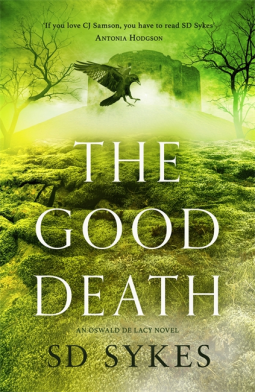
#BookReview ‘The Good Death’ by @SD_Sykes #historical #mystery

The Good Death is fifth in the Oswald de Lacy historical mystery series by SD Sykes and it feels like the last. That is only my guess but there is a ‘rounding of the circle’ to the story, answering questions raised in the first novel. I read it quickly, and sort of guessed the mystery but not quite. SD SykesThe story is told in two timelines as Oswald in 1370 sits at the bedside of his mother, who is dying. She clutches to her breast a letter which she will not show him. Instead she demands he tell her the truth of what happened in 1349 when Oswald was an eighteen-year-old novice monk, prior to where Plague Land, first novel in this series, begins. Sent by his mentor in the infirmary, Brother Peter, to gather herbs in the woods, Oswald meets a terrified girl who runs from him into a fast-flowing river where she drowns. Oswald carries her body to the village and discovers that other young girls have disappeared, never seen again, but no one in authority will investigate. Plague is reported in neighbouring villages and everyone wants to stay close to home. Only the beautiful widow Maud Woodstock listens to Oswald’s concerns and, flattered by her attention, he decides to investigate.
Brief passages are spent at Somerhill Manor in 1370 – Oswald’s mother is dying but still manipulative, his wife is bored, a house guest is irritating and his sister is jealous of the time he spends with their mother – but the bulk of the story takes place in 1349. Oswald is forced to remember an incident in his past that he would rather forget, when as a teenager he becomes an enthusiastic investigator. He jumps to conclusions based on prejudice, generalisations and gossip, putting himself in danger, but finding each possible suspect is innocent. As his list of potential murderers gets shorter, the danger to Oswald – from the murder, and also from the approaching plague – increases. But what if the murderer is someone he doesn’t know or doesn’t consider a likely suspect.
This series has got better with every book and if this is the last, it will be a loss. Sykes tells Oswald’s story in a fast-moving engaging way that is rooted in its medieval time of violence, patriarchy, misogyny and forbidden passions.
Excellent.
CLICK HERE TO READ MORE ABOUT THIS BOOK

Click the title to read my reviews of the first three books in this series:-
PLAGUE LAND #1 OSWALDDELACY
THE BUTCHER BIRD #2 OSWALDDELACY
CITY OF MASKS #3 OSWALDDELACY
THE BONE FIRE #4 OSWALDDELACY

If you like this, try:-
‘Moonlight and the Pearler’s Daughter’ by Lizzie Pook
‘Wakenhyrst’ by Michelle Paver
‘Heresy’ by SJ Parris

And if you’d like to tweet a link to THIS post, here’s my suggested tweet:
#BookReview THE GOOD DEATH by @SD_Sykes https://wp.me/p2ZHJe-6xU via @SandraDanby

COMING SOON… THE NEXT BOOK I REVIEW WILL BE:- William Boyd‪

#BookReview ‘A Dangerous Business’ by Jane Smiley #historical #mystery

Gold Rush California 1851. In Monterey, young women are going missing. Assumed to be whores, the authorities take no notice. So two prostitutes Eliza and Jean decide to investigate the disappearances. The principal suspects are their clients. A Dangerous Business by Jane Smiley is a book I didn’t want to put down, not in the way a thriller makes you want to read one more page but with a curiosity about Eliza’s prospects. Jane SmileyInspired by Edgar Allen Poe’s fictional detective Dupin – which Jean insists is pronounced ‘DuPANN’ – they begin to look for clues, looking at their surroundings more cautiously than ever before. Eliza re-reads Poe, ‘What struck her the most about Dupin was that he could look at all sorts of injury and destruction and still keep thinking in what you might call a cold and logical way.’ At times they investigate more by instinct than clue, but Smiley keeps us interested in Eliza. She is the heart of the book. She tells the story as she seeks clues in between doing business with her clients.
Life in Monterey is free and wild. People come and go without notice, ships arrive and leave, ranchers build houses in wild country, which means plenty of customers for Eliza at Mrs Parks’ establishment. The two women are unsure how many other girls are presumed to have left town but are really dead. After they find a body hidden beneath bushes, Eliza suspects everyone. The friends explore remote tracks up the hillsides on rented horses and this experience is to prove useful.
Both women are taking in a pause in their lives, rootless, with no reason to return home, they are earning a living while deciding what to do next and where to go. Eliza swings between finding the occasional client attractive and then wondering if he is the murderer. Jean, who works in a brothel for the female trade, occasionally dresses as a man and passes convincingly on the street in her disguise. She toys with the idea of a life on the stage in San Francisco. Smiley is an expert at building character layer on layer. She is also good at letting the girls’ imaginations run wild though this is not a crime story with threat and danger around every corner.
More a historical mystery than a crime novel, A Dangerous Business is a different subject for Smiley. But at the heart of the novel are her observations of women’s lives, the experience of women on the edge of civilization in Gold Rush California and what it means to be a woman alone at this time.
CLICK HERE TO READ MORE ABOUT THIS BOOK AT AMAZON

Click the title below to read my reviews of other novels by Jane Smiley:-
A THOUSAND ACRES
SOME LUCK [LAST HUNDRED YEARS #1]
EARLY WARNING [LAST HUNDRED YEARS #2]
GOLDEN AGE  [LAST HUNDRED YEARS #3]

If you like this, try:-
Frog Music’ by Emma Donoghue
The Dance Tree’ by Karen Millwood Hargrave
‘At The Edge of The Orchard’ by Tracy Chevalier

And if you’d like to tweet a link to THIS post, here’s my suggested tweet:
#BookReview A DANGEROUS BUSINESS by Jane Smiley https://wp.me/p2ZHJe-6sa via @SandraDanby

COMING SOON… THE NEXT BOOK I REVIEW WILL BE:- Rory Clements