
This is a slim, powerful novel about a small community of people living on houseboats on the River Thames at Battersea Reach in 1960s London. Anchored on the southern shore, next to the warehouses, brewery and rubbish disposal centre, they long to be positioned on the prosperous Chelsea shore opposite. In Offshore, Penelope Fitzgerald draws you into the world of Dreadnought, Grace, Maurice, Lord Jim and Rochester – those are the boats – and their occupants.  They live in close, intimate proximity as the boats are tied to each other, only one is fastened to the wharf. Despite this, each person lives in an individual island of loneliness caused by marriage, poverty, sexuality, or just being different. Their lives are governed by tidal movement. ‘On every barge on the Reach a very faint ominous tap, no louder than the door of a cupboard shutting, would be followed by louder ones from every strake, timber and weatherboard, a fusillade of thunderous creaking, and even groans that seemed human. The crazy old vessels, riding high in the water without cargo, awaited their owner’s return.’
The people are inter-dependent but don’t know it until a crisis happens. The catalyst is Nenna, a young mother separated from her husband. She lives on Grace with her two children, Tilda and Martha, who run wild in the mud. One day, when they find antique painted tiles and sell them at an antiques shop on King’s Road, the two children seem more mature and capable than their mother. Nenna’s neighbours act as counsellors, offering marriage advice, boat help, and babysitting services. Richard, the de facto leader of the boat community, worries that his wife is bored and wants to retire to a house advertised in Country Life magazine. Meanwhile Willis, a struggling artist, who lives on Dreadnought, has a leak. This endangers his plan to sell the boat.
A beautifully-written thoughtful novel showing how very different people can rub along together.
Offshore won the Booker Prize in 1979, a year sandwiched between Iris Murdoch in 1978 for The Sea The Sea, and Rites of Passage by William Golding in 1980. Fitzgerald had been shortlisted the previous year for The Bookshop and would be again in 1988 with The Beginning of Spring. What a golden time that was. 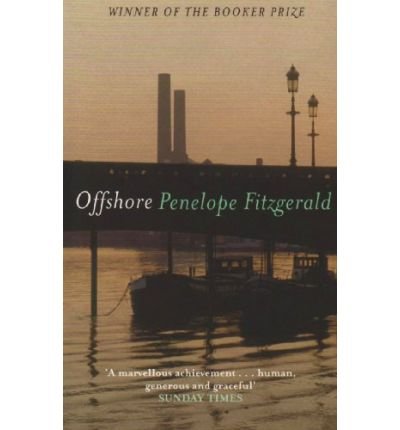 My paperback copy of Offshore [above] is an old Fourth Estate edition with a moody photo of the River Thames at dusk.
Read my review of THE BLUE FLOWER, also by Penelope Fitzgerald.
If you like this, try these other Booker-winning novelists:-
‘Life Class’ by Pat Barker [won the Booker in 1995 with ‘The Ghost Road’]
‘Mothering Sunday’ by Graham Swift [won the Booker in 1996 for ‘Last Orders’]
‘The Children Act’ by Ian McEwan [won the Booker in 1998 with ‘Amsterdam’]
And if you’d like to tweet a link to THIS post, here’s my suggested tweet:
#BookReview OFFSHORE by Penelope Fitzgerald via @SandraDanby http://wp.me/p5gEM4-2n2

 SANDRA DANBY'S BOOK REVIEWS