Tag Archives: slavery

#BookReview ‘James’ by Percival Everett #historical #slavery #HuckleberryFinn

James by Percival Everett is a road trip, a meandering journey of a slave, Jim, as he flees persecution, afraid of being separated from his wife and daughter. As he travels, Jim sees a different world, a world where slaves are not always treated as chattels belonging to white men. Percival EverettA re-telling of Mark Twain’s Huckleberry Finn, James is Jim’s own story. It is wry, sometimes funny, sometimes violent, sometimes poignant. In 1861, when Jim hears he is about to be sold far away from his family, he runs from the town of Hannibal, Missouri and hides on nearby Jackson Island while he decides what to do next. He doesn’t expect to be found so quickly but found he is, by white teenager Huckleberry Finn who has run away from his violent father. And so, familiar from Twain’s novel, they begin a trip down the dangerous Mississippi River, hoping to find the Free States. They encounter friends, foes, tricksters, drunks, runaway slaves, and slaves who are happy to be enslaved. And then they are told there is a war between the North and the South, a war about the end of slavery.
Everett turns on its head the perception of the slave as uneducated, oppressed, a victim. When together, the slaves speak as their true selves, about emotions, love, politics, the natural world, everything that is life. But when with white people the slaves speak a dialect expected by the massas, speech that demonstrates their lack of education, ignorance, subservience, simple-mindedness. Everything the whites assume and expect. But Jim can read and write, he is well-read. In a fever-dream he is visited by the authors of books he has read; Voltaire, Rousseau, Locke. There are some twists; a slave who is so pale-skinned he can pass unnoticed amongst the white folk; a band of minstrels who don blackface to sing badly-composed slave songs; slaves who will betray a runaway to their white masters.
The winding circular structure to the story mirrors their geographical journey, putting Jim in the path of danger many times. Along the way, Everett examines the nature of morality, the hypocrisy of white masters who beat their slaves in the week and go to church on Sunday, the kindness of some strangers, the hatred of others.
James is a fascinating re-telling of a classic novel, at times uncomfortable, lacerating in its irony and punishment of the white owners. A novel I am glad to have read though I can’t honestly say it was enjoyable.

If you like this, try:-
‘My Name is Yip’ by Paddy Crewe
A Thousand Moons’ by Sebastian Barry
The Last Runaway’ by Tracy Chevalier

And if you’d like to tweet a link to THIS post, here’s my suggested tweet:
#BookReview JAMES by Percival Everett https://wp.me/p2ZHJe-82X via @SandraDanby

COMING SOON… THE NEXT BOOK I REVIEW WILL BE:- Verity Bright

#BookReview ‘The Confessions of Frannie Langton’ by Sara Collins #historical

The Confessions of Frannie Langton by Sara Collins tells the story of a Jamaican woman enslaved as a child, exploited by two men and subsequently accused of murder in Georgian London. I am left with the feeling that this debut, though full of lush description and a distinctive heroine, is an ambitious story that would benefit from being given some air to breathe. Sara CollinsFrances Langton, house-slave at Paradise, a Jamaica sugar cane plantation. Frances Langton, housemaid in the home of a London scholar. Frances Langton, the mulatto murderess. Which is the real Frannie? A woman born into slavery in Jamaica then transported to London and gifted to another master, in each place she is studied and manipulated by two men who cannot agree on the pigment of negro skin, the intellectual capacity of blacks and whether they can be educated. There are hints about things that happened to Frannie in her past, things that she did to others – leading I think to the description of the book as ‘gothic’ – some of which are explained by the end, some of which remained vague to me.
This is Frannie’s story, told in her voice, written as she waits in gaol for her trial and written for her lawyer. But we never actually meet this lawyer, he remains a cardboard cut-out so Frannie’s version of the truth remains unverified.We read the sworn testaments of witnesses at her trial, are they the truth or spoken with prejudice and ulterior motives? The book is really two stories – Frannie’s exploitation at Paradise by two men who fancy themselves scientists, and her London lesbian love affair and the murder – that don’t fit together convincingly.
The best thing for me about the book is the character of Frannie, unlike anything I have read recently. The depth of research is evident in the detail but the pacing is unpredictable – Frannie’s voice in the beginning is spellbinding but the middle section is soggy – and I’m intrigued by the scientific exploration of racism. I wanted less of the laudanum addiction and romance between Frannie and her mistress and longed for the trial to be used as the spine on which to hang Frannie’s slave story. A slow read, but definitely an author to watch.

If you like this, try:-
The Mermaid and Mrs Hancock’ by Imogen Hermes Gowar
The Convenient Marriage’ by Georgette Heyer
The Cursed Wife’ by Pamela Hartshorne

And if you’d like to tweet a link to THIS post, here’s my suggested tweet:
#BookReview THE CONFESSIONS OF FRANNIE LANGTON by Sara Collins @mrsjaneymac https://wp.me/p5gEM4-3Us via @SandraDanby

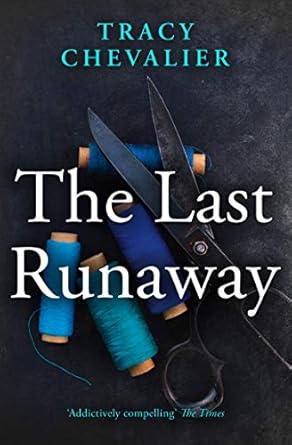
#BookReview ‘The Last Runaway’ by @Tracy_Chevalier #historical

Tracy Chevalier is so skilled at getting under the skin of the protagonist in a specific period whether it’s a 19th century fossil collector or a 15th century Belgian weaver, you always believe her. Honor Bright is a real person from page 1 of The Last Runaway and you are rooting for her. Tracy ChevalierThe book tackles a difficult subject: the rights and wrongs of helping escaping slaves, and the moral issue this poses for Ohio’s Quakers. Honor struggles to understand this sometimes frightening new country with its huge skies and geometrical roads, forthright people and different social rules. Even the air seems strange. “I feel when I am in it as if the air around me has shifted and is not the same air I breathed and moved in back in England, but is some other substance,” she writes to her parents.
Chevalier does her research thoroughly, but feels no need to wave the depth of her research in her reader’s face. Instead it informs every simple description. Woven throughout the book is Honor’s sewing of quilts. Even this is different in Ohio where Honor’s calm nature and precise sewing is admired by the local hat-wearing ladies, but her needle workmanship is deemed overly exact for the local Quaker ladies who prefer to quickly sew appliqué quilts rather than take time to plan traditional patchwork designs.
Strong women play a key role in the book. Honor is a strong character, though perhaps she does not know it. Belle Mills, the local milliner is strong too. Honor describes Belle, “If women were meant to look like doves these days, Belle resembled a buzzard.” The quilt Honor most admires is owned and made by Mrs Reed, a small black woman who decorates her hat with fresh wildflowers.

Read my reviews of Tracy Chevalier’s other novels:-
A SINGLE THREAD
AT THE EDGE OF THE ORCHARD
NEW BOY
THE GLASSMAKER

If you like this, try:-
‘The Signature of All Things’ by Elizabeth Gilbert
‘The Knife with the Ivory Handle’ by Cynthia Bruchman
‘Summertime’ by Vanessa Lafaye

And if you’d like to tweet a link to THIS post, here’s my suggested tweet:
#BookReview THE LAST RUNAWAY by @Tracy_Chevalier via @SandraDanby https://wp.me/p2ZHJe-1iN