Monthly Archives: March 2014

Great opening paragraph 53… ‘Hard-Boiled Wonderland and the End of the World’ #amreading #FirstPara

“The elevator continued its impossibly slow ascent. Or at least I imagined it was ascent. There was no telling for sure: it was so slow that all sense of direction simply vanished. It could have been going down for all I knew, or maybe it wasn’t moving at all. But let’s assume it was going up. Merely a guess. Maybe I’d gone up twelve stories, then down three. Maybe I’d circled the globe. How would I know?”
Haruki MurakamiFrom ‘Hard-Boiled Wonderland and the End of the World’ by Haruki Murakami

Read these #FirstParas from other books by Haruki Murakami:-
DANCE DANCE DANCE
NORWEGIAN WOOD
THE WIND-UP BIRD CHRONICLE

Try one of these #FirstParas & discover a new author:-
‘Mara and Dann’ by Doris Lessing
‘The Ghost Road’ by Pat Barker
‘The L-Shaped Room’ by Lynn Reid Banks

And if you’d like to tweet a link to THIS post, here’s my suggested tweet:
#Books #FirstPara HARD-BOILED WONDERLAND AND THE END OF THE WORLD by Haruki Murakami http://wp.me/p5gEM4-m9 via @SandraDanby

#BookReview ‘The Aftermath’ by @Rhidianbrook #WW2

1946. Post-war Germany, Hamburg. The Aftermath by Rhidian Brook is a gentle novel with an emotionally difficult core: the adjustment of two families, one German one English, to the landscape of rubble a year after the end of the Second World War. Broken country, broken families, broken minds. The title refers to the aftermath of the war and also to the aftermath of events in the lives of both families. Both are grieving and are in new territory, geographically and emotionally. They are proud and unsure. Together, will they heal? Rhidian BrookThe English family: Colonel Lewis Morgan is occupied with the Occupied while his newly-arrived wife Rachael prevaricates, “I don’t know. It was suffix and prefix to her every other thought. This indecision was becoming her signature.” Their son Edmund has no such doubts, facing a challenging encounter with the teenage girl upstairs involving a glimpse of knickers and a steaming pisspot, he then ventures beyond the house’s garden into forbidden territory and meets the local feral youth.
The German family: Herr Lubert, a widower, and his daughter move upstairs when the Morgans arrive in the requisitioned house. Ironically Stefan Lubert is an architect, surrounded by broken buildings, but works instead in a factory while waiting for his papers to arrive which will allow him to practise again. School is closed so Frieda is on the ‘rubble runs’, clearing bricks and rubbish, where she mixes with the feral youth.
They all make their own adjustments to the new situation and for a while it is a quiet, polite tussle for power. Rachael makes changes in the house; she moves plants and drapes a modest cloth over a nude sculpture. She sets herself rules about not fraternising with the Germans, who she believes need punishing. She disagrees with Herr Lubert about a Mies van der Rohe chair which he explains is a Bauhaus design, functionality stripped to simplicity. She says it is uncomfortable.
It is as if each family is trying the other on for size, it is a fascinating observation of ordinary people in extraordinary times. Lewis reflects on the logic of the tasks he must perform: “They blow up a soap factory which employed two thousand Germans, made something everyone needed and had no military value whatsoever and, in return, the Russians send the Germans bread. It was like balancing Hell’s ledger.”
The cover of the book is an attractive, calm monotone and the story is also told in a calm tone; but underneath the emotions are building. As the initial discomfort eases, passion rises.

Read my review of another Rhidian Brook novel:-
THE TESTIMONY OF TALIESIN JONES

If you like this, try:-
The Translation of Love’ by Lynne Kutsukake
Homeland’ by Clare Francis
The Ways of the World’ by Robert Goddard

And if you’d like to tweet a link to THIS post, here’s my suggested tweet:
#BookReview THE AFTERMATH by @Rhidianbrook via @SandraDanby http://wp.me/p5gEM4-So

Great opening paragraph 52… ‘Astonishing Splashes of Colour’ #amreading #FirstPara

“At 3.15 every weekday afternoon, I become anonymous in a crowd of parents and child-minders congregating outside the school gates. To me, waiting for children to come out of school is a quintessential act of motherhood. I see the mums – and the occasional dads – as yellow people. Yellow as the sun, a daffodil, the submarine. But why do we teach children to paint the sun yellow? It’s a deception. The sun is white-hot, brilliant, impossible to see with the naked eye, so why do we confuse brightness with yellow?” Clare MorrallFrom ‘Astonishing Splashes of Colour’ by Clare Morrall

Read my reviews of these other novels by Clare Morrall:-
AFTER THE BOMBING
NATURAL FLIGHTS OF THE HUMAN MIND
THE LANGUAGE OF OTHERS
THE LAST OF THE GREENWOODS
THE MAN WHO DISAPPEARED
THE ROUNDABOUT MAN

Try one of these #FirstParas & discover a new author:-
‘Tipping the Velvet’ by Sarah Waters
‘The Secret History’ by Donna Tartt
‘Queen Camilla’ by Sue Townsend

And if you’d like to tweet a link to THIS post, here’s my suggested tweet:
#Books #FirstPara ASTONISHING SPLASHES OF COLOUR by Clare Morrall http://wp.me/p5gEM4-mc via @SandraDanby

Great opening paragraph… 52

clare morrall - astonishing splashes of colour 10-6-13“At 3.15 every weekday afternoon, I become anonymous in a crowd of parents and child-minders congregating outside the school gates. To me, waiting for children to come out of school is a quintessential act of motherhood. I see the mums – and the occasional dads – as yellow people. Yellow as the sun, a daffodil, the submarine. But why do we teach children to paint the sun yellow? It’s a deception. The sun is white-hot, brilliant, impossible to see with the naked eye, so why do we confuse brightness with yellow?”
‘Astonishing Splashes of Colour’ by Clare Morrall

To read an interview in The Independent with Clare Morrall about her latest book, After the Bombing, click here.

COMING SOON: my review of After the Bombing.

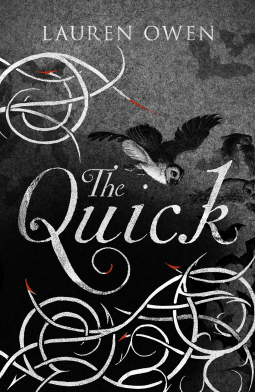
#BookReview ‘The Quick’ by Lauren Owen @pioneers_o #historical

The Quick by Lauren Owen is a gothic tale about a brother and sister from Yorkshire. The story moves between Aiskew Hall – where we first meet Charlotte and James as children – and London; both settings atmospheric, both drawn so clearly you can smell the air. This book will reward re-reading: only after I had finished the last page did I go back to the beginning and appreciate the menace of the first sentence, “There were owls in the nursery when James was a boy.” Lauren Owen Aiskew is ever-present. When they are older and far from home, Charlotte reminds James “… how the air smelled green in spring, and smoke-grey in autumn, how on April mornings the mists would lift slowly, leaving a blue haze behind.”
This book has a really slow build. It starts with a prologue, an excerpt from 1890, which I read and then immediately forgot. I enjoyed Part One about the childhood of James and Charlotte at Aiskew, their mother dead, their father absent, Charlotte teaching James his alphabet by chalking the letters onto flagstones, playing games in the secrets of the big house. When the siblings are parted as James goes to university and then to London, the story starts to move a little quicker. I started to feel expectant, waiting for something to happen. Which of course, it does, and it is creepy and not what I was expecting. For me the story really gets going when Charlotte comes to London. After that, the action comes thick and fast. The tension in the second half is more like a film, making the first part of the book feel as if the author was feeling her way into the story.
Definitely one to read again. And I can see it on television.
CLICK HERE TO READ MORE ABOUT THIS BOOK AT AMAZON

If you like this, try:-
Frog Music’ by Emma Donoghue
The Penny Heart’ by Martine Bailey
Orphans of the Carnival’ by Carol Birch

And if you’d like to tweet a link to THIS post, here’s my suggested tweet:
#BookReview THE QUICK by Lauren Owen @pioneers_o via @SandraDanby http://wp.me/p5gEM4-Rj

#BookReview ‘Holes’ by Louis Sachar #YA #mystery

Holes by Louis Sachar has been sitting on my shelf forever but I picked it up this week when I exhausted my Kindle’s battery. How lovely to hold an actual book again. I know this is a book for tweens, but I’d heard such good things about it that I wanted to see for myself. Louis Sachar I loved the premise: that Stanley is wrongly found guilty of stealing a pair of trainers and is sent to a juvenile correction camp where the punishment is to dig a hole a day. Five feet deep and five feet wide. Every day. It is supposed to be character-building, but Stanley thinks there is another agenda. “There is no lake at Camp Green Lake. There once was a very large lake here, the largest lake in Texas. That was over a hundred years ago. Now it is just a dry, flat wasteland.”
It is a story about finding out who you are, standing up to bullies and finding your bravery. “Out on the lake, rattlesnakes and scorpions find shade under rocks and in the holes dug by the campers.”
Woven in with the day-to-day tale of hole-digging is the background to Stanley’s unlucky family; unluckiness blamed on his no-good-dirty-rotten-pig-stealing-great-great-grandfather. Stanley is a kind of every-boy, who helps a boy worse off than himself and ends up challenging the system.  And Sachar ties up the loose-ends brilliantly.
Not just for kids.
CLICK HERE TO READ MORE ABOUT THIS BOOK

Read my review of THE CARDTURNER, also by Louis Sachar.

If you like this, try:-
The Ship’ by Antonia Honeywell
The Choir’ by Joanna Trollope
The Mystery of Three Quarters’ by Sophie Hannah #3Poirot

And if you’d like to tweet a link to THIS post, here’s my suggested tweet:
#BookReview HOLES by Louis Sachar http://wp.me/p5gEM4-K1 via @SandraDanby

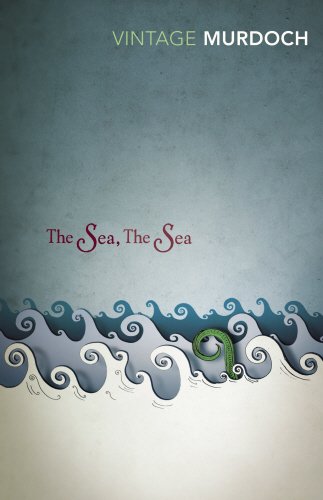
Great opening paragraph 51… ‘The Sea, The Sea’ #amreading #FirstPara

“The sea which lies before me as I write glows rather than sparkles in the bland May sunshine. With the tide turning, it leans quietly against the land, almost unflecked by ripples or by foam. Near to the horizon it is a luxurious purple, spotted with regular lines of emerald green. AT the horizon it is indigo. Near to the shore, where my view is framed by rising heaps of humpy yellow rock, there is a band of lighter green, icy and pure, less radiant, opaque however, not transparent. We are in the north, and the bright sunshine cannot penetrate the sea. Where the gentle water taps the rocks there is still a surface skin of colour. The cloudless sky is very pale at the indigo horizon which it lightly pencils in with silver. Its blue gains towards the zenith and vibrates there. But the sky looks cold, even the sun looks cold.”
Iris Murdoch From ‘The Sea, The Sea’ by Iris Murdoch 

Read these other #FirstParas by Iris Murdoch:-
A SEVERED HEAD
THE PHILOSOPHER’S PUPIL

Try one of these #FirstParas & discover a new author:-
‘The Impressionist’ by Hari Kunzru
‘These Foolish Things’ by Deborah Moggach
‘Sophie’s World’ by Jostein Gaarder

And if you’d like to tweet a link to THIS post, here’s my suggested tweet:
#Books #FirstPara THE SEA THE SEA by Iris Murdoch http://wp.me/p5gEM4-mi via @SandraDanby

Great opening paragraph… 51

iris murdoch - the sea, the sea 10-6-13“The sea which lies before me as I write glows rather than sparkles in the bland May sunshine. With the tide turning, it leans quietly against the land, almost unflecked by ripples or by foam. Near to the horizon it is a luxurious purple, spotted with regular lines of emerald green. AT the horizon it is indigo. Near to the shore, where my view is framed by rising heaps of humpy yellow rock, there is a band of lighter green, icy and pure, less radiant, opaque however, not transparent. We are in the north, and the bright sunshine cannot penetrate the sea. Where the gentle water taps the rocks there is still a surface skin of colour. The cloudless sky is very pale at the indigo horizon which it lightly pencils in with silver. Its blue gains towards the zenith and vibrates there. But the sky looks cold, even the sun looks cold.”
‘The Sea, The Sea’ by Iris Murdoch

#BookReview ‘The Accident’ by Chris Pavone #thriller

The Accident by Chris Pavone is a fast-moving thriller with so many questions. To start with, we have the Prologue about an unidentified man writing a book. This is his third draft of a manuscript called ‘The Accident.’ An excerpt from his m/s finishes: “…if what you are reading is a finished book, printed and bound and distributed into the world, I am, almost certainly, dead.” I was hooked. The Accident is Pavone’s second novel, his favourite thriller writer is John Le Carré and he certainly paces his storytelling the same way. Chris PavoneThe second person we meet is Isabel Reed, a New York literary agent. It is dawn and she has just finished reading a manuscript: ‘The Accident by Anonymous.’ She is astounded at the enormity of the story, the revelations and accusations. As well as being a page-turning thriller, this novel is also an insight of the publishing world in New York and how the connections of power function in the USA: media, publishing, Government, CIA, black-ops. Isabel was once a top literary agent, now she is desperate for the last big m/s. Is this it? She stands under the shower: “It all beats down on her, the shower stream and the manuscript and the boy and the past, and the old guilt plus the new guilt, and the new earth-shattering truths, and fear for her career and maybe, now, fear for her life.” There is a lot we don’t know about Isabel: how come she has this m/s; she thinks about a husband, where is he; she thinks about a child, Tommy, also absent. But the story moves so quickly, I put those questions aside and continued reading.
I admit that at the beginning, I lost track of who was where; so many characters are introduced with anonymous snapshots that I got a bit irritated. Which ‘he’ was this? But I stuck with it and the characters assumed names. The thing that kept me reading was the excerpts from the m/s – as Anonymous tells the story, bit-by-bit we learn more about the secret, the bombshell. So when the murders start to happen, I was expecting death. I was soon picking up my Kindle to grab two minutes reading on the run. Who is doing the killing? Who is the author? Is the m/s true, or revenge?
CLICK HERE TO READ MORE ABOUT THIS BOOK

And here’s my review of another thriller by Chris Pavone:-
THE TRAVELERS

If you like this, try:-
Purity’ by Jonathan Franzen
‘A Hero in France’ by Alan Furst
Wolf’ by Mo Hayder

And if you’d like to tweet a link to THIS post, here’s my suggested tweet:
#BookReview THE ACCIDENT by Chris Pavone via @SandraDanby http://wp.me/p5gEM4-QO

#BookReview ‘Insurgent’ by Veronica Roth #YA #fantasy

Insurgent, second in the fantasy trilogy by Veronica Roth, is action-led and the pace fairly trips along. Everyone living in the post-dystopian city of Chicago belongs to one of five factions, each represents a human virtue. When the factions disagree, there is a struggle for power. Veronica RothHeroine Tris is a complex mixture of two factions: her upbringing in Abnegation [considerate, selfless] and her adopted faction Dauntless [brave, daring, reckless]. This dangerous mixture gets her into trouble and that drives the story along. She is confrontational, brave, but often makes questionable decisions. She distrusts Four’s father and believes he is misleading them: ‘…sometimes, if you want the truth, you have to demand it.’ Demand, not ask: this tells me more about Tris than about Four’s father Marcus.
As this is the second novel of the trilogy there is more time for characterisation, we see more of Tris’s inner world in Insurgent compared with Divergent. She is maturing into her divergent personality, ‘I drift off to sleep, carried by the sound of distant conversations. These days its easier for me to fall asleep when there is noise around me. I can focus on the sound instead of whatever thoughts would crawl into my head in silence. Noise and activity are the refuges of the bereaved and guilty.’ And she is both.
I had difficulty keeping track of the huge list of characters and longed for a cast list. But more importantly is the lack of clarity about the main enemy: who is it? There’s lots of infighting to keep track of too, petty squabbles some of which have carried forward from the first book and which I had forgotten. I made the mistake of not reading the books back-to-back which would have really helped.
Tris’s confusion reminded me of my teenage years, confusion is universal: ‘Sometimes I feel like I am collecting the lessons each faction has to teach me, and storing them in my mind like a guidebook for moving through the world. There is always something to learn, always something that’s important to understand.’ Like all young people, Tris must learn there is no cut-off date by which she will have learned everything, adults continue to learn until they die.
CLICK HERE TO READ MORE ABOUT THIS BOOK AT AMAZON

Click the title to read my reviews of the other books in this series:-
DIVERGENT #1DIVERGENT
ALLEGIANT #3DIVERGENT

If you like this, try:-
Beneath the Keep’ by Erika Johansen #prequelTearling
Children of Blood and Bone’ by Tomi Adeyemi #1LegacyofOrisha
La Belle Sauvage’ by Philip Pullman #1TheBookOfDust

And if you’d like to tweet a link to THIS post, here’s my suggested tweet:
#BookReview INSURGENT by Veronica Roth via @SandraDanby http://wp.me/p5gEM4-Po