
I admit to loving the premise of this book when I first heard about it. A Dead Letter Depot where researchers reunite lost letters with senders and recipients. The Lost Letters of William Woolf by Helen Cullen left me wishing for more. It promised to be a novel about letters and mystery and turned into one focussed on a struggling marriage, which was not what I expected. 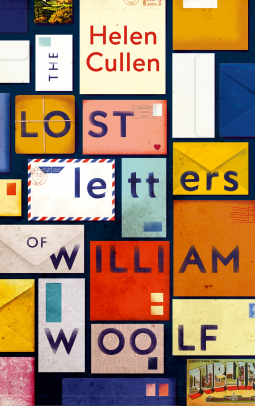 William’s marriage to Clare has gone stale and to avoid confronting what must change, he becomes obsessed by his work at the Dead Letter Depot and in particular the letters from someone called Winter addressed to ‘My Great Love’. In his vulnerable state, William begins to imagine that he may be that person and sets out to find her. Interspersed with this task we see William correctly fulfil his role, taking a lost fossil to the correct museum for example.
I switched between liking the character of William with being frustrated at his unrealistic romanticism, and could understand Clare’s frustrations. Ditto, she seemed impatient and too inclined to throw stones in a glasshouse. Clearly they were not communicating, ironic in a book about writing letters, and neither completely held my sympathy.
So what kept me reading? The lost letters, the mystery of Winter’s identity and to whom she was writing. And there lies one disappointment: the solution to Winter’s was such an anti-climax I had to flick back through the book to find an earlier reference in order to appreciate the revelation. I had two other disappointments. As much as I loved the concept of the Dead Letter Depot, a small voice in my head kept saying: it isn’t real, it wouldn’t get funding, it should be one man at a desk not a department with enough staff or budget for a Fancy Dress Fundraiser, and shouldn’t the lost letters be old not recently posted. I was also unclear of the timeline of the story. William and Clare feel like a 21st century couple living in the 1980s, pre-mobiles, pre-tablets. Something jarred and it would not go away.
This novel could have been so much more if there was less about the fragile relationship between William and Clare and more about the Dead Letter Depot, William’s fellow workers and the cases they worked on. But it is nicely written and if you are looking for an easy-to-read romance for your holiday, you will probably love it.
If you like this, try:-
‘Butterfly Barn’ by Karen Power
‘Forever Fredless’ by Suzy Turner
‘Girl in Trouble’ by Rhoda Baxter
And if you’d like to tweet a link to THIS post, here’s my suggested tweet:
#BookReview THE LOST LETTERS OF WILLIAM WOOLF by Helen Cullen @wordsofhelen https://wp.me/p5gEM4-3oH via @SandraDanby
 “I have had many copies of the book over the years but this one [above] is my favourite as it contains all three books in the series. Part of its enduring appeal for me is the characters who are all just flawed enough to make them endearingly frail and human. My favourite character is Jo who is unruly and tempestuous and rails against the confines of poverty and the expectation that women should conform to the domestic role expected of them rather than pursue any ambitions of their own. There is also a small broken piece of my heart that will forever be in thrall to Beth who shows just how much a small life can matter and influence those around it.
 Each murder brings him one step closer to the perfect death. Ex-priest, DI Farrell is called on to investigate a gruesome death in rural Scotland. All evidence points to suicide, except for one loose end: every light in the cottage was switched off. Why would he kill himself in the dark?
 What is a ‘Porridge & Cream’ book? It’s the book you turn to when you need a familiar read, when you are tired, ill, or out-of-sorts, where you know the story and love it. Where reading it is like slipping on your oldest, scruffiest slippers after walking for miles. Where does the name ‘Porridge & Cream’ come from? Cat Deerborn is a character in Susan Hill’s ‘Simon Serrailler’ detective series. Cat is a hard-worked GP, a widow with two children and she struggles from day-to-day. One night, after a particularly difficult day, she needs something familiar to read. From her bookshelf she selects ‘


 Directed by Alfred Hitchcock, Rebecca won 11 Oscar nominations and won two – for Best Picture and Cinematogrophy. Watch the trailer here.
 Various television adaptations include the 1979 BBC production [above] starring Jeremy Brett as Maxim, Joanna David as the second Mrs de Winter, and Anna Massey as Mrs Danvers. Watch the first episode here.


 SANDRA DANBY'S BOOK REVIEWS