
None of us have the luxury of hearing what is said about us after we are dead. In Fred’s Funeral, Canadian author Sandy Day tells the story of one soldier, returned from the First World War, who felt misunderstood and sidelined by his family. Only when he dies in 1986, seventy years after he went to war, does he observe his own funeral and find out what they really think of him. 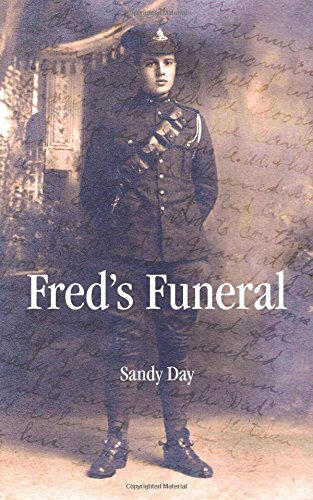 Fred Sadler has lived his post-fighting years in one institution or another. Clearly he is suffering from some form of shell shock or Post-Traumatic Stress Disorder but this goes undiagnosed. There are periods of living in boarding houses, his family is unwilling to have him live with them, until his behaviour deteriorates and he is sent back to hospital. Now dead and trapped as an unwilling ghost, Fred observes his funeral presided over by Viola, the sister-in-law he always disliked. As the mourners sit around and share memories of Fred, he watches, frustration mounting, as he is unable to correct their observations. They portray a ‘Fred Sadler’ which he does not recognise. I kept expecting something to happen; a true memory of the war, an event, which would explain Fred’s illness and set the record straight with his family. But it didn’t come. The story is told in linear fashion; the anecdotes of Viola and the remaining family are interchanged with Fred’s reaction to these stories plus a few flashbacks to the war. Clearer signposting of these sections would make reading easier.
Day clearly captures the time and place of post-Great War Canada, a subject which is new to me. However I found the repeated digressions into the extended family history and details of the lifestyle a distraction from the main story [so many cousins, great-great grandparents and houses]. I so wanted to cut some of these unrelated sections to allow a stronger novel to push its way to the surface; simpler, more powerful. The inclusion of so many family details makes me wonder if the core of Fred’s Funeral is a memoir, inspired by a real family, from which the author feels unable to cut some relations and take the leap into pure fiction.
The portrayal of Fred’s experience at Whitby Hospital for the Insane is heart breaking, as is the disinterest of his family. For them, Fred is an embarrassment. It is a sad indictment of our treatment of soldiers returning from war and our ignorance that the effect of fighting can last a lifetime. It is easy to assume that in the 21st century this has changed, but the modern day strand of Day’s story suggests it hasn’t. It is as if Fred’s life has paused. “He banished feeling anything long ago. He feels timid. He feels tentative, like every step he takes is on a thick layer of ice and at any moment, he might crash through into a frenzy of drowning.”
At the end of the novel, there is no ‘reveal’, no surprise, and I felt a little let down. Overall, this is a thoughtful examination of how family tensions, petty jealousies and misunderstandings can spread down the generations. Gossip and guesses are transformed into ‘truth’.
If you like this, try:-
‘Etta and Otto and Russell and James’ by Emma Hooper
‘Wake’ by Anna Hope
‘Yuki Chan in Bronte Country’ by Mick Jackson
And if you’d like to tweet a link to THIS post, here’s my suggested tweet:
#BookReview FRED’S FUNERAL by Sandy Day https://wp.me/p5gEM4-35o via @SandraDanby


 “When I feel I haven’t had a book grab me in a while, or if I’m in a reading slump, I turn to this book, which is normally about once a year or more if I need it. One thing that draws me back to the book is the emotions in the book and how they have changed as I grew. What I take from the book and how I relate to the characters has changed over the years, it is a brand new book every time I read it. When I first read it I identified with Mark, the main character, but as now that I have my own family I identify with his mum and his lawyer.
 Bronagh seems to have it all; her own flat, a fantastic new job as a party planner and a blossoming romance with long-term friend, Max. Little does she know that someone is plotting to take everything away from her.
 What is a ‘Porridge & Cream’ book? It’s the book you turn to when you need a familiar read, when you are tired, ill, or out-of-sorts, where you know the story and love it. Where reading it is like slipping on your oldest, scruffiest slippers after walking for miles. Where does the name ‘Porridge & Cream’ come from? Cat Deerborn is a character in Susan Hill’s ‘Simon Serrailler’ detective series. Cat is a hard-worked GP, a widow with two children and she struggles from day-to-day. One night, after a particularly difficult day, she needs something familiar to read. From her bookshelf she selects


 “I first read it when I was about fifteen. I have always loved westerns, but this is probably the best western I have ever read. I bought it because I like the author’s style and stories. He is above all a great storyteller. I bought it in the winter and thoroughly enjoyed it. It has a great sense of ‘place’ with writing truly evocative of a cold, frozen climate. I read it every winter and never tire of it. It would in reality be strange to read it in the summer.
 The plot: “King Mabry, an aging gunfighter and cattleman, is travelling to Cheyenne across frozen wastes and is being hunted for what he knows and the gold he is carrying. Thwarting his pursuer, he comes across a troupe of players (being led astray by outlaws), he is attracted to one of troupe and returning to help against his better judgement, tracks them and tries to help. Wounded, he is aided by one of the troupe who escapes. Travelling together they fight Indians, the weather and finally the outlaws in a tense action filled showdown. It is a perfect story of relationships, growth of spirit, survival and romance.”
 Rupert Brett is back and it is 1995, with the property markets raging and the Sub-Prime madness just beginning. The Irish Sea, a shipment of drugs is intercepted, the IRA lose the cocaine and their most feared enforcer, Tir Brennan, is captured. Deauville, a wealthy French aristocrat has a terrible accident with far reaching consequences. Bogota, the head of the old drug cartels is dead and Ballesteros is now running new routes to the US and beyond. The events are all linked and somehow drugs are being smuggled with impunity across the globe. With a source originating in Palm Beach, US, Rupert Brett is again asked to go undercover, with SAS Sergeant Chris Adams as protection. They must find out how the drugs are being smuggled into the corporate world of property, polo and high finance. The answers run deeper than either could imagine and a dangerous former nemesis returns, throwing their lives into turmoil.
 SANDRA DANBY'S BOOK REVIEWS