
Aultbea, a small fishing village on the shores of Loch Ewe on the west coast of Scotland, was transformed during World War Two into a Royal Navy base for the Arctic convoys. Into this true history Fiona Valpy weaves the fictional story of Flora Gordon in The Skylark’s Secret. 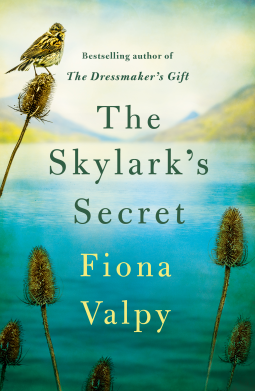 In 1977, Lexie Gordon returns to Loch Ewe from London after the death of her mother Flora. Lexie arrives home a single mother to baby Daisy, her West End singing career broken because of her damaged vocal chords. She feels a failure, gossiped about by the locals, seen as an outsider. Living in her mother’s cottage, she becomes curious about the father she never met and who her mother never spoke freely about.
In this dual timeline story, the narrative alternates clearly between Lexie in the Eighties and Flora in 1940-1944. Flora lives with her widowed father, Iain, gamekeeper for local estate Ardtuath House, in a quiet village where the toughest enemy is the weather. Then one day a fleet of warships arrive, the first of many. Loch Ewe is to become the temporary base for the Home Fleet. As thousands of navy ratings and officers arrive, Iain and Flora hope her brother Ruaridh will be aboard one of the destroyers. The convoys are to change life by the loch forever. Flora and her two friends Bridie and Mairi enlist in the Wrens as drivers. Laird’s son Alec also returns home with an English girlfriend. When Alec admits his lifelong love for Flora, the two young people must face the disapproval of the intimidating laird. With both Alec and Ruaridh on separate ships accompanying the Arctic convoy of merchant ships sailing for Russia, Flora fears for their lives. Meanwhile, a group of evacuees arrive from Glasgow, including two ragamuffins who lodge with bossy but kind-hearted Moira Carmichael.
Valpy unravels the story of Flora’s war years, the hardships, the danger, the exhilarating moments of freedom when the two young men arrive home safe. But always on the horizon is the next convoy which must face the twin dangers of Arctic ice and marauding U-boats. In 1978, Lexie must make a place for herself and Daisy in the community which includes her mother’s old friend Bridie, Lexie’s schoolfriend Elspeth, and fisherman Davy. She feels a stranger and takes to walking the hills, remembering times with her mother, trying to find her place in the world.
This is a story of wartime courage, romantic entanglements, fear, grief and gratitude for sacrifices made. A well-researched book that shows that research with a light hand on the page, allowing the fictional story room to breathe. Excellent.
Here’s my review of another Fiona Valpy novel:-
THE SKY BENEATH US
If you like this, try:-
‘Mrs Sinclair’s Suitcase’ by Louise Walters
‘The Paying Guests’ by Sarah Waters
‘Another You’ by Jane Cable
And if you’d like to tweet a link to THIS post, here’s my suggested tweet:
#BookReview THE SKYLARK’S SECRET by Fiona Valpy @FionaValpy https://wp.me/p5gEM4-53P via @SandraDanby



 Maggie explains, “Workhouse Orphan, inspired by a brave young man way back in my family history and dedicated to him, tells the story of a boy forced at a very tender age to leave his siblings behind in their grim London workhouse and work down a Yorkshire coal mine. Despite the hardships he encounters, he never loses sight of his wish to reunite the family. While not originally intended to be a book for children – it’s actually suitable for anyone with an interest in social history – I’ve been told by parents that it’s made a good bedtime read and given their own offspring cause to realise how lucky they are!”
 What is a ‘Porridge & Cream’ book? It’s the book you turn to when you need a familiar read, when you are tired, ill, or out-of-sorts, where you know the story and love it. Where reading it is like slipping on your oldest, scruffiest slippers after walking for miles. Where does the name ‘Porridge & Cream’ come from? Cat Deerborn is a character in Susan Hill’s ‘Simon Serrailler’ detective series. Cat is a hard-worked GP, a widow with two children and she struggles from day-to-day. One night, after a particularly difficult day, she needs something familiar to read. From her bookshelf she selects


 Thomas’s best known poem has been referenced frequently in popular culture. In the 1996 film Independence Day, the president gives a rousing speech to his bedraggled army as they prepare to fight the aliens, saying “We will not go quietly into the night.”
 In the 2014 film Interstellar, the poem is quoted frequently by Michael Caine’s character, Professor John Brand, while Matthew McConaughey and Anne Hathaway are sent into hyper sleep with the words, “Do not go gentle into that good night.”


