#GuestPost ‘Short Story Talk’ by Amanda Huggins @troutiemcfish #shortstories #amwriting

A warm Yorkshire welcome today to my blog to short story writer Amanda Huggins, a 2018 Costa Short Story Award runner-up, who has clear ideas about writing the short form. Welcome Amanda! Amanda Huggins“There’s been talk in recent years of a short story renaissance. In January 2018The Bookseller magazine reported that sales of short story collections were up 50%, reaching their highest level in seven years. However, this turned out to be largely due to a single book — Uncommon Type by Tom Hanks. This January the news was all about poetry — sales were up 12% in 2018, for the second year in a row.

“It’s great to see a renewed interest in both forms — certainly a couple of independent bookshops I’ve talked to this week have confirmed that short story sales are up — and more collections are being featured in review columns. There was also the buzz around Kristen Roupenian’s short story, ‘Cat Person’, published in the New Yorker at the end of 2017, which really resonated with a younger audience. Whatever you thought of that story, it was all good publicity for the short form.”

Amanda Huggins

Four books on Amanda’s ‘To Read’ pile

“As a writer, I know that crafting a two thousand word story requires a different set of skills to novel writing, and the former should never be seen as practice for the latter — a short story isn’t a miniature novel any more than a novel is a protracted short story. Although short fiction is suited to the pace and attention span of the modern world, some readers say they don’t read shorts because they can’t lose themselves in the story the way they can in a novel. It is true that they demand your fine-tuned focus, they seek to be read straight through, and every sentence weighs in heavy because it has to earn its place. Yet all these things bring their own rewards. A cracking story will repay your time and attention by leaving you with something to think about for days after you’ve read it.

“When I’ve finished reading a novel I often pass it on, however I usually keep short story collections and return to them over the years in the same way that I do with poetry. I have countless favourites, many by established authors, but also a growing number by emerging short story writers. The collections on my shelves include books by William Trevor, Tessa Hadley, Helen Simpson, Helen Dunmore, Raymond Carver, AL Kennedy, Wells Tower, Stuart Evers, Miranda July, Yoko Ogawa, KJ Orr, Ernest Hemingway, Taeko Kono, Haruki Murakami, Richard Ford, Alice Munro, Flannery O’Connor, Anton Chekhov, Nikolai Gogol, Annie Proulx, Isaac Babel, Angela Readman, and AM Homes.”

Amanda Huggins

Amanda’s laden bookshelf

“Stylistically, Hemingway’s short stories are near the top of my list — his concise, declarative sentences; his restricted choice of words and sparing use of adjectives; the cadence, the deliberate repetition — all deceptively simple. He summed it up perfectly himself: “If a writer of prose knows enough about what he is writing about, he may omit things that he knows and the reader, if the writer is writing truly enough, will have a feeling of those things as strongly as though the writer had stated them.”

“For fresh contemporary writing, I really like Miranda July. Her stories are unsettling, quirky, alternately grounded and surreal, oddball, off-beat, skewed. Yet they betray vulnerability, and are both raw and poignant.

“I’m also a huge fan of Japanese writing — novels, novellas and short stories. Japanese literature is often poetic, quiet, unhurried, and that way of writing suits the short story form. Sparing and effective use of language, subtlety and nuance, a certain elusiveness, all demand that the stories are read slowly, and that they are re-read and savoured. These are the qualities that draw me back again and again, and the tales of yearning and loss, of not quite belonging, all resonate with the themes I explore in my own fiction. I admire Murakami’s short stories, and really enjoyed his recent collection, Men Without Women. Murakami is renowned for his surreal writing, yet I prefer his stories when he writes of single men and smoky bars, lonely hearts and enigmatic women. I also love the short stories and novels of Yoko Ogawa. Like Murakami, her writing is often surreal, and can be unsettling and even grotesque. She is adept at self-observation and dissecting women’s roles in Japanese society. Taeko Kono explored women’s roles too, burrowing deep beneath the routines of daily life to reveal a disturbing underbelly — and who could resist a collection called Toddler Hunting and Other Stories?

“One of the funniest scenes I’ve ever come across in a short story is in Kazuo Ishiguro’s ‘Come Rain or Come Shine’, from his collection, Five Nocturnes. The description of the protagonist pretending to be a dog in order to cover up the accidental damage he has caused in his friend’s apartment made me cry laughing. I’ve only read the story once — I think I’m frightened something will be lost if I read it again, that the humour was somehow magnified by my particular mood at the time I read it!

“To conclude, I’d like to talk a little about my favourite collection from last year, which was Helen Dunmore’s Girl Balancing. I’m a big fan of Dunmore’s writing and The Siege is one of my all time favourite books. My favourite stories in this final collection of her short fiction are in the first section, ‘The Nina Stories’— and in particular I love the title story, ‘Girl Balancing’. These stories are almost notes for a novel-in-waiting; a sequence of vignettes centred around a girl called Nina, set in the 60s/70s. They are painstakingly intense; attention is paid to Nina’s every moment and action, and there are some lovely period details that evoke a strong sense of place. The writing turns the mundane into something beautiful, and the final story soars. Seventeen-year-old Nina is left alone on Christmas Day in a house at the seaside. She goes roller skating along the seafront with her friend, Mal, and when the mood turns, she must outwit him. I’ll leave you to find out for yourself if she succeeds.”

Amanda’s Bio
Amanda Huggins is the author of the short story collection, Separated From the Sea (Retreat West Books), and the flash fiction collection, Brightly Coloured Horses (Chapeltown Books). She was a runner-up in the 2018 Costa Short Story Award, and has been shortlisted and placed in numerous other competitions, including the Colm Toibin International Short Story Award and the Bath, Bridport, and Fish flash fiction prizes. She is also a published poet and award-winning travel writer, currently shortlisted for this year’s Bradt New Travel Writer of the Year Award. Amanda grew up on the North Yorkshire coast, moved to London in the 1990s and now lives in West Yorkshire. She works full-time in engineering and is writing her debut novella.

Amanda’s Links
Blog
Twitter @troutiemcfish
Retreat West Books
Chapeltown Books 

Amanda’s books
Amanda Huggins
Read my reviews of Separated from the Sea
Amazon

Amanda Huggins… and Brightly Coloured Horses.
Amazon

And if you’d like to tweet a link to THIS post, here’s my suggested tweet:
Talking #shortstories with prizewinner @troutiemcfish #amwriting https://wp.me/p5gEM4-3Qu via @SandraDanby

#BookReview ‘When All Is Said’ by Anne Griffin #Irish #contemporary

This book stayed with me a long time after I finished it. Three words sum up When All is Said by Anne Griffin. Masterful. Emotional. Funny. It is the story of Maurice Hannigan as he sits at a bar one evening. He drinks a toast to five people and tells the story of his life. It is one of those Irish novels which makes your emotions tingle and say ‘yes, it is like that’, which makes tears prick your eyes and laughter rise in your chest. This is Griffin’s debut novel but she is an accomplished prizewinning writer who knows how to tell a story. It is unbearingly touching and will, without fail, make you cry. Anne GriffinMaurice is in the bar of the Rainsford House Hotel in Rainsford, Co Meath, Ireland. At the beginning we don’t know why he is there, the first few pages are an introduction to Maurice, how he feels his age, as he conducts an imaginary conversation with his son Kevin who lives in America. His first drink is a bottle of stout and as he drinks, he tells the story of his brother Tony and their childhood. A key incident in this section has reverberations throughout Maurice’s life and throughout this novel; a gentle reminder that we all may grow old, we may live in the same place or move away, but our childhood and our actions stay with us. We are introduced to Emily, owner of the hotel, and Svetlana, barmaid. Griffin has a talent with sense of place; she makes the hotel come alive.
Four more drinks follow. For Molly, a glass of Bushmills 21-year old malt. For Noreen, a bottle of stout. For Kevin, a rare whiskey, Jefferson’s Presidential Select. And for his wife Sadie, Maurice drinks a glass of Midleton whiskey. “Svetlana places my final drink down in front of me: Midleton, you can’t fault it. Majestic stuff. I look at it like she has just handed me the keys to a new harvester. It’s the autumn colours that get me. It’s the earth of it, the trees, the leaves, the late evening sky.”
As each story is told, Anne Griffin weaves in the present day so the two strands blend and the past explains Maurice’s situation, why he feels as he does, why he longs for what he longs for. This is a beautiful Irish novel about love, dyslexia, grumpiness, family, bullying, forgiveness and whiskey. I loved it and didn’t want it to end.

Read my review of LISTENING STILL, also by Anne Griffin.

If you like this, try:-
A History of Loneliness’ by John Boyne
Brooklyn’ by Colm Tóibín 
That They May Face the Rising Sun’ by John McGahern

And if you’d like to tweet a link to THIS post, here’s my suggested tweet:
#BookReview WHEN ALL IS SAID by Anne Griffin https://wp.me/p5gEM4-3Qg via @SandraDanby

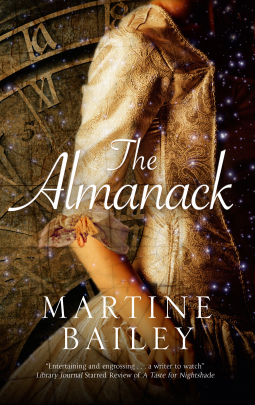
#BookReview ‘The Almanack’ by @MartineBailey #historical #mystery

In 1751, eleven days were lost as Britain aligned with the Gregorian calendar and this is the year in which Martine Bailey sets her third novel, The Almanack. An original mixture of historical mystery, detective novel and romance, it has time as its theme throughout. The passing of time and the fixedness of the past, the slippery unpredictability of the future, and the way our choices made today can impact on the time to come. Martine BaileyTabitha Hart is travelling north from London, home to a village near Chester, summoned by a plea from her mother. On route she is robbed and arrives at Netherlea in shredded clothing to find her mother recently drowned. Tabitha left Netherlea in disgrace and her return is not welcomed by village gossips and officials but she refuses to ignore worries about the nature of her mother’s death. Consulting her mother’s Vox Stellarum, the Chester almanack, she discovers handwritten notes outlining her fears of someone called ‘D’. A childhood friend now village constable, widower Joshua Saxton, offers solid, reliable support as Tabitha struggles to stay in the village, caring for Bess, the baby daughter she left behind with her mother. It is clear Joshua is fond of Tabitha but she does not return his affections; awkwardness complicated when she meets Nat Starling, lodger at Eglantine Hall, a writer of ‘penny oracles, horoscopes and dream lore.’ Tabitha starts to make connections between her mother’s suspicions and the predictions in the printed almanac, written by De Angelo. Could this be the ‘D’ who threatened her mother? But there are many people in the village with the initial ‘D’. Who can she trust?
Almanacks, or printed yearbooks, not only contained a calendar, festival dates, seasonal notes, sunrise and sunset times, planetary alignments, historical facts and other country lore but also riddles, predictions and horoscopes. Exactly the sort of thing hack Nat Starling writes to scratch a living. The theme of time breathes in every chapter, together with the lost eleven days in 1751 that confused the established seasonal calendar. Although the past cannot be changed, memories of the past may vary between people and written records can be amended to tell a different version of the truth. Lies told in the past may in the future be deemed historical fact. And so Starling thinks on the river of time: ‘If he was standing here in the now, then to the left, downriver, the past was disappearing away into the night. Time past could never be changed: what was done was done. If only the past did not stay fixed like dead flies in amber. If only he could live his life again.’
A thoroughly enjoyable historical mystery, there is so much detail in this book it will repay reading. I did not fully engage with the riddles – one precedes each chapter – based on original riddles, with the answers written at the back of the book. Bailey manages the twists and turns of the plot, efficiently hiding the identity of ‘D’ until I finally guessed correctly just before the end. This is Bailey’s third novel and another brilliant read, evidence of her mastery of her period and intricate plotting.

And here are my reviews of other novels by Martine Bailey:-
THE PROPHET #2TABITHAHART
AN APPETITE FOR VIOLETS
THE PENNY HEART

If you like this, try this:-
‘The Cursed Wife’ by Pamela Hartshorne
Orphans of the Carnival’ by Carol Birch
Dark Aemilia’ by Sally O’Reilly

And if you’d like to tweet a link to THIS post, here’s my suggested tweet:
#BookReview THE ALMANACK by @MartineBailey https://wp.me/p5gEM4-3QV via @SandraDanby

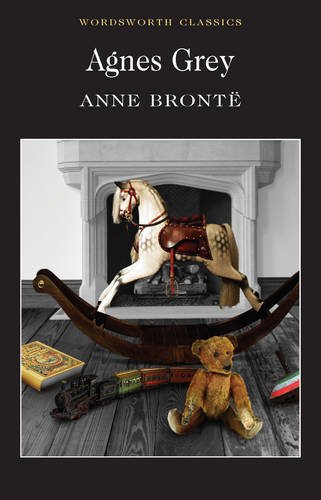
Great Opening Paragraph 114… ‘Agnes Grey’ #amreading #FirstPara

“All true histories contain instruction; though, in some, the treasure may be hard to find, and when found, so trivial in quantity, that the dry shrivelled kernel scarcely compensates for the trouble of cracking the nut. Whether this be the case with my history or not, I am hardly competent to judge. I sometimes think it might prove useful to some, and entertaining to others; but the world may judge for itself. Shielded by my own obscurity, and by the lapse of years, and a few fictitious names, I do not fear to venture; and will candidly lay before the public what I would not disclose to the most intimate friend.”
Anne BrontëFrom ‘Agnes Grey’ by Anne Brontë

Here’s the #FirstPara of JANE EYRE by Anne’s sister, Charlotte Brontë.

Try one of these #FirstParas & discover a new author:-
‘Love in the Time of Cholera’ by Gabriel Garcia Marquez
‘In Cold Blood’ by Truman Capote
‘Family Album’ by Penelope Lively

And if you’d like to tweet a link to THIS post, here’s my suggested tweet:
#Books #FirstPara AGNES GREY by Anne Brontë http://wp.me/p5gEM4-2xM via @SandraDanby

#BookReview ‘Blackberry and Wild Rose’ by @Soniavelton #historical #Huguenot

Blackberry and Wild Rose, the debut novel of Sonia Velton, is entrancing. So many novels are hyped prior to publication but disappoint on reading. This does not. Carefully imagined and cleverly plotted, it kept me reading until the end. It reminded me of Tracy Chevalier’s early novels in which the reader is immersed in a historical world down to the smallest detail. Sonia VeltonBlackberry and Wild Rose tells the story of two women in eighteenth century Spitalfields, London, where the houses are full of weavers and looms clatter every hour of daylight, set alongside the everyday noise, bustle and smells of market stalls, shops, inns and bawdy houses. In 1768, Sara Kemp arrives in Spitalfields from the country, sent away from home by her mother for something she does not understand. Obviously alone and lost, she is taken up by Mrs Swann and put to work in her brothel. Esther Thorel is an Englishwoman married to a Huguenot master of silk. Dissatisfied with her life with a husband obsessed by his business, Esther paints naturalistic flowers which she longs to see reproduced in silk. Dismissed by her husband, instead she fulfils the role expected by her husband and does good works with other Huguenot wives. When the paths of the two women cross one day outside the Wig and Feathers tavern, the lives of many people change. Sara, trying to escape Mrs Swann, must pay an unaffordable sum of money for her freedom. Esther pays the debt and employs her as maidservant in her household. Esther’s husband Elias is unaware of Sara’s background. Both women are blind to each other’s plight. Esther sees Sara as a charitable case, simply helped; Sara despises Esther’s inability to see the truth in front of her nose. It is apparent that there is one set of rules for men, another for women. Though so different, Sara and Esther are essentially trapped by their sex and by their roles, and dependent on the prosperity of the Thorel silk business.
Eighteenth century silk weaving was a highly competitive business, threatened by the import of light, cheap printed cottons imported by the East India Company. As the margins of the masters, including Thorel, are cut, the wages of their journeymen weavers are cut too. The weavers gather together in ‘combinations’, early trade unions, to press their case. Some are militant, issuing ultimatums. Some are violent. As this instability threatens the Thorel livelihood, Esther and Sara individually set off on paths which lead them into a conflict which ends in death. Both must make decisions; to tell the truth and suffer, or to lie and survive.
The woman are credible, contradictory, selfish, generous, often peevish and unlikeable. They are not modern women, with the morals and expectations of modern life, placed into a historical setting. Although both are independent and often wilful, they are eighteenth century women and so may not be to the taste of some readers. The men are similarly selfish, ambitious, deceitful and nasty – with one or two exceptions – and utterly believable. These are not stereotypes, there are characters which redeem faith in human nature, but this is not a novel in which the role of women is enhanced from the factual truth of the time. The story ends with a trial at which the judge says, ‘I understand that all this is difficult for you – a servant and a woman – to understand…’ But the men in this story underestimate the women at their peril.
The story of Esther, silk designer, is loosely based on the real Anna Maria Garthwaite, whose patterns and silks can be seen in London’s Victoria & Albert Museum. The title of the novel is one of Esther’s designs. Excellent.

If you like this, try:-
The Cursed Wife’ by Pamela Hartshorne
The Mermaid and Mrs Hancock’ by Imogen Gowar Hermes
The Penny Heart’ by Martine Bailey

And if you’d like to tweet a link to THIS post, here’s my suggested tweet:
#BookReview BLACKBERRY AND WILD ROSE by @Soniavelton https://wp.me/p5gEM4-3Q4 via @SandraDanby

#BookReview ‘Nemesis’ by Rory Clements #thriller #WW2

Nemesis by Rory Clements is the third in his Tom Wilde series which sees the American-born Cambridge professor tangle with more spies as Britain enters the Second World War. It is a page-turning read that I galloped through despite a few moments of confusion about who was double-crossing who; to the point where I started to distrust everyone except Tom. Rory ClementsIt is September 1939 and a strange time, the pause before war starts when sandbags are filled and the propaganda starts. Wilde, on holiday in southern France with girlfriend Lydia, negotiates the release of a former student, a brilliant chorister, from an internment camp. Marcus Marfield fought for the International Brigade in the Spanish Civil War and seems to be suffering from PTSD. Wilde returns him to Cambridge though feeling uneasy about the circumstances of Marcus’s release. Marcus’s behaviour is worrying. Clements includes many of the characters featured in the earlier two books, including British spy Philip Eaton, doctor Rupert Weir and fellow don Horace Dill.
Critical at this stage of the war was America joining the Allies but two unrelated incidents spread bad PR in the US; the ambassador in Paris escapes assassination and a British ship The Athenia, carrying American civilians, is sunk. On board are the wife and children of Jim Vandenberg, Tom’s contact at the US Embassy. As Jim waits for news of his wife and sons, strange things start to happen around Marcus Marfield and Tom is pulled into the investigation. Though unqualified, he has a skill for spying and takes to it eagerly, always riding his distinctive Rudge motorcycle.
This is a fun, gripping series set at a fascinating time in Britain’s history when each side was plotting to win the propaganda war and influence America. It tempts me to start reading Clements’ Elizabethan spy novels.

Click the title to read my reviews of the other books in the Tom Wilde series:-
CORPUS #1TOMWILDE
NUCLEUS #2TOMWILDE
HITLER’S SECRET #4TOMWILDE

A PRINCE AND A SPY #5TOMWILDE
THE MAN IN THE BUNKER #6TOMWILDE
THE ENGLISH FUHRER #7TOMWILDE
A COLD WIND FROM MOSCOW #8TOMWILDE

And from the Sebastian Wolff series:-
MUNICH WOLF #1SEBASTIANWOLFF

If you like this, try:-
A Hero in France’ by Alan Furst
An Officer and a Spy’ by Robert Harris
Day’ by AL Kennedy

And if you’d like to tweet a link to THIS post, here’s my suggested tweet:
#BookReview NEMESIS by Rory Clements https://wp.me/p5gEM4-3PU via @SandraDanby

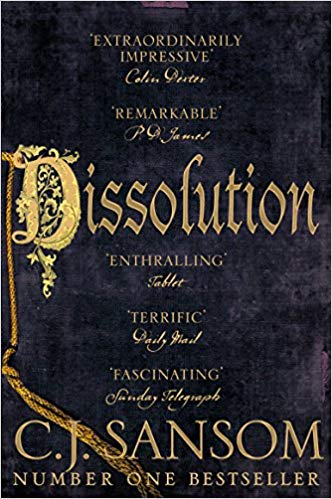
#BookReview ‘Dissolution’ by CJ Sansom #Tudor #detective

Oh my goodness why have I taken so long to read the Shardlake series by CJ Sansom? I was absolutely gripped by Dissolution, first in this Tudor series of mysteries featuring Matthew Shardlake, commissioner for Thomas Cromwell. And now I want to read all the others. CJ SansomIt is 1537. Henry VIII is king and supreme head of the Church of England. A year has passed since Anne Boleyn was beheaded and her successor as queen, Jane Seymour, has just died following childbirth. Cromwell’s team of investigators, or commissioners, are reviewing every monastery across the land. The dissolution of these institutions is expected as Catholic worship is reformed and anglicised. Lawyer Shardlake is sent by Cromwell to the monastery of Scarnsea on the Sussex coast where the investigating commissioner Robin Singleton has been murdered. Cromwell wants a quick solution to the murder so he can tell the king the problem and solution at the same time, and so puts pressure on Shardlake to find the murderer within days.
Shardlake is a great central character; a hunchback, as a boy he turned to his studies when sports and girls seemed impossible. ‘My disability had come upon me when I was three, I began to stoop forward and to the right, and no brace could correct it. By the age of five I was a true hunchback, as I have remained to this day.’ At Scarnsea, Shardlake needs all his bravery and perseverance to unravel Singleton’s murder. There is only one person he can trust, his servant Mark Poer. Everyone else is a suspect. Sansom twists a variety of motives to make every person at Scarnsea a potential murderer and as the story is told totally from Shardlake’s viewpoint, we must consider each piece of new evidence with him. Everyone at the monastery knows their way of life is threatened and some monks fear the changes. But there have been sexual misdeeds in the past, drinking, gambling and, Shardlake comes to suspect, financial fraud too.
When the snow falls, Scarnsea is cut off from the outside world. Shardlake’s investigation is systematic, interviewing monks, examining correspondence, visiting the crime scene, checking financial records, considering potential scenarios. There is a creepiness about the monastery which made me shiver as Shardlake shivered, and not not just from the extreme cold. Threat is ever present, made gloomier by the adjacent marshes.
Dissolution is a terrific book. The historical setting and details are authentic; Shardlake is a compelling protagonist, caught as he is between light and shade, between what he wants to do and what he knows he should do; and the murderer is not obvious.
CLICK HERE TO READ MORE ABOUT THIS BOOK AT AMAZON

And here are my reviews of other novels by CJ Sansom:-
DOMINION
DARK FIRE #2SHARDLAKE
SOVEREIGN #3SHARDLAKE
REVELATION #4SHARDLAKE
HEARTSTONE #5SHARDLAKE
LAMENTATION #6SHARDLAKE

If you like this, try:-
‘The Last Hours’ by Minette Walters
‘The Witchfinder’s Sister’ by Beth Underdown
The Ashes of London’ by Andrew Taylor

And if you’d like to tweet a link to THIS post, here’s my suggested tweet:
#BookReview DISSOLUTION by CJ Sansom https://wp.me/p5gEM4-3zp via @SandraDanby

My Porridge & Cream read: Kathryn Haydon @HaydonKathryn #romance #books

Today I’m delighted to welcome romance author Kathryn Haydon. Her ‘Porridge & Cream’ read is The Prophet by Kahlil Gibran.

“I have chosen The Prophet by Kahlil Gibran because this is a book that speaks to me, soul to soul. The words reach out over the years and touch me as though they were written yesterday. It is the East speaking to the West in the manner of Rabindranath Tagore’s famous Gitanjali. Magical and mystical, with a wonderful cadence! Every human condition known to mankind is illustrated by beautiful verse. Kathryn Haydon“I first came upon this little book in the mid 1990’s. Quite by chance, really – although what is chance and what is really synchronicity? While doing a counselling course with the Exeter branch of the W.E.A., I attended a residential weekend on the edge of Dartmoor. We (students) were invited to bring along a special poem to read out, or a few lines from a book to share with the group. It didn’t matter what, so long as the words had significance and meaning. Someone read from The Prophet – I forget who – and I was spellbound. This is a flavour of what I heard:
“You are the bows from which your children as living arrows are sent forth.
The Archer sees the mark upon the path of the infinite, and He bends you with His might that His arrows may go swift and far.
Let your bending in the Archer’s hand be for gladness;
For even as He loves the arrow that flies, so He loves also the bow that is stable.”
“As soon as I could, I bought a copy for myself. It’s only a slim volume, sitting unpretentiously on my bookshelf, there to be dipped into whenever I feel need. What triggers a need? A myriad of things, from happiness to loss and the deep sadness of bereavement – and all life experiences in between.” Kathryn HaydonAmazon

Kathryn’s Bio
I am a West Country girl who loves to write, a romantic novelist published by Mezzanotte. The red earth of Devon is steeped in my bones, the county’s glorious coast and countryside my inspiration.  To date, I have two books published, both in the medical romance genre as befits a retired nurse! I write the kind of stories you won’t want to put down – real page turners, with characters who tug at your heart strings. Books with a feel-good factor, although please have a box of tissues at the ready because I suspect you’ll need them. My storylines pick-up emotive issues.

Kathryn’s links
Twitter
Facebook
Mezzanotte Publishing

Kathryn’s latest book Kathryn HaydonPalliative care nurse, Melanie Smythe is focussed on two things: the job she loves at Greenways Hospice and helping care for her twin nieces. There is no room for romance. In the past she’s been let down and the experience has left her wary. Melanie fears history will repeat itself. Then a chance encounter with new locum GP, Luke McGrath makes her think maybe he’s the one to change all that. There are differences between them, but the smouldering hot doc makes her pulse race. However, Melanie is holding something back and this leads to a misunderstanding. Angry and hurt, Luke severs their relationship. Will they be able to fix what’s been broken?
Amazon

What is a ‘Porridge & Cream’ book? It’s the book you turn to when you need a familiar read, when you are tired, ill, or out-of-sorts, where you know the story and love it. Where reading it is like slipping on your oldest, scruffiest slippers after walking for miles. Where does the name ‘Porridge & Cream’ come from? Cat Deerborn is a character in Susan Hill’s ‘Simon Serrailler’ detective series. Cat is a hard-worked GP, a widow with two children and she struggles from day-to-day. One night, after a particularly difficult day, she needs something familiar to read. From her bookshelf she selects ‘Love in A Cold Climate’ by Nancy Mitford. Do you have a favourite read which you return to again and again? If so, please send me a message.
Discover the ‘Porridge & Cream’ books of these authors:-
Julie Christine Johnson’s choice is ‘Pride and Prejudice’ by Jane Austen
Jane Cable chooses ‘A Horseman Riding By’ by RF Delderfield
Race of Scorpions’ by Dorothy Dunnett is chosen by JG Harlond

 And if you’d like to tweet a link to THIS post, here’s my suggested tweet:
Why does romance author @HaydonKathryn re-read THE PROPHET by Kahlil Gibran? #books https://wp.me/p5gEM4-3PC via @SandraDanby

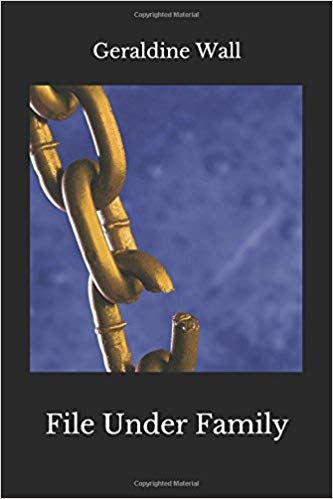
#BookReview ‘File under Family’ by Geraldine Wall #genealogy #mystery

Anna Ames is a trainee probate genealogist working for Triple H, Harts Heir Hunters, and File under Family is the first in a series of genealogy mysteries about Anna by Geraldine Wall. When Margaret Clark dies Anna is charged with finding her missing heir, daughter Briony. The trail leads abroad and unleashes an international social media campaign, reveals sexual abuse in prison and considers how enthusiasm can conflict with client confidentiality. Geraldine Wall Wall introduces the character of Anna and her family life which I am sure will continue to feature throughout the series. While she faces problems balancing work with studying for her Diploma in Genealogy qualification, these are nothing when compared to Anna’s stress at home. Her husband Harry has early-onset dementia so Anna’s father George has moved in to help with caring for Harry and their two teenagers, Ellis and Faye. Faye has a new Russian boyfriend who wants to take her to Russia with him. Ellis is auditioning for a role in the school panto while George is investigating his spiritual side and writing poetry. Worst of all, as Harry’s condition gradually deteriorates he becomes increasing aggressive towards Anna. Into this walks an unattractive stranger.
I found the first couple of chapters disorientating as the story pitches straight into Anna’s day with minimal explanation of her job. But the story settles down and the mystery of Briony’s whereabouts kept me reading. I particularly liked the characters of Margaret’s friends, Joan and Diane, and the importance of Bob the dog in the family dynamics. Anna’s home life is at times a little over-complicated as each family member has their own drama. Anna is a positive character, strongly defending her own family and trying to do her best for her client, albeit crossing the line at times and getting into trouble. This only serves to endear her as a convincing character. However the last quarter of the novel, after Briony’s case is solved, seemed to meander almost as if it was merging straight into book two in the series.
Not so much a genealogical mystery, more a family drama enriched by Anna’s job as a probate genealogist.

Here’s my review of the next in this series by Geraldine Wall:-
FILE UNDER FEAR #2ANNAAMES

If you like this, try:-
‘The Cheesemaker’s House’ by Jane Cable
‘The Lie of the Land’ by Amanda Craig
The Ghost of Lily Painter’ by Caitlin Davis

And if you’d like to tweet a link to THIS post, here’s my suggested tweet:
#BookReview FILE UNDER FAMILY by Geraldine Wall https://wp.me/p5gEM4-3Aw via @SandraDanby

A #poem to read in the bath… ‘I loved her like the leaves’

The sense of loss in this Japanese poem is unquenchable. Written by Kakinonoto Hitomaro in 7th century Japan, it speaks of emptiness so great there is no hope or comfort. Hitomaro was a poet of the Asuka period [538-710], serving as court poet to the Empress Jitō, and is considered to be one of the four greatest poets in Japanese history along with Fujiwara no Teika, Sōgi and Bashō.

Kakinonoto Hitomaro

Kakinomoto Hitomaro by Kikuchi Yosai

‘I loved her like the leaves,
The lush green leaves of spring
That pulled down the willows
on the bank’s edge
where we walked
while she was of this world.
I built my life on her.
But man cannot flout
the laws of this world.
To the shimmering wide fields
hidden by the white cloud,
white as white silk scarf
she soared away like the morning bird,
hid from our world like the setting sun.
The child, the gift she left behind –
he cries for food; but always
finding nothing that I might give him,
I pick him up and hold him in my arms.
On the pillow where we lay,
My wife and I, as one,
I pass the daylight lonely till the dusk,
the black night sighing till the dawn.
I grieve and grieve and know no remedy.
I ache and know no road where I might meet her.

[NB. This poem features in two editions of poems that I own and, owing to different translations, there are variations]

The poem features in many anthologies, including my own The Picador Book of Funeral Poems and The Penguin Book of Japanese Verse.
Amazon


Read these other excerpts, and perhaps find a new poet to love:-
‘Alone’ by Dea Parkin
‘A thousand years, you said’ by Lady Heguri
‘After a row’ by Tom Pickard

And if you’d like to tweet a link to THIS post, here’s my suggested tweet:
A #poem to read in the bath: ‘I loved her like the leaves’ by Kakinonoto Hitomaro https://wp.me/p5gEM4-3dY via @SandraDanby