
Christmas Pudding is another between-the-wars comedy of manners by Nancy Mitford. With scathing observation at times as sharp as Jane Austen, Mitford introduces a new character, Lord Lewes: ‘He was tall, very correctly dressed in a style indicating the presence of money rather than of imagination, and had a mournful, thin, eighteenth-century face.’ This is her second novel and features some of the personalities featured in her first, Highland Fling, though familiarity with the first is not essential for enjoyment. 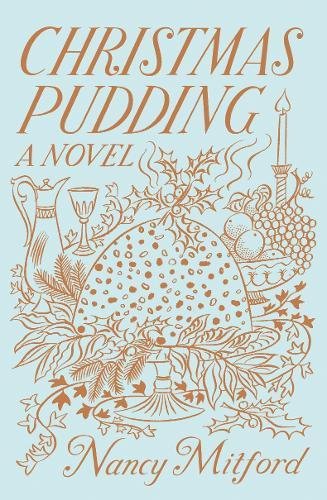 The action takes place over one month around Christmas, the pudding of the title refers to Mitford’s mixture of personalities in two house parties in the Cotswold countryside. Paul Fotheringay, whose debut literary novel has been heralded as a comic farce, is desperate to escape London and find inspiration for his next book. Wanting to be taken seriously as an author, he settles on a biography of Victorian poet, Lady Maria Bobbin. When he is refused access to the diaries by the current Lady Bobbin he conjures a plot with her teenage son Bobby to masquerade as Bobby’s tutor over the Christmas holidays and so gain secret access to the diaries. And so Paul becomes part of a love triangle at the Bobbin’s home Compton Bobbin, involving Bobby’s sister Philadelphia and the honest, boring but reliable Lord Michael Lewes. The second house party, at the rather kitsch over-furnished Mulberrie Farm, is held by former prostitute and now society lady Amabelle Fortescue. Mitford’s characters move in the same overlapping social circles so it is inevitable that Amabelle and her guests Sally and Walter Monteath will socialize with some of the guests at Compton Bobbin.
Love is the central theme, true love, idealised love, upper-class arranged marriage and marriage for pragmatic facing-old-age reasons. As has always occurred in aristocratic circles, marriage is approached with a healthy dose of pragmatism making romantic love seem frothier and more idealised than ever.
This is light-hearted fiction and limited in its observation of characters; there is no upstairs/downstairs contrast here, which would enrich the social commentary. But the old and young are perfectly capable of condemning themselves out of their own mouths. Reading this novel will not change your life, but it will amuse you and the ending is not the easy way-out you may expect. My one criticism is that there are slightly too many peripheral characters with their own strings of plot.
Read my reviews of these other novels by Nancy Mitford:-
HIGHLAND FLING
LOVE IN A COLD CLIMATE
PIGEON PIE
THE BLESSING
THE PURSUIT OF LOVE
WIGS ON THE GREEN
Read the first paragraph of THE PURSUIT OF LOVE here.
If you like this, try these:-
‘Sweet Caress’ by William Boyd
‘A Death in the Dales’ by Frances Brody
‘Mothering Sunday’ by Graham Swift
And if you’d like to tweet a link to THIS post, here’s my suggested tweet:
#BookReview CHRISTMAS PUDDING by Nancy Mitford http://wp.me/p5gEM4-2UO via @SandraDanby
 “I have had many copies of the book over the years but this one [above] is my favourite as it contains all three books in the series. Part of its enduring appeal for me is the characters who are all just flawed enough to make them endearingly frail and human. My favourite character is Jo who is unruly and tempestuous and rails against the confines of poverty and the expectation that women should conform to the domestic role expected of them rather than pursue any ambitions of their own. There is also a small broken piece of my heart that will forever be in thrall to Beth who shows just how much a small life can matter and influence those around it.
 Each murder brings him one step closer to the perfect death. Ex-priest, DI Farrell is called on to investigate a gruesome death in rural Scotland. All evidence points to suicide, except for one loose end: every light in the cottage was switched off. Why would he kill himself in the dark?
 What is a ‘Porridge & Cream’ book? It’s the book you turn to when you need a familiar read, when you are tired, ill, or out-of-sorts, where you know the story and love it. Where reading it is like slipping on your oldest, scruffiest slippers after walking for miles. Where does the name ‘Porridge & Cream’ come from? Cat Deerborn is a character in Susan Hill’s ‘Simon Serrailler’ detective series. Cat is a hard-worked GP, a widow with two children and she struggles from day-to-day. One night, after a particularly difficult day, she needs something familiar to read. From her bookshelf she selects ‘


 Directed by Alfred Hitchcock, Rebecca won 11 Oscar nominations and won two – for Best Picture and Cinematogrophy. Watch the trailer here.
 Various television adaptations include the 1979 BBC production [above] starring Jeremy Brett as Maxim, Joanna David as the second Mrs de Winter, and Anna Massey as Mrs Danvers. Watch the first episode here.




 SANDRA DANBY'S BOOK REVIEWS