Tag Archives: contemporary fiction

#BookReview ‘Outline’ by Rachel Cusk #contemporary

Outline by Rachel Cusk is a strange book, without a narrative spine. So, not a novel as such, more a collection of incidents which happen to an unnamed woman writer visiting Athens to teach creative writing. We learn more about the people she interacts with, than about her. People rarely ask her questions and her internal monologue is sparse. There is no cause and effect, no tension, nothing to make me curious. Rachel CuskThis book was shortlisted for two prices, the Folio Prize, and the 2015 Bailey’s Women’s Prize for Fiction. The writing is beautiful, by which I mean the expression, the ideas explored and use of language, but it left me untouched, without strong feelings of like or dislike. Central to this feeling, I think, is that we do not know the narrator’s name.
There is a quote from one of the narrator’s writing students, speaking in a class discussion, which sums it up for me: “…a story might merely be a series of events we believe ourselves to be involved in, but on which we have absolutely not influence at all.”

If you like this, try:-
‘Yuki Chan in Bronte Country’ by Mick Jackson
‘Foxlowe’ by Eleanor Wasserberg
‘All the Birds, Singing’ by Evie Wyld

And if you’d like to tweet a link to THIS post, here’s my suggested tweet:
#BookReview OUTLINE by Rachel Cusk via @SandraDanby http://wp.me/p5gEM4-1Fb

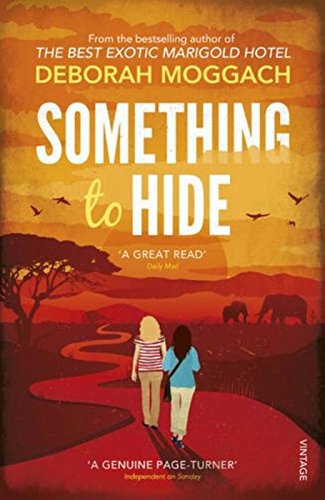
#BookReview ‘Something to Hide’ by Deborah Moggach #contemporary

The beginning of Something to Hide by Deborah Moggach introduces three characters who seem ordinary people, living everyday lives, facing challenges which we or our family/friends/neighbours are facing every day. What is there about them that could possibly be of interest to me? But Moggach draws me into their stories until I read late into the night. Deborah Moggach

The Prologue is set in Africa, the plot revolves around Africa though not always in an obvious way. Don’t read the ‘Dear Reader’ letter from Moggach at the front of the book, save it until you’ve finished reading. That way, you will turn the page, drawn into the story of each woman – Lorrie in the USA, Jing and her husband in China, Petra in London – wondering how they can possibly be connected. Their situations are universal and Moggach demonstrates how globally connected we are these days, globally similar despite our assumptions and generalizations about things we know nothing about. But at the end of the day, it is a book about those universal things: love and lies.

This is a thoughtful book, with dramatic settings. I can certainly see it as a film.

CLICK HERE TO READ MORE ABOUT THIS BOOK AT AMAZON

Read my review of these other novels by Deborah Moggach:-
THE BLACK DRESS
THE CARER
TULIP FEVER

Read the first paragraph of THESE FOOLISH THINGS [now THE BEST EXOTIC MARIGOLD HOTEL] here.

If you like this, try:-
‘All My Puny Sorrows’ by Miriam Toews
‘Angel’ by Elizabeth Taylor
‘The Lie’ by CL Taylor

And if you’d like to tweet a link to THIS post, here’s my suggested tweet:
#BookReview SOMETHING TO HIDE by Deborah Moggach via @SandraDanby http://wp.me/p5gEM4-1Fr

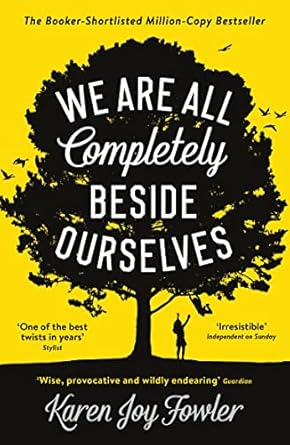
#BookReview ‘We Are All Completely Beside Ourselves’ by Karen Joy Fowler #contemporary

If you can, read We Are All Completely Beside Ourselves by Karen Joy Fowler without reading any reviews or comments beforehand. There is a mammoth twist, which is best avoided. I am one of the lucky few who didn’t read a spoiler before I started reading, I knew only that it was about sibling love. But even so, I did spot the surprise way before it happened, and consequently then read on waiting for the ‘twist’ promised on the cover. Which left me a little deflated. I don’t know why, I expected the twist to be near the end. Karen Joy FowlerThis is a very clever story, packed with philosophy, contemporary references such as Star Wars to Korean vocabulary. Rose is a student, looking back at her childhood and the disappearances, at different times, of her sister Fern and her brother Lowell. The story darts around the timeline and Rose tells different versions of her life story as she comes to terms with her life so far. Mostly this method of storytelling worked for me, but on a few occasions I admit to losing patience with Rose who I found an irritating unreliable narrator. I kept reading because the story is unusual, but my incredulity was stretched at times.
The best bit? The very last paragraph makes it worthwhile reading on, but I can’t say it’s a book I enjoyed.

If you like this, try:-
‘Frog Music’ by Emma Donoghue
‘Vinegar Girl’ by Anne Tyler
‘A Little Life’ by Hanya Yanagihara

And if you’d like to tweet a link to THIS post, here’s my suggested tweet:
#BookReview WE ARE ALL COMPLETELY BESIDE OURSELVES by Karen Joy Fowler http://wp.me/p5gEM4-1tq via @SandraDanby 

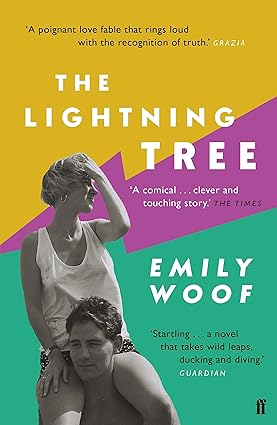
#BookReview ‘The Lightning Tree’ by Emily Woof #contemporary

The Lightning Tree by Emily Woof is the twin story of Ursula and Jerry. Emily WoofUrsula grows up in a house of mirrors and though she tries to avoid looking at her reflection, she cannot. So it is apt that she is the chameleon of this story, changing her appearance, her style, her clothing, so that as the years pass she seems a different person.
Ursula lives in Jesmond, a nicer area of Newcastle, and through her childhood she passes close to Jerry, who grows up in a flat at the rougher Byker Wall. When they do meet, there is a connection. Their lives run in parallel, twisting and turning, sometimes together, other times far apart.
It is a love story, and an un-love story. How it is to fall in love as an adolescent and then see that love challenged into maturity, changing priorities, changing values, changing circumstances. Jerry, his nose always in a book, goes to Oxford and seems destined for politics. Ursula, less academic, goes to India where she undergoes something of a ‘Marabar Caves’ experience which is not really explained and which I still didn’t understand at the end of the book.
Interwoven with Ursula and Jerry’s stories is that of Ursula’s Ganny Mary, her rural Lancashire upbringing, and how her life was affected by the death of her father and the change in her mother Annie who had her own ‘Marabar Caves’ experience, up Pendle Hill in Lancashire.
There’s no doubting the energy in this book, but I did find the storyline confusing, there are so many surplus characters who we never really engage with, and Ganny Mary never ages. It is an enigmatic book, but one which I struggled to really grasp.

If you like this, try:-
‘Himself’ by Jess Kidd
‘Foxlowe’ by Eleanor Wasserberg
‘The Lost Girl’ by Sandu Manganna

And if you’d like to tweet a link to THIS post, here’s my suggested tweet:
#BookReview THE LIGHTNING TREE by Emily Woof via @SandraDanby http://wp.me/p5gEM4-1wL

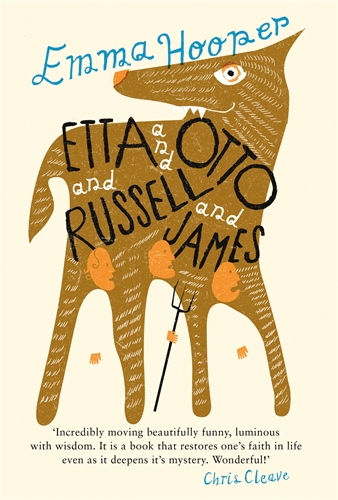
#BookReview ‘Etta and Otto and Russell and James’ by Emma Hooper #contemporary

This was a ‘sort of’ book for me. I ‘sort of’ enjoyed it but… I was ‘sort of’ irritated with it too. The story premise for Etta and Otto and Russell and James by Emma Hooper grabbed me straightaway, and the excellent first paragraph. Emma Hooper

Otto,
The letter began, in blue ink.
I’ve gone. I’ve never seen the water, so I’ve gone there. Don’t worry…”

Etta and Otto are in their eighties. The setting is Canada. Etta sets out one day to walk towards the water, which means either east to the Atlantic or west to the Pacific. She goes east. Otto stays at home, working his way through Etta’s index cards, trying hard to make cinnamon buns like hers. Gradually we learn their back stories: Otto’s childhood on the farm then as a soldier in France during the Second World War; of Etta’s teaching days and then a munitions worker. The Russell in the title is their childhood neighbour and friend. The James of the title is a coyote.
I was unclear why Etta was walking, unclear why Otto seemed philosophical and Russell concerned by her adventure. The relationships are enigmatic, the memories are fluid, which I found confusing. And what precisely happened at the end, I re-read and still do not understand. Enigmatic again, perhaps too much smoke and mirrors. Partly, also I think the problem was insufficient editing combined with the layout of the text [in the Kindle edition]. The viewpoint shifts from paragraph to paragraph, something I hate as it means a minute mental re-adjustment each time which interrupts the flow of the story. Also there is no punctuation to show dialogue, another pet hate of mine, and it is often difficult to know who is talking when. Anything which takes you ‘out’ of the story has to be a bad thing.
Some of the writing is beautiful though. My favourite passages were when Etta is walking with James; their relationship, their dialogue, and the description of the places they walk through are wonderful. When they come to their final river to cross, she takes the bridge and he swims, and we never see James again. I was sorry for that loss.

If you like this, try:-
‘In Another Life’ by Julie Christine Johnson
‘The Love Song of Miss Queenie Hennessey’ by Rachel Joyce
‘Ferney’ by James Long

And if you’d like to tweet a link to THIS post, here’s my suggested tweet:
#BookReview ETTA + OTTO + RUSSELL + JAMES by Emma Hooper http://wp.me/p5gEM4-1wo via @SandraDanby

#BookReview ‘Mobile Library’ by @d_whitehouse #contemporary

Stuffed with book and movie references – from The Lion, The Witch and the Wardrobe to The Terminator – if Mobile Library by David Whitehouse was a film it would be described as a ‘road movie’. Really, it’s a book about running away to find yourself. David WhitehouseChapter One, titled ‘The End’ is reminiscent of Thelma and Louise and The Italian Job. A mobile library van stands at the edge of cliffs, surrounded by police. Inside are Bobby, Rosa and Val. We don’t know who they are or why they are there: such an incentive to keep reading.
Twelve year-old Bobby lives with his father and his father’s girlfriend Cindy, a mobile hairdresser who paints a look of suspicion onto her face every morning with her foundation. Bobby misses his mother and saves anything of hers he can find: hairs from her hairbrush, scraps of paper.
When his schoolfriend, Sunny, offers to protect Bobby from the bullies by turning into a cyborg like The Terminator, neither of them realize what that really entails. Bones are broken, blood is spilled, until Phase Three when Sunny ends up in hospital and disappears. Bobby, alone, passes the time by peeling wallpaper off his bedroom walls. When he meets Rosa and her mother, he finds a place that feels more like a home should be.
When things go wrong, the trio run away in the library van and have adventures along the way [as is the way of road movies]. Lessons are learned about love, life and family. They have an objective: to find Sonny. Bobby reads books from the library – Tom Sawyer, Of Mice and Men – takes a lesson from the story and applies it to his situation. This is a funny, touching story, its message is that family is where you make it. Anyone who loves books will love this story, it is a book with heart.

If you like this, try:-
Paper Cup’ by Karen Campbell
The Funny Thing About Norman Foreman’ by Julietta Henderson
Etta and Otto and Russell and James’ by Emma Hooper

And if you’d like to tweet a link to THIS post, here’s my suggested tweet:
#BookReview MOBILE LIBRARY by @d_whitehouse http://wp.me/p5gEM4-1sF via @SandraDanby

#BookReview ‘A Thousand Acres’ by Jane Smiley #contemporary #family

This is one of those books that I should have read years ago. I don’t know why I didn’t, and I wish I had. the latest book by Jane Smiley, Some Luck, is the first of a new trilogy and is currently sitting on my Kindle waiting to be read. But first, I felt I should read that book I wish I’d read years ago: A Thousand Acres. You know: the one that won the Pulitzer, the one that mirrors King Lear, etc etc. Jane SmileyThe setting is Iowa, remote farmland. The first page took me straight to that wonderful description of In Cold Blood, Truman Capote’s description of Kansas, more remote farmland. ‘The village of Holcomb stands on the high wheat plains of western Kansas, a lonesome area that other Kansans call ‘out there’.’
Being a farmer’s daughter, I was soon immersed in the detail of the Cook family’s daily life on their Iowa farm ‘out there’: the drainage of the land, spreading manure, moisture levels, the hogs, the purchase of a new tractor, yields, profit and loss.
Smiley had my attention straight away. Overlaid over the groundwork of farming are the daily lives of the family members: Larry, the aging father, and the two daughters, Rose and Ginny and their husbands, who stayed on the farm. A peripheral character is Caroline, the third daughter, the one who got away, now a lawyer, who visits her father but doesn’t interact much with her sisters. Both farming sisters are used to tragedy: Rose is recovering from breast cancer, Ginny has suffered five miscarriages. But they get on with life, because that’s the pragmatic approach to life they were taught.
Then two things happen and everything changes. Out of the blue, Larry says he is leaving the thousand acre farm to Rose and Ginny, nothing to Caroline. And the son of a neighbouring farmer, who had gone to Canada to avoid the Vietnam draft, returns. From this point, the family slowly unravels as the traumatic past stories are told alongside the unfolding modern-day traumas, set against the empty Iowa horizon and a neighbourhood where there are no secrets.
I couldn’t put this book down although it is in no way a page-turning thriller. It’s all about the characters: I wanted to know what happened to them in the past as children that turned them into the adults they are now. Is family everything? Will they stay together and keep the thousand acres together? There is a new generation of Cook children, Rose has two daughters. Will the thousand acres be preserved for them to inherit, or will they escape the empty landscape of rural Iowa as Caroline did?
CLICK HERE TO READ MORE ABOUT THIS BOOK AT AMAZON

Click the title below to read my reviews of other novels by Jane Smiley:-
A DANGEROUS BUSINESS
SOME LUCK [LAST HUNDRED YEARS #1]
EARLY WARNING [LAST HUNDRED YEARS #2]
GOLDEN AGE  [LAST HUNDRED YEARS #3]

If you like this, try:-
Housekeeping’ by Marilynne Robinson
Love is Blind’ by William Boyd
Poor Caroline’ by Winifred Holtby

And if you’d like to tweet a link to THIS post, here’s my suggested tweet:
#BookReview A THOUSAND ACRES by Jane Smiley via @SandraDanby http://wp.me/p5gEM4-1kk

#BookReview ‘The Goldfinch’ by Donna Tartt #contemporaryfiction

I knew it from the first page, The Goldfinch by Donna Tartt is the rare sort of book that you want to go on forever and when you finish it you want to start reading all over again for the first time. It is a book I will keep and re-read and re-read. Donna Tartt Three main reasons why I loved it. I liked Theo, it is his story and Tartt lets him tell it all the way through. No other viewpoint. It is about art and antiques, or specifically one painting and the effect it has on Theo’s life. The possession of it, the responsibility, the guilt, the value. The meaning of the painting itself, the tiny bird shackled by a chain at its ankle. And the painter, Carel Fabritius, student of Rembrandt, died too young in the Delft gunpowder explosion of 1654 when he was 32. And lastly, it’s one of those wide-ranging American novels – New York to Las Vegas to Amsterdam – that the Americans seem to do so well and the English are rubbish at [if you can think of a modern English novel that does do it, please let me know because I’d love to read it]. Tartt says she carries a notebook everywhere and is always jotting down ideas and facts. It shows. Each page is crammed with information. I have to admit early on I was wondering if 13-year old Theo would really remember details of a painter called Egbert van de Poel, but it is the adult Theo telling the child’s story so I cut her some slack.
It is about art, fate, the things life throws at us, love and friendship. It takes in alcoholism, drug addiction, art fraud, post-traumatic stress disorder, grief, unrequited love. At the heart of it is a mystery. As Theo’s feckless father, who gambles according to astrology, says: “sometimes you have to lose to win.” And it is chock full with popular references, from Boris referring to reading the ‘Dragon Tattoo’ books to Pippa’s Hunter wellies.
Of the peripheral characters, I loved Hobie, loved Boris. Pippa remains enigmatic to the end. Tartt’s characters are alive, her places are real. She makes you smell the dust. I’ve been to Las Vegas and have ventured beyond the Strip, but not to the outer edges where the desert reclaims the streets and where the teenage Theo and Boris meet. And I’ve been to New York, walked the streets Theo walks, been to the Met [thank goodness, un-bombed], and been to Amsterdam too with its circular canals. And that brings me to the first chapter, and the ending. I was so intrigued by that first chapter, why is Theo in the hotel room, anxiously scanning the Dutch television news. What has he done? What I imagined it to be… I was wrong, but I had to read almost to the end before I realised I was wrong. That’s really good going for a book that is 771 pages long. There is anticipation, numerous twists in the tale, and there is a little over-intellectualising [often the over-serious way of ‘the big American novel’] but nothing that stopped me reading on. For me, the book went on slightly too long, past its natural finishing point. I would have stopped at the end of the chapter where Theo and Hobie meet post-Christmas, post-Amsterdam.
It is a literary success, and a page-turner. A deserved winner of the Pulitzer, for me.

Read the #FirstPara of THE SECRET HISTORY also by Donna Tartt.

If you like this, try:-
A Little Life’ by Hanya Yanagihara
Purity’ by Jonathan Franzen
A Spool of Blue Thread’ by Anne Tyler

And if you’d like to tweet a link to THIS post, here’s my suggested tweet:
#BookReview THE GOLDFINCH by Donna Tartt http://wp.me/p5gEM4-1cm via @SandraDanby 

#BookReview ‘One Step Too Far’ by @tinaseskis #contemporary #mystery

I became aware of One Step Too Far by Tina Seskis by word of mouth, often the best kind of recommendation. It is certainly a page turner. I sat down to read it one hot sunny day and raced through it. Tina SeskisThe theme is running away. What place a woman has to be in to leave everything behind, the desperation, the guilt, the expectations for a new life, the logistics of running. Emily runs, and runs one step too far. The reason for her running is dangled in front of the reader like a carrot, hints, deceptions, and this is why you keep reading. Is it something she did, or something done to her? Is it criminal or emotional? The story of Emily’s escape, and the story of the reason for her escape, are told in parallel. I had my suspicions about her reason, and I was almost right. Almost, but not quite.
One of the intriguing things in the narrative mix is that Emily is a twin, and the two twin sisters do not get on. This added welcome spice to the tale of Emily’s childhood in Manchester, and her reinvention in London. The twin thing enables some convenient misunderstandings, doppel-gangers and threat of discovery.
A great holiday read.
CLICK HERE TO READ MORE ABOUT THIS BOOK AT AMAZON

If you like this, try:-
‘The Ivy Tree’ by Mary Stewart
‘Please Release Me’ by Rhoda Baxter
The House at the Edge of the World’ by Julia Rochester

And if you’d like to tweet a link to THIS post, here’s my suggested tweet:
#BookReview ONE STEP TOO FAR by @tinaseskis via @SandraDanby http://wp.me/p5gEM4-1ca

#BookReview ‘The Awakening of Miss Prim’ by Natalia Sanmartin Fenollera #contemporary

The title, The Awakening of Miss Prim, gives away the storyline of this charming tale by Spanish journalist Natalia Sanmartin Fenollera. Miss Prim is to be awakened. The assumption is that the catalyst for this awakening is love. But that is to over-simplify a thoughtful tale of self-knowledge, or maturing as an adult, about making the leap from intellectual maturity to emotional maturity. Natalia Sanmartin FenolleraPrudencia Prim is a librarian who begins a new job in a private house in the village of San Ireneo de Arnois, in an un-named country. Even when I had finished the book I was still unclear in which country it is set, though this does not affect the storytelling at all. Miss Prim is to catalogue the private library of a man who is never named, but is known simply as The Man in the Wingchair.
San Ireneo is an unusual village, it feels as if you are taking a step back in time. “That morning she urgently needed to buy notebooks and labels. The day before, she had had a small disagreement with her employer, the fifth since her arrival at the house. He’d come into the library and declared that he didn’t want her to use a computer to catalogue the books.” So, a computer, it is a contemporary tale then.
The discussions beside the fireplace between Miss Prim and The Man in the Wingchair range widely, from literature and philosophy to the quality of life in the village. And the neighbours, who all have wonderfully exotic names such as Herminia and Hortensia. The women seem to run the village, and have formed a club to support each other and they tackle problems together. Their meetings are always characterised by cake, tea and toast. Miss Prim finds this inclusiveness difficult to handle, she resents interference and in the beginning finds the atmosphere claustrophobic. She is an independent, well-qualified young woman, who knows her own mind. She does not need anyone else and is not looking for love. Of course not!
This is a delightful tale which ranges from classical literature to art to the philosophy of education. One of my favourite scenes is when Miss Prim takes The Man in the Wingchair to task for not including Little Women in his library, lamenting the loss of his nieces in not being able to read the story of the Meg, Jo, Beth and Amy.
CLICK HERE TO READ MORE ABOUT THIS BOOK AT AMAZON

If you like this, try:-
Paper Cup’ by Karen Campbell
The Perfect Affair’ by Claire Dyer
The Language of Others’ by Clare Morrall

And if you’d like to tweet a link to THIS post, here’s my suggested tweet:
#BookReview THE AWAKENING OF MISS PRIM by Natalia Sanmartin Fenollera http://wp.me/p5gEM4-11v via @SandraDanby