Tag Archives: fiction

#BookReview ‘Pigeon Pie’ by Nancy Mitford #satire #historical

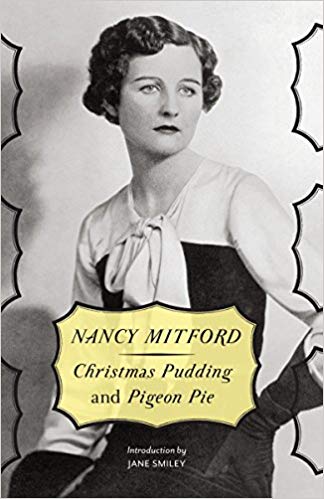
Pigeon Pie, the fourth novel of Nancy Mitford, was first published in 1940 by Hamish Hamilton. This was a serious error by its publisher given that Mitford wrote this light-hearted satire about wartime spying just before World War Two broke out in 1939. Not surprisingly, it was a commercial miss. Which is a shame. It is a funny, more tightly-plotted and disciplined novel than her first three and is a transition between her pre-war and post-war novels. Nancy MitfordAt the outbreak of war, Lady Sophia Garfield enrols at her nearest First Aid Post and is put in charge of the office, folding and counting laundry and taking telephone calls. As the book is set during the first few months of war, the Phoney War, not a lot happens for Sophia except endless first aid drills. She teases an acquaintance, Olga – who poses in the press as a mysterious Mata Hari figure – and lunches with inept friends Ned and Fred who work at the Ministry of Information. Then Sophia stumbles on a nest of spies; or counter-spies, or counter-counter spies, she’s not sure which.
Although her characters seem of a type with those of her first three novels – Mitford has a reputation for writing about the upper class, their extravagant and thoughtless lifestyles – in Pigeon Pie they are less cartoonish. Sophia particularly is interesting, drawn as she is into different worlds: her husband Luke’s enthusiasm for a new American religion, the Boston Brotherhood, brings new friends to dinner and a lodger upstairs; her godfather Sir Ivor King, aka The King of Song, disappears; journalist Rudolph Jocelyn enlists; and Sister Wordsworth at the Post is jolly and efficient about bandages and disinfectants and such like. Mitford weaves a plot of spies, kidnapping, bombs, code and general sneaking around, despite Sophia being unable to remember Morse Code and seeing codes in innocent messages.
This had me chuckling aloud.
CLICK HERE TO READ MORE ABOUT THIS BOOK

Read my reviews of these other novels by Nancy Mitford:-
CHRISTMAS PUDDING
HIGHLAND FLING
LOVE IN A COLD CLIMATE
THE BLESSING
THE PURSUIT OF LOVE
WIGS ON THE GREEN

Read the first paragraph of THE PURSUIT OF LOVE here.

If you like this, try these:-
‘The Paying Guests’ by Sarah Waters
‘The Heat of the Day’ by Elizabeth Bowen
‘The Slaves of Solitude’ by Patrick Hamilton

And if you’d like to tweet a link to THIS post, here’s my suggested tweet:
#BookReview PIGEON PIE by Nancy Mitford https://wp.me/p5gEM4-3h2 via @SandraDanby

#Bookreview ‘The Marriage Plot’ by Jeffrey Eugenides #romance

The title of this, the third novel by Pulitzer Prize-winning author Jeffrey Eugenides, refers to the entanglements of three students and the plotting of Victorian romance novels. The Marriage Plot tells of the romantic, sexual, philosophical, religious and literary coming togethers/going aparts of a literature student Madeleine Hanna, scientist Leonard Bankhead and theology student Mitchell Grammaticus at Brown University in 1982 America. Jeffrey EugenidesIt is a tale of youthful assumptions, experimentations, dreams and disappointments. Perhaps it is a tale which will strike a chord with people of the same age as Madeleine, Leonard and Mitchell, rather than those who are older.
None of the three main characters are particularly likeable and at times the book gets bogged down in literary theory, philosophy, science and religious theory. Leonard is brilliant but a manic depressive, something which colours the entire book. The portrayal of his illness is convincing and shows the knife edge of pharmaceutical dosage needed to maintain a healthy mental balance. Leonard yo-yo’s back and forth, coping and not coping, at times allowing his manic tendencies to win. Madeleine accuses him of liking being depressed all the time. Mitchell is the idealistic one who goes to India to work for Mother Theresa’s Calcutta hospice and confronts some unpalatable truths. In comparison, Madeleine seems rather spoiled. Both men dote on her however and this is the spine which holds the story together: who will Madeleine finally choose?
Eugenides describes mundane things so beautifully. “Outside, the temperature, which had remained cold through March, had shot up into the fifties. The resulting thaw was alarming in its suddenness, drainpipes and gutters dripping, sidewalks puddling, streets flooded, a constant sound of water rushing downhill.” Simple writing at its best. But at other times the writing feels manic and not just in Leonard’s sections. There is an authorial indulgence with many clever asides from the plot and characters. I soon learned to read these parts slightly out-of-focus, not worrying for example that I didn’t grasp Leonard’s sections on yeast or Mitchell’s constant references to Something Beautiful for God, Malcolm Muggeridge’s book about Mother Theresa. The last third of the book passed much quicker than the first two.
The Marriage Plot is ambitious, as Middlesex was, and rightly so, but is perhaps the inevitable ‘difficult’ book after such a huge success. This will not deter me from reading Eugenides again.

Click the title to read the first paragraph of MIDDLESEX, also by Jeffrey Eugenides.

If you like this, try these:-
‘If I Knew You Were Going to Be This Beautiful, I Never Would Have Let You Go’ by Judy Chicurel
‘A Sudden Light’ by Garth Stein
‘Barkskins’ by Annie Proulx

And if you’d like to tweet a link to THIS post, here’s my suggested tweet:
#BookReview THE MARRIAGE PLOT by Jeffrey Eugenides via @SandraDanby http://wp.me/p5gEM4-2yP

#BookReview ‘Gilead’ by Marilynne Robinson #classic #Americanwriters

Gilead by Marilynne Robinson is a read like no other. A slow, contemplative journey through the memories of one man’s life, as he waits to die. In 1956, the Reverend John Ames writes a letter to his young son. It tugs the heartstrings. Marilynne Robinson Robinson writes with a clear unadorned style drawing heavily on biblical texts but it is not a religious tract, it is the story of a man’s life, his memories, his regrets and loves. The first few lines grabbed me and didn’t let me go. Do not start reading this book if you are feeling impatient. Some passages are easy and quick to read, others deserve more thought. It unwinds slowly like a length of thread, telling us the story of John Ames, his father and grandfather, the legacy of the Ames family which has been inherited by the Reverend’s seven-year old son.
I am not religious and some of the references will have passed me by. In the first half of the novel, I would think ‘oh no not another section about religion’, but as I read deeper into the book I became drawn into the stories of John Ames and his forebears and how their beliefs shaped their lives. I wanted to know what happened to John Ames Boughton, the troublesome son of his best friend and fellow reverend. I wanted to know how the Reverend Ames met his second wife. Some of the questions posed are not answered until the very end.
It is a peaceful novel, set against the backdrop of Fifties Iowa, which draws on local history including the Underground Railroad. Robinson draws a picture of the Gilead community, the people, their kindnesses, their grievances. She paints a clear picture. ‘We were very pious children from pious households in a fairly pious town.’
At times, the writing was so sublime I re-read. For example, ‘Sometimes I have loved the peacefulness of an ordinary Sunday. It is like standing in a newly planted garden after a warm rain. You can feel the silent and invisible life.’
Gilead, the second novel by Marilynne Robinson, won two prizes in 2005: the Pulitzer Prize for Fiction, the National Book Critics Circle Award. I came to it with trepidation, having respected the writing style of her first novel, Housekeeping but struggled with the pace of the narrative.
CLICK HERE TO READ MORE ABOUT THIS BOOK AT AMAZON
Try the #FirstPara of GILEAD here.

Read my reviews of Robinson’s other novels:-
HOME
HOUSEKEEPING
JACK

If you like this, try:-
‘Barkskins’ by Annie Proulx
‘Did You Ever Have a Family?’ by Bill Clegg
‘The Past’ by Tessa Hadley

And if you’d like to tweet a link to THIS post, here’s my suggested tweet:
#BookReview GILEAD by Marilynne Robinson via @SandraDanby http://wp.me/p5gEM4-2Cb

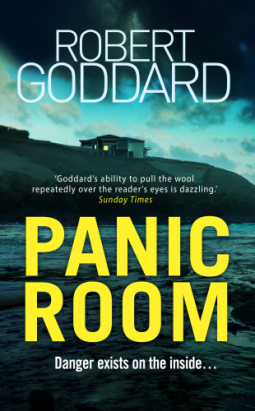
#BookReview ‘Panic Room’ by Robert Goddard #thriller

Panic Room by Robert Goddard starts in the voice of someone unnamed, someone who feels safe in a beautiful, calm place, who wants to stay there forever but who knows that is unrealistic. It made me ask so many questions: who is the speaker, where is this safe place and why isn’t it forever? Robert GoddardIt’s a while before we learn the identity of the first speaker. We are next introduced to Don Challenor, an ordinary middle-aged bloke, an estate agent who has been sacked, who is given a temporary job by his ex- wife Fran. To prepare for sale a multi-million property, Wortalleth West in Cornwall, for a client of Fran’s. Don jumps in his vintage MG to drive west, not realising how his life will change.
In the house he sets about his job, taking photos and measurements in order to prepare the sales brochure. Except the dimensions of one room don’t make sense. There is a mystery void. A steel door which cannot be opened. Is it a panic room? Why is it there? What’s in it? Is it dangerous? Could someone be inside, watching? Or are they trapped? Why not simply ask the owner of the house? Of course, nothing is that straightforward. And so the search to solve the riddle begins.
This is a cracking thriller which starts slowly and winds up and winds up as all the disparate threads of story begin to fall into place. It is an old-fashioned thriller with a conflicted but strong heroine, a disillusioned male hero who rediscovers his strength and guile, an arch villain who cannot be fathomed because he seems too nice and reasonable, and a couple of thugs who don’t worry about the trail they leave. Add in a Cornish witch, a kidnapping and a disappearing teenager, and you begin to wonder how on earth it will all make sense.
Goddard draws a beautiful picture of the Cornish coastline, it will make you want to go there… just not to Wortalleth West. You don’t have to work hard, just sit back and let this master thriller writer take you on a journey of family lies and disappearance, manipulation and fraud, big finance, global warming and cutting edge science. It will not be what you expected.

Read my reviews of Goddard’s other books:-
THE FINE ART OF INVISIBLE DETECTION #1UMIKOWADA
THE WAYS OF THE WORLD #1WIDEWORLDTRILOGY
THE CORNERS OF THE GLOBE #2WIDEWORLDTRILOGY
THE ENDS OF THE EARTH #3 WIDEWORLDTRILOGY
THIS IS THE NIGHT THEY COME FOR YOU #1SUPERINTENDENTTALEB

If you like this, try:-
‘An Officer and a Spy’ by Robert Harris
‘The Travelers’ by Chris Pavone
‘Purity’ by Jonathan Franzen

And if you’d like to tweet a link to THIS post, here’s my suggested tweet:
#BookReview PANIC ROOM by Robert Goddard https://wp.me/p5gEM4-3iz via @SandraDanby

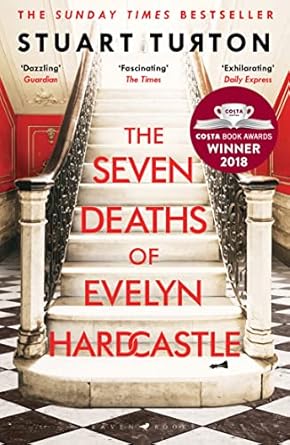
#BookReview ‘The Seven Deaths of Evelyn Hardcastle’ by Stuart Turton #crime #thriller

The Seven Deaths of Evelyn Hardcastle by Stuart Turton is a whodunnit version of Groundhog Day set at a country house party. There is a twist: the Bill Murray character must live each day in a different body, a host, and solve a murder or never escape back to his normal life. I found this to be a tortuous, convoluted and mystifying plot, impossible to review without giving away clues (intentionally or not), but I will have a go. Stuart TurtonIf you like conventional detective stories which follow the rules of crime fiction, presenting a challenge to be solved, this may not be for you. If you like going on a mystery journey where nothing is as it seems, you will like it. Mysteries work when the reader has something to cling onto, to make them identify with a character, to make them care, to give them someone to root for. This story has so many unknowns I spent most of the story in a state of confusion. Like Coco Chanel dressing for the evening and then removing two elements to ensure she wasn’t over-dressed, I finished this book wishing the author had undertaken a similar cutting exercise. The solution to the murder, and the fate of the protagonist were not the elements I found most fascinating; I enjoyed the challenge faced by Aiden – if that is his true name – when he inhabits the body of a host, a stranger. The obese body but sharp mind of Lord Ravencourt; the over-excited Jonathan Derby who acts without thinking and molests the chambermaids; the beaten-up butler who knows a lot but lays in bed drifting in and out of consciousness.
The list of characters is so long – with too many similar names, Millicent/Madeline, Daniel/Donald – plus others who are simply unnamed background extras, I couldn’t remember which each one was. This is complicated by the fact that the hero – whose name might be Aiden Bishop – doesn’t know who is who either. He doesn’t know who can he trust, who has he already met at Blackheath House, and who he knew before arriving at the party – as he also has amnesia about his real identity and previous life. Two/three other people are also experiencing this mobile bodied state, and Aiden is competing with them to solve the crime. Because only one, he is told by the mysterious fancy dress Plague Doctor, will survive. Oh and there’s a mysterious footman too who may or may not be trying to kill Aiden. Oddly, none of the other time-trapped people appear in Aiden’s body.
By a quarter through I was seriously confused and becoming seriously irritated. Is this a story best read in one sitting, so you are better able to remember all the twists and obfuscations? But the book is not short, 528 pages. Or could it be that there is just too much going on? A closed room mystery, each day repeating itself, a hero with amnesia who must relive each day in a different host body and be influenced by the stranger’s body and personality, a murder that happens every night meaning the victim cannot be rescued, a competition to solve the murder in order to survive, obtuse threats from sinister unidentifiable figures, key characters introduced rather late in the game. There is no doubting the planning skills of the author but at times I did suspect he set out to wilfully confuse rather than tease the reader. I ran through various scenarios: is it a game show, is it a wind-up like Candid Camera, is Aiden the murderer and doesn’t know it, is Aiden the murderer and cleverly duping everyone?
Ambitious, overwhelming, fantastical, mysterious, I can’t help but admire the ambition of the author and the scope of his story. Hidden beneath the machinations are two serious questions: how far will a person go in order to escape an intolerable situation, and is it ever possible to escape your own past? A Marmite book: love it or hate it.

If you like this, try these:-
‘Himself’ by Jess Kidd
‘The Last of Us’ by Rob Ewing
‘Curtain Call’ by Anthony Quinn

And if you’d like to tweet a link to THIS post, here’s my suggested tweet:
#BookReview THE SEVEN DEATHS OF EVELYN HARDCASTLE by Stuart Turton https://wp.me/p5gEM4-3kf via @SandraDanby

#BookReview ‘Vanishing Acts’ by @JodiPicoult #contemporary

This is the first book by Jodi Picoult which I have read, so I wasn’t sure what to expect. I would describe Vanishing Acts as long, intriguing, multi-layered. Is it the greatest? No, but it makes me want to read more of her books. Her multiple-perspectives mean you get a 360° view of a situation and see how different people view the same thing, something we are not always privy to in real life. Jodi PicoultDelia Hopkins lives in New Hampshire with her widowed father Andrew and her daughter Sophie. She works with her own search-and-rescue bloodhound to find missing people. She is about to marry Eric, a friend since childhood. Everything seems happy, except for strange dreams which she cannot explain. ‘I am little, and he has just finished planting a lemon tree in our backyard. I am dancing around it. I want to make lemonade, but there isn’t any fruit because the tree is just a baby. How long will it take to grow one? I ask. A while, he tells me. I sit myself down in front of it to watch. He comes over and takes my hand. Come on, grilla, he says. If we’re going to sit here that long, we’d better get something to eat.’ Fitz, a journalist, who also grew up with Delia and Eric, cannot explain the significance of the lemon tree. But the puzzles keep coming, after a policeman knocks on the door and arrests her father for kidnapping.
This is a story about repressed memory and triggered memory, the difference of which is central to the court case which is the core of this novel. It is about trust, instinct and loyalty and how sometimes the hardest thing to do is the right thing to do.
It is a long book and some sections felt over-written, a style I sometimes find with American authors; using two metaphors where one will do. But the plotting is excellent and the rope of tension pulls you mercilessly onwards. My paperback [below] is an American edition by Washington Square Press, it changes typeface for each different point of view which I found surprisingly irritating.

And read the first paragraphs of VANISHING ACTS and NINETEEN MINUTES, both by Jodi Picoult.

If you like this, try:-
‘Somewhere Inside of Happy’ by Anna McPartlin
‘Something to Hide’ by Deborah Moggach
‘Crow Blue’ by Adriana Lisboa

And if you’d like to tweet a link to THIS post, here’s my suggested tweet:
#BookReview VANISHING ACTS by @JodiPicoult via @SandraDanby http://wp.me/p5gEM4-2uE

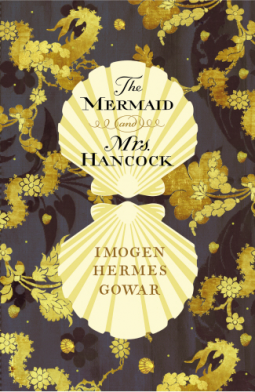
#BookReview ‘The Mermaid and Mrs Hancock’ by Imogen Hermes Gowar #historical

Quite a few things in The Mermaid and Mrs Hancock by Imogen Hermes Gowar are not as they seem. The mermaid, which may or not be real, is actually dead and quite gruesome. And the story starts with shipping merchant Mr Hancock, not Mrs. He is a widower. Imogen Hermes GowarThis story about London in 1785 is a full-on feast for the senses and at first is a bit overwhelming: wind ‘sings’, raindrops ‘burst’, skin is ‘scuffed and stained’, a face is ‘meaty’. But then I fell into the life of Jonah Hancock and wondered when the mermaid, and Mrs Hancock, would appear. Soon the captain of the Calliope, one of Jonah’s ships, returns homes without the ship but with a mermaid.
The Mermaid and Mrs Hancock overflows with contrasts: Deptford and Mary-le-Bone are villages outside London, whales are dismembered and rendered beside the river but in nearby Blackheath the air is to be treasured. It seems unlikely that the path of Jonah, conservative, hard-working, will intersect with Angelica Neal, a former upper class prostitute. But thanks to the mermaid, they meet and their lives take different turns as a result. Gowar juxtaposes sumptuous silks, satins and pearls of the girls at Mrs Chappell’s high-class brothel, where they are tutored at some expense in dancing and singing, performing masques for their high-paying clientele; with the potatoes peeled and stockings darned by Jonah’s niece Sukie and maid Bridget. The beauty of the whores, the ugliness of the mummified mermaid. Contrasts are everywhere.
The story is slow to build and I admit to skipping some paragraphs of description, many dedicated to situations and characters with no bearing on the main storyline. But then I would stop and admire a sentence like this, ‘Overnight, Deptford’s heady miasma had begun to settle, like silt in a puddle, but sunrise stirs it back up again and Mr Hancock stumps through that great rich stink of baking bread and rotten mud and old blood and fresh-sawn wood with the cat trotting on her tiptoes beside him.’ Over-stuffed with imagery, but beautifully written. I enjoyed the final third but was left regretting threads and characters left dangling that could have enriched the story; Tysoe Jones and Polly particularly.
This is a bawdy morality tale set in Georgian London that issues the warning to be careful what you wish for and compares inner and outer beauty, man’s treatment of women and the exploitation of a mermaid for money. The story is predictable, given the tradition of mermaids, and because of this the pacing would benefit from more audacious plot twists and turns. I liked Jonah and wanted to shout to him, ‘have nothing to do with her.’ He is simply too nice.

If you like this, try:-
‘The Quick’ by Lauren Owen
‘An Appetite for Violets’ by Martine Bailey
‘The Wicked Cometh’ by Laura Carlin

And if you’d like to tweet a link to THIS post, here’s my suggested tweet:
#BookReview THE MERMAID AND MRS HANCOCK by Imogen Hermes Gowar https://wp.me/p5gEM4-3lK via @SandraDanby

SaveSave

SaveSave

SaveSave

#BookReview ‘Offshore’ by Penelope Fitzgerald #contemporary

This is a slim, powerful novel about a small community of people living on houseboats on the River Thames at Battersea Reach in 1960s London. Anchored on the southern shore, next to the warehouses, brewery and rubbish disposal centre, they long to be positioned on the prosperous Chelsea shore opposite. In Offshore, Penelope Fitzgerald draws you into the world of Dreadnought, Grace, Maurice, Lord Jim and Rochester – those are the boats – and their occupants. Penelope FitzgeraldThey live in close, intimate proximity as the boats are tied to each other, only one is fastened to the wharf. Despite this, each person lives in an individual island of loneliness caused by marriage, poverty, sexuality, or just being different. Their lives are governed by tidal movement. ‘On every barge on the Reach a very faint ominous tap, no louder than the door of a cupboard shutting, would be followed by louder ones from every strake, timber and weatherboard, a fusillade of thunderous creaking, and even groans that seemed human. The crazy old vessels, riding high in the water without cargo, awaited their owner’s return.’
The people are inter-dependent but don’t know it until a crisis happens. The catalyst is Nenna, a young mother separated from her husband. She lives on Grace with her two children, Tilda and Martha, who run wild in the mud. One day, when they find antique painted tiles and sell them at an antiques shop on King’s Road, the two children seem more mature and capable than their mother. Nenna’s neighbours act as counsellors, offering marriage advice, boat help, and babysitting services. Richard, the de facto leader of the boat community, worries that his wife is bored and wants to retire to a house advertised in Country Life magazine. Meanwhile Willis, a struggling artist, who lives on Dreadnought, has a leak. This endangers his plan to sell the boat.
A beautifully-written thoughtful novel showing how very different people can rub along together.
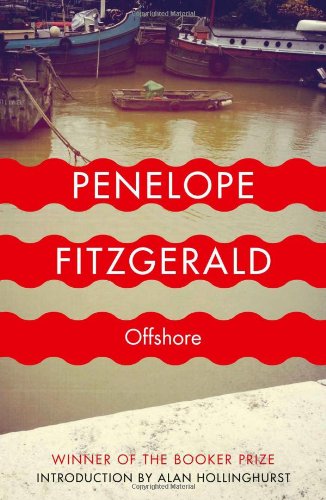
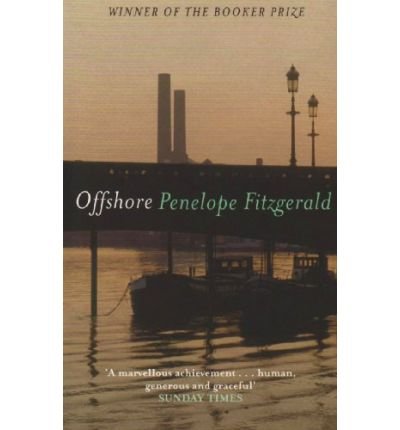
Offshore won the Booker Prize in 1979, a year sandwiched between Iris Murdoch in 1978 for The Sea The Sea, and Rites of Passage by William Golding in 1980. Fitzgerald had been shortlisted the previous year for The Bookshop and would be again in 1988 with The Beginning of Spring. What a golden time that was. Penelope FitzgeraldMy paperback copy of Offshore [above] is an old Fourth Estate edition with a moody photo of the River Thames at dusk.

Read my review of THE BLUE FLOWER, also by Penelope Fitzgerald.

If you like this, try these other Booker-winning novelists:-
Life Class’ by Pat Barker [won the Booker in 1995 with ‘The Ghost Road’]
Mothering Sunday’ by Graham Swift [won the Booker in 1996 for ‘Last Orders’]
The Children Act’ by Ian McEwan [won the Booker in 1998 with ‘Amsterdam’]

And if you’d like to tweet a link to THIS post, here’s my suggested tweet:
#BookReview OFFSHORE by Penelope Fitzgerald via @SandraDanby http://wp.me/p5gEM4-2n2

#BookReview ‘The Heart’s Invisible Furies’ by @JohnBoyneBooks #historical #Ireland

From the first sentence I was entranced. The Heart’s Invisible Furies by John Boyne starts with such an opening sentence, full of conflict, hypocrisy, resentment and hope, it made me want to gobble up the pages and not put the book down. I wasn’t disappointed. John BoyneThe Heart’s Invisible Furies is the life story of one man, Cyril Avery, but also of a country and its attitudes to sexuality. The story starts in Goleen, Ireland, in 1945; a country riven by loyalty to, and hatred of, the British, at the same time in thrall to its Catholic priests whose rules were hypocritical, illogical and cruel. Cyril narrates his story, starting with how his 16-year old mother was denounced in church by the family priest for being single and pregnant. She was thrown out of church and village by the priest and disowned by her family. On the train to Dublin she meets a teenager, Sean, also heading for the big city. Wanting to help someone so obviously alone, Sean offers to let Catherine stay at his digs until she finds lodging and a job. These first friends she make are some of the most important in her life, and re-appear at important times also in Cyril’s life. Catherine gives birth and, as she carefully arranged, her baby is taken by a nun and placed with a waiting adoptive family. We the readers therefore know the identity and story of Cyril’s birth mother from page one; he doesn’t. As he grows from quiet boy to quiet teenager, falling in love at the age of seven with Julian, Cyril begins to lead a life of lies and shame forced on him by Ireland’s attitude to homosexuality and his inability to be true to himself. Cyril negotiates the first 30 years of his life, trapped between lying in order to stay safe or being truthful and getting arrested. Then he finds himself at the marriage altar. What happens next changes his life in so many ways, ways in which don’t become fully apparent until the last third of the novel.
This could be a depressing novel. It isn’t. It is charming and funny, but can turn on a sixpence and make you gasp with anger, despair or sadness. The characterisation is masterful. I particularly enjoyed Cyril’s adoptive mother Maude Avery, a chain-smoking novelist who detests the growing popularity of her books; his adoptive father Charles Avery who starts off being an awful snob with a talent for unintentional insults; and Mrs Goggin, who runs the tearoom at the Irish parliament with a rod of iron.
I loved this book. Honest, sad, laugh-out-loud funny, touching, with paragraphs I just had to read out aloud to my husband. It is about being true to yourself, the need for honesty in relationships, and the power of love. My favourite book of the year so far.

Read the first paragraph of THE HEART’S INVISIBLE FURIES.

Read my reviews of these other novels by John Boyne:-
A HISTORY OF LONELINESS
A LADDER TO THE SKY
A TRAVELLER AT THE GATES OF WISDOM
ALL THE BROKEN PLACES
STAY WHERE YOU ARE & THEN LEAVE
WATER #1ELEMENTS
EARTH #2ELEMENTS

If you like this, try:-
‘A Little Life’ by Hanya Yanagihara
‘How to be Both’ by Ali Smith
‘Tipping the Velvet’ by Sarah Waters

And if you’d like to tweet a link to THIS post, here’s my suggested tweet:
#BookReview THE HEART’S INVISIBLE FURIES by @JohnBoyneBooks https://wp.me/p5gEM4-3iJ via @SandraDanby

#BookReview ‘Day’ by AL Kennedy @Writerer #WW2

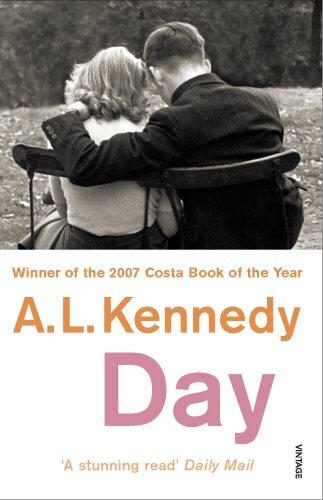
Day, the title of this novel by AL Kennedy, does not refer to a period of twenty-four hours, but to Alfred Francis Day. Alfie. Rear gunner in a Lancaster in World War Two and now extra on the set of a war film. Past and present are mingled together as he starts to remember things he would rather forget. The passages in the bomber are electrifying, in their detail and understanding. The cold, the smell, the fear, how the professionalism of their training kicks in when the action starts. It is totally believable. AL KennedyThe timelines are mixed here as Alfred’s memories are inter-mingled: when Alfred was a member of the bomber crew; his time in a prisoner-of-war camp; and as a film extra in 1949. Where the novel is not so clear, for me, is the intermingling of these three timelines, though after fifty pages everything started to clarify. If you find this, persist and everything will fall into place.
Through Alfred’s memories and his conversations with Ivor, his post-war employer at a bookshop, his bomber crew and the other film extras, we start to piece together the story of his life. It is particularly poignant when he falls in love, heavily, after a fleeting encounter during a bombing raid in London. He meets Joyce in a shelter and from then on she fills his head, when his head should be concentrating on shooting down enemy fighters as his crew drops bombs on Hamburg. ‘Turning his head and turning his head while the heath beyond him dreams, his head pressing back in his pillow and eyes closed and no clear memory he can see, only the wonder that her heartbeat was everywhere in her skin.’
Alfie is a complex character. He is a small man who reads to educate himself. He is nicknamed ‘Boss’ by his flight crew even though he is not the skipper. In flight training, he asks Sergeant Hartnell to show him how to fight and win. ‘Look, son… You’re not the first. Happens quite often in fact. Lads come along and they ask me for help… help with an argument they’ve got to settle back home…’ He tells Alfred his best bet is to hit them from behind with a bit of pipe, but when Alfred gets his chance he throws bricks.
We learn most about him as he remembers his mother and father, both of whom die during the war. In Alfred’s head, his mother and Joyce seem connected and he learns that memories are fickle, the things we would rather forget are the ones that return. ‘Some memories, the ones you’d rather keep – the more you tried to look at them, the more they wore away.’
CLICK HERE TO READ MORE ABOUT THIS BOOK AT AMAZON

And click the title to read my reviews of these other AL Kennedy books:-
ALL THE RAGE
ON WRITING
SERIOUS SWEET

If you like this, try:-
‘The Paying Guests’ by Sarah Waters
‘The Slaves of Solitude’ by Patrick Hamilton
‘Wake’ by Anna Hope

And if you’d like to tweet a link to THIS post, here’s my suggested tweet:
#BookReview DAY by AL Kennedy @Writerer via @SandraDanby http://wp.me/p5gEM4-2C6